Fiction
Jupiter: The Billionaire Giant of Our Solar System. AI-Generated.
Jupiter: The Billionaire Titan of Our Solar System In the vastness of the cosmos, few celestial entities attract attention like Jupiter, the most massive planet in our solar system. A tumultuous giant of gas, storms, and enigmatic magnetic fields, Jupiter represents not only a cosmic marvel but also a topic of intrigue for scientists, futurists, and speculative economists alike. But what if we evaluated Jupiter in the same manner we assess Earth’s resources? What if we endeavored to estimate its net worth? Although it may appear abstract to assign a monetary value to a gas giant, examining Jupiter’s "worth" aids us in understanding not only the planet itself but also the future of space economics, resource extraction, and cosmic colonization. 1. The Physical Scale of Jupiter Jupiter is a titan. With a diameter of approximately 139,820 kilometers, it is over 11 times broader than Earth and has a volume capable of accommodating more than 1,300 Earths. Its mass is 318 times that of Earth, containing over 70% of the planetary mass in the solar system (excluding the Sun). Unlike Earth, Jupiter is predominantly composed of hydrogen and helium, the fundamental components of stars. Its swirling atmosphere houses the renowned Great Red Spot, a storm larger than Earth that has persisted for centuries. 2. What’s Within Jupiter? Elements, Gases, and Potential Assets While Jupiter lacks a solid surface, it is not devoid of value: Hydrogen and Helium: The most prevalent elements in the universe. Liquid metallic hydrogen deep within Jupiter may one day be utilized for advanced propulsion technologies or quantum superconductors. Ammonia and Methane: Present in its upper atmosphere, these compounds could serve as potential components in synthetic fuels or bio-processors. Possible Metallic Core: Although unverified, some hypotheses propose a rocky or metallic core, which might encompass rare elements. Magnetosphere: Jupiter boasts the strongest magnetic field of any planetapproximately 20,000 times more powerful than Earth’sforming valuable radiation belts that could be leveraged for advanced research or energy acquisition. While not extractable in a traditional sense, Jupiter’s resources could be tapped through atmospheric scooping, fusion-based extraction, or future megastructures. 3. The Economics of Space: Appraising Jupiter in Tangible Terms Assessing a planet that is uninhabitable and predominantly gaseous presents challenges, yet speculative models can inspire our imagination: a. Hydrogen Valuation: Hydrogen serves as a fuel source for nuclear fusion, often regarded as the holy grail of clean energy. The value of hydrogen fluctuates based on purity and form, but liquid hydrogen is approximately $6 per kilogram on Earth. Jupiter’s hydrogen mass is estimated at around 1. 3 x 10²⁷ kilograms. Even if we value just 1% of this (accessible mass) at Earth prices, it would result in: 1. 3 x 10²⁵ kg × $6/kg = $78,000,000,000,000,000,000 That equates to $78 quintillionand that is a conservative estimate. b. Helium-3 Potential: Helium-3 is exceedingly rare on Earth but holds significant value for future nuclear fusion reactors. On the Moon, it is appraised at $3 billion per ton. Jupiter may possess millions of tons of helium-3. If even 1 million tons were feasibly extractable: 1,000,000 tons × $3 billion = $3 quadrillion 4. Jupiter’s Moons: Billion-Dollar Properties Jupiter possesses 95 verified moons, including Europa, Ganymede, and Callisto, which are regarded as leading candidates for prospective colonization. Europa may contain a subsurface ocean, potentially supporting life. Ganymede is the most substantial moon in the solar system and may be abundant in water ice. Callisto has minimal radiation, rendering it suitable for possible human settlements. If celestial objects were real estate, Jupiter’s moons would be valued in the multi-trillion-dollar range. A future extraterrestrial economy could appraise these moons similarly to how land is valued today, with advantageous locations, resources, and life-support capabilities increasing their worth. Strategic and Scientific Importance Even without direct resource extraction, Jupiter possesses significant strategic importance: A gravitational slingshot for spacecraft trajectories. A natural laboratory for examining planetary formation. A vast magnetosphere for scientific investigation. In the realm of space exploration economics, such characteristics hold immense intellectual and technological significance, potentially saving billions in propulsion and research expenditures. Risks and Limitations Jupiter is not devoid of obstacles: Its atmosphere is lethal. Radiation levels are extreme. The gravitational force is substantial, complicating both entry and exit. Extracting resources from Jupiter would demand centuries of technological progression, AI automation, and potentially interstellar-level infrastructure. Total Estimated Net Worth While conjectural, here is a conservative assessment: Hydrogen reserves (1%): $78 quintillion Helium-3 (1 million tons): $3 quadrillion Moons (strategic value): $2–5 quadrillion Scientific worth, gravitational utility: Incapable of calculation Total Estimated Net Worth: $80–90 quintillion (and increasing with technology) Conclusion Jupiter may be unwelcoming, yet it symbolizes a cosmic treasure trove for future civilizations. Its gases, gravitational capabilities, and diverse moon system establish it as the most affluent celestial body in our solar system by potential worth. As we explore deeper into space, Jupiter may ultimately be recognized not merely as the monarch of planets but as the billionaire magnate of the cosmos.
By Say the truth 2 years ago in History
The Eternal Green: Tracing the Glorious History and Value of the Emerald Stone
The Eternal Green: The Radiant Legacy and Financial Worth of the Emerald Stone Among the gemstones valued throughout history, few equal the emerald in intrigue, sophistication, and worth. With its rich green shades, emblematic significance, and storied allure to royalty and mystics alike, the emerald has captivated societies for millennia. From ancient Egyptian burial sites to Colombian quarries, from Incan shrines to European regalia, the narrative of the emerald is a worldwide saga of affluence, conquest, and fascination. However, beyond its aesthetic allure lies significant worth. With some solitary stones commanding tens of millions of dollars, and the global emerald industry expanding rapidly, the stone's net worth in both cultural and financial dimensions is substantial. 1. Ancient Origins: A Jewel Suitable for the Deities The earliest documented emeralds were extracted in Egypt circa 330 BCE, although there are assertions of utilization dating back to 1500 BCE. Cleopatra herself was famously infatuated with emeralds and claimed dominion over all Egyptian emerald quarries. These mines, located in the Eastern Desert, would become known as "Cleopatra’s Mines," supplying gemstones for both the queen and her entourage. The ancient Romans also esteemed emeralds for their brilliant green hue. Pliny the Elder, a Roman naturalist, wrote extensively about emeralds, noting their ability to solace the eyes and spirit. Roman emperors frequently employed emeralds in rings, necklaces, and ceremonial attire. In India, emeralds were regarded as sacred stones. Maharajas donned them in elaborate adornments, and they were often inscribed with prayers and utilized in spiritual ceremonies. 2. The Incan Link and Spanish Conquest The indigenous populations of South America, particularly the Incas and Muzo community of Colombia, esteemed emeralds immensely. For them, emeralds were divine gifts, employed in religious rituals and royal embellishments. These stones were mined from sites that remained concealed from outsiders for centuries. The situation transformed in the 16th century with the arrival of Spanish conquistadors. Upon uncovering the affluent emerald mines in what is presently Colombia, they ruthlessly extracted not only the stones but also the knowledge of the indigenous peoples. Spanish vessels commenced transporting emeralds across the Atlantic, satisfying the unquenchable desires of European monarchies. Colombia’s emeralds were larger, clearer, and more vibrant than any previously encountered, swiftly becoming the most desired gemstones globally. 3. The Emergence of Global Trade and Emerald Kingdoms During the Age of Exploration, emeralds evolved into one of the most precious trade commodities alongside gold, silver, and spices. European royaltyparticularly in Spain, Portugal, France, and Englandutilized emeralds to embellish crowns, brooches, and even swords. The Mughal Empire in India, already fond of emeralds, became a principal purchaser of Colombian gems, often inscribing them with sacred Islamic writings and employing them as imperial gifts. In the 19th and 20th centuries, emerald extraction expanded to Brazil, Zambia, Pakistan, and Afghanistan. Nonetheless, Colombian emeralds remain the benchmark due to their clarity and rich green hue. 4. Symbolism and Cultural Influence Throughout time, emeralds have represented rejuvenation, affection, fertility, and wisdom. In astrology, they are linked to Venus, embodying beauty and balance. Additionally, they are regarded as the birthstone for May. Emeralds were thought to possess mystical abilities: Ancient Egyptians believed emeralds could confer everlasting youth. The Incas regarded them as sacred gemstones. Medieval European mystics believed emeralds could guard against malevolent spells and enhance clairvoyance. Even in contemporary times, emeralds are utilized in feng shui, crystal healing, and modern astrology for their purported soothing and restorative properties. 5. The Contemporary Emerald Market and Estimated Net Worth The global emerald market has evolved into a multibillion-dollar sector. The most prized emeralds originate from Colombia, Zambia, and Brazil, with Colombian emeralds constituting over 70% of the world’s premium supply. Emeralds are assessed based on hue, clarity, carat weight, and cut. Unlike diamonds, emeralds are nearly always included (featuring internal imperfections), thus making high-clarity stones exceptionally rare and precious. Noteworthy instances: The Rockefeller Emerald, an 18. 04-carat Colombian emerald, fetched $5. 5 million in 2017. The Bahia Emerald, weighing over 800 pounds and containing hundreds of thousands of carats, is valued (controversially) at up to $400 million. Global market valuation: As of the mid-2020s, the emerald gemstone market is estimated to exceed $8 billion annually. With sustained demand from collectors, luxury sectors, and countries such as China, India, and the U. S. , this value is projected to escalate by 6–8% each year. Estimated total value of known emerald reserves and markets: $100–120 billion. 6. Challenges and Sustainability Contemporary emerald mining confronts challenges including: Illegal mining and trafficking, particularly in conflict-affected regions. Labor exploitation and inadequate safety measures for miners. Ecological harm, especially from unregulated extraction. However, organizations like the Responsible Jewellery Council and initiatives towards ethically sourced gemstones are transforming industry standards. Conclusion From the sacred ceremonies of the Incas to the treasure chests of Spanish galleons and the showcase windows of modern jewelry boutiques, emeralds have persisted as emblems of power, luxury, and allure. With a rich heritage spanning over 4,000 years and a valuation surpassing $100 billion, the emerald is not merely a stoneit is a vibrant connection between history, beauty, and worth.
By Say the truth 2 years ago in History
The Golden Sea: History’s Greatest Lost Treasure Beneath the Waves
The Golden Sea: Unraveling the History of the World’s Greatest Ocean Treasure For centuries, the planet’s oceans have concealed unimaginable riches beneath their waves. Among the tales of submerged galleons, pirate caches, and lost civilizations, one myth prevails above the others: the legendary Golden Sea. Allegedly possessing the most significant treasure ever lost to the depths, the Golden Sea has captivated treasure seekers, historians, and explorers alike. But is this renowned treasure a fabricationor a recollection obscured by centuries of saltwater? In this article, we delve into the origins of the Golden Sea legend, the actual shipwrecks that may have inspired it, and the potential value of this treasure in contemporary society. 1. The Legend of the Golden Sea The legend of the Golden Sea likely traces its origins to 16th to 18th-century maritime exploration, an era when European empires vied to dominate international trade. According to narratives relayed by sailors and chroniclers, a massive treasure convoyoften characterized as a “fleet of gold-laden vessels”disappeared somewhere in the Atlantic or Pacific Ocean during a ferocious storm, pirate attack, or mutiny. Some accounts assert that the treasure was en route from the New World to Spain, laden with Aztec and Inca gold seized by conquistadors. Others suggest it belonged to Chinese emperors, transported aboard enormous treasure junks that succumbed to monsoon gales or foreign naval forces. The most enduring version situates the Golden Sea in the Caribbean, where the Spanish treasure fleet was lost to hurricanes or enemy artillery. Over the years, the legend evolved into a mythical narrative. It became known not merely as a submerged vessel, but a “Golden Sea”a metaphor for the vastness and enigma of the treasure concealed beneath the ocean. 2. Historical Roots: Authentic Shipwrecks That Sustained the Myth While the Golden Sea may exist as a collective fable, it is grounded in actual occurrences. Several historic shipwrecks resonate with the magnitude and splendor of the myth: The 1715 Spanish Treasure Fleet: One of the most renowned treasure losses, this fleet of 11 ships departed Havana for Spain, transporting gold, silver, and gemstones valued at billions today. All but one vessel sank off the coast of Florida during a hurricane. Only a small fraction of the treasure has ever been retrieved. The Nuestra Señora de Atocha (1622): This Spanish galleon sank in a hurricane near the Florida Keys while carrying emeralds, gold, and silver from Colombia and Peru. Modern treasure hunter Mel Fisher discovered the wreck in 1985, recovering artifacts valued at over $450 million. The San José (1708): A Spanish galleon sunk by British forces near Cartagena, Colombia. It is believed to contain over $17 billion in treasure. The shipwreck was rediscovered in 2015, but legal disputes have hindered recovery efforts. The Flor de la Mar (1511): A Portuguese vessel that sank in the Strait of Malacca with treasure plundered from the Malacca Sultanate. Its cargoreportedly worth over $2. 5 billionhas never been located. Each of these wrecks contributes to the mythology of the Golden Seawhether through magnitude, secrecy, or sheer historical drama. 3. What Was Included in the Treasure? Historical documentation indicates that the Golden Sea’s treasure, whether tangible or fictitious, likely comprised: Gold ingots and coins extracted from mines in Peru, Colombia, and Mexico. Silver bars and plates, utilized as currency and regal gifts. Emeralds, rubies, and pearls, many of which remain uncut and invaluable. Religious relics, such as gold crucifixes, chalices, and artifacts pillaged from temples and cathedrals. Exotic trade commodities, encompassing Chinese porcelain, silk, and spices. In contemporary valuation, such a treasure could effortlessly surpass $25 billion, excluding its historical and cultural significance. 4. Contemporary Searches and Technological Advances Due to innovations in deep-sea scanning, underwater robotics, and satellite imagery, treasure seekers are nearer than ever to uncovering the remnants of these legendary hoards. Firms like Odyssey Marine Exploration and private investors have allocated millions toward search endeavors throughout the Atlantic and Caribbean. Governments have commenced collaboration with archaeologists to safeguard national heritage and avert looting. AI-enhanced mapping technologies can now examine thousands of square miles of ocean floor for anomalies within weeks. Nevertheless, the vastness of the ocean, legal complexities, and natural degradation imply that even if the Golden Sea treasure is real, it may never be entirely recovered. 5. The True Worth of the Golden Sea If we envision the Golden Sea not merely as a singular wreck but as a metaphorical collection of the world’s most priceless lost treasures, its overall net worth may encompass: $25–30 billion in gold and silver $5–10 billion in gemstones and artifacts $15 billion in historical, archaeological, and tourism value Total estimated net worth: $50–60 billion Yet this remains a conservative estimation. The allure of the Golden Sea lies not solely in its physical components but in what it symbolizesthe enduring human aspiration to explore, to dream, and to seize the unattainable. Conclusion The Golden Sea may remain undiscovered, but it persists in the imaginations of adventurers, scholars, and treasure seekers globally. Whether dispersed across the Caribbean, concealed in Southeast Asia, or awaiting silently in the depths of the Pacific, it stands as the ultimate emblem of lost magnificence and uncounted wealth. Pursuing the Golden Sea is to pursue a dream as immense as the ocean itself.
By Say the truth 2 years ago in History
Extraordinary Love Story: "You Are, I Am"**
The first time I looked into your eyes, the world stopped. I felt like I was transported to a different world by the depth of your eyes. There was a light in your eyes, as if it was teaching me to understand anew every moment.
By Arshad Ali2 years ago in History
Dominican Republic nightclub collapse kills 98
Dominican Republic nightclub collapse kills 98 On the night of April 8, 2025, tragedy struck Santo Domingo, the capital of the Dominican Republic, when the roof of the renowned Jet Set nightclub collapsed during a merengue concert. The catastrophic event resulted in the deaths of at least 98 individuals and left over 160 others injured.
By Muhammad Hayat2 years ago in History
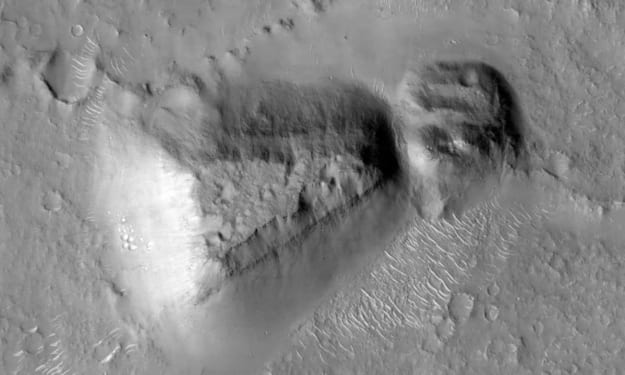
Mysterious Landmarks on Mars Discovered by NASA Spark Alien Life Debate.
Mysterious Landmarks on Mars Discovered by NASA Spark Alien Life Debate. Mars the mysterious and dusty neighbor of Earth has once again stirred the imagination of the world. NASA over the years has released a series of intriguing images captured by its high tech rovers and orbiters exploring the Red Planet. These images showcase bizarre looking formations and structures which some believe are more than just the result of natural geological processes. The debate has intensified Could Mars have once hosted alien life? The allure of Mars is undeniable. As one of the closest planets to Earth and with surface conditions that are more hospitable than most other celestial bodies in our solar system Mars has always been at the center of scientific and speculative discussions about extraterrestrial life. While gas giants like Jupiter and Saturn are ruled out due to their extreme environments Mars has long stood as a beacon of potential a planet that might have once harbored the conditions necessary for life. Our collective obsession with the planet goes back centuries but in the age of technology and space exploration that curiosity has grown even stronger. The success of missions such as the Mars Reconnaissance Orbiter Curiosity Rover and most recently the Perseverance Rover has given us access to thousands of high resolution images of the Martian surface. Some of these images show peculiar shapes and patterns formations that don’t easily fit into our understanding of natural geology.
By Adnan Rasheed2 years ago in History
Trump tariffs including 104% against China come into force
Trump tariffs including 104% against China come into force Trump's new tariffs on dozens of countries, including tariffs of 104 percent on Chinese goods, have gone into effect, intensifying his global trade war. The round of so-called “reciprocal” tariffs on imports to the US – imposed from 12.01am Eastern Time (0401 GMT) – come as the US president’s punishing levies have shaken a global trading order that has persisted for decades, raised fears of recession and driven worldwide stocks sharply downward. According to Reuters, the S&P 500 fell below 5,000 on Tuesday for the first time in nearly a year and is getting closer to entering a bear market, which is defined as being 20% below its most recent high. Since Trump announced the tariffs on Wednesday, the value of S&P 500 companies' stock markets has decreased by $5.8 trillion. A sell-off across Asian markets resumed on Wednesday after a brief respite, with Japan’s Nikkei down over 3% and South Korea’s won currency sliding to a 16-year low. Additionally, US stock futures pointed to Wall Street suffering losses for the fifth day in a row. Trump nearly doubled duties on Chinese imports, which had been set at 54% last week, in response to counter-tariffs that Beijing announced last week. China has vowed to “fight to the end” over what it views as blackmail. Trump has offered investors mixed signals about whether the tariffs will remain in the long term, describing them as “permanent” but also boasting that they are pressuring other leaders to ask for negotiations. During a White House event on Tuesday afternoon, he stated, "We have a lot of countries coming in that want to make deals." At a subsequent event, he stated that he anticipated China to pursue an agreement as well.
By Danielle W. Jones2 years ago in History
Scientists Announce They Have Resurrected the Dire Wolf
9 April 2025 In an innovation that blurs the boundaries A group of geneticists who are torn between science fiction and reality and now paleobiologists declared that they have successfully restored Canis dirus, the extinct dire wolf.
By moyensefat2 years ago in History
Miracle at 17,000 Feet: The Pilot Who Was Sucked Out and Survived Flight 5390.
Miracle at 17,000 Feet: The Pilot Who Was Sucked Out and Survived Flight 5390. On June 10, 1990 British Airways Flight 5390 was on a routine journey from Birmingham England to Málaga,l Spain. What began as a normal flight soon turned into one of the most extraordinary survival stories in aviation history. At 17,000 feet in the sky the cockpit window suddenly blew out and in an instant the captain was sucked halfway out of the aircraft. What followed was a remarkable display of bravery quick thinking and human determination that saved the lives of everyone on board. The BAC One Eleven aircraft was under the command of Captain Tim Lancaster a seasoned and respected pilot. As the plane climbed smoothly through the sky no one anticipated the terrifying turn events would take. Without warning a loud explosion echoed through the cabin.
By Adnan Rasheed2 years ago in History
The Lost Treasure of Cleopatra: The Hidden Wealth of Egypt's Last Pharaoh. AI-Generated.
The Lost Treasure of Cleopatra: The Hidden Wealth of Egypt's Last Pharaoh Cleopatra VII, the last Pharaoh of Ancient Egypt, has fascinated historians, archaeologists, and storytellers for centuries. Celebrated for her political brilliance, romantic liaisons with Julius Caesar and Mark Antony, and dramatic demise, Cleopatra was more than just a queen—she was an empire unto herself. But behind the myth and majesty lies one of history’s most enduring mysteries: what happened to Cleopatra’s treasure? When Cleopatra ruled Egypt from 51 to 30 BCE, she presided over one of the richest and most powerful kingdoms of the ancient world. The Nile’s fertile banks, bustling trade ports, and immense natural resources made Egypt a glittering prize. Cleopatra inherited a kingdom that was both culturally sophisticated and financially robust. But how much wealth did she truly possess—and where did it all go? A Fortune Fit for a Pharaoh Cleopatra’s net worth, when adjusted to modern terms, is impossible to calculate with precision, but scholars estimate it may have been equivalent to hundreds of billions of dollars today. Some even suggest that she could have been among the richest women in history. As queen, Cleopatra had control over Egypt’s vast grain reserves, which were critical to feeding the Roman Empire. She also held dominion over immense reserves of gold, silver, spices, gemstones, and rare artifacts that poured in from Africa, India, and the Middle East through trade. The famed Library of Alexandria alone, stocked with untold knowledge and priceless scrolls, could be considered a cultural treasure beyond valuation. But Cleopatra didn’t just inherit wealth—she expanded it. She was a shrewd economist and administrator who reformed Egypt’s taxation systems, encouraged commerce, and maintained a luxurious but strategically necessary court. The Treasure of Antony and Cleopatra One of the most intriguing aspects of Cleopatra’s wealth is what became of it after her death. Following the defeat of Antony and Cleopatra at the Battle of Actium in 31 BCE, Octavian (later Augustus Caesar) moved to annex Egypt and absorb its riches into the Roman Empire. According to ancient sources like Plutarch and Cassius Dio, Cleopatra took steps to hide or destroy some of her wealth to keep it from falling into Roman hands. The most popular legend claims that before her suicide in 30 BCE, Cleopatra had her most precious treasures—including gold, jewelry, and sacred artifacts—sealed and hidden, possibly beneath the Nile or in secret tombs in or near Alexandria. Some versions of the legend suggest that Cleopatra’s loyal followers transported the treasure to a hidden location, possibly one of the many Ptolemaic burial chambers in the desert or under the ocean floor near the ruins of ancient Alexandria. Others say she may have built a secret vault beneath her palace or in the Temple of Isis at Taposiris Magna, where some archaeologists believe she might be buried alongside Antony. The Treasure Hunt: Fact or Fantasy? Modern treasure hunters, archaeologists, and explorers have spent decades searching for Cleopatra’s lost wealth. One of the most active sites of excavation is Taposiris Magna, located about 45 kilometers west of Alexandria. There, archaeologists have uncovered coins bearing Cleopatra’s face, royal statues, and ceremonial objects—all suggesting that the temple may have been closely associated with her. In 2020, the Egyptian Ministry of Antiquities revealed that dozens of mummies were found buried with golden tongues in the area, suggesting ritualistic burials possibly linked to royal or elite lineages. Still, no definitive signs of Cleopatra’s final resting place—or her treasure—have been discovered. In Alexandria itself, much of the ancient city now lies submerged beneath the Mediterranean due to centuries of earthquakes and tsunamis. Divers exploring these underwater ruins have uncovered sphinxes, columns, and statues, but again, no massive treasure troves. The Real Treasure: Cleopatra’s Legacy While the literal treasure of Cleopatra remains hidden, her greatest wealth may be her enduring legacy. Cleopatra defied the stereotypes of her time. She was not merely a seductress or puppet queen—she was a ruler who spoke nine languages, studied philosophy and science, and commanded loyalty from her people and respect from her enemies. Her image, enshrined on coins, in Roman propaganda, and through Shakespearean drama, continues to captivate the world. Cleopatra has been portrayed as both goddess and villain, but her story is ultimately one of survival, ambition, and unmatched charisma.
By Say the truth 2 years ago in History