Fiction
AI in Cybersecurity: A game changer or a double-edged sword?
Artificial intelligence has utterly transformed cybersecurity in diverse manners, both remarkable and multifold. Its skills—including scouring immense datasets, searching for anomalies and systematising retaliation—have propelled protective tactics to unprecedented heights.
By Abjol Hussain Laskar2 years ago in History
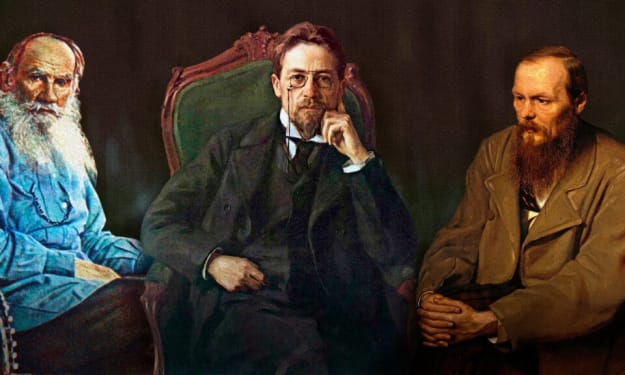
The top 5 great russian writers
Russian writers hold a special place in the world of literature. The influence of Russian literature extends beyond the realm of literary circles—it has impacted politics, economics, and society across the globe. Almost every writer and reader, big or small, holds Russian literature in high regard. There is hardly another example where the writers of a single country have had such a far-reaching influence. Russian literature reached its peak of richness in the 19th century. With a new language, fresh artistry, and modern ornamentation, it brought about a literary revolution that rippled beyond Russia and captivated the entire world. Even today, the world remains enchanted by the fragrance of the Golden Age of Russian literature. This Golden Age was glorified and enriched by several great writers. Today’s discussion is about five of them. Alexander Pushkin Alexander Sergeyevich Pushkin is often called the Shakespeare of Russian literature. The Golden Age of Russian literature began with Pushkin. Though he is regarded as the father of modern Russian poetry, he revived the entire landscape of Russian literature through his dramas, short stories, and novels. Born in 1799 and passing away in 1837, Pushkin was born into an aristocratic family in Tsarist Moscow. Despite his noble birth, he led a revolutionary and combative life. Although he is considered the father of Russian literature, he spent the first ten years of his life primarily speaking French. At just 15, he shocked everyone with his radically different poetry. His poems are largely romantic. Some of his famous works include Message of Europe, Ruslan and Ludmila, The Bronze Horseman, and Boris Godunov. His most beloved literary work is the verse novel Eugene Onegin, which took a lifetime to write. It is so complex that its English translation required two volumes for just 100 pages of the original. Pushkin was influenced by the liberal philosophies of Kant and Voltaire. He was a reformist and consistently wrote against monarchy. His revolutionary poetry frequently brought him into conflict with the authorities, resulting in years of exile. Pushkin was the first Russian writer whose works spread globally. Pushkin led a chaotic life—he was stubborn and short-tempered. He fought many duels. In one such duel by the Black River, he was shot. Two days later, the eccentric, debt-ridden Pushkin died at just 38. By then, he had already reshaped the map of Russian literature. Nikolai Gogol Pushkin’s friend Gogol was born ten years after Pushkin (in 1809) and died fifteen years later (in 1852), living a brief life of just 43 years. Gogol was born into a literary-minded family in Ukraine, then part of the Roman Empire. As a literary heir, he developed an early passion for poetry and drama. Gogol, like Pushkin, led a wild life. He self-published his first poetry book, and when no one bought a single copy, he burned all the remaining copies in a fit of rage. But he didn’t stop writing. He traveled extensively across the Soviet Union, Switzerland, Germany, Italy—even Palestine. He formed friendships with philosophers, writers, and spiritual figures throughout the Soviet region. He held multiple jobs, none of which satisfied him. Initially, Gogol wrote poetry and stories about Ukrainian village life. Over time, his writing style evolved. His friendship with Pushkin greatly enriched both their literary careers. Gogol’s works combined satire and realism, which distinguished him from others. It is believed he mocked Tsarism in his writings. His most famous works include the short story The Overcoat and the novel Dead Souls. It is largely due to Dead Souls that he is considered the pioneer of modern Russian novels. After Pushkin’s death in 1837, Gogol fell into despair and turned toward spirituality. He began to believe that the Devil was using him to write sinful material. As a result, he burned the second volume of Dead Souls. This act of destroying both his first and last books completed a symbolic cycle. After burning the final manuscript, Gogol became bedridden, stopped eating, and eventually died ten days later. Thus ended the life of one of modern Russian literature’s finest minds. Fyodor Dostoevsky The year was 1849. Under the Tsarist regime, a group of revolutionaries was taken before a firing squad for operating a secret progressive society. Just before execution, a last-minute order spared them. They were sent into exile. One of them, Fyodor Dostoevsky, was a novelist, short story writer, and philosopher—now one of the brightest names in world literature. Born in Moscow in 1821, Dostoevsky published his first novel Poor Folk at age 24, considered the first social novel in Russia. His four major novels are Crime and Punishment, The Idiot, The Demons, and The Brothers Karamazov. He became renowned for using the “stream of consciousness” technique, which was later popularized by James Joyce. His characters are complex and tormented, often exhausted and confused by moral dilemmas. Joyce described his novels as full of “violence.” Dostoevsky’s ideas and writing influenced countless writers and philosophers, including James Joyce, Albert Camus, Franz Kafka, Friedrich Nietzsche, Samuel Beckett, and even Albert Einstein. He suffered from epilepsy throughout his life and had a severe gambling addiction. A statue of him still stands at a casino in Germany. He lost his savings and even borrowed money meant for his ill wife's treatment, signing contracts under pressure to pay his debts. Despite this, he continued gambling. His first wife, with whom he had a rocky relationship, died of tuberculosis. Later, he fell in love with his 25-years-younger stenographer Anna and married her. Anna helped stabilize his life. Two months before his death in 1881 at age 59, Dostoevsky completed The Brothers Karamazov, which he dedicated to his beloved wife Anna. Leo Tolstoy Since 1901, the Nobel Prize has been awarded in literature, but the biggest controversy remains the committee’s failure to honor Leo Tolstoy. He died in 1910, and even by then, he was considered the greatest name in world literature. His novels War and Peace and Anna Karenina consistently rank at the top of the greatest literary works of all time. War and Peace took five years to write and spans over a thousand pages with more than 600 characters. It tells the story of Napoleon Bonaparte’s invasion of Russia and the rise and fall of aristocratic families. Anna Karenina, written over three years, explores Russian society and a complex romantic relationship. These two novels alone define Tolstoy’s literary legacy, although he also wrote Resurrection, an autobiography, and many timeless short stories. Born into an aristocratic family in 1828, Tolstoy lost both parents at a young age. He was exceptionally intelligent and hardworking. According to Maxim Gorky, Tolstoy was “a world unto himself.” He taught himself Latin, English, Arabic, Italian, and Hebrew—learning new languages just to read books in their original form. Early in life, Tolstoy was unsure whether to pursue literature, but under the influence of his friend and fellow writer Ivan Turgenev, he began writing. His first book Childhood was followed by two more autobiographical volumes. Most people write autobiographies later in life, but Tolstoy began his literary journey with one, as his life was already filled with remarkable events. After a failed stint managing his estate, he traveled across Europe and even fought in the Crimean War. These experiences enriched Tolstoy’s writing. His work extended beyond novels—his short stories are also invaluable. He was a philosopher, too. His teachings on nonviolence influenced Mahatma Gandhi. In his final years, Tolstoy turned toward spirituality, giving away nearly all his wealth. At age 82, he left home in poverty and died of pneumonia at a small train station in Russia—one of the brightest stars of world literature. Anton Chekhov Continuing the tradition of iconic Russian writers, Anton Chekhov also lived a short life—only 44 years. Born in 1860 and passing in 1904, Chekhov was the son of a serf-turned-merchant father and a Ukrainian mother. He grew up in a harsh family environment. In his words, “I have my mother’s heart and my father’s talent.” Chekhov was a doctor by profession, although he earned very little from it. He traveled across Russia, Ukraine, and even to prisoner camps in Japan, offering free medical help, building hospitals, and treating those suffering during a cholera outbreak. During this time, he wrote several letters considered among his finest works. He began writing to support his family financially after suddenly becoming the primary breadwinner. He submitted pieces to newspapers and gradually realized writing was his true calling. Even in his short life, his works gained immense recognition, both during and after his lifetime. He is regarded as one of the world’s greatest short story writers. His plays rank among the most frequently performed in history. His best-known plays include Three Sisters, The Seagull, and The Cherry Orchard. Though initially slow to gain popularity, his fame grew steadily. His most famous short stories include The Lady with the Dog, The Chameleon, The Black Monk, The Steppe, and A Dreary Story. His stories were often more blunt than traditional tales. Like Dostoevsky, Chekhov also gained fame for his use of stream of consciousness. Afraid of marriage, Chekhov married just three years before his death. He and his wife lived in separate cities. His death was also peculiar. After long suffering from tuberculosis, he one day sat up in bed and said in German—despite barely knowing the language—“I am dying.” He smiled, took a glass of champagne, drank it in one sip, and passed away in 1904. Thus ended the life of one of the greatest short story writers and playwrights in world literature.
By Riham Rahman 2 years ago in History
The Sundarbans: A Proud Heritage of Bengal
The sundarban is a her that fills the people of Bengal with pride. Nature has gifted us with forest paradise so magnificent that its stories can be told to the entire world. Recognized as a UNESCO World Heritage Site, the Sundarbans is the largest mangrove forest in the world, situated at the confluence of the Ganges and Brahmaputra rivers. What doesn’t this forest have? It is the home of the world-famous Royal Bengal Tiger. In addition, there are spotted deer, crocodiles, venomous snakes, turtles, and countless other species. The forest is also rich with diverse trees like Sundari, Garan, and Keora. People live in this heritage-rich jungle with their families. They earn their livelihood by collecting honey, cutting wood, and fishing. While doing so, they face numerous dangers—fears of being taken by tigers while collecting honey or wood, fear of snake bites, or attacks by crocodiles while fishing in the rivers. Yet, people continue to live there—they must. And with them, reside their deities \[1]. There are various theories about the human settlement in the Sundarbans. Many scholars believe that people started living there between the 8th and 10th centuries. In the medieval period, human habitation diminished due to various reasons. Some believe it was due to attacks by the Portuguese and the Arakanese. Other accounts exist as well—for example, a Sufi saint is said to have arrived in the 12th century and initiated agricultural activities. Some scholars suggest that woodcutters, fishermen, and farmers used to frequent the rivers of the Sundarbans for their livelihood. Moreover, during the 17th and 18th centuries, bandits also raided this region. While there is disagreement about exactly when permanent settlements began, most agree that they began toward the end of the 19th century. At that time, British Collector General Claude Russell divided the forest into two parts—one for forestry and the other allocated for agriculture and land leasing. From then on, people from nearby regions like Odisha, Bihar, Jharkhand, and Chhattisgarh began settling here for livelihood and land. After their arrival, deforestation increased, especially during the time of Tillman Henckell, who was then the Magistrate of Jessore district \[2]. The Sundarbans is a perilous place for humans. The residents constantly face danger, but over time, they have also discovered ways to survive. Some of these methods are spiritual, others practical. For instance, families fear crocodiles, so the women observe rituals to appease the crocodile deity. When honey collectors, or *mouals*, go deep into the forest, they take along *bauls* (tiger charmers), believed to be experts at handling tigers through chants and rituals. Bauls must also follow strict rules—since Friday is a sacred day for Muslims, they are not allowed to enter the forest on that day; they must not eat pork or crab; they cannot be involved in usury, etc. These rules mainly apply to Muslims. The life of a baul is extremely difficult and dangerous \[2, 3]. One way to understand the rituals, customs, lifestyle, beliefs, and socio-economic conditions of Sundarbans residents is to visit them and conduct interviews. Another way is to study their folk manuscripts (*puthis*), which often narrate tales of their local deities. The Sundarbans is home to both Hindus and Muslims. Among the Muslims, there are communities like Sheikh, Syed, and Pathan. Among Hindus, one finds barbers, fishermen, Chandals, washermen, yogis, etc.—most of whom belong to the Shudra caste. These people depend on the forest for their livelihood and must struggle against nature to survive. As a result, they rely heavily on religious beliefs and their deities to overcome adversity. Among the most revered deities are *Dakshin Rai* and *Bonbibi*. A well-written essay on the origin of Bonbibi can be found here. Dakshin Rai is believed to be the tiger deity. Residents of the Sundarbans worship him, and various mythological tales surround his origin. These stories have been passed down orally. Some believe he is the son of Lord Shiva. Others believe that after Lord Ganesha’s head was severed, it flew south and became the origin of this deity. In the manuscript *Bonbibir Johurnama* by the late Munshi Mohammad Khater, Dakshin Rai is also described as a forest demon or evil spirit. On the other hand, *Bonbibi* is another deity believed to protect everyone in the jungle. The most remarkable aspect is that both Hindu and Muslim communities believe in her divine power. However, the religious ceremonies honoring Bonbibi vary between the two religions. Muslims refer to the deity as Bonbibi, while Hindus call her Bondébi and worship her as a mother goddess. In Sharad Mitra’s essay *On an accumulation droll from eastern Bengal and on a muslimani legend about the Sylvan Saint Banabibi and Tiger deity Dakshina Roy*, it is mentioned that any Muslim girl can be chosen as Bonbibi and entrusted with a red flag. It’s important to note that such belief in a common, imaginary deity across two religious groups is not trivial. Deep philosophical thinking lies behind it. In a place where survival itself is a struggle and merely staying alive is paramount, depending on a mythical figure like Bonbibi is seen as essential—with the hope that she will protect them from any danger \[4]. Even though we know much about the Sundarbans as a region, how much do we truly know about its people? Their thoughts and beliefs differ from those in other parts of Bangladesh and are quite fascinating. Their likes and dislikes may also be different. There is significant scope for research on these people who live so close to nature. These individuals, who spend their lives battling constant threats, present a stark contrast to the lives of modern, urbanized humans. Research can be conducted on this contrast and on how important that difference is. **References:** \[1] Karmakar, S. (2018). *Ethnic identity and forest preservation: A sociological enquiry on Sundarbans, West Bengal*, *Journal of Research in Humanities and Social Science*, Volume 6(1), page: 20-25 \[2] Jalais, A. (2010). *Forest of Tigers: People, Politics & Environment in the Sundarbans* (New Delhi, India: Routledge) \[3] Hunter, W. W. (1973). *A Statistical Account of Bengal. Vol. I. District of the 24 Parganas and Sundarbans* \[4] Sarkar, S. C. (2010). *The Sundarbans: Folk Deities, Monsters and Mortals* (New Delhi, India: Social Science Press and Orient Blackswan) ---
By Riham Rahman 2 years ago in History
Mike Waltz seen in photos using Signal app at White House after group chat scandal
Mike Waltz Spotted Using Signal App at White House After Group Chat Leak Sparks Controversy Congressman Mike Waltz was recently photographed using the encrypted messaging app Signal during a visit to the White House, sparking new conversations about digital privacy and communication security among lawmakers. The sighting comes in the wake of a recent group chat scandal involving leaked messages from a private conversation among Republican members of Congress. The controversy has heightened awareness of the risks of unsecured communication, pushing several lawmakers to reevaluate how they share sensitive information.
By GLOBAL NEWS2 years ago in History
Microsoft goes passwordless by default on new accounts
Microsoft Goes Passwordless by Default on New Accounts In a move that reflects the growing shift toward enhancing security and improving user experience, Microsoft has announced that new accounts will now be created without requiring a password by default. This is a significant step in the company’s ongoing efforts to create a more secure and user-friendly authentication process. Why the Change? The decision to go passwordless comes after years of growing concerns about password-related vulnerabilities. Passwords have long been a weak point in the security landscape, often prone to being guessed, stolen, or hacked. Microsoft’s push towards a passwordless future aims to mitigate these risks and offer users a more secure alternative to traditional password-based authentication. According to Microsoft, passwords are one of the most common vectors for cyberattacks, including phishing, data breaches, and credential stuffing. By eliminating passwords, Microsoft intends to reduce the chances of accounts being compromised by attackers exploiting weak or reused passwords. How Does It Work? Instead of relying on passwords, Microsoft will use a combination of alternative authentication methods to ensure secure access to accounts. These include: Windows Hello: This biometric authentication system, which supports facial recognition or fingerprint scanning, allows users to sign in to their accounts simply by using their face or fingerprint. Authenticator App: The Microsoft Authenticator app can be used to verify a user’s identity with push notifications or a one-time passcode, making it a safer and more convenient alternative to traditional passwords. Security Keys: Physical security keys, such as USB or NFC devices, can be used as an additional authentication layer to protect users’ accounts from unauthorized access. These methods work together to provide a seamless, yet highly secure, sign-in experience without the need for remembering complex passwords. Benefits of Passwordless Authentication Increased Security: By removing passwords from the equation, Microsoft reduces the potential for phishing attacks, data breaches, and other forms of password exploitation. Even if a user’s device is compromised, attackers cannot simply access accounts by guessing or stealing a password. Convenience: Passwordless sign-ins can be faster and easier for users, particularly in an age where remembering multiple complex passwords can be cumbersome. Users no longer need to worry about password resets or creating strong, unique passwords for every service. Reduced Administrative Overhead: For businesses, passwordless authentication eliminates the need to manage password policies, reset requests, and other common password-related issues, saving time and resources. Challenges Ahead Despite the advantages, there are still some challenges that Microsoft will need to address as it rolls out passwordless authentication. Not all users may be comfortable with using biometric data or security keys, and there will likely be a learning curve for those unfamiliar with the new authentication methods. Moreover, some applications or services may not be fully compatible with passwordless sign-in methods yet. Microsoft will need to work with third-party developers to ensure a smooth transition across the entire digital ecosystem. The Future of Authentication Microsoft’s move to a passwordless future is part of a broader industry trend aimed at improving security while simplifying user experiences. Other tech giants, such as Apple, Google, and Facebook, have also made strides in promoting passwordless authentication solutions. Ultimately, the goal is to move beyond passwords, which have been a fundamental aspect of digital security for decades. As security threats continue to evolve, companies like Microsoft are leading the charge in creating more secure, user-friendly alternatives that promise to shape the future of authentication. With this shift, Microsoft is helping pave the way for a more secure and convenient digital world—one where passwords may become a thing of the past.
By MD Alamgir Hossain Shawon2 years ago in History
The Mongol War Machine: The Largest Imperial Army in History
The Power of the Mongols: The Largest Military Force of an Empire in History The Mongol Empire, established by the renowned Genghis Khan in the 13th century, formed the largest uninterrupted land empire in recorded history. At its zenith, the empire commanded a military force exceeding one million soldiers recruited from various regions throughout Eurasia. This article delves into the formation, organization, and operational excellence of the Mongol military, which facilitated conquests spanning from China to Europe. We analyze the origins, tactics, and enduring impact of the largest imperial army ever witnessed. Introduction: Constructing an Empire from the Steppes In the early 13th century, a nomadic warrior named Temujin, later recognized as Genghis Khan, unified the Mongolian tribes of Central Asia and embarked on a military campaign that would profoundly alter the world. Within a few decades, the Mongols established the largest uninterrupted land empire in history, extending from the Pacific Ocean in the east to the heart of Europe in the west. Central to this swift expansion was the Mongol armya military apparatus unparalleled in its composition, defined by discipline, mobility, and exceptional organization. At its peak, the Mongol Empire commanded an army estimated to comprise between 700,000 to 1,000,000 troopsa staggering figure for its era, particularly when considering the population base of the empire. Origins and Composition of the Mongol Army The Mongol army was initially formed from the tribal warriors of the Mongolian steppe. These fighters were proficient horsemen and archers, trained from a young age to navigate and combat in challenging terrains. Genghis Khan implemented groundbreaking military reforms that converted these tribal factions into a professional and highly loyal combat force. Key characteristics of the Mongol army's structure include: Decimal System: Soldiers were arranged into units of 10 (arban), 100 (zuun), 1,000 (mingghan), and 10,000 (tumen). Each unit had a leader, with rigorous discipline enforced. Merit-Based Leadership: Genghis Khan advanced generals based on competence and loyalty rather than noble lineage. This fostered effective leadership and cohesion. Multi-ethnic Recruitment: As the empire grew, the Mongols integrated conquered populations into their ranks, including Chinese engineers, Persian physicians, and Turkic warriors, significantly enhancing their capabilities. Mobility and Strategy: The Cornerstone of Mongol Success What rendered the Mongol army particularly formidable was not only its size but also its mobility and strategic acumen. Mongolian cavalry could cover up to 100 miles daily, affording them an incomparable advantage in speed and surprise. They employed a blend of feigned retreats, encirclement, and psychological warfare to overcome significantly larger and better-equipped forces. Some of their notable strategies included: Feigned Retreats: Simulating withdrawal to lure adversaries into a trap. Coordinated Invasions: Striking multiple targets simultaneously across extensive distances. Intelligence Networks: Utilizing spies and scouts to collect vital information prior to engagements. Terror as Warfare: Employing extreme brutality to intimidate other cities into capitulation without resistance. These tactics enabled the Mongols to triumph over major powers such as the Khwarezmian Empire, the Jin Dynasty, and even segments of the Kievan Rus and the Islamic Caliphates. Campaigns Across Continents The Mongol army's operations were extensive and unyielding. Under Genghis Khan and his successorsÖgedei, Möngke, and Kublai Khanthe empire proliferated in every direction: China: The Mongols engaged in protracted conflicts against the Jin and Song dynasties, ultimately establishing the Yuan Dynasty in 1271 under Kublai Khan. Middle East: They dismantled the formidable Khwarezmian Empire and subsequently plundered Baghdad in 1258, concluding the Islamic Golden Age. Europe: The Mongol incursion into Europe reached Poland and Hungary in the 1240s, vanquishing large forces with smaller, more agile troops. Southeast Asia and Japan: Although they faced failures, the Mongols initiated campaigns in Vietnam, Java, and even launched attempts to invade Japan. Decline and Legacy of the Mongol Military In spite of their remarkable accomplishments, the Mongol army could not sustain its unity indefinitely. Following Kublai Khan's demise in 1294, the empire splintered into distinct khanatesthe Yuan in China, the Golden Horde in Russia, the Ilkhanate in Persia, and the Chagatai Khanate in Central Asia. Each operated its own military, and internal strife undermined the once-cohesive Mongol war apparatus. Nevertheless, the influence of the Mongol army endured: They transformed warfare through mobility, logistics, and psychological strategies. Their empire promoted commerce across Eurasia, contributing to the Pax Mongolica and the growth of the Silk Road. They fostered cross-cultural exchanges, introducing innovations such as gunpowder and printing, along with advancements in astronomy and medicine. Conclusion: The Greatest Imperial Army The Mongol Empire's military was not only the most extensive assembled by a single empire in historyit was also among the most efficient, feared, and strategically sophisticated. It altered the trajectory of world history, redefined civilizations, and left a legacy of both reverence and dread. Genghis Khan’s ambition for global supremacy may have diminished, yet the strength of his imperial army endures as a symbol of unmatched military success.
By Say the truth 2 years ago in History
The Largest Army in History: Global Mobilization During World War II
The Largest Military Force Ever Assembled: The Grand Mobilization of World War II Throughout history, numerous empires and nations have raised formidable military forces, but none rivals in magnitude and extent to the worldwide mobilization during World War II. This article examines how the world’s largest military force was established, with over 100 million individuals enlisted, and how this extraordinary military endeavor influenced not just the conflict’s resolution but the entire trajectory of the 20th century. From Nazi Germany’s Blitzkrieg units to the Soviet Union’s Red Army and America's industrially driven military prowess, the narrative of the largest army ever deployed is one of ambition, sacrifice, and transformation.
By Say the truth 2 years ago in History
Letters From a Locked Drawer
The Drawer No One Touched In the quiet town of Meadowridge, 16-year-old Clara Wren lived with her father in an old, creaky house full of memories. Her mother had passed away when Clara was just a baby, and the only thing left of her was an antique wooden desk in the attic. It had belonged to her mother, and on that desk sat a single drawer locked tight for as long as Clara could remember.
By Muhammad Hayat2 years ago in History
The New Cold War? Inside the 2025 U.S.-China Economic Clash!
The economic rivalry between the United States and China has intensified dramatically in 2025, marking a pivotal chapter in the two nations’ increasingly complex relationship. While disagreements over trade policy, technology, and national security are not new, recent developments have turned long-standing friction into a full-blown economic confrontation, with both sides imposing steep tariffs and retaliatory measures.
By Seyam Ahmed 2 years ago in History