Events
The Copper Scroll: Directions to Lost Treasure Beyond the Dead Sea
A Discovery Unlike Any Other In 1952, a significant discovery was made within the barren caves near Qumran, located near the Dead Sea. This find, unlike any other in the region, consisted of a pair of scrolls hammered out of copper. These scrolls, unlike the fragile manuscripts written on parchment or papyrus that were typically found, contained a record that read more like instructions, as though someone had left behind a coded guide to something immense.
By The Secret History Of The Worldabout a year ago in History
Second World War
Auther Name Hazratullah The Second World War, which raged from 1939 to 1945, stands as one of the most transformative periods in human history. It was not merely a conflict between nations; it was a monumental struggle that reshaped political boundaries, altered societies, and redefined the course of technology, culture, and global power. The roots of this war trace back to the aftermath of the First World War, when the Treaty of Versailles imposed harsh penalties on Germany, creating widespread resentment and economic instability. These conditions set the stage for the rise of Adolf Hitler and the National Socialist Party, whose aggressive expansionist policies would ignite a global conflict unlike any before.
By Asmatullahabout a year ago in History
The Secret Blueprints of the Sphinx: Lost Evidence of a Forgotten Age?
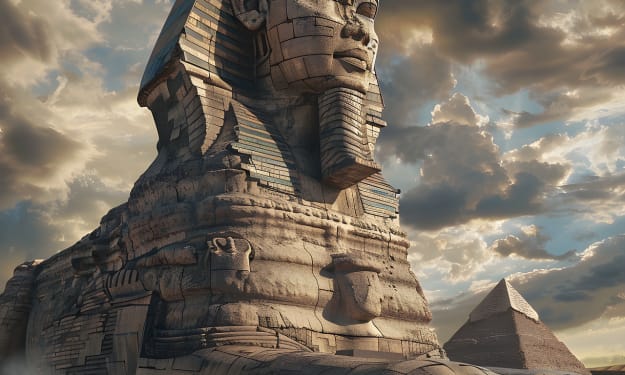
Lost Evidence of a Forgotten Age? The Great Sphinx of Giza has long stood as one of the most mysterious monuments in human history. Half lion, half man, it watches over the Giza plateau, older than the pyramids and cloaked in mystery. While much attention has been given to the missing records of the Great Pyramid, the Sphinx holds its own puzzle: where are its blueprints, inscriptions, or records of construction?
By The Secret History Of The Worldabout a year ago in History
Tyranny of the British on the Helpless". AI-Generated.
The sun struggled to rise over Noorabad, its golden light dimmed by the haze of smoke that clung stubbornly to the sky. Just yesterday, the village had been alive with laughter and peace. Children chased each other barefoot through fields of golden wheat, mothers baked bread over clay stoves, and elders sat under the sprawling neem tree, their voices weaving stories of honor and faith. Now Noorabad was silent. The air was thick with the smell of ash and gunpowder. Homes that had sheltered generations were reduced to blackened shells. Fields were no longer golden but gray, scorched and trampled beneath boots that did not belong. A crow cawed somewhere in the distance, breaking the suffocating quiet, but even its voice carried a strange sorrow. Ayaan stumbled through the rubble, gripping his little sister Amira’s hand tightly. She was six, her tiny frame trembling against his side. Her dress was torn, stained with dirt and blood. Her bright eyes were clouded with fear, too heavy with pain for a child so young. “Stay close to me,” Ayaan whispered, his voice hoarse. He tried to sound brave, but his words trembled in the cold morning air. They passed what had once been their neighbor’s home. The door dangled on one hinge, swinging gently in the breeze, and smoke curled lazily from its charred roof. Ayaan forced himself not to look at the motionless figure sprawled across the doorway. His heart pounded in his ears, but he had to be strong—for Amira. The echoes of last night’s horror were impossible to silence. It began with the sound of horses. Ayaan had been helping his father sharpen a sickle for the morning’s harvest when the pounding of hooves shattered the quiet. Karim’s face had gone pale, but his voice was steady. “Go inside,” he had told Ayaan. Within moments, soldiers in red coats stormed the village, their muskets gleaming beneath the pale moonlight. They shouted orders in harsh voices, their words foreign and sharp. The British were not there for peace or trade. They had come to take. “Give us the grain!” one soldier barked in broken Urdu, his rifle aimed at Karim’s chest. “This grain is for our children,” Karim said, his voice calm but unyielding. The soldier didn’t hesitate. The shot rang out like thunder. Karim crumpled to the ground, blood pooling around him. Ayaan’s mother screamed, rushing forward, but another soldier struck her with the butt of his rifle. She fell, her scream cut short. Flames erupted as torches were hurled onto thatched roofs. People fled in every direction, but there was no escape. Soldiers fired into the crowd, their boots crushing anyone who fell. Ayaan had grabbed Amira, dragging her away from their burning home. He remembered her small, terrified hand gripping his so tightly it hurt. He remembered his mother’s scream. And then—silence. Now, under the pale light of dawn, the weight of loss threatened to crush him. “Where are Mama and Baba?” Amira’s small voice cracked the stillness. Ayaan knelt and cupped her tear-streaked face. “They’re… with Allah now,” he whispered, his own voice breaking. Amira buried her face in his shoulder and sobbed softly. Ayaan hugged her close, rocking her gently as his own tears fell. He wanted to cry out, to curse the soldiers who had turned Noorabad into ashes, but he knew he couldn’t. He had to be strong. He guided her through the ruins. The mosque’s tall minaret was scarred with bullet holes. The neem tree that had once been the village’s heart was now a blackened stump. Everywhere, there were bodies—neighbors, friends, people he had known his entire life. Noorabad was gone. When they reached the outskirts of the village, Ayaan found his father’s body where it had fallen. Karim’s eyes were closed, his expression calm, almost as if he had fallen asleep. His prayer beads still rested in his hand. Ayaan knelt, trembling, and carefully took them. He wrapped the beads around his wrist, holding them tightly. “I’ll remember, Baba,” he whispered. “I’ll tell the world.” As the day wore on, survivors began to gather. They were few—mostly women, children, and the elderly. Their faces were blank masks of grief, their eyes hollow. The healer, Hakim, leaned on his walking stick, his shoulders bent with sorrow. “We can’t stay here,” he said softly, surveying the ruins. “They’ll come back.” “Where will we go?” someone asked, their voice trembling. Hakim’s gaze swept over the ashes of Noorabad, over the fields that would never bloom again. “Anywhere,” he said. “But not here.” The group moved slowly, carrying what little they could salvage. Ayaan walked in silence, Amira’s small hand in his. He didn’t know where they would go, but he knew this: they had no home now, no land, no safety. The empire had taken it all. That night, they camped in the wilderness. A small fire flickered weakly, casting shadows on their weary faces. Amira fell asleep beside Ayaan, her head resting in his lap. He stroked her tangled hair, staring into the flames, unable to sleep. He could still see his father standing proudly, refusing to bow. He could still hear his mother’s scream. He could still smell the smoke of their burning home. The British had come not just to take grain, but to crush their spirit. Noorabad was gone, wiped from the earth in a single night. But Ayaan’s heart burned with something stronger than grief. They thought they could erase Noorabad, but they hadn’t erased him. They hadn’t erased the memory of his father’s courage, his mother’s love, or the laughter of the children who once played in the fields. He would grow, and he would remember. He would tell their story, and one day, he would fight. He looked at Amira sleeping peacefully, her face illuminated by the glow of the fire. For her, he would survive. For Noorabad, he would endure. Tears rolled silently down his cheeks, but they were not just tears of sorrow anymore. They were tears of rage. Tears of resolve. Tears of war. The empire thought it had silenced Noorabad. But Noorabad’s spirit lived on—in the heart of a boy who had lost everything and vowed never to forget.
By Mubashir Khan about a year ago in History
The Lost Archives of the Great Pyramid: Hidden Knowledge of a Forgotten Civilization?
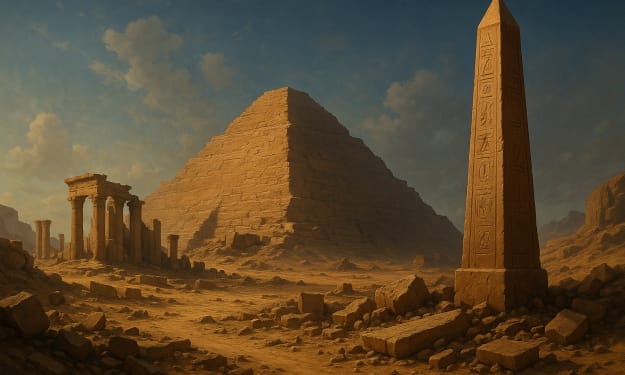
Hidden Knowledge of a Forgotten Civilization? From the deserts of Giza rises the Great Pyramid, a monument that has endured for over 4,500 years. Yet one of the greatest mysteries remains unanswered: where are its architectural records? The ancient Egyptians documented nearly every aspect of life, from farming to astronomy, but not a single papyrus, tablet, or inscription exists that describes the construction of the most astonishing monument in human history.
By The Secret History Of The Worldabout a year ago in History
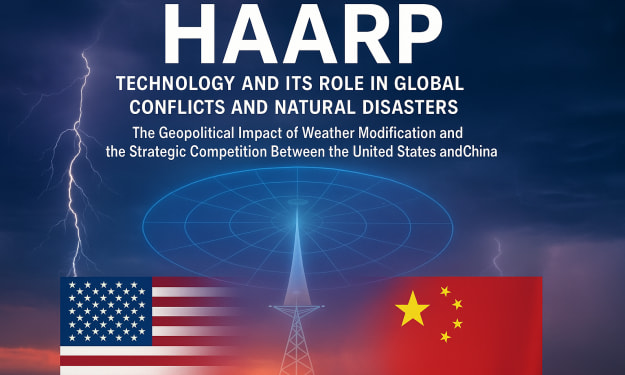
HAARP Technology and Its Role in Global Conflicts and Natural Disasters. AI-Generated.
Introduction Modern warfare is no longer limited to weapons of steel, gunpowder, or nuclear bombs. In the 21st century, technology has expanded the battlefield to domains such as cyberspace, outer space, and even the earth’s atmosphere. Among the controversial technologies often discussed in the context of environmental warfare and strategic manipulation is HAARP (High-Frequency Active Auroral Research Program). Originally developed as a scientific project in the United States, HAARP has become the subject of widespread debate, speculation, and conspiracy theories regarding its ability to influence weather patterns, trigger natural disasters, and affect global security.
By INAM ULLAHabout a year ago in History
Why Germany Did Not Develop the Atomic Bomb. AI-Generated.
The Second World War was not only a conflict of soldiers and armies but also a war of science, engineering, and technology. Among the most transformative developments of the twentieth century was the atomic bomb, whose successful construction by the United States under the Manhattan Project changed the course of history. Yet Germany, despite having some of the world’s leading physicists such as Werner Heisenberg, Max Planck, and others, failed to build the weapon. The question of why Nazi Germany did not develop an atomic bomb remains one of the most compelling debates in the history of science and war. To understand this failure, one must examine the interplay of political ideology, scientific challenges, resource limitations, and the role of individuals—especially Heisenberg—who stood at the center of the German nuclear program.
By INAM ULLAHabout a year ago in History
The Talking Walls of Angel Island
Throughout the U.S. Reconstruction Era, violence and bigotry towards Chinese Americans was business as usual. Prior to Reconstruction, California Governor John Bigler delivered a speech to his state assembly in 1952. In his deliverance, he requested a ban on Chinese immigration. Bigler believed these migrants were ignorant to political participation and the court of law. He claimed they could never assimilate or become good citizens, much less become good jurors or voters.
By DJ Nuclear Winterabout a year ago in History
The Great Destiny of a Nation
The Great Destiny of a Nation Part I: The Seed Under the Ground In the 15th-16th centuries, in the West, the idea of a national "home," of a unitary state, took deep root. But for the peoples of Eastern Europe, especially for the Romanians, this idea was a seed buried deep, which waited for centuries to sprout. A seed constantly threatened by greedy empires—the Tsarist, the Ottoman, and the Habsburg—that devoured peoples, denationalized them, and forced them to abandon their lands.The most enlightened Romanians, intellectuals, priests, and politicians, understood with painful clarity that, without a national state, their people were condemned to disappear. More than half of them were scattered under foreign domination, like fragments of a shattered mosaic. This realization did not come overnight but was the result of a long and suffering historical process. The Revolution of 1848 was not a failure but a lighthouse. It was the moment when the program for the formation of modern Romania was drawn with blood and courage. It was the first whisper of the nation, which began to demand its right to exist.Starting in 1848, the desire for union became a creed, a fundamental goal. The leaders of the Romanians, visionary and pragmatic alike, knew they could not act alone. They needed a partnership with history, the support of the great powers. Their plan was a marathon, not a sprint. The union had to be done in stages, just like the Italians and Germans. The first stage was the union of Moldavia and Wallachia, under the leadership of Alexandru Ioan Cuza, a nucleus of strength, a solid foundation for what was to come.The War of Independence of 1877-1878 followed, a crucial moment. Romania, armed with unshakeable determination, entered the battle to win its freedom. This was the second whisper, a whisper of courage, which was heard at the Congress of Berlin and led to the international recognition of absolute independence.
By alin butucabout a year ago in History
The Relentless Pursuit of a Dream: Nkrumah’s Dance with Danger
A Leader’s Dream Under Fire Picture this: it’s a warm August day in 1962, and Dr. Kwame Nkrumah, Ghana’s first president, steps out of his car in Kulungugu, a small town in the north. He’s just come from a meeting in Burkina Faso, his mind buzzing with dreams of a united Africa. Kids are gathered, waving, their faces bright with excitement. He smiles, waves back, ready to shake hands, to connect. Then-boom. A bomb rips through the air. Chaos erupts. Shrapnel flies, people scream, and Nkrumah’s bodyguard throws him to the ground, saving his life. Fifty-five people are injured, and Nkrumah walks away with just a few scratches. But that moment? It’s a stark reminder that leadership, especially the kind that dares to dream big, comes with a target on your back. Can you imagine the weight of that?
By KWAO LEARNER WINFREDabout a year ago in History