Events
Unmasking Legends: The Top 10 Hackers of All Time
In the ever-evolving landscape of cybersecurity, there exists a group of individuals whose names evoke a mix of fear, admiration, and intrigue. These are the hackers – masterminds of the digital age who have pushed the boundaries of technology and challenged the status quo. From pioneers of the early days to modern-day cyber warriors, their exploits have left an indelible mark on the history of computing. Join us as we unravel the tales of the top 10 hackers of all time.
By Spiridon Matei2 years ago in History
How myth and mythology define civilisational Values
It was April 21, 753 B.C. This was almost 400 years before Alexander the Great and the epitome of Greek civilisation. It was also 750 years before Christ's birth and the rise of Christianity. On a pleasant and breezy spring day, with birds flying south and the sun emerging after winter, the story of Rome and its founder, Romulus, began.
By Ricky Lahiri2 years ago in History
The Worst Punishment in the History of Mankind
The phrase "the gauntlet will be run" is appended to many slogans for criticizing someone or overcoming the difficult challenges. While originally it is a brutal form of punishment from a time long past, the modern diversionary system is seen as a therapeutic practice that helps the inmates improve their thinking processes.
By Amine Oubih2 years ago in History
Most Evil Poacher Who Killed 184 Humans
Among the pages of criminal calenders, the name of Koose Munisamy Veerappan has been written with blood that shines like diamonds, the famous bandit who was in the jungles of South India. Along with rap sheet enlisting a list that comprises of elephant poaching, sandalwood smuggling, and a body count that can be compared to some of the lamest ones of serial killers, Veerappan's life story is on the verge of as good as a Hollywood blockbuster. From early days of a young shooter to his tenure as the man of terror wanting two states, Veerappan’s life is the history of violence, betrayal and his tireless efforts to achieve power.
By Amine Oubih2 years ago in History
Was Hitler Insane or Just Plain Evil
Would any normal human being ever be able to perform the actions of Adolf Hitler with glee and enthusiasm? To tell you the truth, I still do not know whether he learned to be bad or he was born that way. But then, for one second, I see totally unrelated with all of this: Hitler’s possibly deformed genitals. The truth is actually us, and if you had hidden notions like these, be ready to be shocked after you facing the truth!
By Amine Oubih2 years ago in History
The Ugly Truth About George Washington
George Washington, being considered the father of the United States, and the symbol of great and proud America, has a legacy that is both admired and questioned. Along with the stories of his bravery on the war front and leadership as the first US President, there is also the shadowy aspect of his life which sometimes remains unmentioned. If not for Washington's incalculable role in the creation of the country, it's equally important to highlight the multifaceted nature of his personality and decisions.
By Amine Oubih2 years ago in History
Why Hitler Practiced Occult Rituals
Some of the coldest pages in the historical books can be written in the name of the German Nazi Party, at the very core of the turmoil from the World War II. The horrors of the Holocaust, the Night of the Long Knives, and the gruesome human experimentation in concentration camps have left scholars grappling with a fundamental question: probably it was the psychological effects that made peace loving people to turn into perpetrators of unspeakable violence under the influence of such cruel conditions. At the search for the reasons, some have resorted to the hypothesis of the paranormal forces, for example of the demons or the 666, though these notions absolutely contradict to the results of the scientific research.
By Amine Oubih2 years ago in History
What Happened to Saddam Hussein's Space Gun
The 1980s were the years of the distinctive ambitions and spectacular visions. Meanwhile, nothing was as intense as the supergun project, which was an attempt to destroy the entire population of the enemy at once — something that became possible due to collaboration between Saddam Hussein, the ex-president of Iraq, and the mysterious engineer Gerald Bull.
By Amine Oubih2 years ago in History
The Dancing Plaque of 1518: A Dance to Death
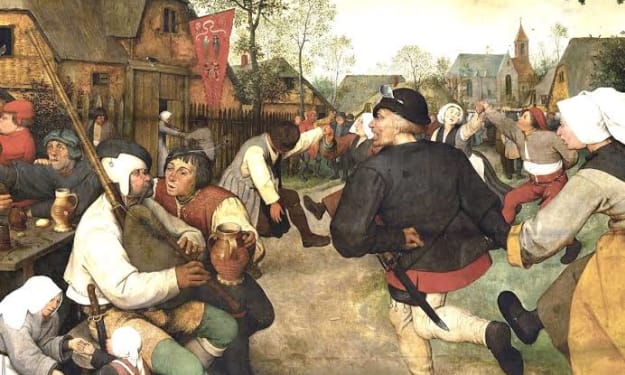
The summer of 1518 marked a peculiar chapter in the history of Strasbourg, where an inexplicable phenomenon unfolded, leaving the city in the grip of a bizarre epidemic. It all began with Frau Troffea, who, in July of that year, stepped onto the streets of Strasbourg and began to dance. What ensued was a bewildering spectacle as more and more people joined in, driven by an uncontrollable urge to dance. This event, known as the Dancing Plague of 1518, has perplexed scholars and historians for centuries, offering a window into the complexities of human behavior and the mysteries of the past. As the days passed, the number of dancers grew exponentially, with men, women, and children alike succumbing to the strange compulsion to dance. The streets of Strasbourg became a stage for this frenzied spectacle, as the afflicted dancers twirled and gyrated in a trance-like state. Despite efforts by local authorities to intervene, the epidemic continued unabated, defying conventional explanations and remedies. Scholars have proposed various theories to account for the Dancing Plague of 1518, yet none offer a definitive explanation. Some have speculated that the outbreak was triggered by ergot poisoning, a hallucinogenic fungus that can infect rye grain and induce convulsions and hallucinations. Others have suggested mass hysteria or psychological stress as possible contributing factors, fueled by the religious fervor and social tensions of the time. To understand the Dancing Plague within its historical context, one must consider the broader cultural and social dynamics of 16th-century Europe. The Renaissance was a period of profound change and upheaval, characterized by religious schisms, economic instability, and social unrest. Against this backdrop, the epidemic may be seen as a manifestation of the anxieties and uncertainties of the era, as people sought solace and release through collective expression and communal rituals. The legacy of the Dancing Plague of 1518 extends far beyond its immediate impact, resonating with themes of human psychology, social behavior, and historical interpretation. Some view it as a cautionary tale about the power of suggestion and the susceptibility of the human mind to irrational impulses. Others see it as a testament to the resilience of the human spirit in the face of adversity, a reminder of the strange and inexplicable ways in which people cope with uncertainty and adversity. While the Dancing Plague of 1518 may never be fully understood, its legacy endures as a reminder of the strange and unpredictable ways in which human behavior can manifest in times of crisis. It serves as a cautionary tale and a source of fascination, challenging us to confront the mysteries of the past and the complexities of the human condition. In the books of history, the Dancing Plague of 1518 stands as a testament to the enduring mysteries of the human experience, a reminder of the strange and inexplicable ways in which people respond to the challenges of their time. As we continue to unravel its mysteries, we are reminded of the boundless complexity of the human psyche and the enduring allure of historical inquiry. Moreover, the Dancing Plague continues to provoke thought and discussion among scholars and scientists, challenging conventional notions of human behavior and mental health. In an age marked by advances in psychology and neuroscience, the epidemic serves as a reminder of the complexities of the human mind and the mysteries that lie within. In recent years, researchers have revisited the Dancing Plague from interdisciplinary perspectives, drawing on insights from psychology, anthropology, and cultural studies to shed new light on its underlying causes and significance. While no single explanation can account for the phenomenon in its entirety, these efforts have deepened our understanding of the social, cultural, and psychological factors that may have contributed to its occurrence. In the end, perhaps the true significance of the Dancing Plague lies not in its resolution but in the questions it inspires and the conversations it sparks.
By Deji Akomolafe2 years ago in History
Insane Things that Used to Be Illegal
So, you decide that you want to be a time traveler. Think you can do it?Yes, you are a history lover with an adventurous spirit. You've seen enough movies on science fiction to know you should avoid stepping on any bug and telling Medieval peasants about Iphones and Doritos, but there's more to that than just that!
By Amine Oubih2 years ago in History
A Unique Tribe
In around 1502, there was an improvement in Benin Realm, Oba (King) Esigie was on the high position and since progression to the lofty position was from father to child, he was concerned that he had no male youngster who will rise the lofty position after his home call. He wedded many spouses to create a male kid. The hunch was that a few powers were behind his not having male youngsters. One of his spouses considered and self-isolated.
By Olatunde Lajuwomi2 years ago in History
Insane Assassination Attempts to Kill Hitler
In all the pages of history, there is hardly any player that has elicited as much hate and opposition as Adolf Hitler, the well-known head of National Socialist Germany. His rule of wickedness in World War Two was the cause of the mass agony and death, far more than ever seen as the result of any recent contemporary issues. Obviously, the crimes he committed were devastating, therefore, many people worked to inflict assassination on him. From the bravest plots to the best plans, the elimination tactic of Hitler was as many as they were endless.
By Amine Oubih2 years ago in History