Events
Chinese New Year 2025: Year of the Snake. AI-Generated.
Chinese New Year, also known as Lunar New Year, is one of the most significant cultural celebrations in the world. It marks the start of a new lunar calendar year and is deeply rooted in centuries-old traditions. In 2025, this vibrant and colorful holiday will usher in the Year of the Snake, offering a chance for families and communities to come together, honor their heritage, and look forward to a year of prosperity and growth.
By bipul biswas2 years ago in History
Afghanistan: A Nation of Resilience and Transformation
Officially known as the Islamic Emirate of Afghanistan, this landlocked nation has a population of 43.3 million, making it the 36th most populous country in the world. Covering an area of 652,000 square kilometers, Afghanistan ranks 41st in terms of size globally.
By Sajjad Rana Hussain2 years ago in History
The Origins of Love: A Journey Through Time and Emotion
Love is one of the most complex and profound emotions experienced by humans. It has inspired countless works of art, literature, and music, transcending cultures and generations. But where does love come from? What are its origins? To understand love, we must journey through the realms of biology, psychology, and history, uncovering how this powerful emotion has shaped humanity and continues to define our existence. #### **The Biological Roots of Love** From a biological perspective, love is deeply rooted in our evolutionary history. Scientists believe that love evolved as a survival mechanism, fostering bonds that ensured the continuation of our species. In the earliest human societies, pair-bonding and attachment were essential for raising offspring and providing protection. Love, in this context, was not just an emotion but a tool for ensuring the survival of families and communities. The brain plays a central role in love, with specific chemicals and regions driving the experience. The "love cocktail" includes neurotransmitters like dopamine, oxytocin, and serotonin. Dopamine is associated with pleasure and reward, creating the euphoric feelings of romantic attraction. Oxytocin, often called the "love hormone," fosters bonding and trust, particularly in long-term relationships and between parents and children. Serotonin contributes to feelings of happiness and well-being, stabilizing emotional connections. These chemical processes underscore the biological importance of love, but they do not fully capture its depth and diversity. Love is more than a biological response—it is also shaped by our minds, cultures, and histories. #### **The Psychological Dimensions of Love** Psychology offers another lens through which to understand the origins of love. Renowned psychologist John Bowlby developed the theory of attachment, which explains how early relationships with caregivers influence our capacity to love. Bowlby identified three attachment styles—secure, anxious, and avoidant—that shape how we form bonds throughout life. For instance, children who experience secure attachments with their caregivers are more likely to develop healthy, loving relationships as adults. On the other hand, those with anxious or avoidant attachment styles may struggle with trust, intimacy, or emotional regulation. These patterns reveal how love is deeply influenced by our early experiences and psychological makeup. Additionally, psychologist Robert Sternberg proposed the Triangular Theory of Love, which identifies three components of love: intimacy, passion, and commitment. Different combinations of these elements give rise to various types of love, from romantic love to friendship and familial love. This theory highlights the multifaceted nature of love and how it evolves over time. #### **The Historical and Cultural Evolution of Love** Love has not always been understood or expressed in the ways we recognize today. Its meaning and significance have evolved across cultures and historical periods. In ancient civilizations, love was often intertwined with mythology and spirituality. The Greeks, for example, identified different types of love, including **eros** (romantic or sexual love), **philia** (friendship or affectionate love), and **agape** (selfless, unconditional love). These distinctions reflect the diverse ways in which love was experienced and valued in their society. The medieval era introduced the concept of courtly love, characterized by chivalry and idealized romantic devotion. This notion of love was often unattainable, serving as a source of inspiration for poets and artists. During the Renaissance, love became more humanized, celebrated as a natural and essential aspect of life. In modern times, love has taken on new meanings, influenced by societal changes, technology, and globalization. Today, love is often seen as a personal journey, emphasizing self-discovery and authenticity. However, it remains deeply connected to cultural norms and values, varying widely across the globe. #### **Love Beyond Romantic Relationships** While romantic love often dominates discussions, it is only one form of love. The origins of love can also be traced to the bonds of family, friendship, and community. Parental love is one of the earliest and most universal forms of love. From the moment a child is born, the connection between parent and child lays the foundation for emotional and social development. This love is often marked by sacrifice, patience, and unconditional support. Friendship, too, is a vital expression of love. It transcends biological ties, offering companionship, trust, and mutual respect. In many cultures, friendships are as significant as familial relationships, providing emotional support and a sense of belonging. Community and altruistic love reflect a broader sense of connection. Acts of kindness, compassion, and service demonstrate our capacity to love beyond our immediate circles. This form of love has been a driving force behind social movements, charitable efforts, and humanitarian work throughout history. #### **The Spiritual and Philosophical Perspectives** Spirituality and philosophy have long sought to understand the nature and origins of love. Religious traditions often describe love as a divine force or a reflection of the sacred. For example, Christianity emphasizes agape love, urging followers to love others selflessly and unconditionally. Similarly, Buddhism teaches **metta** (loving-kindness) as a practice of compassion toward all beings. Philosophers have also grappled with the meaning of love. Plato viewed love as a pursuit of beauty and truth, leading individuals to higher understanding. For existentialists like Jean-Paul Sartre, love was seen as a way of finding meaning in an uncertain world. These spiritual and philosophical perspectives remind us that love is not only an emotional or social construct but also a profound existential experience. #### **Love in the Modern World** In today's fast-paced, technology-driven world, the nature of love continues to evolve. Online dating, social media, and global connectivity have transformed how people form and maintain relationships. While these changes offer new opportunities, they also present challenges, such as maintaining authenticity and navigating virtual interactions. Despite these shifts, the essence of love remains unchanged. It is a force that unites, heals, and inspires. Whether expressed through a simple act of kindness, a lifelong partnership, or a shared vision for a better world, love continues to be a cornerstone of human existence. #### **Conclusion** The origins of love are as complex and multifaceted as the emotion itself. Rooted in biology, shaped by psychology, and enriched by culture and spirituality, love transcends time and space. It is a universal force that binds us to one another, to the world around us, and to the very essence of life. By exploring the origins of love, we gain a deeper appreciation for its power and significance. Love is not merely an emotion—it is a fundamental part of what it means to be human. As we navigate the challenges and opportunities of the modern world, love remains our greatest strength, reminding us of our shared humanity and our boundless capacity for connection.
By Nora Ariana2 years ago in History
The Pandiyan Sword: A Conquest’s Legacy
"The Pandiyan Sword: A Symbol of Power and Conquest" The history of ancient Tamil dynasties is filled with tales of valor, conquests, and cultural exchanges. Among these, the Pandiyan sword, an iconic weapon of the Pandiyan kings, holds a significant place. Captured by Rajendra Chola I during his legendary conquests, this sword became a symbol of the Chola Empire's supremacy. This article explores the fascinating history of the Pandiyan sword—its origins, craftsmanship, and the role it played in the power struggles of South India. Origins of the Pandiyan Sword The Pandiyan sword was a weapon of exceptional craftsmanship, wielded by the kings of the Pandiyan dynasty, one of the most prominent Tamil kingdoms. Cultural Significance: The sword was more than a weapon; it symbolized authority, protection, and divine favor. It was often associated with the Pandiyan kings' claim to divine ancestry. Craftsmanship: Made of high-quality iron and steel, the sword was likely forged using the famed wootz steel, a material known for its sharpness and durability. Tamil Nadu was a center for wootz steel production, making the Pandiyan sword a marvel of metallurgy. Design: The sword featured intricate engravings, possibly depicting Tamil deities, floral motifs, and inscriptions highlighting its royal ownership. Rajendra Chola’s Conquest and the Capture of the Sword Rajendra Chola I, one of the greatest rulers of the Chola dynasty, expanded the empire's influence across South India and Southeast Asia. His military campaigns against the Pandiyan kingdom were pivotal in the history of the sword.
By Say the truth 2 years ago in History
Cholas vs. Mauryans: A Clash of Power and Strategy
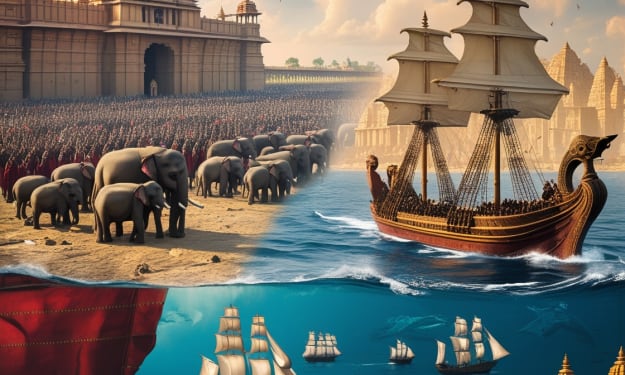
"Cholas vs. Mauryan Empire: A Comparative Analysis of Two Indian Powerhouses" The Chola absolutism (circa 9th–13th aeon CE) and the Mauryan Empire (322–185 BCE) angle as two of the best able and affecting empires in Indian history. While the Mauryan Empire is acclaimed for its all-inclusive territorial conquests and authoritative efficiency, the Chola absolutism is acclaimed for its amphibian ascendancy and cultural achievements. This commodity compares their aggressive might, reserves, aegis strategies, tactics, and argosy ability to accept how these two empires anchored their legacies in Indian history. 1. Prime Army Mauryan Empire The Mauryan Empire, beneath rulers like Chandragupta Maurya and Ashoka the Great, boasted one of the better armies of the age-old world. Composition: The Mauryan aggressive consisted of infantry, cavalry, war elephants, and chariots. Infantry: Approximately 600,000 soldiers. Cavalry: 30,000 horsemen. War Elephants: 9,000, a analytical asset in battles. Chariots: 8,000, acclimated for advancement and shock tactics. Training: Soldiers were anxiously accomplished and maintained by a centralized authoritative system. Organization: The aggressive was well-structured, with abstracted capacity for anniversary unit, overseen by an able war council.
By Say the truth 2 years ago in History
Colombia
Colombia is a vibrant and diverse country in South America. Known for its rich culture, beautiful landscapes, and warm people, Colombia has much to offer. It is a country full of history, art, and nature, making it a popular destination for tourists and a place of pride for its citizens.
By Farhan Sayed2 years ago in History
Socrates in the Agora: The Philosopher of the People
Socrates’ Enduring Impact on Philosophy While his methods and teachings were revolutionary, Socrates’ philosophical engagements in the Agora also led to tension and resentment among some Athenians. His critiques of traditional beliefs, political leaders, and societal norms made him a polarizing figure. Trial and Execution Socrates’ relentless questioning and influence on Athenian youth were seen as threats to traditional values. In 399 BCE, he was charged with corrupting the youth and impiety (not believing in the gods of the state). Despite having the opportunity to escape, Socrates chose to face his trial and eventual execution, famously stating that “an unexamined life is not worth living.” His death became a turning point, immortalizing his ideas and commitment to philosophy. Influence on Students and Legacy Socrates never wrote down his teachings, but his students, including Plato and Xenophon, preserved his ideas. Through their works, the Socratic method and philosophy were passed down, shaping the foundations of Western thought. His focus on ethics, virtue, and self-examination continues to inspire educators, leaders, and thinkers worldwide. Socrates’ Agora: A Symbol of Free Thought The Agora, with its open exchanges of ideas, symbolizes the essence of Socratic philosophy. It serves as a reminder of the importance of dialogue, intellectual curiosity, and the courage to challenge established norms. "Socrates in the Agora: The Philosopher of the People" The Agora of Athens was the active hub of age-old Greek life, area merchants traded goods, politicians debated policies, and citizens aggregate to barter ideas. Amid the circadian bustle, a atypical amount stood out: Socrates, the philosopher who revolutionized the way bodies anticipate about ethics, knowledge, and existence. Known for his acid questions and bound following of truth, Socrates acclimated the Agora as his date to appoint with Athenians from all walks of life. His attendance in this exchange of account laid the foundation for Western aesthetics and approved the ability of chat in apprehension added truths. The Role of the Agora in Athenian Life The Agora was added than a marketplace; it was the epicenter of Athenian society. Located at the bottom of the Acropolis, it was a amplitude where: Merchants and Artisans: Sold appurtenances alignment from aliment and ceramics to accomplished jewelry. Politicians and Orators: Held attainable debates and addressed citizens on affairs of governance. Cultural Activities: Festivals, plays, and religious ceremonies brought action to the Agora. Citizens: Aggregate to altercate philosophy, politics, and accustomed concerns. For Socrates, the Agora was not aloof a concrete area but a belvedere for bookish engagement. Socrates’ Access to Philosophy Socrates alone the acceptable role of philosophers as abroad scholars. Instead, he absorbed himself in the Agora, agreeable anon with people: The Socratic Method: Socrates acclimated a analytic approach, allurement acid questions to claiming assumptions and bare contradictions in his interlocutors’ beliefs. His adjustment was not to accommodate answers but to adviser others to ascertain truths themselves. Focus on Belief and Virtue: Unlike the accustomed philosophers of his time, Socrates focused on questions of morality, justice, and how to alive a acceptable life. He believed that accurate ability led to blameless actions, emphasizing the accent of self-awareness. Engaging the Common People: Socrates did not confine his conversations to the elite. He batten with artisans, merchants, and adolescent men alike, authoritative aesthetics attainable to all. His apprehensive appearance—barefoot and clad in simple clothing—symbolized his antipathy for actual abundance and focus on bookish riches. Encounters in the Agora Socrates’ conversations in the Agora were generally ad-lib and challenging. He approached individuals and groups, allurement them questions that appear the inconsistencies in their beliefs. Some notable capacity and examples include:
By Say the truth 2 years ago in History
Sargon the Great
History often dazzles us with tales of grand achievements, larger-than-life figures, and pivotal moments that changed the world. Yet, with the help of archaeology, we also gain intimate glimpses into ancient societies and the extraordinary individuals who shaped them. One such figure is Sargon the Great, a man who lived over 4,300 years ago in the Mesopotamian region. Sargon’s story is nothing short of legendary—he was a simple man who rose to wield the powers of an emperor, becoming the first ruler to unify a vast, multinational empire.
By A História2 years ago in History
The Sunken Wealth: Treasures of the Deep
"Lost Treasures Below the Waves: The Gold and Argent of the Deep" For centuries, endless treasures accept been absent below the world’s oceans, active with alveolate ships, abysmal cities, and abandoned civilizations. From charlatan hoards to colonial riches, these treasures are not alone of immense budgetary amount but additionally represent alluring capacity of history. Today, with avant-garde technology, campaign abide to bare these underwater treasures, sparking admiration and concern about the belief they hold. This commodity delves into the history of absent underwater gold and silver, notable discoveries, the estimated absolute net worth, and the advancing efforts to balance these admired riches. A Glimpse into the Past: How Treasures Were Lost The ocean has claimed its allotment of treasures throughout history. Storms, wars, and animal absurdity led to the biconcave of ships burdened with gold, silver, and added adored items. Here are some of the best accepted sources of absent underwater treasures: Trade Routes and Shipwrecks: During the Age of Analysis (15th–18th centuries), European admiral transported all-inclusive amounts of gold and argent from the Americas to Europe. Many ships fell victim to storms, pirates, or abyssal errors, biconcave with their cargo. Pirates and Plunder:
By Say the truth 2 years ago in History
How to Travel the World for Free (Yes, It’s Actually Possible!)
Years ago, I wouldn't have believed you if you said you could travel the world for free. But today, I've explored far-off places without spending a lot, thanks to smart hacks and resourcefulness. It's not just a dream; it's real!
By Wilson Igbasi2 years ago in History
The Story of Paddy: A Legacy of Growth and Sustenance
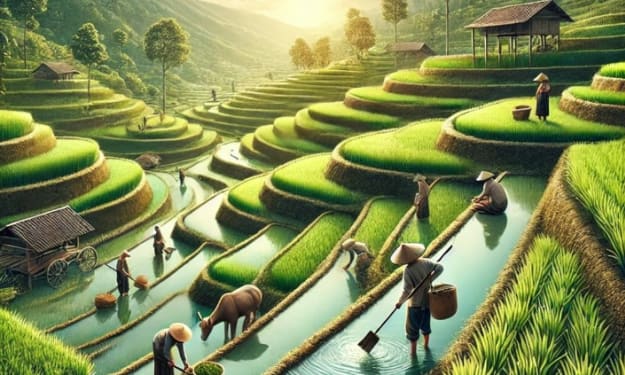
"The History of Paddy: From Age-old Fields to Modern All-around Staple" Origins of Paddy Cultivation Paddy agronomics traces its roots to over 10,000 years ago, basic in regions abounding with baptize and balmy climates. The two key breed of rice, Oryza sativa (Asian rice) and Oryza glaberrima (African rice), were calm apart in Asia and Africa. Asia: The Yangtze River Valley in China is admired as the cradle of rice farming, with affirmation dating aback to 7,000–10,000 years ago. From there, rice agronomics advance to India, Southeast Asia, and beyond. Africa: African rice was calm about 3,000 years ago in the civil Niger Delta, basic for bounded diets and agronomical systems. Spread Across the Globe Southeast Asia and India By 2000 BCE, rice had become a basic in the Indo-Gangetic plains. Innovations like terraced agriculture in Southeast Asia accustomed paddy to advance alike on arresting terrains. The Middle East and Europe Rice accomplished the Middle East and Southern Europe through age-old barter routes. By the Middle Ages, it was actuality able in Italy and Spain due to the Moors. The Americas Introduced in the 17th aeon through colonization and the across bondservant trade, rice agriculture in the Americas was afflicted by African agronomical expertise, decidedly in the Carolinas. Innovations in Paddy Cultivation Terraced Farming: Adapted for arresting landscapes, abnormally in Southeast Asia. Irrigation Systems: Developed to ensure constant baptize supply, acute for wetland paddy fields. Modern Techniques: Mechanization and high-yield amalgam varieties accept adapted rice farming, affair all-around demand. Global Significance of Paddy Today, paddy-derived rice feeds over bisected the world’s population. It plays a axial role in cultural traditions, bread-and-butter systems, and aliment security, authoritative it one of humanity's best important crops. Would you like me to abide or aggrandize this into a abounding article? If yes, let me apperceive the focus or sections you'd like to add! Scientific Advancements in Paddy Farming High-Yield Varieties: The Green Revolution introduced hybrid rice strains, increasing productivity and addressing food security. Water Management: Innovations in irrigation, such as drip and sprinkler systems, reduce water usage in paddy farming. Pest Control: Integrated pest management (IPM) techniques have minimized crop loss and reliance on harmful chemicals. Genetic Research: Scientists are developing rice strains resistant to drought, salinity, and diseases to adapt to climate change. Environmental Challenges and Solutions Climate Change: Erratic rainfall and rising temperatures affect paddy yields globally. Methane Emissions: Traditional flooded fields release methane, contributing to greenhouse gases. Techniques like Alternate Wetting and Drying (AWD) reduce emissions. Soil Degradation: Overuse of chemical fertilizers depletes soil health This illustration captures the timeless beauty of traditional paddy farming. Terraced green fields glisten under the sun, with farmers working diligently amidst flowing water. The scene reflects the cultural and economic significance of rice cultivation, a practice that has sustained civilizations for thousands of years and continues to feed more than half the world's population.
By Say the truth 2 years ago in History