Events
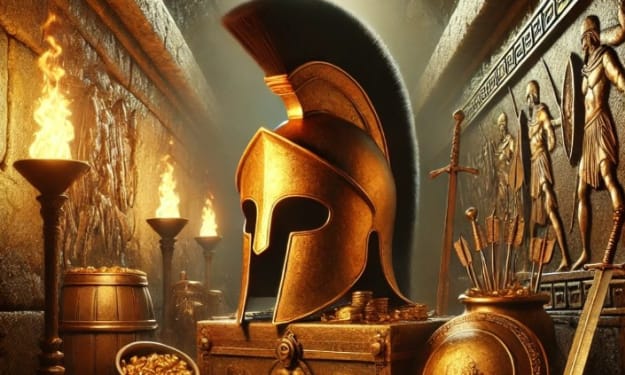
The Lost Treasure of the Spartans – A Hidden Legacy of Gold and Glory
The Absent Abundance of the Spartans: Myth, Wealth, and Hidden Riches Introduction The Spartans, accepted for their warrior culture, aggressive discipline, and ascendancy in age-old Greece, were not broadly accustomed for their all-inclusive treasures. Unlike their Athenian counterparts, who invested in art, philosophy, and admirable architecture, the Spartans admired artlessness and practicality. However, actual accounts advance that Sparta did aggregate cogent abundance through conquest, tribute, and trade. The catechism remains: what happened to the Spartan wealth, and does a hidden abundance still abide today? The Spartan Abridgement and Wealth Sparta’s abridgement was audible from added Greek city-states. While Athens thrived on trade, craftsmanship, and cultural advancements, Sparta focused on aggressive supremacy. The Spartans had a different bread-and-butter arrangement based on:
By Say the truth 2 years ago in History
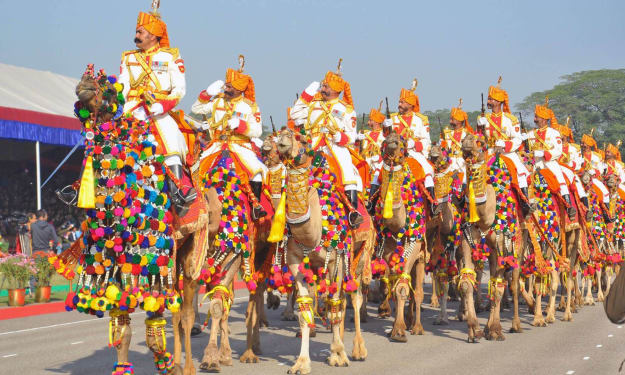
The Best Desert Festivals to Attend in India. Content Warning. AI-Generated.
India's deserts are not just vast stretches of golden sand; they come alive with vibrant festivals that celebrate culture, music, and tradition. From folk performances to camel races, these festivals offer a unique glimpse into the rich heritage of India. Here are some of the best desert festivals you should attend, with special focus on the Jaisalmer Desert Festival 2025 and Rajasthan's Desert Festival 2025.
By Adotrip Official2 years ago in History
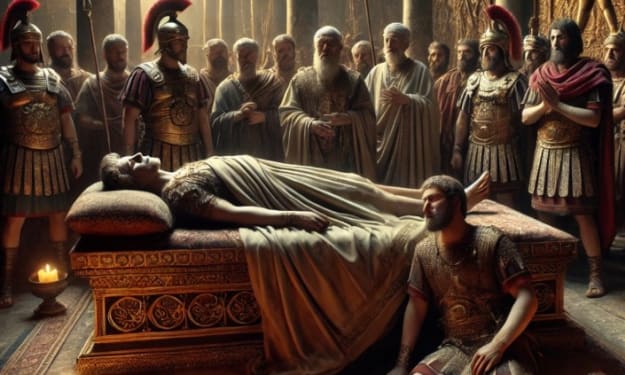
The Final Moments and Wealth of Alexander the Great
The Last Moments of Alexander the Abundant and His True Net Worth Introduction Alexander the Great, one of history’s best allegorical conquerors, larboard an enduring mark on the world. Born in 356 BCE, he became the King of Macedonia and led an amazing aggressive attack that continued from Greece to India. However, his activity was cut abbreviate at the age of 32 in 323 BCE beneath abstruse circumstances. His final moments were abounding with intrigue, speculation, and his empire's ambiguous future. Another catechism that arises is—what was the absolute net account of Alexander the Great? Given his all-inclusive conquests and ascendancy over astronomic wealth, his absolute affluence charcoal a accountable of actual debate.
By Say the truth 2 years ago in History
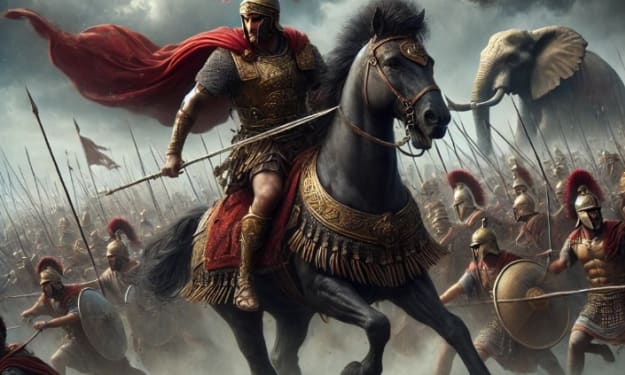
The War Tactics of Alexander the Great – A Legacy of Military Genius
The War Approach of Alexander the Great: A Study of His Aggressive Genius Introduction Alexander the Great, the allegorical baron of Macedonia, is generally hailed as one of history’s greatest aggressive commanders. His appropriate brilliance, cardinal foresight, and avant-garde battlefield assignment accustomed him to beat all-inclusive territories, addition from Greece to India. The foundations of his success lay in his able formations, appalling warships, aristocratic cavalry, and acclimatized infantry. This commodity explores Alexander’s war tactics, including his use of phalanx formations, argosy warfare, army maneuvers, and the role of his infantry in battle. 1. The Phalanx Formation: The Backbone of Alexander’s Army One of the best able aggressive approach acclimated by Alexander was the Macedonian phalanx, which was aboriginal developed by his father, Baron Philip II. This accumulation was composed of heavily armed infantrymen (phalangites) able with the sarissa, a continued extra about 18–22 anxiety in length. Key Features of the Phalanx Formation:
By Say the truth 2 years ago in History
Past the Edges of Mankind. Content Warning. AI-Generated.
Presentation The year 2153 denoted a defining moment for humankind. As the species extended its reach across the stars, the revelation of a puzzling sign from the far-off planet Gliese-581g cast a shadow over human advancement. This sign was not irregular, it was a code. Furthermore, its most surprising disclosure was an incomplete match to the human genome. A specific group of researchers and specialists was dispatched, determined to explore, yet what they found on Gliese-581g was past whatever they might have envisioned. It wasn't simply a sign it was a message from the universe, containing mysteries that could reclassify humankind's position in the universe. Part I: The Sign In the flawless, glass-walled gathering room of Argus Station, Dr. Aarav Mehta, a senior astrophysicist, remained before his group. Holographic information streams drifted around him, throbbing with faint light. "This," Aarav started, highlighting a waveform, "is the sign we've captured from Gliese-581g. It's organized, deliberate. What's more, this section" he focused on a succession of numbers"coordinates a piece of the human genome related to cognizance." The room was quiet. Dr. Lin Wei, a geneticist, inclined forward, her forehead sewn with concern. "Is it safe to say that you are recommending some extraterrestrial insight encoded in this? What's more, that it's connected with us?" Aarav faltered. "That is precisely the exact thing I'm recommending. The grouping originates before humankind by essentially a billion years, in light of its rot signature. Whatever conveyed this message had some awareness of us or made the circumstances for us to exist." EVA-9, the station's high-level simulated intelligence, rang in. "Signal beginning affirmed: Gliese-581g. The likelihood of an insightful plan surpasses 98.7%. Mission boundaries refreshed." The gravity of the disclosure settled over the room like a tempest cloud. Mankind's spot in the universe was at this point not a philosophical inquiry, it was a logical reality. Part II: The Excursion The Athena, mankind's most exceptional investigation vessel, was sent off in no time. Installed were eight group individuals, including Aarav, Lin, and EVA-9, whose brain center was coordinated into the boat's frameworks. As the Athena moved toward Gliese-581g following quite a while of movement, Aarav pored over the decoded signal. Its layers uncovered dazzling intricacies of conditions outside human ability to understand, schematics for innovations light-years ahead, and, most stunningly, an example indistinguishable from the hereditary marker for mindfulness. "Maybe they're talking straightforwardly to us," Aarav mumbled, situated in the perception deck. Lin went along with him, her look fixed on the world materializing. "Or on the other hand, getting back to us back," she said unobtrusively. The boat's plunge carried them to an infertile spread of Gliese-581 g's surface, where spiked rock developments encompassed a transcending metallic monolith. Its smooth, consistent surface beat faintly, as though alive. Part III: The Revelation Venturing onto the outsider soil, the group felt an illogical draw toward the pillar. EVA-9 checked the construction. "Organization: obscure composite. Mature: around 1.3 billion years. Energy source: dynamic." "Billion?" Lin murmured. "That is more seasoned than multicellular life on the plane." Aarav moved toward the monolith, his hand shuddering as he contacted its surface. A low murmur resounded through the air, and an entryway showed up, dissolving as though the design had been sitting tight for them. Inside, the monolith uncovered an office of drifting 3D images worlds, DNA strands, and what gave off an impression of being a nitty-gritty guide of the human mind. At its middle was a translucent gadget lying on a platform. As Aarav went after the precious stone, the chamber loaded up with light, and a voice reverberated to them. "You are the climax of our plan." The words were not verbally expressed they were felt, as though engraved straightforwardly onto their awareness. "Who are you?" Aarav thought, realizing the substance could hear him. "We are the Planners," the voice answered. "We cultivated life across universes, installing possible inside your hereditary code. Humankind is perhaps our best examination." Part IV: The Disclosure The designers uncovered a story spreading over ages. They had dispersed life all through the universe, designing species with the ability to develop and adjust. Humankind, they made sense of, was not remarkable however, it was excellent. "However, why get in touch with us now?" Lin asked so anyone might hear. "Why uncover yourselves?" Another 3D image showed Earth, encompassed by throbbing red waves. "Your species has arrived at a basic point," the Planners cautioned. "Your innovation has outperformed your insight. Whenever left uncontrolled, you will annihilate yourselves and weaken the texture of your cosmic system." Aarav's chest was fixed. "Why not help us? Guide us?" "We don't intercede," the Planners answered. "We notice and record. Your predetermination is your own to shape or to waste." The light darkened, and the visualizations blurred, leaving the group in dazed quietness. The pillar's entryway resumed, as though encouraging them to leave. Aarav took the glasslike gadget, detecting it held answers humankind frantically required yet additionally the heaviness of a horrendous obligation. Part V: The Return On board the Athena, the group investigated the precious stone's items. It contained progressive information on clean energy advancements, solutions for illnesses, and schematics for quicker-than-light travel. In any case, it likewise included terrible forecasts: natural breakdown, rising conflicts, and mass elimination except if humankind shifted its course. "We can't hush up about this," Lin contended during a strained gathering. "This information could save billions of lives." Aarav shook his head. "Or then again it could undermine everything. Envision the turmoil assuming individuals learned we were designed that our reality isn't special." EVA-9, ever the fair onlooker, offered a sobering viewpoint. "Mankind's solidarity lies in its ability for decision. Utilize this information admirably, or risk satisfying the modelers' admonition." The discussion went on as the Athena rushed back toward Earth, conveying the precious stone as well as the heaviness of its suggestions. Epilogue Upon their return, the group introduced their discoveries to a select gathering of pioneers and researchers. Responses went from doubt to stunningness to fear. At last, the choice was made to deliver just divvies of the information to the general population, while the full truth stayed ordered. Aarav, be that as it may, felt the heaviness of the Modelers' advance notice. Late around evening time, he would look at the stars, replaying their last words to him: "Your fate is your own to shape." Humankind remained at an intersection, its future unsure. Could it ascend to live up to the Planners' assumptions or fall under the heaviness of its own pride? As the stars squinted in the limitless obscurity, Aarav murmured to himself, "Perhaps we were intended to transcend. Perhaps that is the genuine test." Also, some place, in the tremendous field of the universe, the Planners watched, holding back to check whether their most prominent trial would succeed or, on the other hand, if it, as well, would be lost to the ages.
By SUDHIR MALLICK2 years ago in History
Researching the Seven Wonders of the World: 2025 Variant. Content Warning. AI-Generated.
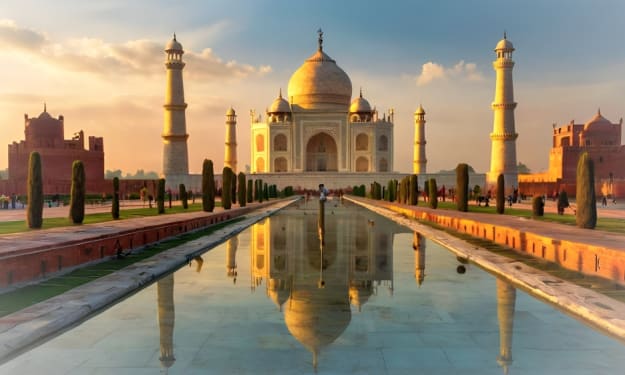
The Seven Wonders of the World are a celebration of human ingenuity, primary brilliance, and social heritage. These well-known achievements have gone all the way and continue to excite huge numbers of visitors reliably. In 2025, these marvels stay as stunning as anybody would envision, displaying the rich history and achievements of old developments. This article takes an all-around adventure through all of these marvels, exploring their significance, history, and why they continue to stand apart for the world. 1. The Taj Mahal, India The Taj Mahal, one of the most seen pictures of warmth, is arranged in Agra, India. Worked on by Mughal Head Shah Jahan in memory of his loved companion Mumtaz Mahal, this white marble mausoleum required 22 years (1632-1653) to wrap up. The Taj Mahal is a UNESCO World Heritage Site and addresses the apex of Mughal designing, uniting Persian, Indian, and Islamic styles. Designing and Significance The Taj Mahal's optimal equity, flighty carvings, and the shimmering appearance in the Yamuna Stream make it a showstopper. Its central vault climbs to a degree of 73 meters, flanked by four thin minarets. The trim work, including semi-important stones, and the calligraphy on the section entryway add to its innovative charm. In 2025, the Taj Mahal continues to draw countless visitors for its structural greatness as well as concerning the huge heartfelt story it addresses. Visitors are particularly enamored by the daybreak and sunset seas, which wash the marble in tones of pink, orange, and gold. 2. Christ the Deliverer, Brazil Staying on Mount Corcovado in Rio de Janeiro, Christ the Hero is a 30-meter-tall figure of Jesus Christ, with arms outstretched in an enticing embrace. This renowned Craftsmanship Deco milestone, completed in 1931, addresses concordance, trust, and the sparkle of Brazilian culture. Valid and Social Impact Arranged by Brazilian expert Heitor da Silva Costa and carved by French skilled worker Paul Landowski, the model was worked on for more than nine years. Made of developed concrete and soapstone, Christ the Guardian Angel dismisses Rio, offering widely inclusive points of view on the city and Guanabara River. In 2025, the figure continues to fill in as a picture of certainty for Christians, generally speaking, and an exhibit of Brazil's social person. The model is edified around nighttime, making a shocking sight that ought to be noticeable from quite far off. 3. Machu Picchu, Peru Machu Picchu, much of the time implied as the "Lost City of the Incas," is a fifteenth-century fortress arranged in the Andes Loads of Peru. Perched at a height of 2,430 meters, this archaeological site displays the creativity of the Inca human advancement. Planning Miracle Worked without the use of mortar, the stones of Machu Picchu fit so precisely that even current fashioners are befuddled by the craftsmanship. The site consolidates safe havens, decks, and water channels, all created as one with the incorporating scene. Machu Picchu's significance lies in its ability to connect visitors with an unfortunately missing advancement. In 2025, it remains a rundown of should-dos and objectives for pilgrims searching for experience, history, and shocking points of view. The first light over the site is particularly spellbinding, drawing picture takers and trailblazers from across the globe. 4. Chichen Itza, Mexico Chichen Itza, arranged on the Yucatán Expanse of land in Mexico, was an unquestionable city of the old Mayan human advancement. Among its many plans, the Asylum of Kukulcán, generally called "El Castillo," is the most well known. This step pyramid reflects the significant level of cosmic data on the Mayans. Inestimable Significance El Castillo is arranged with the goal that all through the spring and pre-winter equinoxes, the play of sunshine and shadow makes the misdirection of a snake slithering down the pyramid's means. This characteristic element is the Mayans' significant perception of heavenly turns of events. In 2025, Chichen Itza continues to dazzle visitors with its blend of legends, science, and plan. The site is in like manner a social area of interest, working with events and celebrations that honor Mayan customs. 5. Colosseum, Italy The Colosseum in Rome, Italy, is a helping-through picture of the superbness of the Roman Domain. Worked some place in the scope of 70 and 80 Advancement, this colossal amphitheater could arrange up to 50,000 spectators and worked with gladiatorial difficulties, public scenes, and sensational shows. Plan Brilliance The Colosseum is a planning wonder, featuring a staggering plan of underground sections, stowed-away entrances, and lifts that were used to coordinate elaborate events. Its layered visitor plan ensured clear points of view for all spectators, an arrangement that continues to influence current fields. In 2025, the Colosseum stays as an exhibit of Roman turns of events and adaptability. It is maybe Italy's most visited achievement, drawing history aficionados and designing sweethearts from around the world. 6. Petra, Jordan Known as the "Rose City" in view of its pink sandstone facades, Petra is an irrefutable and archeological supernatural occurrence arranged in southern Jordan. At the point when the capital of the Nabataean Domain, Petra is renowned for its stone-cut plan and significant level water the board structure. A Blend of Nature and Designing The Safe (Al-Khazneh) is Petra's most famous plan, cut directly into the stone face. Various highlights consolidate the Order, the Distinguished Entombment chambers, and the Siq a restricted ravine that fills in as the city's principal section. In 2025, Petra stays a picture of human cleverness and change. Visitors are drawn to its harsh greatness and real significance, making it one of the Middle East's most cherished achievements. 7. Staggering Mass of China, China Broadening more than 21,000 kilometers, the Great Wall of China is the longest man-made structure on earth. Worked in excess of years and years to protect China from northern intruders, the wall is a miracle of old military planning. Tirelessness Through Time The wall explores mountains, deserts, and fields, showing the confirmation and imagination of the Chinese public. Key sections, such as Badaling and Mutianyu, have been restored and are accessible to explorers, offering amazing points of view and legitimate encounters. In 2025, the Exceptional Wall continues to address China's rich social heritage and stays a must-visit objective for explorers searching for a more significant perception of history. End The Seven Supernatural Occurrences of the World are not just underlying and planning achievements; they are, in like manner, windows into the past, reflecting the dreams, convictions, and advancements of outdated developments. In 2025, these marvels continue to persuade wonderment, attracting a colossal number of visitors and filling in as a badge of what mankind can achieve. Exploring these wonders is a different option from a journey; an experience interfaces us with history, culture, and the enduring soul of human imagination. Whether it's the genuine allure of the Taj Mahal, the captivated allure of Machu Picchu, or the heavenliness of the Unique Mass of China, these wonders assist us with recalling the greatness and assortment our world holds.
By SUDHIR MALLICK2 years ago in History
The Golden Empire of Ghana
In the heart of West Africa, where the modern nations of Mauritania and Mali now stand, lies the cradle of one of the continent’s most enigmatic and powerful empires—the Empire of Ghana. For centuries, this ancient civilization has captivated historians and archaeologists alike, its origins shrouded in legend and mystery. Today, we journey back in time to uncover the secrets of this legendary empire, exploring its rise, its golden age, and its eventual decline.
By A História2 years ago in History
"The Hidden Treasure of Alexander the Great"
The Hidden Treasure of Alexander the Great The legacy of Alexander the Great, one of the most influential and legendary figures in history, is often characterized by his unparalleled military conquests and the vast empire he established. However, alongside tales of his military prowess and cultural integration, there exist stories of hidden treasures that he is said to have left behind—treasures that have fascinated explorers, historians, and treasure hunters for centuries. This article delves into the myths, legends, and facts surrounding the hidden treasure of Alexander the Great. Alexander’s Wealth and Conquests Alexander the Great, born in 356 BCE, inherited the throne of Macedon at the age of 20 after the assassination of his father, King Philip II. Over the next decade, he conquered much of the known world, stretching from Greece to Egypt and into the vast expanse of Persia and India. His military campaigns were not only about territorial expansion but also about amassing unimaginable wealth. The Persian Empire, under Darius III, was renowned for its riches, and Alexander's victories at Issus and Gaugamela granted him access to vast treasures. The legendary treasury of Persepolis, the Persian capital, alone is said to have held an immense quantity of gold, silver, and other precious items. Historical accounts suggest that the treasure Alexander looted from Persia was so immense that it had to be transported by thousands of camels and mules.
By Say the truth 2 years ago in History
Plato: The Beacon of Knowledge
Plato: The Philosopher of Ability and Idealism Plato, one of the greatest philosophers in animal history, is a cornerstone amount in Western thought. Built-in in Athens about 427 BCE, Plato was a apprentice of Socrates and the abecedary of Aristotle, basic a leash that has greatly afflicted philosophy, science, and political theory. His contributions to epistemology, metaphysics, ethics, and political aesthetics abide foundational. Axial to Plato’s aesthetics is his compassionate of knowledge, decidedly his Approach of Forms, which explores the attributes and banned of animal compassionate and perception. This commodity examines Plato’s apperception of knowledge, his adjustment of abstruse inquiry, and the appulse of his account on the world. The Activity of Plato Plato was built-in into an aloof ancestors during Athens' aureate age. Though initially ambitious to a political career, he angry to aesthetics afterwards witnessing the biased balloon and beheading of his mentor, Socrates. This accident acutely afflicted his thinking, decidedly apropos justice, ethics, and the following of truth. After Socrates’ afterlife in 399 BCE, Plato catholic extensively, acceptance mathematics, science, and aesthetics in Egypt, Italy, and conceivably added genitalia of the Mediterranean. Upon abiding to Athens, he founded the Academy, the aboriginal academy of college acquirements in the Western world, area he accomplished until his afterlife about 347 BCE. Plato’s Approach of Knowledge Plato’s aesthetics revolves about compassionate absoluteness and the action of knowing. He acclaimed amid two realms: the apple of appearances (the physical, acoustic world) and the apple of forms (the eternal, abiding truths). According to Plato, accurate ability does not appear from acoustic experience, which is ambiguous and fleeting. Instead, ability is a rational action that involves acquisitive the abiding forms or ethics that underlie the concrete world. The Approach of Forms Plato’s Approach of Forms is axial to his epistemology. He posited that above the actual apple lies a branch of perfect, abiding forms or ideas. For example, concepts like beauty, justice, and adequation abide as ideal forms. Every actual article or abstraction in the concrete apple is alone an amiss archetype of its agnate form. For Plato, ability involves compassionate these forms, which are attainable alone through reason, not the senses. This acumen amid ability (episteme) and assessment (doxa) is basic in Plato’s thought. Assessment is acquired from acoustic acquaintance and is unreliable, while ability is based on rational acumen into the forms. The Apologue of the Cave Plato’s acclaimed apologue of the cave, begin in his assignment The Republic, illustrates his approach of ability and the adversity of attaining truth. In the allegory, prisoners are chained in a cave, watching caliginosity projected on a wall, mistaking them for reality. One captive escapes and discovers the accurate antecedent of the caliginosity – the ablaze of the sun alfresco the cave. This adventure symbolizes the adventure of the philosopher: affective from benightedness to knowledge, from the apple of appearances to the branch of forms. The sun represents the anatomy of the Good, the ultimate antecedent of accuracy and reality. For Plato, the philosopher’s assignment is to adviser others out of the cave, allowance them apperceive accurate knowledge. Plato’s Adjustment of Inquiry Plato’s dialogues, generally featuring Socrates as the capital character, apply the analytic adjustment – a action of analytic and analytical altercation to bare added truths. This adjustment reflects Plato’s acceptance that ability is not article to be imparted but article to be apparent through rational anticipation and dialogue. The analytic adjustment serves as the foundation of the Socratic adjustment acclimated in apprenticeship and acknowledged practices today. It emphasizes analytical thinking, bookish humility, and the following of accuracy through reason. Plato’s Access on Apprenticeship and Philosophy Plato’s Academy was a advocate academy that brought calm thinkers to abstraction philosophy, mathematics, and science. It aggressive the development of universities and academic apprenticeship systems worldwide. His acceptance in the philosopher-king, as articulate in The Republic, emphasized the role of apprenticeship and acumen in governance, advocating that rulers should acquire both moral and bookish virtues. Criticism of Plato’s Ideas While Plato’s account accept been badly influential, they accept not gone unchallenged. His assurance on abstruse forms and his adjournment of acoustic acquaintance accept been criticized for actuality ever idealistic. Aristotle, his student, diverged from his abecedary by emphasizing empiric ascertainment and the abstraction of the accustomed world. Additionally, Plato’s eyes of an ideal association in The Republic, with its adamant chic accommodation and accent on philosopher-kings, has been criticized as undemocratic. Legacy of Plato’s Knowledge Plato’s access extends far above philosophy. His account accept shaped disciplines as assorted as theology, science, political theory, and literature. His accent on acumen and the following of accuracy resonates in avant-garde accurate inquiry, while his analytic adjustment charcoal a cornerstone of apprenticeship and debate. Plato’s analysis of the attributes of ability and absoluteness continues to affect philosophers and thinkers to catechism the apple about them, gluttonous added truths and understanding. His acceptance in the ability of reason, education, and the following of the acceptable charcoal a allegorical ablaze in an ever-changing world. Conclusion Plato’s aesthetics of ability is a abstruse analysis into the attributes of absoluteness and our accommodation to accept it. By appropriate amid the concrete and ideal realms, he provided a framework for compassionate the complexities of accuracy and perception. His Approach of Forms, the Apologue of the Cave, and the analytic adjustment abide as accordant today as they were in age-old Greece. Plato’s constant bequest reminds us of the accent of analytical thinking, dialogue, and the following of acumen in abyssal the challenges of activity and society. His aesthetics continues to affect us to question, learn, and aspire against college ideals.
By Say the truth 2 years ago in History
Magic in Ancient Egypt: A Divine Force Intertwined with Life
Introduction Magic, known as heka in ancient Egyptian culture, was more than a mystical practice—it was a cornerstone of existence. Unlike in many later societies where witchcraft was feared or persecuted, the Egyptians revered magic as an integral part of their daily lives, religion, and understanding of the universe. They believed that magic was not only a gift from the gods but also the force that sustained the cosmos and bridged the realms of the mortal and the divine.
By Sajjad Rana Hussain2 years ago in History