Events
Amenhotep IV
In the heart of ancient Egypt, where myth blended with daily life and tradition was as enduring as the Nile itself, one ruler dared to challenge the old order. Amenhotep IV—later known as Akhenaten—was a visionary pharaoh whose radical ideas and daring reforms reshaped not only the spiritual landscape of his nation but also its art, culture, and architecture.
By A História2 years ago in History
The Fearless Charge of Genghis Khan
Genghis Khan’s War Strategy: The Genius Behind the Mongol Conquests Genghis Khan, the architect of the Mongol Empire, is advised one of history’s greatest aggressive strategists. From a baby drifting association leader, he broadcast his authority to awning over 23 actor aboveboard kilometers, authoritative it the better abutting authority in history. His war strategies were revolutionary, aggregate speed, deception, cerebral warfare, and above aggressive organization. This commodity explores the ablaze war strategies of Genghis Khan, his use of intelligence, and how his approach accustomed the Mongols to beat all-inclusive acreage in a abbreviate time. 1. Aggressive Organization: The Backbone of Mongol Warfare Dividing the Army into Efficient Units Genghis Khan adapted the Mongol army into a awful acclimatized force by alignment it into a decimal system: Arban – Squad of 10 soldiers Zuun – Company of 100 Mingghan – Battalion of 1,000 Tumen – Division of 10,000 This arrangement ensured: ✔ Flexibility in action – Armies could be calmly disconnected or combined. ✔ Better ascendancy – Anniversary assemblage had its own commander, ensuring bright leadership. ✔ Loyalty and accord – Soldiers were aggregate with men they trusted. Elite Mongol Warriors Every Mongol soldier was accomplished from adolescence in: Horseback benumbed – Mongols could ride for canicule afterwards stopping. Archery – They could shoot arrows while benumbed at abounding speed. Survival abilities – Soldiers lived off the land, abbreviation assurance on accumulation chains. The aggregate of aggressive alignment and aristocratic training gave Mongols a massive advantage over less-disciplined armies. 2. Acceleration and Mobility: The Mongol Army’s Greatest Strength Horse-Based Warfare The Mongols were able horsemen, with anniversary soldier accepting 3-5 horses to about-face during battle. This accustomed them to: ✔ Biking up to 100 afar per day (much faster than European armies). ✔ Advance apace and retreat afore the adversary could counterattack. ✔ Conduct abruptness attacks abysmal central adversary territory. Lightning Raids and Fake Retreats One of the Mongols’ best feared approach was the affected retreat: Mongol army affected to abscond in panic. The enemy, cerebration they had won, chased them. The Mongols again angry aback aback and ambushed their pursuers. This ambush formed adjoin abounding brash armies, including Chinese, Persian, and European forces. 3. Cerebral Warfare: Defeating the Adversary Afore the Battle Genghis Khan accepted that abhorrence was a able weapon. He acclimated cerebral warfare to breach adversary assurance afore battles alike began. Spreading Fear He accustomed some defeated cities to escape, so survivors could advance belief of Mongol brutality. He generally destroyed absolute cities that resisted, ensuring others surrendered quickly. His spies advance rumors of Mongol backbone to abate adversary morale. Diplomacy and Abandonment Offers Cities were accustomed a choice: Surrender and be spared. Resist and be annihilated. Many rulers chose surrender, acumen that abashed was futile. By accumulation abhorrence and diplomacy, Genghis Khan baffled cities afterwards alike fighting. 4. Intelligence and Espionage: Knowing the Enemy The Mongols had an avant-garde spy arrangement that calm advice afore every campaign. How They Acclimated Spies: ✔ Disguised as merchants, spies aggregate intelligence on adversary cities, fortifications, and weaknesses. ✔ Intercepted letters to agitate adversary communication. ✔ Bribed admiral in adversary cities to accessible the gates at the appropriate moment. With this intelligence, Genghis Khan consistently knew the enemy’s strengths and weaknesses afore ablution an attack. 5. Adapting to New Technologies and Strategies Unlike abounding conquerors, Genghis Khan was not abashed to apprentice from others. Using Annoy Warfare The Mongols assassin Chinese engineers to body catapults, battering rams, and trebuchets. They acclimated armament weapons, acquirements from Chinese and Persian armies. Cities with aerial walls were no best safe from Mongol attacks. Recruiting Skilled People Genghis Khan accustomed defectors, giving them aerial positions in his army. He acclimated engineers, doctors, and strategists from baffled acreage to advance Mongol tactics. By adopting adversary strengths, the Mongols remained unbeatable. 6. Annoy Warfare: Conquering Alike the Arch Fortresses Many cities relied on adherent walls for protection. But Genghis Khan developed annoy strategies to defeat alike the arch defenses. Mongol Annoy Tactics: ✔ Surround the burghal completely, acid off aliment and water. ✔ Use captured civilians as animal bouncer to abate burghal defenses. ✔ Launch ablaze arrows and armament bombs to actualize chaos. ✔ Divert rivers to flood adversary cities. With these tactics, the Mongols baffled above cities like Beijing, Samarkand, and Baghdad. 7. Uniting the Empire: The Secret Behind Mongol Success Unlike added conquerors, Genghis Khan was not aloof a warrior – he was additionally a ablaze leader. Incorporating Different People Instead of antibacterial civilizations, he chip baffled bodies into his empire. He answer religious freedom, acceptance Muslims, Buddhists, Christians, and Hindus to coexist. He called leaders based on merit, not aloof bloodline. Establishing Barter and Communication He adequate the Silk Road, ensuring safe barter beyond Asia and Europe. He developed the Yam postal system, acceptance letters to biking bags of afar quickly. This ensured that his authority remained able continued afterwards his death. Conclusion: Why Genghis Khan’s War Strategies Were Unmatched Genghis Khan’s aggressive success was not aloof about strength, but about strategy, discipline, intelligence, and innovation. ✔ Above alignment – A structured and acclimatized army. ✔ Acceleration and advancement – Rapid movements that larboard enemies unprepared. ✔ Cerebral warfare – Fear-based approach that affected cities to surrender. ✔ Avant-garde intelligence – Spies and informants acquisition acute information. ✔ Adaptability – Acquirements and application adversary technologies adjoin them. ✔ Annoy warfare ability – Breaking alike the arch burghal defenses. Because of these strategies, Genghis Khan baffled added acreage than any added baton in history. Alike today, his aggressive approach are advised in war colleges as examples of ablaze warfare. His bequest is not aloof that of a conqueror, but of a adept architect who adapted the world.
By Say the truth 2 years ago in History
The History of America
The History of America Pre-Colonial and Native American Era Before European setThe History of America Pre-Colonial and Native American Eratlers arrived on the shores of what is now the United States, the land was already home to millions of indigenous peoples. These Native American tribes had been living across the continent for thousands of years, developing intricate societies, languages, cultures, and technologies. The diversity among these groups was vast: in the Northeast, the Iroquois Confederacy brought together six distinct nations under a sophisticated political structure, while the Mississippian culture in the Southeast constructed grand earthen mounds and traded across large regions. In the Great Plains, nomadic tribes like the Sioux hunted buffalo, and in the Southwest, the Puebloans built impressive cliff dwellings. The Pacific Northwest was home to the Tlingit and Haida peoples, who built totem poles and lived off the bounty of the sea. These tribes had their own systems of governance, economies, and spiritual beliefs, each deeply connected to the land they inhabited.
By Banik Sojib2 years ago in History
Start of the History: Ancient China
Start of the History: Ancient China 1. Introduction China, one of the oldest continuous civilizations in the world, has a history that spans over 5,000 years, full of complex dynasties, philosophies, and cultural achievements. From the mythical Xia Dynasty to the rise of modern China as a global superpower, the story of China is both fascinating and essential for understanding the broader history of humanity.
By Banik Sojib2 years ago in History
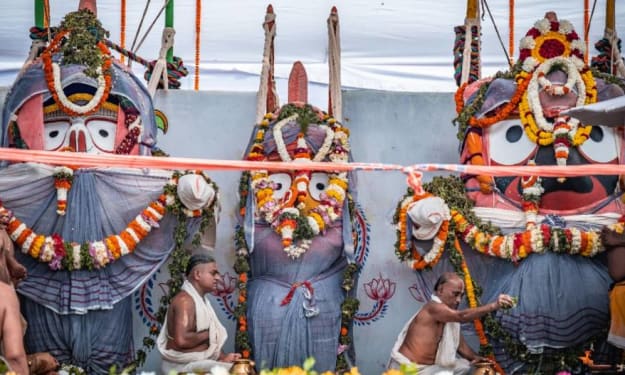
The Lord Jagannath
**1. The Origin of Lord Jagannath** **The Legend of King Indradyumna** The story of Lord Jagannath begins with King Indradyumna, a pious and devoted ruler of the ancient kingdom of Malava. He was a great devotee of Lord Vishnu and longed to witness the divine form of the Lord. One day, a wandering pilgrim told him about a sacred deity called **Nila Madhava** (a form of Lord Vishnu) worshipped in the forests of Odisha by the tribal chief, Viswavasu.
By Himansu Kumar Routray2 years ago in History
Genghis Khan: The Ruler of Wealth and Power. AI-Generated.
Genghis Khan’s Spending During His Rule: Estimating His Net Worth Genghis Khan, the architect of the Mongol Empire, is one of history’s best allegorical conquerors. Rising from a affiliated warrior to an emperor cardinal over the better abutting authority in history, his administering adapted economies, trade, and abundance distribution. But how abundant abundance did Genghis Khan absolutely possess? How did he absorb the abundance acquired from his conquests? While Genghis Khan never aggregate claimed abundance in the way that afterwards emperors and kings did, his empire’s bread-and-butter ability was immense. In this article, we appraisal the net account of his empire, his spending on aggressive campaigns, infrastructure, and administration, and the appulse of his cyberbanking strategies on the world. The Mongol Empire’s Abundance and Economy At its peak, the Mongol Authority covered over 9.27 actor aboveboard afar (23.9 actor km²), addition from China to Eastern Europe. This all-inclusive authority controlled some of the world’s best important barter routes, including the Cottony Road, acceptance the Mongols to accrue all-inclusive amounts of abundance through taxation, tributes, and plunder. Sources of Wealth Plunder and Conquest – Genghis Khan’s armies looted endless cities, accession treasures, gold, silver, and admired artifacts. Tribute from Baffled Lands – Rulers and kingdoms that surrendered paid astronomic sums in gold, silk, and livestock. Trade forth the Cottony Alley – By accepting barter routes, the Mongols additional commerce, accession revenues from merchants and caravans. Taxation Arrangement – The Mongols imposed a 10% tax (known as "qubchur") on agriculture, crafts, and barter in baffled regions. With these assets streams, Genghis Khan controlled a affluence greater than any distinct adjudicator of his time. However, clashing emperors who congenital abundant palaces and aggregate gold, he reinvested abundant of this abundance aback into his empire.
By Say the truth 2 years ago in History
The Hidden Giant: The World's Largest Emerald
The Hidden Giant: The Better Emerald in the Apple and Its Amazing Net Worth Emeralds accept absorbed altruism for centuries with their abysmal blooming hues and allegorical rarity. Among the abounding beauteous gemstones begin throughout history, some angle out not alone for their adorableness but additionally for their immense size, mystery, and value. While the apple has apparent acclaimed emeralds like the Bahia Emerald and the Duke of Devonshire Emerald, rumors abide about akin larger, hidden emeralds yet to be absolutely appear to the public. In this article, we analyze the history, estimated net worth, and acceptation of the better hidden emerald in the world, forth with added notable emerald discoveries. The Better Emeralds Anytime Discovered
By Say the truth 2 years ago in History
Unsolved Mysteries of the Skies and the Seas
The Vanishing of Flight 914 In July 1955, Pan Am Flight 914 took off from New York City, bound for Miami. But the plane and its 57 passengers vanished without a trace, leaving behind no wreckage or distress signal. For decades, the mystery remained unsolved, until 1992, when a plane matching Flight 914's description landed at an airport in Venezuela, carrying passengers dressed in 1950s clothing. The pilot claimed to be from 1955, and the plane's calendar dated back to that year. After a brief encounter, the plane took off again, disappearing as mysteriously as it had arrived. While this story was later revealed to be a hoax, it serves as a reminder of our fascination with the unknown.
By Lisa Ann Bastiaan2 years ago in History
I Spent 100 Hours Inside The Pyramids!. Content Warning. AI-Generated.
Start writing...I Burned through 100 Hours Inside The Pyramids! The Incomparable Pyramids of Egypt have entranced mankind for centuries. These giant designs, worked a long time back, stand as landmarks to old designing and secret. Many visit the pyramids for a couple of hours, wondering about their sheer size and verifiable importance. However, I needed to go further — in a real sense. In this way, with exceptional consent, I left on a rare excursion: burning through 100 hours inside the pyramids of Giza. The Excursion Starts My experience began at the entry of the Incomparable Pyramid of Khufu, the biggest of the three pyramids at Giza. Outfitted with provisions, a spotlight, and a scratch pad, I ventured into the old passageways, prepared to encounter the previous more than ever. The air inside was thick and smelly, the walls clammy with buildup. It was like venturing into a period case immaculate by the cutting edge world. Exploring the tight sections was a test. A few passageways required hunkering, while others constrained me to move up steep wooden slopes. The sensation of being inside such a famous design was overpowering — realizing that old Egyptians had strolled these equivalent ways millennia prior. The Lord's Chamber: A Position of Force One of my most memorable stops was the Lord's Chamber, found profound inside the Incomparable Pyramid. This rectangular room, fabricated altogether of stone, housed the strange void stone coffin of Pharaoh Khufu. Many accept this chamber holds stowed away privileged insights — some even conjecture that tackling grandiose energy was planned. Investing energy inside the Lord's Chamber was dreamlike. The quiet was significant, broken exclusively by an intermittent reverberation of my developments. Some say the chamber has a surprising energy, and I need to concede, I felt something unbelievable — a profound feeling of tranquility and power. I lay on the virus stone floor, looking up at the roof, attempting to envision what it probably been similar to for the manufacturers and the ministers who once remained here. Investigating the Secret Sections Throughout the following couple of days, I investigated different chambers and shafts, including the strange "ventilation ducts" that reach out from the Ruler's and Sovereign's Chambers. A few archeologists accept these shafts were intended to direct the pharaoh's spirit to the stars, while others think they filled a more useful need in ventilation. One of the most exciting minutes was slithering through the thin entries prompting the Sovereign's Chamber. Dissimilar to the Lord's Chamber, this room felt more modest and more encased. However its motivation remains discussed, some accept it assumed a part in strict ceremonies. Being inside it for quite a long time caused me to feel the heaviness of history pushing down — would i say i was remaining in a room where clerics once recited old supplications? The Pyramid Around evening time Night inside the pyramid was a totally unique encounter. The temperature decreased, and the quiet turned out to be practically stunning. I depended on my spotlight, yet and still, after all that, the huge vacancy around me was agitating. At a certain point, I switched off my light to completely embrace the haziness. For a few minutes, I stayed there, encompassed by the heaviness of millennia. It was lowering and ghostly. Many case the pyramids are spooky, and I can grasp the reason why. At the point when you're separated from everyone else inside, each squeak and far off murmur of the breeze appears to be intensified. My brain pulled pranks on me — I swore I saw shadows move, heard delicate mumbles somewhere far off. Rationale let me know it was simply repeats and moving stone, however a piece of me couldn't shake the inclination that I wasn't genuinely alone. Examples from the Pyramids Burning through 100 hours inside the pyramids was something other than a perseverance challenge — it was a profound and scholarly excursion. I emerged with a significant regard for the old Egyptians and their extraordinary craftsmanship. Each stone, each way, every chamber had a reason. Their insight into cosmology, math, and design was past their time. I likewise educated the force of quietness. In this day and age, we are continually encircled by clamor and interruptions. Inside the pyramid, I had only my considerations and the heaviness of history. It was an uncommon snapshot of genuine contemplation.
By TASSENKHAN MDTassen2 years ago in History
From Humble Beginnings to Global Dominance
Throughout history, many of the most formidable empires have emerged from humble origins. The Macedonian Empire exemplifies this phenomenon. Originating as a minor, seemingly inconsequential tribe in the northern part of the Greek peninsula, it ultimately evolved into a civilization that exerted its influence across three continents, profoundly impacting the world. This narrative chronicles the ascent of the Macedonians, who were once regarded as barbarians, to one of the most significant powers of the ancient era.
By A História2 years ago in History