Events
Hijacked at Sea: The Maersk Alabama Story. AI-Generated.
### Key Points - On April 8, 2009, the Maersk Alabama, a U.S.-flagged ship carrying humanitarian aid from Oman to Kenya, was hijacked by Somali pirates 440 km off Somalia’s coast. - The crew tried to defend themselves using water hoses and hiding in a safe room, but pirates boarded, taking Captain Richard Phillips hostage. - The U.S. Navy intervened, and on April 12, 2009, Navy SEALs rescued Phillips, killing three pirates, with one surrendering and later imprisoned. - It seems likely that this event highlighted the need for better ship security, leading to changes like armed guards on cargo ships. ### The Hijacking Event The Maersk Alabama, a large cargo ship, was on a mission to deliver aid when it faced a terrifying attack. On April 8, 2009, while 440 km from Somalia, the crew spotted a speedboat approaching fast. The ship’s top speed of 18-20 knots couldn’t outrun the pirates’ 25-knot boats, leaving them vulnerable. Captain Richard Phillips sounded the alarm, and the crew rushed to a safe room, with 14 of 19 members making it there. Two hid elsewhere, while Phillips and two others stayed on the bridge, the ship’s command center at the front. ### Crew’s Defense and Hostage Situation The crew had few options to fight back. They used water hoses to try and stop pirates from climbing aboard, but it wasn’t enough. A pirate with an AK-47 rifle boarded, and the helmsman rocked the ship side to side to throw them off. Despite their efforts, the pirates took control, capturing Phillips and forcing him into a lifeboat, demanding ransom. The crew managed to capture one pirate briefly during a hostage exchange attempt but released him under threat. ### Rescue and Aftermath The U.S. Navy arrived, with ships like the USS Bainbridge and Navy SEALs joining the effort. On April 12, 2009, when a pirate pointed a gun at Phillips, SEAL snipers killed three pirates simultaneously, rescuing him unharmed. One pirate surrendered, later sentenced to 33 years in prison in 2011. This event, the first U.S.-flagged ship hijacked by pirates in nearly two centuries, led to increased security measures, like armed guards on ships, reducing pirate attacks off Somalia. An unexpected detail is that the crew later sued Maersk Line, alleging Phillips ignored warnings to stay farther from the coast, settling for an undisclosed sum. This shows the complexity of responsibility in such incidents. --- ### Survey Note: Detailed Analysis of the Maersk Alabama Hijacking The Maersk Alabama hijacking on April 8, 2009, stands as a significant maritime security event, capturing global attention and highlighting the persistent threat of piracy off Somalia. This incident involved the U.S.-flagged cargo ship Maersk Alabama, which was en route from Ṣalālah, Oman, to Mombasa, Kenya, carrying humanitarian aid. The ship, measuring 508 feet (155 meters), had 21 Americans onboard, including Captain Richard Phillips. The attack occurred 240 nautical miles (440 km) southeast of Eyl, Somalia, a region notorious for pirate activity due to decades of instability and lack of policing in Somali waters. #### Incident Overview and Context The hijacking began when the crew sighted a speedboat with four armed pirates, each carrying AK-47s, approaching on the morning of April 8, 2009. This was not the first close call; the crew had evaded similar boats twice in the previous 24 hours, but this time, escape was impossible. The Maersk Alabama’s top speed of 18-20 knots was outpaced by the pirates’ speedboats, capable of over 25 knots, leaving the ship vulnerable. Captain Phillips, aware of the danger, sounded the alarm, initiating a desperate defense. #### Crew Actions and Defense Strategies The crew’s initial response included shooting flares and spraying fire hoses to ward off the attackers, aligning with the user’s mention of water hoses as a defense method. Of the 19 crew members, 14 managed to retreat to a fortified steering room, a safe haven designed for such emergencies. Two others hid elsewhere, while Phillips and two companions remained on the bridge, the ship’s highest point and command center at the front. The helmsman attempted to disrupt the pirates by rocking the ship side to side, a tactic to prevent boarding, but it proved ineffective against the determined attackers. Two pirates successfully boarded, marking the first U.S.-flagged ship boarded by pirates in nearly two centuries, a detail confirmed by multiple sources. The crew’s efforts to disable the ship and send distress calls were critical. They ambushed and briefly captured one pirate during an attempted hostage exchange, later releasing him when the pirates threatened Phillips. This back-and-forth highlighted the crew’s resilience, using limited tools like water hoses and their wits to resist. #### Pirate Actions and Hostage Crisis The pirates, demanding a $2 million ransom, forced Phillips into an 18-foot (5.5-meter) covered lifeboat after their initial boat capsized. This escalation intensified the standoff, with the pirates running out of khat, a stimulant, by April 11, allowing the U.S. ship to attach a tow cable. The hostage situation drew global attention, with Phillips’ life hanging in the balance. #### Rescue Operation and Resolution The U.S. Navy’s response was swift, with the USS Bainbridge reaching the scene on April 9, joined by other vessels and aircraft. The Maersk Alabama was ordered to continue to Kenya with an armed sailor security detail, a precursor to broader security changes. On April 10, Phillips attempted to escape by jumping overboard but was recaptured, adding to the tension. By April 11, Navy SEAL Team 6 arrived from Virginia, and on April 12, the crisis ended dramatically. One pirate surrendered, requesting medical treatment, and was later sentenced to 33 years in prison in 2011. Simultaneously, SEAL snipers killed three pirates when one pointed a gun at Phillips, believing imminent danger, ensuring his safe rescue. #### Aftermath and Broader Implications The aftermath revealed controversies, with the crew alleging Phillips failed to heed warnings to stay at least 600 miles from the coast, a decision criticized later. They sued Maersk Line in 2009, settling for an undisclosed sum, highlighting debates over captain responsibility. This incident, detailed in Phillips’ book *A Captain’s Duty* (2010, co-written with Stephan Talty) and adapted into the 2013 film *Captain Phillips* starring Tom Hanks, spurred significant changes. Post-hijacking, cargo ships began employing armed security details, reducing pirate attacks off Somalia, a shift noted in subsequent reports. An unexpected detail is the crew’s legal action, underscoring the complexity of maritime safety and corporate accountability. This event, the sixth vessel attacked in a week at the time, underscored the peak of Somali piracy in the late 2000s, with ransoms previously reaching tens of millions, as per historical records. #### Table: Key Timeline of Events | **Date** | **Event** | |----------------|---------------------------------------------------------------------------| | April 8, 2009 | Pirates board Maersk Alabama, crew defends with hoses, Phillips taken hostage. | | April 9, 2009 | USS Bainbridge arrives, standoff begins. | | April 10, 2009 | Phillips jumps overboard, recaptured by pirates. | | April 11, 2009 | Navy SEAL Team 6 arrives, pirates run out of khat, tow cable attached. | | April 12, 2009 | SEAL snipers kill three pirates, one surrenders, Phillips rescued. | | 2011 | Surrendered pirate sentenced to 33 years in prison. |
By Muhammad Waseem khanabout a year ago in History
History through the eyes of Golden Bird. AI-Generated.
Long ago, before modern borders were drawn and before the industrial machines roared to life, there was a land unlike any other. A land where rivers shimmered under the golden sun, where bustling markets overflowed with silk, spices, and precious gems, and where wisdom flowed as freely as the sacred rivers. This was India—The Golden Bird.
By Ink Mindedabout a year ago in History
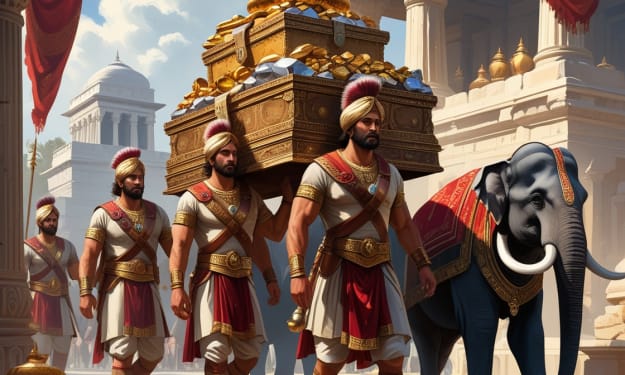
Echoes of Conquest: The Untold Effects of Invasions on History and Treasure
The Impact of Invasions: What Happened and the Treasures They Left Behind Throughout history, powerful empires and armies have launched invasions that reshaped civilizations. These invasions resulted in political upheavals, cultural transformations, economic shifts, and the movement of vast amounts of treasure. From the Mongol conquests to the European colonial invasions, these campaigns left lasting effects on the world. The Immediate and Long-Term Effects of Invasions Political and Territorial Changes One of the most immediate impacts of an invasion is the shift in political control. Empires such as the Roman Empire, the Mongols, and the British Empire expanded their territories through conquest. These invasions often resulted in the establishment of new governments, sometimes through forceful annexation or the imposition of puppet rulers. For example, the Mongol invasion of China led to the establishment of the Yuan Dynasty under Kublai Khan. Long-term effects included redrawing borders, displacing populations, and creating new states. For instance, the Spanish conquest of the Americas led to the creation of Spanish colonies, permanently altering the political landscape of South and Central America. Cultural and Social Transformations Invasions often led to the spread of languages, religions, and customs. The Islamic conquests in the Middle East and North Africa led to the spread of Islam and Arabic culture. Similarly, Alexander the Great’s campaigns spread Greek culture across Asia, influencing art, governance, and philosophy for centuries. However, cultural destruction was also a common consequence. Many historical invasions resulted in the loss of indigenous traditions and knowledge. The arrival of European colonizers in the Americas led to the suppression of native cultures and languages. The destruction of libraries, such as the Library of Alexandria, during conflicts resulted in the loss of invaluable knowledge. Economic and Infrastructural Shifts Invasions frequently altered economies by introducing new trade routes, currency systems, and labor structures. For instance, the Mongol invasions connected distant parts of the world through the Silk Road, fostering economic exchange between Europe and Asia. The British colonization of India restructured its economy, diverting wealth towards Britain and leading to centuries of economic exploitation. Infrastructure suffered during invasions, with cities being burned and looted. The destruction of major centers such as Baghdad by the Mongols in 1258 led to economic decline. On the other hand, some invaders improved infrastructure; the Romans built extensive road networks in conquered territories, facilitating trade and governance. The Fate of Treasures Plundered During Invasions Gold, Silver, and Precious Gems Treasures have been a prime target for invaders. The Spanish conquest of the Aztec and Inca Empires resulted in massive amounts of gold and silver being shipped to Europe. Hernán Cortés and Francisco Pizarro seized enormous amounts of wealth, melting down artifacts and shipping the precious metals to Spain. Similarly, the British looted treasures from India, including the famed Koh-i-Noor diamond, which became part of the British Crown Jewels. The Mongols plundered the wealth of cities they conquered, including China and Persia, taking gold, jade, and textiles back to their empire. Religious and Cultural Artifacts Invasions also resulted in the seizure of religious and cultural artifacts. The Crusades saw European knights looting relics from the Middle East, many of which remain in European churches and museums. The Parthenon Marbles, taken by Lord Elgin from Greece during Ottoman rule, remain in the British Museum, leading to ongoing disputes about their rightful ownership. Lost and Hidden Treasures Some treasures plundered during invasions remain missing. The Amber Room, a masterpiece of art looted by the Nazis during World War II, has never been found. Similarly, treasures from the Summer Palace in China, looted by British and French troops in 1860, are scattered around the world, with many pieces lost. Conclusion The history of invasions is not just a tale of battles and conquests but also of the immense changes they brought to civilizations. From the collapse of empires to the looting of priceless treasures, invasions have left an indelible mark on history. The debate over the return of stolen artifacts continues, highlighting the long-lasting consequences of these conflicts. Understanding the impact of historical invasions helps us appreciate the complexities of cultural heritage and economic transformations shaped by these tumultuous events.
By Say the truth about a year ago in History
"The Greatest Invasion in History: Empires at War"
The Most Significant Invasions in History: When Empires Transformed the World Throughout the annals of history, formidable empires have endeavored to expand their domains through extensive invasions. These conquests shaped civilizations, redefined boundaries, and transformed cultures permanently. Below are some of the most consequential invasions in history that shaped the trajectory of humanity. 1. The Mongol Invasions (13th-14th Century) One of the most extensive and lethal military campaigns in history was orchestrated by Genghis Khan and his Mongol legions. Beginning in 1206, the Mongols invaded China, the Middle East, and Europe, establishing the largest continuous empire the world had ever witnessed. Cities such as Baghdad, Kyiv, and Samarkand were destroyed, resulting in the loss of millions of lives. The Mongols' exceptional equestrian skills, composite bows, and psychological warfare strategies rendered them nearly invincible. 2. The Roman Invasions (1st Century BC - 5th Century AD) The Roman Empire expanded through numerous invasions, but perhaps its most renowned campaigns were Julius Caesar’s conquest of Gaul (58-50 BC) and the invasion of Britain in 43 AD. Rome’s legions overwhelmed local tribes with superior discipline, engineering, and organization. Over the centuries, Rome incorporated extensive territories from Spain to the Middle East, disseminating its language, culture, and laws. 3. The Islamic Conquests (7th-8th Century) Following the emergence of Islam in the Arabian Peninsula, Muslim armies swiftly expanded into the Persian and Byzantine Empires. Under the Rashidun and Umayyad Caliphs, Islamic forces subdued Persia, North Africa, and Spain in less than a century. The proliferation of Islam, Arabic culture, and the establishment of the Caliphate transformed the political landscape of the medieval world. 4. The Norman Invasion of England (1066) One of the most renowned invasions in Western history, the Norman conquest of England by William the Conqueror in 1066, irrevocably altered England. The Battle of Hastings resulted in the defeat of Anglo-Saxon King Harold II, ushering in a new ruling class, the introduction of feudalism, and significant cultural shifts that continue to impact England today. 5. The Spanish Conquest of the Americas (15th-16th Century) The Spanish Empire, led by explorers like Hernán Cortés and Francisco Pizarro, seized extensive territories in the Americas. The Aztec and Inca Empires succumbed to Spanish forces due to superior weaponry, alliances with local tribes, and the catastrophic effects of European diseases. The conquest resulted in immense wealth for Spain but at the expense of indigenous civilizations and cultures. 6. Napoleon’s Invasion of Russia (1812) Napoleon Bonaparte’s ambitious endeavor to conquer Russia became one of the most significant military catastrophes in history. In 1812, he commanded over 600,000 troops into Russia, anticipating a swift triumph. However, severe winters, the scorched-earth tactics employed by the Russian army, and logistical shortcomings decimated his forces, culminating in a humiliating retreat and weakening the French Empire. 7. Hitler’s Invasion of the Soviet Union (1941) Operation Barbarossa, Nazi Germany's incursion into the Soviet Union in 1941, constituted the most extensive military undertaking in history. Hitler's objective was to seize Moscow and eradicate communism, yet the expansive Soviet terrain, severe winters, and resolute resistance reversed the momentum against Germany. The unsuccessful outcome of this invasion signaled the onset of the decline for Nazi Germany in World War II. Conclusion From the Mongols to the Nazis, history is replete with empires striving to expand through monumental invasions. While some of these conquests resulted in innovation and cultural interchange, others caused profound suffering and devastation. Each invasion imparted a significant influence, molding the world as we recognize it today.
By Say the truth about a year ago in History
The Morris Carter Land Commission (1932)
The Closer Union plan (see Colonial Villains: Edward Grigg) was meant to unite Kenya, Uganda and Tanganyika colonies into a single British East African federation. In the spring of 1931, East African delegates were invited to London to ‘represent the Native Races’ and tell the Joint Committee on Closer Union what they thought about the government of East Africa. The ones from Kenya were Rev. Ezekiel Apindi, president of the Kavirondo Taxpayers Welfare Association, from the west, up near Lake Victoria; the Kamba sub headman James Mutua, from the country east of Nairobi; and Chief Koinange wa Mbiyu, the president of the Kikuyu Association. This experience of immersion into the imperial capital of London was also meant to dazzle them enough to tell of England’s modernity upon returning back to the colonies.
By HINGES OF TIMEabout a year ago in History
The Great Pyramid: Tomb or Ancient Power Plant?
For centuries, the Great Pyramid of Giza has stood as an enduring marvel, its towering presence sparking awe and curiosity. Mainstream history tells us it was built 4,500 years ago as a grand tomb for Pharaoh Khufu, a monument to honor a god-king of Egypt’s Fourth Dynasty. Yet, a closer look reveals a structure that defies the conventions of a burial site-lacking artifacts, hieroglyphs, or the ornate decorations typical of Egyptian tombs. No mummies have ever been found inside any pyramid, including this one. So, if it wasn’t a tomb, what was it? Some daring thinkers, including the visionary Nikola Tesla, suggest an astonishing possibility: the Great Pyramid was a colossal power plant, tapping into the Earth’s energy and distributing it wirelessly across the globe-an idea that might have been conceived not 4,500 years ago, but perhaps 13,500 years in the distant past.
By KWAO LEARNER WINFREDabout a year ago in History
Unearthed Enigmas: The World’s Most Puzzling Ancient Discoveries
Across the globe, explorers and archaeologists have stumbled upon cryptic traces of humanity’s past-enigmatic markings, sprawling designs, and artifacts that defy explanation. These relics, etched into the earth or buried beneath it, whisper tales of forgotten cultures and spark endless curiosity. Despite centuries of study, many remain shrouded in mystery. Let’s journey through some of the most bewildering archaeological wonders ever uncovered.
By KWAO LEARNER WINFREDabout a year ago in History
The Defiant Heart: August Landmesser’s Stand Against Nazi Tyranny
Picture this: a single snapshot, frozen in time, sparking curiosity and igniting imaginations across the globe. That’s exactly what happened when a striking photograph from 1935 resurfaced online in 2011, sending the internet into a frenzy. In it, one man stands out-a lone figure amid a sea of raised arms, his own defiantly crossed as Adolf Hitler delivers a speech. This wasn’t a casual oversight; it was a bold, dangerous stand against a regime that thrived on conformity. For decades, people have wondered: Who was this fearless soul, and what fueled his audacity? Meet August Landmesser, a German shipyard worker whose quiet rebellion was rooted in a love story so powerful it could rival any Hollywood romance-only this one unfolds against the grim backdrop of Nazi Germany.
By KWAO LEARNER WINFREDabout a year ago in History
The Voynich Manuscript: A 600-Year-Old Riddle That Refuses to Be Solved
Imagine stumbling across a book that’s small enough to fit in your hand, yet its secrets have stumped the brightest minds for over six centuries. Welcome to the world of the Voynich Manuscript, an artifact so perplexing it’s been dubbed everything from a divine message to a clever fake. Housed today in Yale University’s Beinecke Rare Book and Manuscript Library, this unassuming tome-about the size of a paperback—has sparked novels, inspired music, and even popped up as a hidden gem in video games. But what is it about this little book that keeps us hooked?
By KWAO LEARNER WINFREDabout a year ago in History
The Enigmatic Life of Porfirio Rubirosa
Picture a man who oozes charisma, navigates the world’s elite circles with ease, and leaves a trail of enamored women and whispered legends in his wake. A thrill-seeker with a penchant for fast cars, high-stakes polo matches, and glamorous soirées, he seems ripped from the pages of a spy novel. You might think I’m describing James Bond, but this isn’t fiction. Meet Porfirio Rubirosa, a Dominican playboy whose life was so extraordinary it could eclipse even 007’s wildest adventures.
By KWAO LEARNER WINFREDabout a year ago in History