Events
Trump says Comey called for ‘assassination of the president’ with ’8647′ Instagram post
Former FBI Director James Comey is under investigation by the U.S. Secret Service after a social media post featuring seashells arranged to form the number "8647" was interpreted by some as a veiled threat against President Donald Trump. The slang term for removing something is "86," while "47" refers to Trump as the 47th president of the United States. The post, captioned innocuously as a beach find, drew intense backlash from Trump’s allies, including Donald Trump Jr., Homeland Security Secretary Kristi Noem, and White House officials, who labeled it a veiled death threat. Comey denied any malicious intent, stating he was unaware of the numeric interpretation and promptly removed the post. The Secret Service, supported by the FBI, is reviewing the matter.
By Salequzzamanabout a year ago in History
The Discovery of Bom Jesus
In 2008, deep in the diamond-rich sands of Namibia's Sperrgebiet, an astonishing maritime discovery unfolded — the wreck of the Bom Jesus, a Portuguese ship that had vanished nearly five centuries earlier. Lost in 1533 during the height of the Age of Exploration, this shipwreck revealed a forgotten chapter of seafaring history, global trade, and maritime mystery. Now considered one of the most significant archaeological finds of the 21st century, the Bom Jesus tells a compelling story of ambition, adventure, and unforeseen tragedy.
By Rizwan Ullahabout a year ago in History
The Iron Fist of Ashoka: From Conquest to Compassion in Ancient India. AI-Generated.
. Introduction: The Warrior Prince of Magadha Ashoka was born in 304 BCE, the grandson of Chandragupta Maurya, founder of the Mauryan Empire. As a young prince, he displayed brilliance in administration and warfare. However, due to court rivalries and his aggressive nature, Ashoka was initially posted as governor of Ujjain and later Taxila—strategic frontier cities plagued by rebellion. There, he quickly demonstrated his talent for quelling unrest and commanding loyalty, traits that would define his early reign. When Ashoka ascended the throne around 268 BCE after a bloody succession struggle, he inherited a vast empire—but he was not satisfied. He sought to bring the eastern coastal kingdom of Kalinga under Mauryan control, a region that had resisted his grandfather and father. The Kalinga War: A Ruthless Masterclass in Strategy In 261 BCE, Ashoka launched the Kalinga campaign, one of the bloodiest wars in Indian history. The strategic significance of Kalinga included: Access to vital trade routes along the eastern coast. Control over maritime links with Southeast Asia. Elimination of a defiant and militarily capable neighbor. Ashoka’s war strategy relied on: Massive infantry and cavalry, numbering over 200,000. War elephants, which were used to break enemy lines and inspire fear. A carefully staged campaign using overwhelming force and multiple prongs of attack to encircle Kalinga. After a fierce battle near the Daya River, Kalinga was crushed. Contemporary accounts and inscriptions record over 100,000 killed, and more than 150,000 deported or enslaved. Aftermath: From Victory to Awakening Despite military success, Ashoka was deeply shaken by the aftermath. According to his own inscriptions (notably the 13th Rock Edict), he was filled with remorse after witnessing the suffering of the people, especially the widows and children left behind. This moment marked one of history’s most extraordinary turning points: Ashoka renounced war as a means of expansion. He converted to Buddhism, adopting its principles of non-violence and compassion. He redirected the power of his empire toward moral governance, public welfare, and education. Military Reforms and Defensive Readiness Although Ashoka turned away from conquest, he did not dismantle the Mauryan military. Instead, he: Maintained a powerful standing army to deter invasion. Reinforced border defenses, especially in the northwest where Greek influences were growing after Alexander’s campaigns. Focused on internal stability, using military units for civil works, road protection, and disaster relief. His edicts, inscribed across the empire, suggest a strategy of peace through strength—an empire ready to defend, but unwilling to conquer. Strategic Infrastructure and Control Ashoka’s post-war strategies included a remarkable focus on: Road building: to move troops quickly and promote trade. Military outposts: especially near rebellious provinces and frontiers. Communication hubs, with rest houses and waystations that also served intelligence functions. Through these, he ensured that even without military expansion, the Mauryan Empire remained unified and secure. Ashoka’s Legacy as a Strategist and Statesman Ashoka's military legacy is often overshadowed by his transformation, but it is important to recognize: His conquest of Kalinga was one of the most efficient military campaigns of its time. He demonstrated early expertise in rebellion suppression, troop movement, and logistics. He understood the psychological impact of warfare, which ultimately drove him toward peace. Unlike many rulers, Ashoka did not glorify his wars in monuments or poetry. Instead, he enshrined his regret in stone—carving edicts across his empire that declared violence as a last resort, and dharma (righteousness) as the true path to victory. Conclusion: The Conqueror Who Chose Peace Ashoka's story is a unique blend of military genius and moral courage. From battlefield triumphs to spiritual awakening, he reshaped not only his empire but also the philosophy of leadership in the ancient world. He proved that strength is not merely in conquest, but in the ability to change—and to use power for peace rather than war. His legacy lives on in the symbol of the Ashoka Chakra, at the heart of India’s national flag, a reminder of a ruler who turned from the sword to the path of wisdom.
By Say the truth about a year ago in History
The Military Brilliance of Hannibal Barca: Rome’s Supreme Foe. AI-Generated.
Introduction: The Lion of Carthage Born in 247 BCE in Carthage (present-day Tunisia), Hannibal Barca was raised with a singular ambitionto obliterate Rome. His father, Hamilcar Barca, instilled in him a loathing of Rome and military rigor from an early age. Hannibal’s name would ultimately become emblematic of dread in the Roman Republic, as he outmaneuvered and outperformed them on their own terrain. Strategy 1: Tactical Invasion Through the Alps Perhaps Hannibal’s most audacious decision was to invade Italy not by sea but through the perilous Alps. With an army consisting of approximately 50,000 soldiers, 9,000 cavalry, and 37 war elephants, Hannibal: Withstood severe winter conditions and mountain tribes. Lost nearly half of his forces during the crossing. Still succeeded in surprising the Romans, who had never anticipated an assault from the north. This daring strategy provided him with early momentum and astonished the Roman world, demonstrating his readiness to undertake significant risks for maximal effect. Strategy 2: Proficiency in Terrain and Surprise Hannibal adeptly utilized the landscape and timing to ensnare and annihilate Roman contingents. At the Battle of the Trebia (218 BCE): He enticed the Romans into crossing a frigid river in the morning. Ambushed them with hidden cavalry. Decimated a larger Roman force by manipulating the topography. In every significant engagement, Hannibal meticulously scouted the terrain and crafted traps, ambushes, and encirclements that would disorient and fragment Roman troops. Strategy 3: Psychological Tactics and Diplomacy Hannibal did not depend solely on overwhelming force. He employed psychological strategies to: Instill terror in Italian cities to abandon Rome. Extend clemency to subdued peoples to secure allies. Utilize fear and unpredictability to undermine Roman morale. Despite his military acumen, he struggled to sway Roman allies against the Republica crucial misstep that ultimately resulted in his strategic seclusion in Italy. Strategy 4: The Cannae Masterstroke – Double Envelopment Hannibal’s most significant victory occurred in 216 BCE at Cannae, where he confronted a Roman army twice his strength. There, he executed one of the most renowned tactical maneuvers in historythe double envelopment: Deployed his weakest troops in the center to absorb Roman pressure. Enticed Roman legions inward while his cavalry flanked both flanks. Encircled the entire Roman army and slaughtered over 50,000 soldiers in a single day. Cannae is still taught in military schools as the definitive example of battlefield strategy. Strategy 5: Logistical Expertise and Adaptability For more than 15 years, Hannibal operated deep within enemy territory without direct resupply from Carthage. His survival depended on: Securing local supplies. Establishing temporary alliances with Italian tribes. Adjusting his strategies based on enemy movements. Despite being isolated, he sustained a seasoned cadre of elite forces, consistently adjusting to Rome's shifting strategies. Decline: The Scipio Maneuver and Hannibal’s Return Rome ultimately acclimated to Hannibal’s strategies. Under Scipio Africanus, the Romans: Evaded direct confrontation with Hannibal in Italy. Invaded North Africa, compelling Hannibal to return and safeguard Carthage. In 202 BCE, at the Battle of Zama, Scipio reversed the situation: Employed Hannibal’s own strategies against him. Mitigated his elephants. Conquered Hannibal in the singular significant defeat of his career. Despite the loss, Hannibal remained an idol in Carthage and subsequently served as a diplomat and military consultant abroad. Legacy: The Timeless Adversary Hannibal perished in exile around 183 BCE, pursued by Rome until the end. Yet his legacy endured beyond his adversaries: Roman commanders, including Scipio and later Napoleon, studied and esteemed his strategies. His engagement at Cannae became the benchmark of tactical ingenuity. His boldness, intellect, and adaptability established him as one of the most revered figures in military history. Even Roman historians like Livy and Polybius commended his brilliancedespite being his foes. Conclusion: The Man Who Instilled Fear in Rome Hannibal Barca remains an imposing figure in the history of warfare. His leadership, strategic acumen, and fearless command confronted the most formidable empire of the ancient era and transformed the landscape of military science eternally. He wasn’t merely a leaderhe was a visionary whose battlefield reasoning and tactical brilliance continue to resonate throughout history.
By Say the truth about a year ago in History
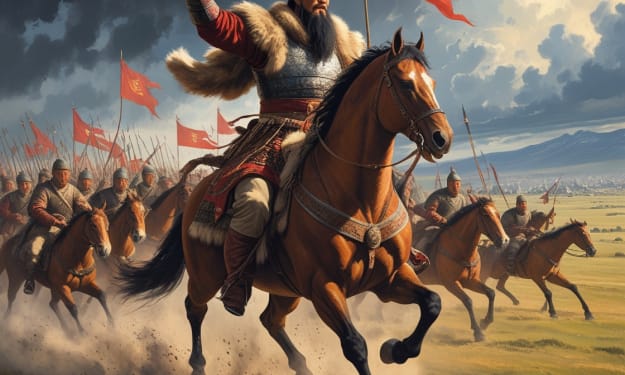
The Thunder of Genghis Khan: Military Tactics of the Mongol Empire’s Founder . AI-Generated.
Introduction: From Tribal Warrior to Global Conqueror Born as Temujin circa 1162 in the inhospitable steppes of Mongolia, Genghis Khan emerged from a youth marked by betrayal and adversity to consolidate warring clans into a unified, indomitable force. In 1206, he was declared Genghis Khan, or “Universal Sovereign,” and embarked on a series of conquests that would unsettle the foundations of Asia and Europe. The essence of his triumph lay not merely in overwhelming force, but in a transformative perspective on combat that adapted to every landscape, adversary, and impediment. Strategy 1: Unification Through Loyalty and Merit Prior to any military engagement, Genghis Khan solidified authority over the Mongol tribes through: Meritocracy: Advancement based on aptitude and fidelity, rather than noble lineage. Strict discipline: Theft or insubordination warranted capital punishment. Loyalty agreements: Warriors pledged unwavering obedience. This transformed the Mongol army into a unified, agile, and fervently loyal entity, where soldiers fought not only for riches but for the vision of a consolidated empire. Strategy 2: Mobility and the Horse Archer Advantage Mongol combatants were exceptionally skilled equestrians from a young age. Each soldier managed several horses, enabling swift movement without exhaustion. The fundamental Mongol tactics relied on: Horse archers capable of accurate shooting while at full gallop. Rapid assaults and withdrawals. Feigning retreats to entice adversaries into traps. A Mongol force could traverse over 100 miles daily, emerging where least anticipated, then vanishing into the steppe before defenders could react. Strategy 3: Intelligence, Espionage, and Deception Genghis Khan developed an intricate network of scouts, spies, and informants. Prior to launching an assault on any city or kingdom, the Mongols: Gathered comprehensive intelligence on geography, defenses, and leadership. Disseminated misinformation to bewilder the opponent. Engaged in psychological warfaredispatching messages demanding surrender or face total destruction. One alarming tactic involved releasing a handful of survivors from plundered cities to narrate the story of Mongol wrath, frequently causing neighboring cities to yield without resistance. Strategy 4: Adaptation and Siege Warfare While initially unacquainted with fortress combat, the Mongols rapidly adjusted. Genghis Khan: Employed Chinese, Persian, and Arab engineers to create siege apparatus. Utilized catapults, gunpowder explosives, and battering rams. Diverted rivers to inundate cities or taint water supplies. Cities like Zhongdu (Beijing) and Samarkand surrendered despite formidable defenses. The Mongols’ capacity to assimilate knowledge from every culture they encountered rendered them invincible. Strategy 5: Ruthless Discipline and Organization The Mongol military framework was structured on a decimal system: Units of 10 (Arban), 100 (Zuun), 1,000 (Mingghan), and 10,000 (Tumen). Every soldier was acutely aware of his precise position and hierarchy. Stringent codes of conduct guaranteed no plunder or sexual violence occurred without directive. Genghis Khan additionally established a military courier network (Yam) with outposts throughout the empire, assuring immediate communication and coordination across extensive distances. Noteworthy Campaigns Against the Khwarezmian Empire (1219–1221): Following the execution of Mongol envoys by Khwarezmian officials, Genghis initiated a campaign of vengeance. The Mongols incinerated cities, exterminated populations, and obliterated irrigation infrastructure to ensure lasting dominance. His forces divided into several fronts, simultaneously conquering cities such as Bukhara, Samarkand, and Nishapur.
By Say the truth about a year ago in History
The Desert Lion: Military Strategies of Saladin, Sovereign of Egypt and Syria
Introduction: A New Authority Emerges in the Middle East Born in 1137 CE in Tikrit (present-day Iraq), Ṣalāḥ ad-Dīn Yūsuf ibn Ayyūb, commonly referred to in the West as Saladin, initiated his career under the Zengid dynasty. Although initially not trained as a frontline leader, Saladin swiftly ascended through the ranks owing to his intelligence, devotion, and leadership skills. Following his appointment as vizier of Egypt in 1169, Saladin gradually gained complete control, ultimately establishing the Ayyubid dynasty. His ambition: to unify the Muslim realm and recover the Holy Land from Crusader dominance. Strategy of Unity: Establishing a Cohesive Front Saladin recognized that fragmented Muslim realms would never repel the Crusaders, who had established Latin Christian entities in the Levant. His primary and most crucial military strategy was political consolidation: He forged alliances across Egypt, Syria, Mesopotamia, and sections of Arabia. He employed both diplomacy and military might to eliminate competing Muslim factions. He positioned himself as the protector of Sunni Islam, garnering support from religious scholars and the general populace. This unification afforded Saladin access to extensive resources and personnel, transforming him from a regional figure into a pan-Islamic leader. War of Attrition: Evading Direct Confrontation with the Crusaders Rather than hastily entering into a full-scale conflict, Saladin appreciated the importance of attrition and selective engagement. His initial confrontations with the Crusaders involved: Disrupting enemy supply routes Conducting raids on Crusader-controlled towns and outposts Avoiding large battles until his forces were adequately prepared By gradually undermining the Crusaders' economy and morale over time, Saladin was able to dictate the pace of the conflict and steadily drive them back without incurring excessive risks. The Battle of Hattin: A Masterstroke of Maneuver Warfare Saladin’s most renowned military triumph occurred in 1187 CE at the Battle of Hattin, near the Sea of Galilee. This engagement marked a pivotal moment in the Crusades and directly contributed to the Muslim reclamation of Jerusalem. Strategic Brilliance at Hattin: Saladin intentionally allowed Crusader forces led by King Guy of Lusignan to traverse arid land with limited water access. His forces persistently harassed the Crusaders, depleting them physically and mentally. When the Crusaders reached the Horns of Hattin, they found themselves ensnared, surrounded by Saladin’s army. The Muslim forces then launched an assault on the parched, demoralized adversary. The outcome was a decisive victorymost Crusader leaders were captured, and the True Cross, a revered Christian artifact, was taken. The Reclamation of Jerusalem: Diplomacy Over Violence After Hattin, Saladin advanced towards Jerusalem, a city that had been governed by Crusader authority for almost 90 years. Instead of seeking retribution for historical transgressions (such as the slaughter during the First Crusade), he facilitated the city's amicable capitulation. This maneuver astonished both allies and adversaries. Saladin: Ensured safe passage for Christians Permitted women and children to exit unscathed Safeguarded sacred sites and welcomed Jews and Muslims back into the city This humanitarian strategy amplified Saladin’s reputation throughout the Muslim realm and Europe, garnering respect even from his opponents. Defensive Strategy During the Third Crusade When the Third Crusade commenced in 1189, led by Richard the Lionheart of England, Saladin confronted a formidable adversary. Rather than engage Richard in open confrontation, Saladin reverted to asymmetric strategies: Avoiding extensive conflicts unless conditions were advantageous Fortifying essential cities such as Acre and Jaffa Employing mobility and local insight to outsmart the Crusader forces
By Say the truth about a year ago in History
Living Through the Storm: Survival Skills for the 21st Century
It wasn’t always this loud. The world, I mean. There was a time when mornings weren’t accompanied by a flood of notifications, when conversations didn’t compete with scrolling thumbs, and when uncertainty was the exception—not the air we all breathed. But somewhere between the rapid rise of technology and the unraveling of once-solid structures—jobs, relationships, the environment—it began to feel like life itself had turned into a storm. And we, unwittingly, were learning how to live through it.
By Muhammad Faizullahabout a year ago in History
Devil`s Rock Lighthouse
Devil's Rock Lighthouse On the northern coast of Maine, where the Atlantic crashes against jagged cliffs, stands a long-abandoned lighthouse—Devil’s Rock Lighthouse. Locals say the devil himself lives there. Built in 1874, the lighthouse once guided countless ships safely to shore. But on a stormy night, everything changed.
By Books Loverabout a year ago in History
Emerging Technologies and Future Trends
As we find ourselves on the threshold of an era marked by unprecedented technological acceleration, the transformative influence of innovation on our collective future becomes increasingly undeniable. From the sophisticated realms of artificial intelligence (AI) and the expansive connectivity of the Internet of Things (IoT), to groundbreaking strides in biotechnology and the global shift toward sustainable energy solutions, these emerging technologies are not merely disrupting traditional industries they are fundamentally redefining how we live, work, communicate, and perceive the world around us. This article delves into some of the most compelling and forward-thinking technological trends poised to shape the trajectory of human progress in the years to come.
By Muhammad Mehebub Alamabout a year ago in History