Discoveries
Israel: A Journey Through Time
The history of Israel is one of the most complex and profound narratives in human civilization. Rooted in ancient traditions, religion, and conflict, Israel's story spans thousands of years, encompassing biblical legends, imperial conquests, diaspora, and the rebirth of a nation in the 20th century. This article explores Israel's historical evolution from ancient times to the present.
By NIAZ Muhammadabout a year ago in History
The Future of the USA: Challenges, Change, and a New American Dream
The Future of the USA: Challenges, Change, and a New American Dream The United States of America has always been a land of ambition — a place where dreams are chased, ideas are born, and change is constant. But as we step deeper into the 21st century, the future of the USA is more uncertain, complex, and exciting than ever before.
By Ali Asad Ullahabout a year ago in History
20 Secrets of the City That Never Sleeps
New York City. Even the name sounds electrifying. Millions of people dream of visiting this unstoppable city, and countless others dream of conquering it. Yet beneath its towering skyline and endless streams of yellow taxis lie fascinating secrets that most tourists and even some lifelong residents don’t know.
By Echoes of Lifeabout a year ago in History
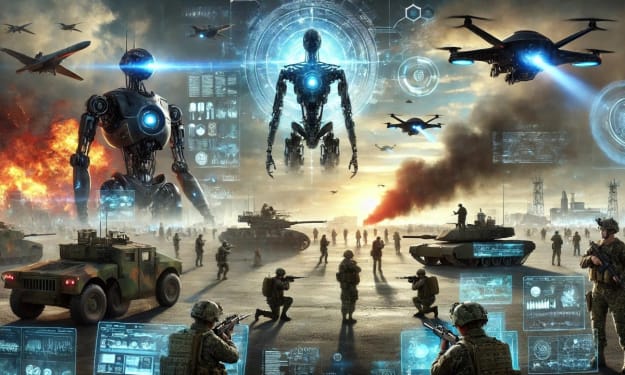
AI vs. Humans: How Smart Weapons Changed the Face of World War 2025
AI vs. Humans: How Smart Weapons Changed the Face of World War 2025 In the history of warfare, every era has brought new weapons that changed the battlefield—spears and swords, muskets and cannons, tanks and missiles. But in 2025, the world saw the rise of a new kind of weapon: one that could think. Powered by artificial intelligence, these smart weapons reshaped war as we knew it. It was no longer just nation versus nation. It became AI vs. Humans, and the world would never be the same.
By Ali Asad Ullahabout a year ago in History
Taiwan, Ukraine, or the Middle East: Which Flashpoint Led to World War III?
Taiwan, Ukraine, or the Middle East: Which Flashpoint Led to World War III? For years, global leaders warned of the possibility of a third world war. Tensions were rising, alliances shifting, and technology advancing at a pace far faster than diplomacy. But no one could predict exactly where the first spark would ignite the flames of a global conflict. In the end, three major flashpoints—Taiwan, Ukraine, and the Middle East—stood on the edge. Each had the potential to trigger a war unlike anything the world had seen before. But which one actually did?
By Ali Asad Ullahabout a year ago in History
The Silent Countdown. AI-Generated.
The Silent Countdown It was a quiet evening in April 2025 when Elena, a young intelligence analyst working for a secret international agency, noticed something strange. Her job was to watch global signals—radio waves, satellite messages, encrypted data. Most days were boring, filled with routine noise and harmless chatter. But today was different. A mysterious signal had appeared on the network. It was weak, almost like static, but hidden inside was a pattern. Something deliberate. Something that did not belong. Elena zoomed in on the frequency. The signal repeated every 72 seconds, a slow, steady pulse. She ran it through decoding programs, but nothing made sense at first. Then, after hours of work, a chilling message emerged—one word repeated in many languages: “WAR.” Her heart raced. Could it be a warning? A code? Or worse—a countdown? She immediately contacted her supervisor, Mark, a seasoned agent who had worked through many crises but had never seen anything like this. “Mark, there’s a signal—encrypted, but it repeats ‘WAR’ in multiple languages. We don’t know where it’s from or what it means, but it’s definitely deliberate,” Elena said, trying to keep calm. Mark frowned. “Has anything else unusual happened?” “Military satellites are picking up unexplained missile movements near the borders of several countries. Cyber attacks have spiked, too—power grids, banks, hospitals.” Mark’s face grew pale. “This isn’t just noise. This might be the beginning of something bigger. An invisible countdown to war.” Hidden Signs Everywhere Across the globe, small signs began to add up. In Europe, radar systems detected unidentified aircraft crossing restricted zones, then vanishing without a trace. In Asia, military bases reported unusual troop movements at night. Ships changed course without explanation. Cybersecurity experts warned of increased hacking attempts from unknown sources. But the public remained unaware. Governments denied any plans for war. Leaders held press conferences filled with calm words and promises of peace. But behind the scenes, the tension was rising. Elena and her team worked day and night, tracing the mysterious signal. They believed it was a secret message sent to coordinate attacks—possibly between hostile nations or hidden groups wanting to trigger global conflict. The agency tried to warn world leaders. But politicians hesitated, afraid of causing panic or appearing weak. “It could be a hoax,” some said. “We don’t want to start a war over a strange signal.” The Countdown Becomes Clear Days passed. The signal grew stronger. New parts of the message appeared in the code—a series of numbers counting down from 10. Elena’s stomach twisted. A countdown to what? Her agency finally decoded enough to realize it wasn’t a threat to one country, but a global warning: something planned to happen when the countdown reached zero. A worldwide strike—an act that would force all nations into war. They had only ten days left. Mark gathered the team. “We need to act fast. We must share this information with every major country, get them to prepare defenses, and try to prevent the war.” But sharing secret information wasn’t easy. Some countries doubted the intelligence. Others wanted to use it as an excuse to increase their military power. The world was split—not united. A Race Against Time Elena found herself caught in a deadly game. Spies from various countries tried to steal her data. Hackers launched attacks against their systems. She barely slept, haunted by the idea that the countdown was real, and war was close. Meanwhile, the mysterious signal continued—sometimes stronger, sometimes fading—but always counting down. The media started noticing unusual global tensions. News of secret missile deployments leaked. Rumors spread about diplomatic breakdowns. People grew nervous, stock markets dropped, and protests against governments began. The world was on edge, but few understood the invisible clock ticking in the background. The Breaking Point With only two days left on the countdown, Elena’s team made a breakthrough. They discovered the signal originated from a hidden satellite in orbit—a satellite controlled by an unknown group of extremists. Their goal was to start World War 3 by forcing nations to attack first out of fear. Elena and Mark alerted international forces. A risky mission was planned to disable the satellite before the countdown reached zero. The mission was dangerous. Pilots flew fighter jets through hostile skies. Cyber teams worked to hack into the satellite’s control systems. Time was running out. The Moment of Truth On the last day, the whole world waited, holding its breath. The countdown was down to the final seconds. In a secret command center, Elena watched the screens, fingers trembling. The satellite’s system was still active. Suddenly, the hackers broke through the defense—a signal stopped the countdown. The satellite’s powerful weapons systems powered down. The countdown disappeared. Aftermath: A Fragile Peace World leaders finally admitted the truth. They revealed the existence of the satellite and the countdown to the public. The world was shocked but relieved. Elena became a hero in secret. She never wanted fame—only peace. But the invisible war was not over. The extremist group behind the satellite was still unknown. There were more signals, more threats, waiting to be uncovered. Elena knew the silent countdown could begin again any day. What if the world is already counting down to another war? Maybe the invisible war is not just in stories. Maybe it is happening right now—in signals no one hears, in shadows no one sees. And the real question is: Will we notice it before it’s too late?
By Ali Asad Ullahabout a year ago in History
One hundred million years ago, squids ruled the primordial waters.
We frequently envision enormous reptiles and shelled ammonites ruling the seas when we think of the ancient oceans. For many years, palaeontologists thought these animals had little competition and dominated the Mesozoic Era.
By Francis Damiabout a year ago in History
“The Day the Wall Fell: Stories from a Divided Germany”
Prologue: The Wall That Wasn’t Always There For 28 years, the Berlin Wall stood like a scar across the heart of Germany — a concrete symbol of division not just of a city or a country, but of the world. Built overnight in 1961 and expanded over time with guards, barbed wire, and snipers, the Wall split families, friends, and futures.
By Hamza Habibabout a year ago in History
The Drone War: How Ukraine and Russia Are Redefining Modern Warfare
Drones and the Future of Global Warfare The Growing Importance of Drones in Modern Warfare: Ukraine-Russia Conflict Following a large-scale drone attack by Ukraine on Russian targets, the global significance of drones in warfare has dramatically increased. Both Ukraine and Russia are utilizing a mix of purpose-built military drones and commercially available drones to support their military strategies. Military Drones Used by Ukraine and Russia Ukraine's primary military drone is the Turkish-made Bayraktar TB2 This drone is about the size of a small aircraft, equipped with high-resolution cameras, and can be armed with laser-guided bombs. According to Jack Watling from the Royal United Services Institute (RUSI), a UK-based defense think tank, Ukraine started the war with fewer than 50 Bayraktar TB2 drones. On the other hand, Russia is using a simpler model known as the Orlan-10. Russia began the war with several thousand of these drones, but due to the intensity of the conflict, it’s believed that only a few hundred remain operational today. How Effective Are Military Drones? Drones have proven to be highly effective in locating enemy positions and guiding artillery fire. Watling states that once a target is identified using the Orlan-10, Russian forces can strike within three to five minutes. Without the drone’s assistance, such a strike could take 20 to 30 minutes. In the past, identifying enemy locations required sending in special forces, which involved significant human risk. Now, drones reduce this risk considerably, as the threat is limited to the loss of equipment rather than human lives. In the early weeks of the war, Ukraine's Bayraktar drones received widespread praise. However, many of these drones have since been shot down by Russian air defenses. Watling explains that these drones are relatively large, slow, and fly at medium altitudes, making them easy targets for modern air defense systems. Commercial Drones in the War Military drones like the Bayraktar TB2 are expensive, with a single unit costing nearly $2 million. Due to this, both sides—especially Ukraine—are increasingly turning to commercial drones like the DJI Mavic 3 which costs around $2,000. A Ukrainian drone manufacturer estimates that the country’s armed forces operate around 6,000 drones, although this figure is difficult to verify. Commercial drones can be modified to carry small bombs and are primarily used for direct attacks on enemy troops and vehicles. Since Ukraine lacks the same level of ammunition as Russia, using drones for target identification helps them use their existing artillery more efficiently. However, commercial drones are much less capable than military-grade ones. For instance, the DJI Mavic has a range of just 30 kilometers and can fly for only 46 minutes. Cheaper models have even more limited capabilities. Counter-Drone Defenses Russia has developed a multi-layered defense system to counter both military and commercial drones. These include radar systems and electronic warfare equipment designed to jam drone communications. One such weapon is the Stupor rifle which emits electromagnetic pulses that interfere with GPS navigation, effectively disabling commercial drones. Russia also employs online systems like Aeroscope which can detect the communication link between commercial drones and their operators. These systems can either neutralize drones mid-flight or force them to return to their base. They can also prevent drones from transmitting surveillance data. Russian reports suggest that the average Ukrainian drone lasts barely a week in combat before being lost or destroyed. Drone Suppliers and Foreign Support According to the White House, Iran has been supplying Russia with Shahed military drones which were previously used by Houthi rebels in Yemen to strike targets in Saudi Arabia and the UAE. From 2022 to 2023, the United States provided Ukraine with more than 700 "Switchblade" kamikaze drones. These drones are equipped with explosives and can loiter in the air until they find a target to destroy. Communication and Logistics SpaceX owned by Elon Musk, has supplied Ukraine with its Starlink satellite communication system. This system provides a secure link between commercial drone operators and their drones, improving battlefield coordination and control. Meanwhile, DJI the Chinese drone manufacturer, has suspended drone sales to both Russia and Ukraine. In a recent move to expand their drone fleet, Ukraine has appealed for crowdfunding to purchase 200 new military drones. Written by Hashim khan
By Real contentabout a year ago in History