Discoveries
Behind the Myth of 3 million
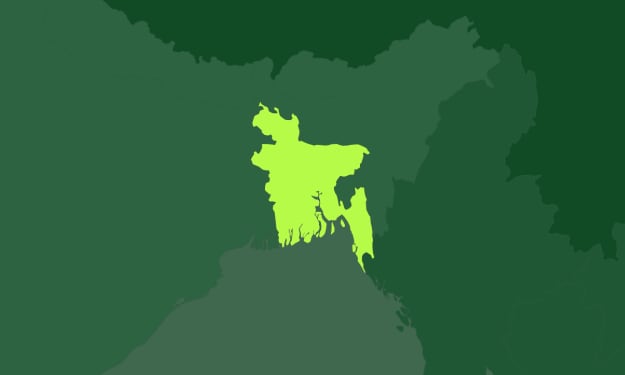
Many myths have been formed around the creation of Bangladesh. Among them is the fiction that the defeated Pakistan Army savagely killed three million people and raped three hundred thousand women during their less than nine months unsuccessful fight to preserve the integrity of a united Pakistan.
By Mushrat Islam Chowdhury about a year ago in History
Trump rallies supporters in Michigan to mark 100 days in office
**Trump Rallies Supporters in Michigan to Mark 100 Days in Office** *Washington Township, MI — April 29, 2017* President Donald Trump marked his 100th day in office with a spirited rally in Washington Township, Michigan, on Saturday evening. Trump decided not to attend the traditional White House Correspondents' Dinner in Washington, D.C. instead of interacting directly with his supporters in a state that was crucial to his victory in the 2016 election. **Celebrating Early Achievements**
By GLOBAL NEWSabout a year ago in History
The Costumes of Ander Season 2
The second season of Ander, which premiered this week on Disney+, continues to tell deeply human stories with gripping portrayals of the political clash between the growing rebellion and the Imperial regime. With such rich and intense subject matter, each aspect of the show had to be intricately crafted, with deep world-building and thematic storytelling, right down to each stitch sewn in the costume department.
By MD IMRAN KHANabout a year ago in History
"From Highlands to Hegemony: The Rise of the Macedonian Empire"
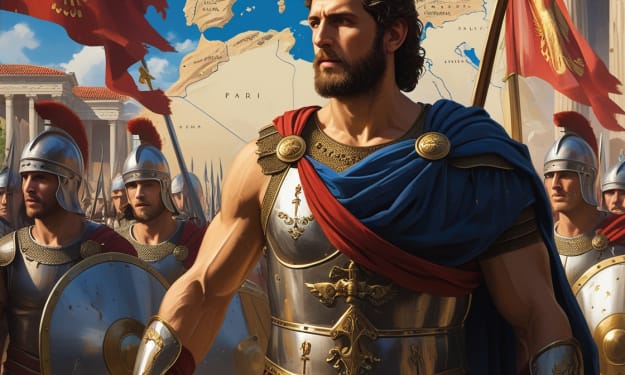
The Emergence of the Macedonian Empire: From Margins to Dominance The Macedonian Empire, one of the most formidable powers of the ancient era, ascended from the rugged, mountainous regions of northern Greece to dominate a significant portion of the known world by the 4th century BCE. Although it existed on the fringes of classical Greek civilization for centuries, the aspirations of two critical monarchsPhilip II and his son, Alexander the Greattransformed Macedonia from a fragmented realm into an empire that extended from the Adriatic Sea to the Indus River. This article examines the intricate and remarkable ascent of the Macedonian Empire, analyzing its political foundations, military advancements, and cultural influence. The Early Kingdom Macedonia was often regarded by southern Greek city-states as a semi-barbaric territory, culturally and politically distinct from the likes of Athens and Sparta. The Macedonian aristocracy traced their ancestry to the Argead dynasty, believed to be descendants of Heracles. Their political framework was less evolved than the democratic or oligarchic systems of the south, with authority concentrated in the hands of warrior-kings who governed over tribal domains. In the early 5th century BCE, Macedonia was a minor power, frequently caught between conflicting Greek states and Persian interests. However, its populace was resilient, proficient in equestrian skills, and adept in irregular warfare. Despite internal discord and pressures from neighboring Illyrians, Thracians, and Greeks, the foundation for unity and expansion was being fortified. Philip II: Architect of Empire The genuine ascent of Macedonia commenced with the rise of Philip II in 359 BCE. A brilliant military tactician and astute diplomat, Philip altered Macedonia’s fortunes in merely two decades. He began by securing his borders and consolidating power domestically. Philip restructured the military, creating the renowned Macedonian phalanx, which utilized longer spears (sarissas) and tighter formations than the conventional Greek hoplite system. This innovation provided his forces a considerable advantage on the battlefield. Philip also invested in siege technologies, cavalry units, and logistical organization, ensuring that Macedonia possessed one of the most modern and efficient militaries in the Greek realm. Diplomatically, he pitted the Greek city-states against one another, intervening when it benefited his interests, employing both marital alliances and force to expand Macedonian influence. By 338 BCE, Philip decisively vanquished a coalition of Greek city-states at the Battle of Chaeronea, establishing Macedonian supremacy over Greece. He founded the Corinthian League, appointing himself as the commander-in-chief, to unite the Greeks in a campaign against their longstanding adversarythe Persian Empire. However, before this campaign could commence, Philip was assassinated in 336 BCE under enigmatic circumstances, bequeathing the throne to his 20-year-old son, Alexander III. Alexander the Great: Expansion and Conquest Alexander inherited a formidable kingdom, a trained military, and a vision of conquest. He swiftly asserted authority, quelling revolts in Greece and eliminating rivals to the throne. In 334 BCE, he initiated his legendary campaign against Persia. Alexander's military brilliance and charisma allowed him to achieve a succession of remarkable victories against significantly larger Persian forces. Notable confrontations included Granicus (334 BCE), Issus (333 BCE), and Gaugamela (331 BCE). Following the conquest of Persepolis, the Persian capital, Alexander adopted the title of Shahanshah (King of Kings), effectively concluding the Achaemenid Empire. However, Alexander’s aspirations did not cease there. He advanced further east, traversing the challenging landscape of Central Asia, ultimately arriving in India. At the Battle of the Hydaspes in 326 BCE, he overcame King Porus, a formidable local monarch, signifying the easternmost extension of the Macedonian Empire. Despite his military triumphs, Alexander faced difficulties in integrating diverse cultures and overseeing the extensive territories he had acquired. His initiatives to amalgamate Greek and Persian customssuch as promoting intermarriage and adopting Persian attirecreated discontent among his Macedonian commanders. In 323 BCE, Alexander passed away unexpectedly in Babylon, likely due to fever, poisoning, or excessive strain. He was merely 32 years old. Legacy and Impact The Macedonian Empire did not remain intact following Alexander's demise. His commandersreferred to as the Diadochipartitioned the empire into several Hellenistic kingdoms, including the Seleucid Empire in Persia, the Ptolemaic Kingdom in Egypt, and the Antigonid dynasty in Macedonia. Notwithstanding the division, Alexander’s conquests left enduring cultural repercussions. Greek emerged as the lingua franca across much of the Near East. Cities like Alexandria in Egypt evolved into hubs of education and culture. The Hellenistic era witnessed a flourishing of science, art, and philosophy, merging Greek and Eastern traditions. Conclusion The ascent of the Macedonian Empire narrates a tale of transformationfrom a marginalized kingdom to the center of one of history's most formidable empires. Under the leadership of Philip II and Alexander the Great, Macedonia capitalized on military advancement, strategic diplomacy, and relentless ambition to alter the ancient world. Although the empire itself was ephemeral, its cultural and political heritage influenced civilizations for centuries to follow.
By Say the truth about a year ago in History
A Historical Overview of India-Pakistan Wars
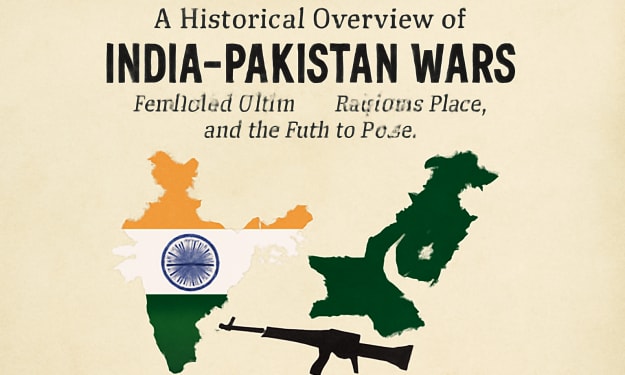
The relationship between India and Pakistan has been marked by conflict and tension since the two nations gained independence from British rule in 1947. The historical context of their rivalry is complex, rooted in a mix of territorial disputes, religious divides, and national identities. Over the years, India and Pakistan have engaged in several wars and conflicts, significantly influencing South Asia's geopolitics and global security.
By Marid Shahran Orikabout a year ago in History
Göbekli Tepe: The Ancient Enigma That Rewrites History
What if our ancestors were far more advanced than we thought? Picture this: 12,000 years ago, before writing, farming, or cities, hunter-gatherers in what’s now Turkey built a massive temple with 20-ton stones.
By Natik Ahsanabout a year ago in History
The Spirit of America: Celebrating Culture, Innovation, and Dive
The Soul of America: Celebrating Culture, Development, and Differing qualities America, the arrive of openings, advancement, and wealthy social legacy, stands as a reference point for the world. From its magnificent scenes to the energetic cities that drive worldwide alter, the Joined together States is more than fair a nation; it could be a image of opportunity, advance, and solidarity through differences. The assorted soul of America can be followed back to its establishing and is reflected in each angle of its society, from the expressions to innovation, legislative issues to social developments. The Social Embroidered artwork of America One of America's most characterizing highlights is its extraordinary social differing qualities. The nation is domestic to individuals from for all intents and purposes each corner of the globe, making it a softening pot of conventions, dialects, and traditions. Whether it's the food, music, or design, American culture may be a combination of impacts that have molded the personality of the country over time. The affect of worker communities on American culture is verifiable. From the Italian impact in Modern York's Small Italy to the dynamic Latinx culture in Los Angeles, these communities have imbued their conventions, nourishments, and dialects, making a energetic and ever-evolving social scene. The combination of societies is celebrated annually in different social celebrations, from Chinese Modern Year parades to Oktoberfest celebrations, exhibiting America's open grasp of worldwide conventions. Development: The Pulse of America America has long been at the cutting edge of advancement and innovative progression. The country's inventiveness has driven to a few of the foremost critical advancements in science, pharmaceutical, and innovation, affecting the world on a worldwide scale. Take, for illustration, the space race of the 1960s, which not as it were put a man on the moon but too illustrated the boundless potential of human innovation. The dispatch of the primary effective commercial flight and the consequent insurgency in discuss travel exemplify America's soul of inventiveness. Within the world of tech, Silicon Valley in California is the undisputed epicenter of mechanical advancement, creating worldwide monsters like Apple, Google, and Facebook. These companies have changed the way the world communicates, works, and interatomic, making the Joined together States a worldwide pioneer in computerized progressions. The U.S. has moreover revolutionized healthcare, with developments such as the advancement of the polio immunization and progressed cancer medicines. From the coming of the web to breakthroughs in fake insights, America's thirst for advance proceeds to reshape long haul of the world. The Characteristic Excellence of America Past its cities and innovation, America is domestic to a few of the foremost breathtaking normal scenes within the world. From the clearing deserts of Arizona to the rich forests of the Pacific Northwest, the Joined together States may be a treasure trove of normal ponders. National parks like Yellowstone and the Amazing Canyon offer guests a see into the endless and untouched excellence of the country's normal world. The flawless lakes of the Midwest, the towering mountains of the Rockies, and the perfect shorelines of the Inlet Coast all highlight the surprising assortment of the American scene. Whether it's a calm climb through the Appalachian Path or a exciting drive along the Pacific Coast Interstate, America's normal magnificence serves as a update of the country's profound association to the arrive and the have to be protect its ponders for future eras. Solidarity in Differences Whereas America has confronted its share of challenges and clashes all through history, it has too appeared flexibility and solidarity in overcoming them. The battle for respectful rights, women's rights, and uniformity for all individuals has been a characterizing highlight of the nation's social advance. Developments such as the Gracious Rights Development of the 1960s and the LGBTQ+ rights development have challenged long-standing disparities and have contributed to a more comprehensive society. The capacity of Americans to come together, in spite of their contrasts, remains one of the country's most momentous characteristics. From the mending soul after the 9/11 assaults to the solidarity appeared amid times of emergency, America's quality lies in its capacity to join together individuals from assorted foundations beneath a shared sense of reason. Conclusion America, with its extraordinary blend of culture, development, and characteristic excellence, proceeds to charm the creative energy of the world. As the nation moves forward, its different character and persistent interest of advance will without a doubt proceed to characterize it. Whether through mechanical headways, social advancement, or the conservation of its awe-inspiring scenes, the spirit of America remains as dynamic and solid as ever. And as long as the nation remains genuine to its standards of flexibility, uniformity, and opportunity, it'll proceed to rouse eras to come.
By Maharuf Islamabout a year ago in History