Books
The Point That Triggered Iran's War – The Timeline & History of Middle Eastern Conflict
The Point That Triggered Iran's War – The Timeline & History of Middle Eastern Conflict The current conflict involving Iran did not begin overnight. It is the result of decades of political, religious, military, and geopolitical tensions that have shaped the Middle East for generations. To understand why the region remains unstable today, it is important to examine the timeline of events that gradually transformed rivals into enemies and turned regional disputes into a major international crisis.
By Wings of Time 4 months ago in History
Iran Destroyed a "$100 Million Toy"?
Iran Destroyed a "$100 Million Toy"? US Attacks Iranian Radars – Bahrain & Pakistan in Focus Tensions in the Gulf region have once again captured global attention as the United States and Iran continue to exchange military actions and political warnings. Recent reports indicate that U.S. forces conducted strikes against Iranian radar and surveillance facilities, while Iran responded with missile and drone attacks targeting locations associated with U.S. military operations in the Gulf. These developments have raised concerns about regional stability and the possibility of further escalation.
By Wings of Time 5 months ago in History
Reconstructing Aristotle's Protrepticus: 99% of Ancient Greek Literature Lost
Aristotle is a well-known Greek philosopher. His statements are as well-known as passages from a collection of famous quotes. His views are proclaimed in innumerable graduation speeches:
By Francis Dami5 months ago in History
Iran Destroyed a "$100 Million Toy"?
Iran Destroyed a "$100 Million Toy"? US Attacks Iranian Radars – Bahrain & Pakistan in Focus Tensions in the Gulf region have once again captured global attention as the United States and Iran continue to exchange military actions and political warnings. Recent reports indicate that U.S. forces conducted strikes against Iranian radar and surveillance facilities, while Iran responded with missile and drone attacks targeting locations associated with U.S. military operations in the Gulf. These developments have raised concerns about regional stability and the possibility of further escalation.
By Wings of Time 5 months ago in History
Portrayals of Exodus
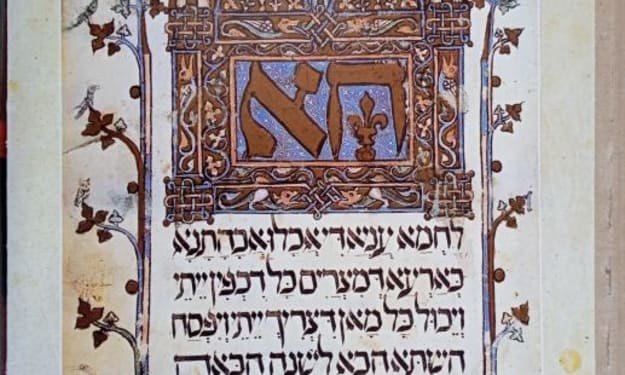
The story of Moses is one of the most renowned stories in the Abrahamic religions. The parable of the adopted son of a Pharaoh’s daughter returning to his people, the Hebrews, and acting as a messenger for both the wrath and salvation of God is of an epic quality that to this day has a hold on the creative minds of people of these faiths. Many pieces of art have been created depicting the Ten Plagues of Egypt, which feature prominently in this story. Today, we will be looking at the depictions of these events, in particular the 4th, 7th, and 10th plagues, as they are illustrated in the religious text, the Sarajevo Haggadah.
By Alex Brown5 months ago in History
Page 74 of the Voynich Manuscript
Humans, though they have reason to be wary of things they do not understand, are still drawn to the unknown. At some indeterminate point in the 14th century, driven by curiosity and a deeply felt desire to know the world and our place in it, a book began to form, a record of a quest for understanding of the world that was familiar, but bent to the will of forces unknown and unknowable to its authors. Authors who, in their time, would have been seen by many as immoral heretics. And so, this book needed to be hidden and became an unknown and unknowable artifact. Encoded and allegorical in its illustrations, this book would move through the centuries as a great mystery, even as the world grew more at ease with the studies its authors undertook.
By Alex Brown5 months ago in History
Is the World Moving Toward World War III?
Is the World Moving Toward World War III? The Nuclear Threat and the Future of Humanity The world is experiencing one of the most uncertain periods in modern history. Ongoing conflicts in different regions, growing rivalry among major powers, and increasing military spending have led many people to ask a serious question: Is the world moving toward World War III?
By Wings of Time 5 months ago in History
The Forgotten President: The Tragic Assassination of James A. Garfield
When we talk about presidential assassinations, we think of Lincoln and JFK. Some may also mention the many failed attempts on Trump, but few recall James A. Garfield. Garfield was a huge loss to the political landscape, and had he survived, he could have achieved much in his career. Sadly, a combination of a lone attacker and an inexperienced doctor ensured this was never to be. Garfield’s Rise It was the year 1880, and the US stood at a crossroads. Was it possible to give formerly enslaved people full rights as citizens? The existing patronage system meant that government jobs often went to the most loyal rather than the most qualified. Could this change? It was at the Republican National Convention in June when James Garfield addressed these issues, demanding that the nation honor its promises to all citizens. His speech was eloquent and commanded the respect of hundreds of delegates who cheered loudly. After hearing him, they wanted one more thing from Garfield: they wanted him to be their presidential nominee. Initially, Garfield tried to refuse the nomination, insisting he had no desire to be president, which was exactly the trait that made him an ideal candidate. Once he agreed, Garfield—who had risen from poverty like Abraham Lincoln and performed heroic service on the Union side in the Civil War—became unstoppable. He became the country’s 20th president in November 1880. He promised progress and reform; however, this was not to be. Just four months after his inauguration, he was shot by Charles Guitar. Charles Guitar Guiteau had shown signs of mental instability long before he pulled the trigger. Despite this, records indicate he was never treated or confined, as psychiatry was still in its early stages. Guiteau had a long history of failed ventures. He failed as a lawyer, journalist, and preacher. When he joined a free-love commune, he failed there as well—the women refused him. Yet he always believed God had assigned him a higher purpose. He became obsessed with Garfield after his nomination. Guiteau traveled to New York in summer 1880, convinced that destiny required him to play a crucial role in Garfield’s victory. Guiteau repeatedly visited Garfield’s campaign office until he was allowed to give a brief, rambling speech endorsing him. The Patronage Conflict Garfield strongly opposed the system of giving government posts to political supporters; he believed positions should be earned. Guiteau, however, strongly supported patronage. He expected a reward for his support, ideally an ambassador role to France. Garfield had more pressing concerns than one disappointed office seeker. He had begun an ambitious agenda including strengthening the US Navy, expanding trade with Latin America, and supporting civil rights. He appointed former enslaved reformer Frederick Douglass as Recorder of Deeds for Washington, D.C., making him the first African American to hold a significant federal position. Deluded, Guiteau traveled to Washington and appeared at the White House daily demanding a job. He only met Garfield once, when he handed him a copy of his speech with “Paris Consulship” written on it. His strange behavior led to him being barred from the White House. When told by Secretary of State James Blaine that he would receive no position, he decided on revenge. The Assassination Guiteau was broke and hopeless, so he stayed in a cheap boarding house. While there, he claimed a divine revelation told him Garfield must be removed and replaced by Vice President Chester A. Arthur. He stalked Garfield for weeks. The President was an easy target, as he often walked without protection. This was especially risky, considering Lincoln had been killed only sixteen years earlier. Guiteau finally struck. On July 2, 1881, at the Baltimore and Potomac Railroad Station, he shot Garfield in the back. Medical Treatment Garfield may have survived if not for the actions of one stubborn physician, Dr. Doctor Bliss, who insisted on controlling all treatment. Bliss rejected antiseptic methods and used unsterilized instruments, even inserting his bare finger into the wound. Later, an early metal detector designed by Alexander Graham Bell was used, but interference prevented proper localization of the bullet. Infection had already spread, making survival unlikely even with better care. Death of the President Garfield died of sepsis on September 19, 1881, in a cottage at Elberon, New Jersey. His wife was nearby, recovering from illness. On the day of his death, Guiteau wrote to President Chester A. Arthur claiming his actions were justified and divinely inspired. At trial, the jury took one hour to convict him. He was sentenced to death and hanged on June 30, 1882, still believing he had fulfilled God’s will. Garfield’s Legacy Despite his short presidency, he made a lasting impact. His death sparked strong demands for civil service reform. President Arthur, grieving his predecessor, rejected the spoils system. Congress passed the Pendleton Act in 1883, creating a merit-based system for federal jobs. Historians still wonder what Garfield could have achieved if he had lived. Many believe he would have become one of the most influential presidents in American history. Instead, he remains a tragic figure overshadowed by his assassination.
By Hafiz afridi5 months ago in History
Rome’s African Emperor: The Forgotten Warrior King Who Rebuilt London and Ruled the Mightiest Empire on Earth
Have you ever stood in front of an old stone wall or walked through ancient ruins and wondered about the hands that built them? The lives, the ambitions, the struggles behind those silent stones? Now imagine discovering that one of the most powerful men who helped shape early London wasn’t some pale senator from Italy, but a battle-scarred warrior born under the blazing African sun in what is now Libya.
By KWAO LEARNER WINFRED5 months ago in History
They Lied to You: The Forgotten Name of Africa and the Glorious Empires They Tried to Erase from History
Have you ever stopped and wondered why we call an entire continent “Africa”? It seems like such a simple, obvious name - one we’ve all grown up hearing since childhood. But what if I told you that name is relatively new, imposed from the outside, and that for thousands of years this vast, ancient land had its own powerful identity and a name that carried deep meaning?
By KWAO LEARNER WINFRED5 months ago in History
Was Moses Known to Egypt as Senenmut?. AI-Generated.
A question raised by the surviving Egyptian record Off The Kirb Ministries recently released a video titled “This New Moses Information is Hard to Ignore...” The video explores a question that is simple on the surface but heavy once the evidence is laid out: was Moses known in Egypt by another name, and could that name have been Senenmut? The video credits the Armstrong Institute of Biblical Archaeology, Christopher Eames, and Scotty Roberts for the research that inspired the argument. The claim presented is not built around a single similarity, a vague resemblance, or a desire to force the Exodus story into Egyptian history. It is built around a pattern of chronology, names, royal access, authority, disappearance, and damaged memory.
By Peter Thwing - Host of the FST Podcast5 months ago in History