Biographies
1945: The Syrian Crisis That Nearly Sparked War Between Britain and France
I. The Decline of French Colonial Power World War II inflicted a severe blow to French colonial authority. After decades of expanding its empire, France faced a humiliating defeat by Nazi Germany in 1940, leading to the establishment of the Vichy regime. Although Free French forces, led by Charles de Gaulle, continued to fight alongside the Allies, France's global influence was significantly diminished. In the Levant, France maintained control over Syria and Lebanon under a League of Nations mandate established after World War I. Despite earlier promises of independence, France was reluctant to relinquish its hold on these territories. This resistance to decolonization set the stage for the 1945 crisis. --- II. Rising Nationalism and Tensions in the Levant As World War II drew to a close, nationalist sentiments surged across the Middle East. In Syria and Lebanon, demands for independence intensified. The presence of French troops and administrators became increasingly unpopular, leading to widespread protests and civil unrest. In May 1945, demonstrations erupted in Damascus and other Syrian cities. These protests were met with violent suppression by French forces, resulting in numerous casualties. The situation escalated rapidly, with reports of French troops firing on civilians and using heavy artillery against populated areas. --- III. The French Military Response On May 29, 1945, French forces launched a brutal assault on Damascus. They shelled the city, targeting government buildings and residential neighborhoods. The Syrian parliament was bombarded, and attempts were made to arrest President Shukri al-Quwatli, who narrowly escaped. The French also cut off electricity and communication lines, effectively isolating the city. The French military actions resulted in significant destruction and loss of life. Estimates suggest that hundreds of Syrians were killed, and many more were injured. The use of Senegalese colonial troops by the French further inflamed tensions, as these forces were accused of committing atrocities against civilians. --- IV. British Intervention and the Brink of War The British government, under Prime Minister Winston Churchill, was alarmed by the French actions in Syria. Concerned about regional stability and its own interests in the Middle East, Britain decided to intervene. Churchill authorized General Bernard Paget to deploy British forces from Transjordan into Syria to halt the French offensive. On May 31, 1945, British troops entered Damascus and confronted the French forces. They demanded an immediate ceasefire and the withdrawal of French troops to their barracks. The British intervention effectively ended the French assault and prevented further bloodshed. The crisis brought Britain and France to the brink of war. Diplomatic relations between the two nations were severely strained, with accusations and recriminations exchanged. However, the British action was widely supported by the international community, which viewed the French response as excessive and unjustified. --- V. The Path to Syrian Independence Following the crisis, international pressure mounted on France to relinquish its control over Syria and Lebanon. The newly formed United Nations and the Arab League both advocated for the independence of the Levantine states. Facing isolation and condemnation, France agreed to negotiate a withdrawal. By April 1946, the last French troops had left Syria, marking the end of the French mandate. Syria declared its independence on April 17, 1946, and was subsequently recognized by the international community. Lebanon also achieved full independence during this period. --- VI. Legacy and Historical Significance The 1945 Syrian crisis highlighted the declining power of European colonial empires and the rise of nationalist movements in the post-war era. It underscored the importance of international diplomacy and the role of emerging global institutions in resolving conflicts. The events also strained Franco-British relations and influenced future decolonization efforts across the Middle East and beyond. The crisis serves as a reminder of the complexities of colonial legacies and the struggles faced by nations seeking self-determination. It remains a pivotal moment in Syrian history and a significant episode in the broader narrative of decolonization. --- Written by: Ikram Ullah
By Ikram Ullahabout a year ago in History
The Great Showdown of 2025: Pakistan vs. India – Who Will Rewrite History?
Pakistan vs India War 2025: Who Will Prevail? The year 2025 has brought with it a conflict that has captured the world's attention—Pakistan and India are once again at odds, leading to a war that many analysts have long feared. This conflict, while rooted in decades-old tensions, is unique in its scale, technology, and international implications. But the burning question remains: who will prevail? Historical Context To understand the current conflict, it's crucial to grasp the historical tensions that have long simmered between Pakistan and India. Since the partition in 1947, both nations have faced off multiple times, with major wars in 1948, 1965, 1971, and 1999. Disputes over Kashmir, political differences, and military posturing have fueled decades of rivalry. While there have been periods of relative peace, the underlying conflicts have never truly faded. Diplomatic tensions, water disputes, and territorial disagreements have only added fuel to the fire. In recent years, both countries have seen political shifts that further deepened their divides. Nationalist sentiments grew stronger, with political leaders using rhetoric that resonated with local populations but stirred up old wounds. This buildup of animosity, paired with increasing military budgets and weapons testing, foreshadowed the inevitable clash of 2025.
By Masih Ullahabout a year ago in History
Dust Between Stars
The sky did not blink. It watched. Liora stood alone on the dead plain, dust swirling weakly around her boots. There was no wind. No sound. Only the silent stretch of stars—and the impossible black sphere hovering in their midst, rimmed by faint fire. It was not a moon. It was absence. A hole punched in the fabric of space.
By UMAIR KHANabout a year ago in History
Escalating Conflict: Ukraine-Russia Tensions Reach a Breaking Point
Escalating Conflict: Ukraine-Russia Tensions Reach a Breaking Point As military clashes intensify, global leaders call for urgent diplomatic action to prevent further escalation in the ongoing Ukraine-Russia conflict.
By Habibullah khan about a year ago in History
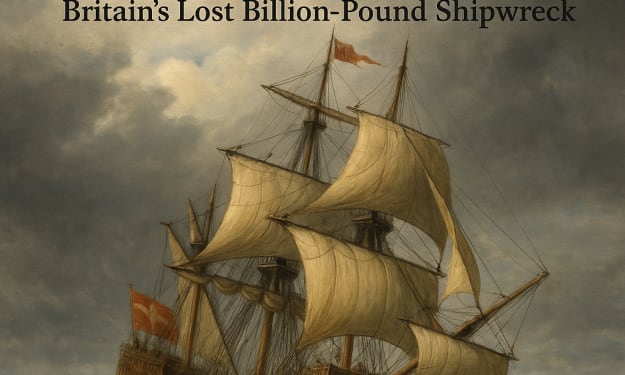
The Tragedy of the Merchant Royal: Britain’s Lost Billion-Pound Shipwreck. AI-Generated.
. A Galleon of Fortune The Merchant Royal was a substantial English galleon constructed around 1627 and owned by English traders. Under the command of Captain John Limbrey, she was a trade ship that navigated between Europe and the Spanish territories in the Americas. For years, she returned with merchandise and silver from the New World. Unlike warships or privateers, the Merchant Royal primarily operated as a peaceful trading vessel. However, what it lacked in armament, it compensated for with the immense worth of the cargo it transported. In 1641, the Merchant Royal was docked in the Spanish-controlled port of Cadiz. At the time, Spain faced financial difficulties and needed to remunerate its troops in the Netherlands. Due to political strains and a deficit of Spanish vessels, a substantial consignment of Mexican gold and silver, designated to pay the Spanish armies, was entrusted to English merchants specifically, the crew of the Merchant Royal. According to contemporary reports, the ship was laden with: 100,000 pounds of gold 400 bars of Mexican silver Over 500,000 pieces of eight (silver coins) Even in 1641, this fortune was appraised to be worth over £300,000, which would correspond to more than $1. 5 billion in today’s economy, adjusting for both inflation and the value of gold and silver. The Sinking of a Legend On September 23, 1641, the Merchant Royal commenced her voyage to England with her staggering bounty onboard. Calamity ensued just days later. Somewhere off the coast of Land’s End in Cornwall, the vessel encountered a violent storm. With her hull already deteriorated from extensive journeys and her pumps failing, the Merchant Royal began to take on water. Despite the crew’s utmost endeavors, the ship was fated. In the turmoil of the storm, the cargo comprising gold, silver, and valuable items was lost to the depths. Only 40 of the ship’s 80 crew members survived, rescued by a nearby vessel named the Dover Merchant. Captain Limbrey was among the survivors, and his account helped enshrine the loss. The precise coordinates of the wreck were never accurately documented, and in the centuries that followed, the Merchant Royal has become a contemporary Atlantis for treasure hunters. The Hunt for the Treasure The enigma of the Merchant Royal has captivated divers, historians, and treasure seekers for generations. Colloquially referred to as the “El Dorado of the Seas,” the ship has inspired numerous expeditions. Yet, despite modern sonar technology and deep-sea submersibles, the precise location of the vessel remains elusive. The most crucial moment in contemporary history occurred in 2007, when the American recovery firm Odyssey Marine Exploration declared that it had retrieved over 500,000 silver coins from a shipwreck in the Atlantic, valued at approximately $500 million. Initially, many speculated this might be the Merchant Royal. However, further investigations indicated it was actually the Nuestra Señora de las Mercedes, a Spanish galleon that sank in 1804. In that same year, British officials cautioned that anyone who discovered the Merchant Royal and neglected to report it would face legal repercussions under the legislation safeguarding historical shipwrecks. Despite all endeavors, the vessel remains missing. Some theorists propose that the wreck might be entombed beneath layers of sediment, while others contend it could have drifted into deeper waters far from its purported sinking site. The Significance of the Merchant Royal Beyond the evident appeal of its gold and silver, the narrative of the Merchant Royal encapsulates the perils and benefits of the Age of Exploration. It was an era when fortunes were created and lost at sea, when wooden ships transported the riches of empires and ventured into the unknown. The wreck also provokes inquiries regarding the ethics of treasure hunting, the ownership of cultural artifacts, and our valuation of maritime heritage. Should a salvaged treasure be repatriated to its nation of origin? Does it belong to the descendants of those who navigated the ship? Or should it remain undisturbed as a marine cemetery and time capsule? Conclusion The Merchant Royal persists as one of the most renowned and valuable shipwrecks never retrieved. Its narrative is a compelling amalgamation of ambition, misfortune, and enigma. Whether it is eventually discovered or remains eternally concealed beneath the ocean's surface it continues to captivate the imagination of those who aspire to find sunken treasures. Somewhere off the coast of England lies a billion-dollar treasure, shrouded in darkness by salt and time. And until it is located, the legend of the Merchant Royal endures.
By Say the truth about a year ago in History
The Curse of the Flor de la Mar: The Lost Treasure of the Malacca Strait
The Curse of the Flor de la Mar: The Lost Treasure of the Malacca Strait Introduction: A Golden Ghost of the Sea Beneath the swirling currents of the Malacca Strait, situated between the coasts of Sumatra and the Malay Peninsula, resides one of history's most captivating maritime enigmas the Flor de la Mar, a 16th-century Portuguese galleon allegedly having sunk with the most considerable treasure ever misplaced at sea. Burdened with gold, diamonds, spices, and invaluable artifacts plundered from the Sultanate of Malacca, this shipwreck remains one of the most elusive and precious fortunes in the world. A Jewel of the Portuguese Empire The Flor de la Mar (Portuguese for "Flower of the Sea") was built in Lisbon around 1502, during the illustrious era of Portuguese exploration. Measuring approximately 120 feet in length and weighing over 400 tons, she was a colossal vessel for her time engineered to dominate the trade routes between Europe and the East Indies. Initially utilized for commerce and military operations, the Flor de la Mar quickly garnered a reputation as both a formidable warship and a fated craft. She was susceptible to leaks and challenging to navigate, yet that did not deter the Portuguese Crown from depending on her for essential conquests most notably the capture of Malacca in 1511. The Fall of Malacca: A Rich Conquest Malacca was one of the wealthiest trading harbors in Asia, controlling access between the Indian Ocean and the South China Sea. When Afonso de Albuquerque, the Portuguese governor of India, conducted a successful campaign to seize the city, he secured not only a strategic position but also access to vast riches. The spoils acquired from Malacca were staggering chests filled with gold and silver, rare spices such as cloves and nutmeg, and artifacts from across Asia. This immense fortune, collected by Albuquerque as tribute to King Manuel I of Portugal, was estimated to be worth billions in today's currency. It was loaded aboard the Flor de la Mar, which was selected as the flagship to convey the plunder back to Lisbon. Disaster at Sea In November 1511, the Flor de la Mar departed from the port of Malacca, navigating the perilous waters of the Strait that bore its name. The ship, already aged and burdened with treasure, struggled against monsoon winds and turbulent seas. Somewhere near the northern tip of Sumatra, calamity struck. Caught in a violent storm, the Flor de la Mar disintegrated and sank. Most of the crew perished, although Albuquerque survived. The treasure, however, was lost to the depths and has never been retrieved. The Lost Fortune Estimates of the treasure aboard the Flor de la Mar vary, but contemporary historians suggest that the cargo could be valued at over $2 billion in today's terms. It encompassed:
By Say the truth about a year ago in History
The Complex History of India and Pakistan: From Unity to Division
A shared civilization, colonial dominance, religious and political divisions, and persistent geopolitical rivalry make up the deeply intricate history of India and Pakistan. They were once part of a unified cultural and political entity under various historical empires, despite the fact that these two nations are largely viewed today through the lens of mutual suspicion and conflict. 1. Shared Origins and Pre-Colonial Unity:
By sadhin khanabout a year ago in History
Imran Khan: Silence Behind Bars
The room is bare—its cold cement floor echoing with silence. The faded blue-and-white walls carry the scent of years of confinement, perhaps even defiance. A modest bed stands in the corner, neatly made, its thin mattress betraying any hope for comfort. A pedestal fan hums lazily in the background, struggling against the summer heat. On the wall hangs a television, its black screen a lifeless rectangle above the sink and tap. Clothes hang on the side, dry and plain. A desk bears the weight of a few essentials—bottled water, toiletries, and scattered papers. But in the middle of this stark simplicity sits a man, dressed in black, engrossed in a book larger than life.
By Muhammad Jawadabout a year ago in History
Quintus Fabius Pictor
In the rich narrative of Roman history, where prominent generals, emperors, and senators frequently take center stage, the more subdued contributions of early historians can often be overlooked. However, among these intellectual trailblazers, Quintus Fabius Pictor emerges as a crucial figure. As the first historian of Rome, he established the groundwork for Latin historiography, significantly shaping the Roman perception of their history and influencing the style and format of historical writing for future generations. Although much of his work exists only in fragments and citations, his impact is profoundly ingrained in the fabric of Roman cultural heritage.
By A Históriaabout a year ago in History