Biographies
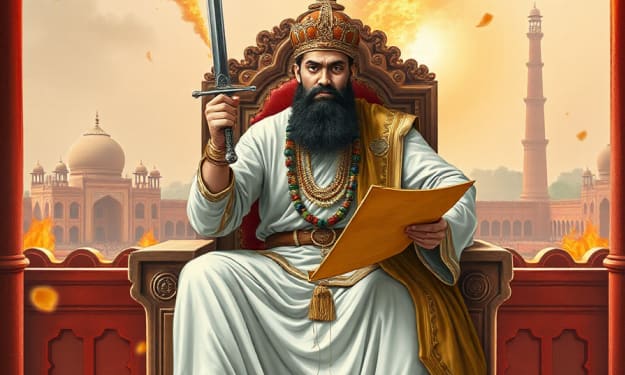
Alauddin Khilji: The Sultan Who Defied Invasions and Reformed an Empire. AI-Generated.
I. The Rise of a Relentless Sultan In the early 13th century, the Indian subcontinent was under the rule of the Delhi Sultanate, but its throne was fragile. Internally, it was plagued by corrupt nobles and rebellions. Externally, it faced the terrifying threat of Mongol invasions from Central Asia.
By uzair hadiabout a year ago in History
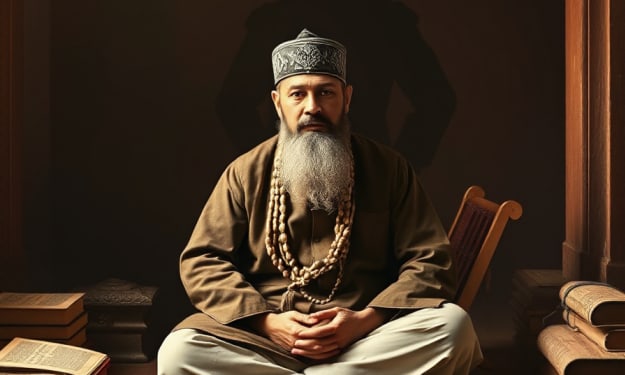
Shah Abdul Aziz: The Scholar Who Declared India Under Occupation. AI-Generated.
I. The Son of a Revolutionary Legacy The legacy of Shah Abdul Aziz began long before his birth. He was the eldest son of Shah Waliullah Dehlawi, one of the greatest Islamic reformers in South Asian history. Shah Waliullah had sought to revive Islamic values, reform religious understanding, and foster unity between Muslims. He translated the Qur'an into Persian — a bold move — and called for the spiritual and moral revival of Muslims under Mughal rule.
By uzair hadiabout a year ago in History
Hyder Ali: The Thunder Before Tipu — The Warrior Who Shook the British Empire. AI-Generated.
I. The Rise of an Unlikely Leader In the dusty plains of 18th-century South India, a storm was brewing — not from the sky, but from the earth itself. His name was Hyder Ali. Born around 1720 in a modest family of military background, Hyder was not a prince by birth — but by sheer grit and intelligence, he would soon become a sultan feared by both the Marathas and the British East India Company.
By uzair hadiabout a year ago in History
Bahauddin Zakariya: The Saint Who United Hearts and Reformed a Region. AI-Generated.
Introduction: A Saint Born for an Age of Chaos In the turbulent 13th century, when invasions tore through India and dynasties rose and fell like the tides, one man built something that outlasted empires — hearts united in love, faith, and knowledge. That man was Hazrat Bahauddin Zakariya Multani, a saint, scholar, and reformer whose teachings still echo through the lands of South Punjab and beyond.
By uzair hadiabout a year ago in History
Begum Rokeya: The Woman Who Dreamed of Freedom — and Gave Muslim Girls a Voice. AI-Generated.
Introduction: A Voice Before Its Time In an era where most women were imprisoned behind the purdah and Muslim girls were often denied even the basic right to read, Begum Rokeya dared to dream. She not only dreamed for herself — she dreamed for a generation. A writer, educator, and reformer, she carved her name in history not by holding power, but by empowering the powerless.
By uzair hadiabout a year ago in History
Shah Waliullah Dehlawi: The Revivalist Who Bridged Faith and Reform. AI-Generated.
Introduction: A Nation in Decline, A Scholar on the Rise In the mid-18th century, Mughal India was a land shadowed by internal decay and foreign threat. The once-glorious empire of Babur and Akbar had begun to fracture under the weight of weak rulers, regional rebellions, and British colonial expansion. As moral and religious confusion spread among the Muslim population, there emerged a guiding light — Shah Waliullah Dehlawi.
By uzair hadiabout a year ago in History
The Lion of Ferghana Who Dreamt of Hindustan. AI-Generated.
The wind howled over the rugged mountains of Ferghana, a land carved by time and battle. In this cradle of stone and history, a boy was born in 1483, destined to etch his name not only on the soils of Central Asia but in the very heart of Hindustan.
By uzair hadiabout a year ago in History
Sultan Abdul Hamid II: The Last Caliph Who Refused to Sell Palestine. AI-Generated.
**Subtitle:** When the world offered him gold for the sacred land, he chose faith over fortune — and stood as the l In the twilight years of the Ottoman Empire, when its foundation trembled under the pressure of modernity, debt, and division, one man rose to protect not just a dying empire, but the soul of a people. He was the last caliph to rule with both power and purpose. His name was **Sultan Abdul Hamid II**, and his story is not just of politics — but of honor, resilience, and faith.
By uzair hadiabout a year ago in History
Sir Syed Ahmed Khan: The Man Who Taught Muslims How to Rise After the Fall. AI-Generated.
In the heart of colonial India, when the Mughal Empire had fallen and the Muslim identity stood bruised, there emerged a visionary — a man who did not pick up arms in rebellion, but picked up a pen. A man who believed that the soul of a nation could be healed through education. That man was **Sir Syed Ahmed Khan**.
By uzair hadiabout a year ago in History
The Veiled Queen of Bhopal: How Nawab Sultan Jahan Fought Colonialism with Education. AI-Generated.
The Silent Thunder of Reform In the heart of British India, amidst a time of suppression, colonial dominance, and social stagnation, emerged a woman who would re-write the narrative of Muslim women in power — Nawab Sultan Jahan Begum of Bhopal.
By uzair hadiabout a year ago in History
Ukraine says at least 40 Russian warplanes hit in massive drone strikes
**Ukraine asserts that over 40 Russian warplanes were hit by massive drone strikes** Ukraine has claimed responsibility for a massive drone strike that allegedly damaged or destroyed more than 40 Russian warplanes across several key airbases, escalating its military campaign dramatically. Officials in Ukraine say that the attack, which took place in the early morning hours of June 1, 2025, was one of the largest and most successful drone operations since the war with Russia began. The operation, codenamed "Spider Web," targeted several Russian airfields, including Olenya in Murmansk Oblast, Diaghilevo in Ryazan Oblast, Belaya in Irkutsk Oblast, and Ivanovo Severny in Ivanovo Oblast, according to Ukraine's Security Service (SBU). Strategic bombers like the Tu-95 and Tu-22M3 as well as the A-50 airborne early warning aircraft are known to be housed at these bases. Ukrainian sources shared footage that showed several aircraft clearly engulfed in flames as thick black smoke rose from some of the affected bases. While Russia has acknowledged that drone attacks have occurred in specific locations, the country has yet to provide an official count of the damage. Access restrictions and ongoing military activity limit independent verification. The fact that this operation was the result of more than a year of planning and development has been emphasized by the Ukrainian government. In order to circumvent radar detection and air defenses, the reportedly used drones were launched from concealed mobile platforms inside Russian territory. Considering the disparity in long-range missile capabilities between the two nations, this strategy represents a significant shift in Ukraine's military tactics. According to Ukrainian officials, the operation involved the simultaneous deployment of more than 70 drones. demonstrating Kyiv's growing reliance on domestically produced weapons, many of these were indigenously developed systems. This, according to analysts, is a direct response to Ukraine's urgent need to expand its strategic reach and restrictions on Western weapons deliveries. Russia used more than 470 drones and a number of missiles to launch its own massive assault on Ukrainian territory in response to the drone attack. A Ukrainian military training facility was hit by one of these missiles, killing at least 12 soldiers and injuring more than 60 others. The tit-for-tat strikes are a significant step up in drone warfare, a strategy that is increasingly defining this contemporary conflict. The drone operation is viewed as a strategic and symbolic success by the Ukrainian government. Ukraine intends to challenge the concept of safe havens far from the front lines and hinder Russia's ability to launch aerial attacks against Ukrainian infrastructure by striking deeply into Russian territory. In the near future, Russia's capacity for coordinated missile strikes and aerial intelligence gathering may be diminished by damaging strategic bombers and surveillance aircraft. In contrast, the strikes by drones occur just a few days prior to the planned international peace talks in Istanbul. The international community is keeping a close eye on the negotiations because Ukraine has confirmed its participation. The timing of such a well-publicized attack raises concerns regarding its potential to influence diplomatic discussions or international perceptions of Ukraine's military resolve. Experts warn that while the attack demonstrates Ukraine's inventiveness and tenacity, it may also elicit harsh Russian retaliation. Nevertheless, the operation highlights a significant shift in contemporary warfare, in which battlefield dynamics are increasingly altered by drones and asymmetric strategies. The skies over Ukraine and Russia may become even more tense as both nations invest in unmanned aerial capabilities. Long-range drone strike technologies could continue to advance, not just in Ukraine but around the world, if the operation in Ukraine is successful. Drone warfare may now be the central battleground in a war that has already reshaped the geopolitical landscape of Eastern Europe with no end in sight and both sides indicating firm military resolve.
By GLOBAL NEWSabout a year ago in History