Ancient
Hercules "The Demigod of Greek Mythology"
Hercules, the legendary hero of Greek mythology, stands as a timeless symbol of strength, courage, and resilience. His epic tales have been passed down through generations, captivating the imagination of people around the world. In this essay, we will delve into the fascinating world of Hercules, exploring his origins, his remarkable feats, and the enduring legacy of this iconic hero. The Origins of Hercules Hercules, known as Heracles in Greek mythology, was the son of Zeus, the king of the gods, and Alcmena, a mortal woman. His birth was a result of Zeus's amorous escapades, which often led to the birth of demigods—individuals with both divine and mortal heritage. From the moment of his birth, Hercules exhibited extraordinary strength and prowess, foreshadowing the hero he would become. The Twelve Labors of Hercules Hercules's most famous exploits are undoubtedly his Twelve Labors, a series of seemingly insurmountable tasks imposed upon him as punishment for a tragic act committed in a fit of madness. These labors were intended to be impossible feats, yet Hercules faced each challenge with unwavering determination. 1. The Nemean Lion: Hercules's first labor was to slay the Nemean Lion, a fearsome creature with impenetrable skin. He strangled the lion with his bare hands and later used its pelt as armor, a symbol of his invincibility. 2. The Hydra of Lerna: Next, Hercules confronted the Hydra, a multi-headed serpent. With the help of his nephew Iolaus, he defeated the beast, but the Hydra's heads multiplied when cut off, making it a formidable adversary. 3. The Ceryneian Hind: Hercules was tasked with capturing the Ceryneian Hind, a deer with golden antlers. His pursuit of the elusive creature tested his speed and agility. 4. The Erymanthian Boar: Hercules's fourth labor was to capture the Erymanthian Boar, a wild and ferocious beast. He succeeded by trapping it in a snowdrift. 5. The Augean Stables: Cleaning the Augean Stables was a seemingly impossible task, as they housed thousands of cattle and had not been cleaned for years. Hercules accomplished it by diverting two rivers to wash away the filth. 6. The Stymphalian Birds: Hercules faced a flock of man-eating birds with bronze beaks and sharp talons. He used a rattle provided by the goddess Athena to drive them away. 7. The Cretan Bull: Hercules traveled to Crete to capture the Cretan Bull, a raging creature wreaking havoc on the island. He successfully subdued the bull and returned it to King Eurystheus. 8. The Mares of Diomedes: Hercules's eighth labor involved capturing the man-eating mares of Diomedes. He accomplished this by feeding the horses their own master. 9. The Belt of Hippolyta: Hercules was tasked with obtaining the magical girdle of Queen Hippolyta, the queen of the Amazons. He succeeded through diplomacy rather than battle. 10. The Cattle of Geryon: Hercules had to retrieve the cattle of Geryon, a giant with three bodies. He slew Geryon and returned the cattle to Greece. 11. The Apples of the Hesperides: Hercules's eleventh labor was to obtain the golden apples of the Hesperides, which were guarded by a dragon. With the aid of Atlas, who temporarily held up the heavens, he retrieved the apples. 12. Cerberus, the Underworld Guardian: The final and most daunting labor was to capture Cerberus, the three-headed hound guarding the gates of the Underworld. Hercules succeeded and returned Cerberus to King Eurystheus before releasing him back to the Underworld. The Legacy of Hercules Hercules's heroic feats not only exemplify physical strength but also symbolize the triumph of human spirit over adversity. His enduring legacy extends far beyond mythology, influencing art, literature, and popular culture for centuries. In art and sculpture, Hercules is often depicted in a heroic pose, with bulging muscles and a lion's pelt draped over his shoulder, symbolizing his victory over the Nemean Lion. Renaissance artists like Michelangelo and Antonio Pollaiuolo drew inspiration from Hercules, contributing to his lasting presence in the world of art. In literature, Hercules's exploits have been recounted in countless works, including epic poems, plays, and novels. The Roman poet Virgil, in his work "The Aeneid," mentions Hercules as a revered ancestor of the Roman people. The Greek playwright Euripides explored the complex character of Hercules in his tragic play "Heracles." In popular culture, Hercules remains a beloved figure, appearing in numerous films, television series, and comic books. The Walt Disney animated film "Hercules" introduced the hero to a new generation, showcasing his journey of self-discovery and heroism. Conclusion Hercules, the mighty demigod of Greek mythology, continues to inspire and captivate us with his incredible strength and heroic deeds. His Twelve Labors represent not only physical prowess but also the indomitable human spirit in the face of seemingly insurmountable challenges. As we delve into the legend of Hercules, we find a timeless hero whose legacy endures in art, literature, and popular culture, reminding us of the enduring power of courage, resilience, and the triumph of the human spirit.
By Raymark Marcos3 years ago in History
Robert Oppenheimer and the Birth of the Atomic Age
Robert Oppenheimer, a renowned physicist, is often referred to as the "architect of the Apocalypse." His role in the development of the nuclear bomb during World War II forever altered the course of warfare, introducing the world to the destructive power of atomic weapons. While Oppenheimer's scientific achievements were groundbreaking, they also carried a heavy moral burden. This article explores the life and contributions of Robert Oppenheimer, the events leading up to the invention of the nuclear bomb, its profound impact on the world, and the ethical dilemmas that plagued Oppenheimer throughout his career.
By Francis Osei3 years ago in History
Flying into the Past:
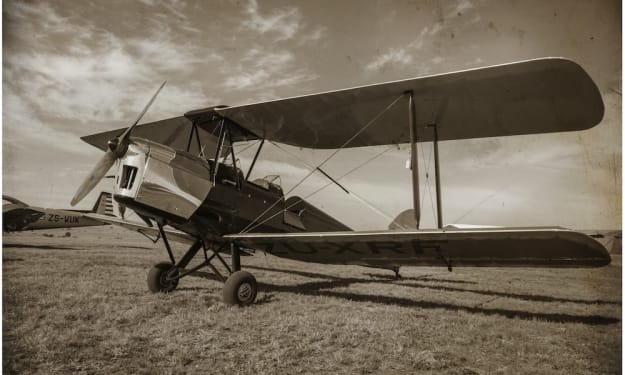
As an aviation enthusiast and history lover, few things pique my interest more than the discovery of ancient artifacts that challenge our understanding of the past. Recently, archaeologists made an astonishing find within an Egyptian pyramid: an ancient monoplane. Yes, you read that correctly - a monoplane! In this article, we will delve into the captivating story of this extraordinary discovery and unravel the mysteries surrounding its existence. Join me as we embark on a journey through time and explore the fascinating world of aviation in ancient Egypt.
By 무이즈 OJELADE3 years ago in History
An Elegy to Sadness: Embracing the Inescapable Abyss. Content Warning.
In the tapestry of human emotions, few threads possess the power to unravel our essence with such relentless persistence as sadness. It is a cavernous state of being that consumes our very existence, haunting every corner of our soul. Sadness, with its infinite shades and depths, possesses a profound ability to leave an indelible mark on our hearts. In this woefully melancholic journey, we shall explore the realm of sadness, surrendering to its mournful embrace.
By emam bhuiyan3 years ago in History