Ancient
Ultimate Adventure Safaris in Egypt
When people think of Egypt, their minds often drift to the ancient pyramids, sprawling deserts, and the mighty Nile River. While these iconic attractions are undoubtedly must-sees, Egypt also offers a wealth of adventure opportunities for thrill-seekers. Whether you're into diving, trekking, or desert safaris, Egypt's diverse landscapes provide the perfect backdrop for an unforgettable adventure holiday.
By LookAtEgypt Trips2 years ago in History
Unveiling Montana's Enigmatic Megalithic Marvels
Over the past decade, an extraordinary revelation has unfolded amidst the rugged wilderness of Montana, USA. Researchers have uncovered a captivating array of towering dolmens, intricate polygonal granite walls, awe-inspiring pyramid complexes, and enigmatic stacked circular terraces that have remained hidden for centuries. These ancient megalithic structures, collectively known as the Montana Megaliths, offer a tantalizing glimpse into the region's enigmatic past and challenge our understanding of early civilizations in North America.
By Kevin MacELwee2 years ago in History
Why Did The World Ignore This Island For 15 Years
Certainly! Here's a rephrased version of the article: --- In the vast expanse of the Indian Ocean lies Tromelin Island, once known simply as Sand Island, a tiny speck barely visible on world maps. This flat, coral-surrounded islet, battered by relentless oceanic forces, holds a story of extraordinary human endurance and survival.
By Iyokho Osaretin2 years ago in History
Ramses II
Ramesses II, also known as Ramesses the Great, was the third pharaoh of the Nineteenth Dynasty of Egypt. In the sands of time, there emerges a colossal figure who transcends the boundaries of history and legend. A name that persists through the ages, a legacy that still captivates the imagination – King Ramses II, known to the world as Ramesses the Great.
By jahidul Islam Sifat2 years ago in History
From Ancient Batteries to Modern Spark Plugs
In 1961, three rock enthusiasts stumbled upon a peculiar object while searching for geodes in California. Initially, they hoped this artifact might be evidence of ancient advanced technology or even time travel. However, skeptics later identified it as a 1920s spark plug. This object, known as the Coso Artifact, turned out to be a Champion spark plug from the 1920s encased in a concretion. It was not evidence of ancient technology but a modern object that had become embedded in natural materials over time. The Coso Artifact is an example of an out-of-place artifact (OOPArt)—an object found in a location or time where it shouldn't logically be according to historical understanding.
By Weronika Bukowska2 years ago in History
Nikola Tesla birth day "happy day for Us" -10 July 1856
Nikola Tesla birth day "happy day for Us" -10 July 1856Today is happy day for us because today Nikola tesla ( the American inventor & electrical engineer) was born and we all that what he did in his arena or time as we all know that he is Dead but his invention are still with us.
By Himanshu Kumar2 years ago in History
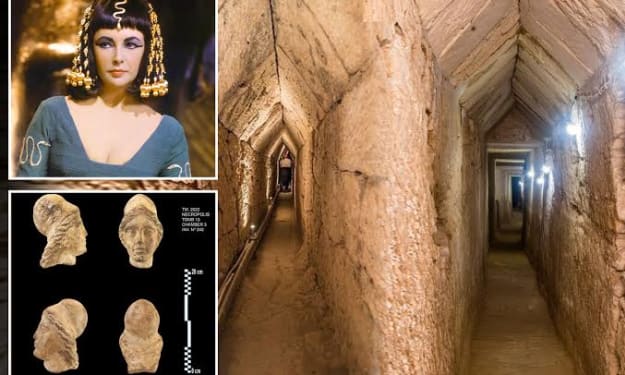
The Enduring Mystery of Cleopatra's Tomb
Cleopatra VII, the last queen of Egypt, is a figure shrouded in mystery and romance. Her life, filled with political intrigue, passionate love affairs, and dramatic power struggles, has fascinated historians and the public alike for centuries. Yet, one of the most captivating mysteries surrounding Cleopatra is the location of her final resting place. Despite numerous efforts, the tomb of Cleopatra and her lover, Mark Antony, remains elusive, prompting endless speculation and exploration. The Historical Context Cleopatra reigned as the last active ruler of the Ptolemaic Kingdom of Egypt, a dynasty of Greek origin that lasted for nearly three centuries following the death of Alexander the Great. Cleopatra's reign was marked by her intelligence, political acumen, and her alliances with powerful Roman figures such as Julius Caesar and Mark Antony. Following the defeat of Antony and Cleopatra by Octavian (later Augustus Caesar) at the Battle of Actium in 31 B.C., the lovers retreated to Alexandria, where they ultimately took their own lives. According to ancient sources, notably Plutarch, Cleopatra and Antony were buried together in a "lofty and beautiful" tomb near a temple dedicated to the goddess Isis. This account, while romantic and vivid, provides few concrete clues about the tomb's exact location. Early Searches and Theories The quest to find Cleopatra's tomb has intrigued archaeologists and historians for centuries. One prevailing theory suggests that the tomb lies somewhere in Alexandria, the city that served as Cleopatra's capital and the cultural heart of her kingdom. However, Alexandria's coastline has changed dramatically over the millennia due to natural disasters such as earthquakes and tsunamis. Much of the ancient city now lies underwater, making the search for the tomb an immense challenge. In the early 20th century, several expeditions sought to locate Cleopatra's tomb within the sunken parts of Alexandria. Despite uncovering a wealth of artifacts and structures, no definitive evidence of the tomb was found. The idea that the tomb might be submerged added an additional layer of difficulty to an already daunting task. Taposiris Magna: A New Hope In recent years, the most promising leads have come from the temple complex of Taposiris Magna, located about 30 miles west of Alexandria. This site, which features ruins dating back to the time of Cleopatra, has been extensively excavated by a team led by Dominican archaeologist Kathleen Martinez. Martinez has long believed that Taposiris Magna could be the final resting place of Cleopatra and Mark Antony. Excavations at Taposiris Magna have uncovered numerous significant artifacts, including coins bearing the images of Cleopatra and Alexander the Great, statues, and various burial chambers. Notably, a number of mummies have been found, some adorned with golden masks, hinting at a burial of significant individuals. While these discoveries have fueled excitement, none have conclusively pointed to the tomb of Cleopatra herself. Why the Tomb Remains Elusive Several factors contribute to the ongoing mystery of Cleopatra's tomb. Firstly, the historical records are sparse and often contradictory. Ancient writers like Plutarch and Cassius Dio provide tantalizing hints but lack detailed descriptions that could guide modern archaeologists. Furthermore, Alexandria's tumultuous history of conquests and natural disasters has likely disrupted or destroyed many potential sites. Additionally, the political and religious significance of Cleopatra and Antony's burial would have made it a target for subsequent rulers who sought to erase their legacy. Octavian, who became Augustus Caesar, had every reason to downplay Cleopatra's influence and might have ordered the destruction or concealment of their tomb. Modern Technology and Future Prospects The search for Cleopatra's tomb continues to evolve with advances in technology. Modern archaeological techniques, such as ground-penetrating radar and underwater exploration tools, offer new ways to investigate both terrestrial and submerged sites. These technologies have already provided new insights into Alexandria's ancient landscape and could eventually lead to the discovery of the elusive tomb. International interest in Cleopatra's tomb remains high, with numerous academic and commercial expeditions launched in recent years. The allure of finding such a historically significant site ensures that the quest will continue, combining traditional archaeological methods with cutting-edge technology. The Legacy of Cleopatra While the physical location of Cleopatra's tomb remains unknown, her legacy endures. Cleopatra is remembered as a powerful and intelligent leader, a shrewd diplomat, and a woman of great charisma and beauty. Her life and death have inspired countless works of art, literature, and popular culture, ensuring that her story continues to captivate audiences worldwide. The search for Cleopatra's tomb is more than just a hunt for ancient treasure; it is a quest to uncover a pivotal chapter in human history. Each discovery brings us closer to understanding the complex web of politics, culture, and personal ambition that defined Cleopatra's era. Whether or not the tomb is ever found, the enduring mystery serves as a testament to Cleopatra's lasting impact on history and the human imagination. Conclusion The mystery of Cleopatra's tomb remains one of the most tantalizing puzzles of archaeology. As explorers and scholars continue their quest, the potential discovery of the tomb promises to shed light on one of history's most fascinating figures. Until then, Cleopatra's story continues to enthrall, reminding us of the enduring power of history and myth.
By Deji Akomolafe2 years ago in History
Adolf Hitler: A Terrifying History of Power, War, and Influence
Adolf Hitler, one of the most infamous figures in modern history, led Nazi Germany with a blend of charisma, ruthless ambition, and strategic cunning that left an indelible mark on the world. His reign from 1933 to 1945 was characterized by aggressive expansionism, horrific atrocities, and a propaganda machine that projected an image of a powerful and invincible leader. This article delves into Hitler’s rise to power, his ruling style, war strategies, and the facets of his persona that garnered support from many during his era.
By suthishkumar_1002 years ago in History
The Bonfire of Secrets
In a forest which was dark and filled with trees, a small village had made its home in the shade of tall and strong trees. The people were still rather primitive and their affairs directly related to the cycles of nature. Each year, as the chill of autumn settled in and the nights grew longer, they gathered for a time-honored tradition: the so called Festival of Bonfires.
By Moon Ghosh 2 years ago in History
5 BIZZARE ANTIQUITIES THAT NO ONE CAN EXPLAIN
5 BIZZARE ANTIQUITIES THAT NO ONE CAN EXPLAIN There are 5 bizarre antiquities that remain unexplained. Despite our knowledge of history, there are mysteries from ancient civilizations that elude us. From historical documents to myths and legends, we try to understand the past. Yet, there are still creations that puzzle us from long ago. 1-THE BONG PIPES IN CHINA In a mysterious pyramid in China's Qinghai Province, near Mount Baigong, there are three caves filled with iron pipes. These pipes lead to a nearby saltwater lake and vary in size, some smaller than a toothpick. The Beijing Institute of Geology determined that these iron pipes date back to about 150,000 years ago. Humans are only believed to have inhabited the region for the past 30,000 years, and the purpose of these pipes remains unknown. The pipes show signs of deliberate construction rather than just being shoved into the ground. An investigation by Chinese scientists in 2002 found that the pipes are made of iron, feric oxide, silicon dioxide, and calcium oxide. The interaction of the iron with the surrounding Sandstone shows the ancient age of the pipes. Some pipes were even found to be highly radioactive, adding to the mystery of this archaeological site. 2-THE STONE SPHERES IN COSTA RICA The stone spheres of Costa Rica, totaling over 300, were first discovered in the 1930s by workers clearing the jungle. Some believed the stones held hidden gold and tried to blow them up with dynamite. These spheres vary in size from a few centimeters to over 2 meters in diameter and weigh up to 16 tons. They are thought to have been carved between 200 BC and 1600 AD and have been found in random locations. Legends suggest they may have come from Atlantis or were made by aliens. Local legends mention a potion that could soften the rock for carving. Some spheres are found in clusters of up to 20, often in geometric patterns pointing to magnetic north. The makers of these stones displayed advanced mathematical ability and knowledge of stone carving. The mystery lies in how such heavy stones, made of granodiorite, were moved from distant granite quarries. One theory suggests they are stone eggs for potential giants to hatch and rule the world. 3-THE ROMAN DODECAHEDRON The Roman dodecahedron is a small hollow object made of bronze or stone with 12 flat faces, each in the shape of a pentagon. There have been around a hundred of these found, varying in size from 4 cm to 11 cm. They date back to the 2nd and 3rd centuries AD and have been discovered in Europe, particularly in France, Switzerland, and parts of Germany. The origin and purpose of these objects remain a mystery to researchers, with theories ranging from weapons to zodiac instruments. Some have even used them to make gloves. Historian Plutarch suggested that the dodecahedron was used for zodiac signs, with each face representing an animal. However, this theory is heavily debated. Despite the uncertainty surrounding these objects, it is clear that they were highly valued by their owners. They have been found among treasures like coins and other valuable items. Overall, the Roman dodecahedron continues to intrigue and baffle historians and archaeologists alike. 4-KIMBAYA AIRPLANES The golden artifacts known as the Kimbaya airplanes were crafted by the Kimbaya civilization in Colombia between 1,000 BC and 1,000 AD. These artifacts, measuring 2 to 3 inches, have been discovered to resemble birds by some archaeologists, while others interpret them as miniature airplanes. What makes these airplane models remarkable is their accurate aerodynamic design. In 1994, German aeronautic engineers Peter Belting and Conrad Lers created large-scale radio-controlled models of these artifacts. Through their experiments, they demonstrated that these designs could fly using both simple single-propeller power and jet power, despite mechanical flight not being invented until the Wright Brothers' flights in 1903. 5-THE LONDON HAMMER In June 1936, in London, Texas, Max Hunt and his wife Emma discovered a rock with wood sticking out while on a walk. They cracked the rock open with a hammer and found a hammer inside. The rock encasing the hammer was dated to the Ordovician period over 400 million years ago. The hammer itself is estimated to be over 500 million years old. Part of the wooden handle has transformed into coal due to its age. The hammer's head is made of over 96% iron, suggesting it was not naturally created. While some may view this as a hoax, there are mysteries that remain unexplained. It is possible that ancient civilizations existed before ours, possibly more advanced, but may have faced apocalyptic disasters leading to a reset in civilization.
By Relebohile Sefume2 years ago in History