Ancient
The Ghost
The Ghost In the curious town of Elderton, settled between moving slopes and old woodlands, there was a house that stood deserted as far back as anybody could recollect. Local people called it the Dim House, a rambling Victorian bequest with ivy-clad walls and covered windows that appeared to watch over the town like an old, unblinking eye.
By Arif zaman2 years ago in History
"Unveiling Secrets: The Enigma of the Three Artifacts Discovered Inside the Great Pyramid of Giza"
The enigma surrounding the three objects found inside the Great Pyramid of Giza continues to divide experts in the field of archaeology. These items were discovered by British explorer Waynman Dixon in 1872 in the Queen's Chamber of the pyramid, which is the largest of the Giza pyramid complex and was built as a tomb for Pharaoh Khufu. Despite its age and size, only three objects have been recovered from the pyramid so far, adding to the mystery. These objects, known as the Dixon Relics, consist of a stone ball, a copper hook-shaped object, and a fragment of wood or rod. They were initially found by Dixon, but later disappeared before being rediscovered in 1972 and donated to the British Museum. However, the wooden fragment was missing, and it wasn't until 2019 that it was found in another collection at the University of Aberdeen. After being identified as part of a larger piece of wood, it was determined that the fragment dates back to 3341-3094 BC, much earlier than the estimated construction date of the Great Pyramid. This discovery has sparked new interest in the objects and their purpose, with some suggesting they may have been tools used by the builders of the pyramid or offerings placed there for the deceased king. In 1993, a secret hatch was found in the Queen's Chamber, but it wasn't until 2011 that a robot was developed to explore it. The robot, named 'The Djedi Project' after the ancient Egyptian magician Djedi, was created by a team of international and Egyptian experts and managed by the University of Leeds. It took five years to develop and successfully captured nine hours of footage, revealing a small chamber with intricate symbols painted on the floor. This has raised questions about the purpose of the shaft, with some speculating it served a larger role than just an air vent. The documentary 'The Robot, The Dentist and The Pyramid' was released in 2020, shedding light on the project and its findings.
By Kevin MacELwee2 years ago in History
Hyssop:
From the Bible’s sacred pages to today’s medicine cabinets, hyssop has stood the test of time with its healing properties and purification and cleansing aspects. Discover how hyssop was used in Biblical times in purification and cleaning rituals and how it offers health benefits today.
By Lisa Briskey2 years ago in History
King Leopold II
King Leopold II of Belgium's formative years and ascent to the throne are marked by significant events. He was born Prince Leopold Louis-Philippe Marie Victor in 1835 in Brussels, the son of King Leopold I of the Belgians and Queen Charlotte. He became King of the Belgians in 1831, having been presented as an alternative candidate by the British government. Leopold's childhood was characterized by feelings of resentment towards his parents, who favored his younger siblings, and he exhibited unruly behavior. Although he faced challenges in his academic pursuits, he developed a strong interest in politics and current affairs. King Leopold I actively sought to expand Belgian colonies worldwide, emphasizing the development of the railway network and ports to enhance international trade. His colonial ambitions led to explorations in regions such as Guatemala, China, Texas, Borneo, and various Pacific islands. King Leopold II's rise to power occurred during a period of political instability, influenced by France's attempts at annexation in response to Prussian expansion and the ambitions of Napoleon III. The tragic decline of Empress Charlotte followed the capture and execution of Maximilian. Leopold II's aspirations for colonial expansion were intertwined with his family connections, including negotiations with Spain regarding the Philippines and ventures in Africa and Vietnam. The personal lives of his family, such as Princess Stephanie's unhappy marriage and Rudolf's tragic demise, also played a role in this narrative. Leopold capitalized on a moral crusade to establish a Belgian colonial presence in Africa, using the suppression of the slave trade as a justification for colonization. He adeptly manipulated international committees to advance his colonial objectives, with Stanley navigating the Congo on behalf of Leopold's International Association.
By Isaac Ekow Anyidoho2 years ago in History
The Forgotten War of 1812
The War of 1812, though relatively minor in scale, was a pivotal conflict that left a profound legacy on the North American landscape. This war was waged between the nascent United States and Great Britain, alongside Canadian colonists and Indigenous nations. While it has largely faded from collective memory in both the United States and Britain, it remains a significant historical event in Canada, symbolizing the defense of liberty and democratic principles. The tensions that precipitated the war were fueled by British impressment of American sailors and growing resentment among Americans. A series of British decrees severely restricted American trade and facilitated the Royal Navy's impressment of American mariners. These escalating tensions contributed to the election of new congressional representatives who championed war and territorial expansion into Native American lands. The alliance formed by Tecumseh with various Indigenous nations and the events surrounding the Battle of Tippecanoe were crucial. Tecumseh's efforts to recruit allies and General William Henry Harrison's advance toward Prophetstown culminated in the Battle of Tippecanoe, which had significant political repercussions for President Madison. The War of 1812 encountered considerable opposition and skepticism regarding the United States' capability to confront Great Britain, a formidable naval power amidst the turmoil of Napoleon's dominance in Europe. In both Canada and the United States, there was notable dissent against the war, particularly from the New England states, which were economically tied to trade with Great Britain. Canadian defense strategies were effectively implemented, with Governor General Sir George Prevost tasked with maintaining control over as much of Canada as possible despite numerous challenges. General Isaac Brock, a distinguished leader in Upper Canada, faced the daunting task of defending a vast territory with limited resources. The War of 1812 serves as a study in contrasts between British and American military capabilities.
By Isaac Ekow Anyidoho2 years ago in History
Dar es Salaam: The Pulse of a Coastal Gem
From dawn to dusk, a coastal marvel unfolds along the shore of the deep blue ocean, known as Dar es Salaam. Each breath of fresh aura, each beat of the busy streets, and each wave go bust onto sandy shores tells a tale of a land where the past and present dance together around harmony. Known as the "Haven of Peace," Dar es Salaam stands as a blend of custom and progress, where very old customs collaborate along modern-day successes.
By Eliakim Msihi2 years ago in History
The King Who Faced God
Nebuchadnezzar was revered as a deity, yet his immense power fostered a sense of arrogance within him. Individuals from various backgrounds and professions prostrated themselves before him, perceiving him as a god. His vast wealth and authority contributed to his hubris, resulting in a skewed perspective on life. A strategic approach of Nebuchadnezzar was to exert control over the kings of Judea. He skillfully coerced these rulers into pledging their loyalty and adhering to his directives. Zedekiah was installed as a figurehead monarch to thwart potential insurrections and revolts. The Babylonians devastated Jerusalem's fortifications and plundered the temple. The destruction of the city’s walls rendered it exposed and perilous for its residents. These walls remained in disrepair until they were rebuilt by the exiles upon their return during Nehemiah's era. The Babylonians not only violated the sanctity of the temple but also looted it, seizing numerous treasures, including sacred items from the temple of God, as well as valuables belonging to the king and his officials. The bronze pillars, standing 18 cubits tall with intricate designs, were also taken, alongside the exile of the Israelites to Babylon. In Babylon, the Israelites adapted their faith to their new reality. Daniel's wisdom was recognized as a gift from the divine. Nebuchadnezzar insisted that the magicians disclose both the dream and its interpretation. The Chaldeans acknowledged that true revelation is a divine endowment, that surpasses human capability. Daniel's predicament unveiled his true nature, as he approached the crisis with composure and tact, demonstrating his integrity.
By Isaac Ekow Anyidoho2 years ago in History
New Discovery in Egypt Scared Scientists. AI-Generated.
Gruesome Discovery in Egypt The Eerie Find A chilling discovery from Egypt a few years ago has captivated the world. Archaeologists unearthed 16 human hands buried meticulously in four eerie pits. Initially, these hands seemed unusual due to their abnormally large size, but the most peculiar detail was that all of them were right hands—no left hands were found.
By Adebayo Mahmud2 years ago in History
The Death of a King
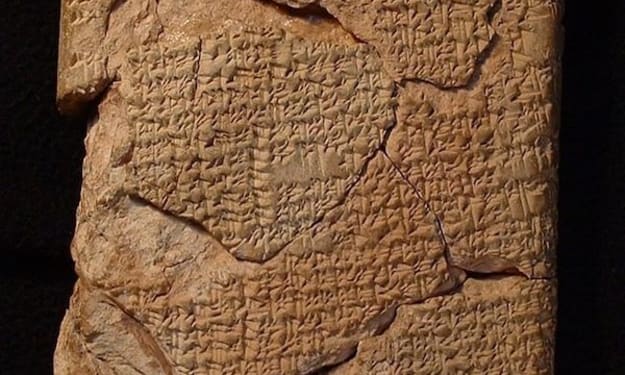
This image displays a cuneiform tablet that has been decoded by the researchers. Researchers have successfully interpreted ancient cuneiform tablets, dating back 4,000 years, which were discovered over a century ago in what is currently known as Iraq. These tablets detail how certain lunar eclipses were believed to foretell death, devastation, and disease.
By Kevin MacELwee2 years ago in History