Ancient
The Evolution of Domesticated Animals: From Wild Ancestors to Modern Companions
The domestication of animals is one of the most significant achievements in human history. Over thousands of years, various wild species have been transformed into domesticated animals that play essential roles in our lives today. This fascinating journey from wild ancestors to modern companions highlights both the adaptability of these animals and the ingenuity of early humans.
By Adeshola Motunrayo2 years ago in History
The Egyptian Discovery That Terrified Scientists
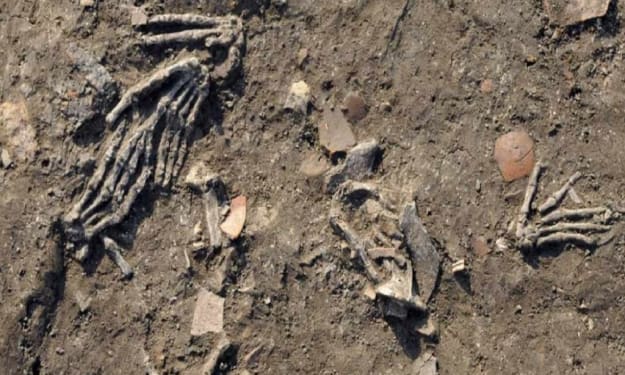
Years ago, a gruesome discovery was made in Egypt that startled scientists. 16 human hands, all right hands, carefully buried in four eerie pits. These hands were abnormally large, making them look less human at first, but they were indeed human hands. Curiously, no left hands were found. This discovery points to an ancient dark ritual, as depicted in old Egyptian art and tales. It was believed that warriors would present the right hand of their defeated adversaries as proof of victory in exchange for gold. The Egyptians believed in the afterlife, so cutting off someone's hand was thought to cut off their power forever, ensuring a complete and eternal defeat for their enemies. This practice is thought to have occurred during battles between the Egyptians and the Hyksos, who lived in what was once known as Canaan.
By Eunice Fasoranti2 years ago in History
did Indians invent planes 7000 years ago . AI-Generated.
when did mankind first create airplanes and space shuttles recent history tells us that the Wright brothers launched the first successful flight in 1903 and that the first space shuttle was built in 1976 but what if ples and space shuttles existed thousands of years ago not only that but they were much more advanced than what we have [Music] today a controversial paper presented at the prestigious science conference the one 102nd Indian science Congress in Mumbai claims human Aviation and advanced space flight was achieved and Mastered by the ancient Indians thousands of years ago the paper presented by Captain Anand bodas a retired principal of a pilot training facility within a session titled ancient Sciences through Sanskrit details that invida texts from 7,000 years ago a planes are described as being able to fly backwards and side to side they could also shuttle between countries continents and even planets the more than 3,000-year old manuscript also described ancient Pilots diets and clothing according to Buddhas during specific periods Pilots drink the milk of Buffalo cow and sheep and they wore clothes made from vegetation grown underwater bodas indicated that there is official history and unofficial history official history only noted that the Wright brothers flew the first plane in 1903 but the inventor of the airplane was really a sage named barad waja who lived around 7,000 years ago he also said that ancient planes had 40 Small Engines the vas are a large collection of Sanskrit texts originating in Ancient India and constitute the oldest layer of Sanskrit literature and the oldest scriptures of Hinduism some of the collections such as the samhitas are known to date back to at least 1700 BC although it is believed that many go back much further the subject of flying machines has been a popular subject among ancient astronaut theorists who argue that some extracts are evidence of extraterrestrial visitations however Captain bodis said that ancient Indians invented the technology and that it was later forgotten because of the passage of time foreign rulers and things being stolen from the country the times of India reports that the paper presented at the conference which included six Nobel laurates and award-winning academics and scientists in its Ro has been met with skepticism claims of pseudo science and the argument that the theory undermines empirical evidence by citing ancient religious texts the Indian science Congress Association is a premier scientific organization of India with more than 30,000 scientist members their mandate is to publish journals hold conferences and advance and promote the cause of science NASA scientist Dr Ram pad Gandhi Ramen started an online petition before the conference to to oppose certain lectures which were thought to advance a mix of science mythology and the politics of Hindu nationalists however others such as an Indian scientist from the US who attended the conference seem to find the examination of ancient testimony compelling saying knowledge always grows its flow never stops so if all this knowledge was available in the ancient days I need to know where it stopped why did it fail to grow why was there no advancements when did it stop I am not a Ware of the chronology of events but I am definitely willing to learn more and find out the concept of ancient civilizations creating airplanes is not new gold trinkets of what looks like airplanes were found in an area covering Central America this object here which looks like a airplane was found in 1898 in a tomb in Egypt and was later dated as having been created near 200 BCE I've also talked about in videos on this channel that we do think that today's technology is the most advanced it has ever been in the history of the world but is that really true I don't think we can be completely sure there's so much about our history that we do not know and cannot explain but do I believe that advanced civilizations existed before that are capable of creating this technology yes I do these civilizations may not be advanced in today's sense with our iPhones and YouTube but advanced in their own way oh and can you imagine if there was some form of YouTube or Twitter back then what would be the content like a DIY video on how to build the pyramids or a prank Channel all there was was videos on how to mess with people of the future episode one Stonehenge anyway let me know how you guys feel about the story in the comments below again thanks so much for watching everybody see you later
By Jariatu Kallon2 years ago in History
The Great Wall of China
The Great Wall of China stands as a testament to civilization and authority. It played a crucial role in the advancement of societies and the supremacy of various dynasties. The narrative of its construction and historical importance is worth exploring. This monumental structure also embodies resilience and cultural legacy. While the original segments date back over 2,300 years, certain portions have been reconstructed in the last 30 years. Following damage incurred during a trade conflict, the wall was restored for tourism, drawing both international and domestic visitors. In the 20th century, the Great Wall experienced significant human-induced destruction, particularly during the conflicts with Japan in the 1930s. The oldest surviving section of the wall is located near China's remote northern frontier. The history of the Great Wall encompasses numerous dynasties and invasions by the Mongols. Various Chinese dynasties constructed distinct walls that together extend for approximately 13,000 miles. The Mongol leader Genghis Khan invaded China and established the Yuan Dynasty, prompting the Ming Dynasty to fortify against Mongol incursions. The ancient art of wall construction provides valuable insights into Chinese heritage. Generations of skilled builders dedicated their lives to the creation of the original wall. The meticulousness of Chief Wall Builder Tai ultimately led to his execution. The Badaling section of the Great Wall is a favored site for tourists, attracting around 11 million visitors each year and accommodating up to 65,000 tourists daily.
By Isaac Ekow Anyidoho2 years ago in History
Queen Victoria
Queen Victoria's heritage and familial connections are noteworthy. She was born to Princess Victoria Marie Louise of Saxe-Coburg-Saalfeld and Prince Edward, Duke of Kent. Her father belonged to the House of Hanover, a royal lineage that traces its roots to northern Germany. In terms of her early life and royal heritage, Victoria was the fifth in line for the British throne and was baptized as Alexandrina Victoria. The House of Hanover had been the ruling dynasty in Britain since 1714, functioning as a constitutional monarch with limited authority. The Victorian era was characterized by significant social, religious, and political transformations. Working-class men did not receive payment until 1911, necessitating financial backing to secure election to Parliament. Educational advancements occurred as the government assumed responsibility, resulting in 90% of children attending school, although rural children were often withdrawn to assist with harvests. The complexities of royal marriages and succession were evident, particularly with George IV's failed unions and absence of legitimate heirs, prompting a race among the king's unmarried brothers to produce a rightful successor. Queen Victoria's childhood seclusion significantly influenced her future reign. Although she experienced feelings of loneliness, this isolation protected her from the negative influences of certain relatives. Contrary to her later reflections, Victoria's early years were filled with maternal affection, indulgence from her governess, and pleasurable outings. At the age of 18, Victoria ascended to the throne. Despite attempts by Conroy to exert control over her, she firmly resisted. Her inaugural public appearance was met with acclaim. Victoria also challenged the longstanding Salic law to claim her position as Queen of Hanover.
By Isaac Ekow Anyidoho2 years ago in History
Unlocking the Enigma of the 1,700-Year-Old Mosaic
Introduction The enigma surrounding the mosaic, dating back 1,700 years, which was discovered during excavations in the Amasya province of northern Turkey 11 years ago and recently displayed, has been deciphered. According to the investigation, the Greek inscriptions 'KTI - CIC' and 'ΠAPEM - BOΛH' on the medallion, featuring god figures at its core, represent a Roman military division.
By Kevin MacELwee2 years ago in History
Hidden Gold Trove Unveiled by Archaeologists
Introduction In modern-day Turkey, a discovery was made of gold coins that were buried in a small pot and date back to the fifth century B.C. Based on their placement under a Helensitic house, it is believed that these coins were intended to settle the debts of mercenaries. The existence of these coins and their burial could possibly be attributed to the conflicts between the Persian and Athenian armies in the ancient Greek city of Notion.
By Kevin MacELwee2 years ago in History
Atlantis in Tigris river.
In the scorching summers of the Middle East, the relentless heat can dramatically alter the landscape, sometimes revealing ancient cities long lost to time. In 2018, such an event occurred when the waters of the Tigris River receded, uncovering a city built by a mysterious empire thousands of years ago. Archaeologists hurried to the site, eager to uncover the secrets of what they believe to be the Bronze Age city of Zaku, founded over 3,000 years ago and submerged in the 1980s when a dam was constructed.
By David Shoremekun2 years ago in History
Discovery of 12,000-Year-Old Monument Suggests It Could Be the Earliest Human Calendar
The markings found on a monument in Turkey, believed to be 12,000 years old, suggest that it may have served as a solar calendar in ancient civilization. These markings, consisting of symbols, were used to record various astronomical events, ranging from major events such as a comet strike to even single days. Interestingly, the monument also indicates the summer solstice as a significant day.
By Kevin MacELwee2 years ago in History
The Enigma of the Midnight Lantern. AI-Generated.
In the heart of the dense Blackwood Forest stood a small village called Thistlebrook. The villagers led quiet lives, their routines undisturbed by the outside world. Yet, Thistlebrook was shrouded in mystery, for deep within the forest lay a legend that fascinated and terrified the locals: the Midnight Lantern. According to folklore, the Midnight Lantern was a mystical light that appeared only at the stroke of midnight on the night of the full moon. It was said to guide lost souls to their final resting place, but those who followed it were never seen again. The lantern was both a beacon of hope and a harbinger of doom, its true nature remaining an enigma. One crisp autumn evening, as the full moon cast a silver glow over the village, a stranger arrived in Thistlebrook. His name was Gabriel, a historian with a penchant for unraveling the unknown. Gabriel had heard of the Midnight Lantern and was determined to uncover the truth behind the legend. The villagers, wary of outsiders and wary of the lantern's curse, tried to dissuade Gabriel from his quest. They spoke of those who had ventured into the forest and never returned, their warnings laced with fear. But Gabriel, driven by curiosity and a thirst for discovery, was undeterred. He made his way to the edge of the forest, prepared for what lay ahead. As midnight approached, Gabriel ventured into the forest, the full moon illuminating his path with an ethereal light. The forest was alive with the sounds of rustling leaves and distant owl calls, creating an atmosphere both enchanting and eerie. Gabriel followed a winding path that seemed to beckon him deeper into the woods, his senses on high alert. At exactly midnight, a soft, glowing light appeared in the distance. It was the Midnight Lantern, its flame flickering gently as if beckoning Gabriel closer. His heart raced with a mixture of excitement and trepidation as he followed the light, navigating through the dense undergrowth and ancient trees. The lantern led Gabriel to a clearing, where an old, weathered stone altar stood. The altar was covered in ivy and moss, and its surface was etched with cryptic symbols that seemed to pulse with a faint, magical energy. Gabriel approached the altar, his eyes fixed on the lantern, which hovered just above it. As he drew near, the lantern’s light grew brighter, casting strange shadows that danced across the clearing. Gabriel noticed a small, ornate box resting on the altar. The box was adorned with intricate designs and seemed to hum with a mystical energy. He hesitated for a moment but then reached out and opened the box. Inside, Gabriel found a collection of old letters, their edges yellowed with age. He carefully unfolded one of the letters, revealing a message written in elegant, flowing script. The letter was addressed to a loved one, and its words spoke of a journey, a search for something lost, and a promise to return. But the final lines were a plea for forgiveness, an acknowledgment of a mistake, and a final farewell. Gabriel’s heart pounded as he realized the significance of the letters. They were from the lost souls spoken of in the legend, their final messages captured in time. The Midnight Lantern, he understood, was not a malevolent force but a guide for those who had unfinished business, leading them to this place of reflection and resolution. As Gabriel read the letters, the lantern’s light began to fade, and the clearing grew darker. He felt a profound sense of peace and clarity, as if the lantern had fulfilled its purpose. The soft glow of dawn began to creep through the trees, signaling the end of his journey. Gabriel returned to Thistlebrook with the letters, sharing his discovery with the villagers. They were astonished and deeply moved by the revelations. The Midnight Lantern, they realized, was not to be feared but respected—a symbol of the importance of closure and the power of unresolved emotions. In the years that followed, Gabriel’s account of the Midnight Lantern became a cherished story in Thistlebrook. The villagers learned to honor the lantern’s role and the memories of those who had come before. The forest, once a place of fear and mystery, became a symbol of hope and reconciliation. And so, the legend of the Midnight Lantern continued to shine, not as a harbinger of doom but as a guiding light for those seeking resolution and peace. Gabriel’s discovery brought a new understanding to Thistlebrook, reminding its people that sometimes, the most profound truths are hidden in the heart of the unknown.
By Musawer Yaseen2 years ago in History