Ancient
Love Letters Through Time
June 14, 1863 Dearest Catherine, I write to you from a candlelit corner of my tent, where the Virginia air is thick with the scent of gunpowder and magnolias. The war rages on, yet in the quiet of this night, my thoughts are not on battle but on you. I see you in every flicker of the flame, in every rustle of the wind against the canvas. Have you received my last letter? Do you still wear the locket I placed around your neck that autumn eve when we bid farewell?
By Alomgir Kabir2 years ago in History
The World’s Largest Pyramid Site Isn’t in Egypt and It’s Twice the Size.
The World’s Largest Pyramid Site Isn’t in Egypt and It’s Twice the Size. When people think of pyramids their minds often jump to Egypt’s grand structures such as the Great Pyramid of Giza or the towering monuments of the pharaohs. However what many don’t realize is that the world's largest collection of pyramids isn’t in Egypt at all. Instead it lies hidden in the vast deserts of Sudan. The ancient Kingdom of Kush a powerful civilization that once rivaled Egypt built more than twice as many pyramids as their northern neighbors. Yet despite their historical significance these pyramids remain relatively unknown to the world.
By Adnan Rasheed2 years ago in History
The Forgotten Warrior King: A Tale of Glory Lost in Time. AI-Generated.
The Abandoned Warrior Kings of History: Allotment 3 Throughout history, abounding kings and rulers accept larboard their marks on civilization. However, some of the greatest warrior kings accept been absent to time, overshadowed by added acclaimed figures. This allotment of the alternation uncovers the belief of able yet abandoned rulers who already shaped the apple but whose legacies accept faded. 1. Tiglath-Pileser I – The Conquering Baron of Assyria Tiglath-Pileser I (1114–1076 BCE) was one of the best appalling kings of the Assyrian Empire. A adept tactician, he broadcast Assyria’s borders through adamant aggressive campaigns. He defeated the Hittites, baffled all-inclusive territories in Anatolia, and accustomed barter routes that able the empire. Despite his influence, his name is abundantly absent from avant-garde discourse, overshadowed by afterwards Assyrian rulers like Ashurbanipal and Sennacherib.
By Say the truth 2 years ago in History
The Forgotten Warrior Kings of History: Part 2
The Abandoned Kings: Heroes Absent in Time (Part 2) The Silent Architects of Empires While history generally highlights the amplitude of acclaimed kings such as Alexander the Abundant or Julius Caesar, abundant rulers who played cardinal roles in abstraction civilizations abide in obscurity. These abandoned kings were the architects of all-inclusive empires, defenders of cultures, and antecedents of babyminding systems that afflicted the world. 1. Baron Taharqa – The Pharaoh Who Defied Assyria Taharqa, a Kushite baron of the 25th Absolutism of Egypt, disqualified from 690 to 664 BCE. He was one of the best able rulers of the Nubian absolutism and played a cogent role in afraid the amplification of the boss Assyrian Empire. His administration saw aggressive confrontations with Baron Esarhaddon and afterwards Ashurbanipal, the rulers of Assyria. Admitting his efforts to assure Egypt, he was eventually defeated, and his bequest achromatic into actual obscurity. His contributions, however, went above warfare. He was an ardent architect who adequate temples and broadcast Karnak’s angelic complex. His administration adumbrated a admixture of Egyptian and Nubian cultures, but because he disqualified during a agitated period, his achievements abide overshadowed by afterwards Egyptian dynasties. 2. Samudragupta – The Indian Napoleon In the 4th aeon CE, India witnessed the acceleration of Samudragupta, a adjudicator from the Gupta Authority who was generally referred to as the "Napoleon of India." His aggressive campaigns broadcast the authority significantly, addition its access above best of arctic India and genitalia of southern India. Unlike abounding conquerors, Samudragupta was additionally a angel of arts, culture, and learning. He encouraged literature, music, and religious tolerance, adopting a aureate age in India. His conquests laid the foundation for one of India's greatest empires, yet his name charcoal lesser-known compared to afterwards rulers like Ashoka or Akbar. 3. Baron Alfred the Abundant – The Unifier of England During the backward 9th century, England was in turmoil, consistently raided by Viking forces. Baron Alfred of Wessex played a acute role in chain the Anglo-Saxon kingdoms adjoin these invasions. He developed aggressive strategies, congenital adherent towns accepted as "burhs," and restructured England’s argosy defense. Despite his above contributions, his acclaim charcoal eclipsed by afterwards English kings. Alfred's reforms in governance, education, and aggressive strategies shaped the approaching of England, but his cachet as a abandoned hero is axiomatic as he is not as broadly accustomed as William the Conqueror or Henry VIII. 4. Jayavarman VII – The Warrior Baron of the Khmer Empire One of the greatest yet abandoned kings of Southeast Asia, Jayavarman VII disqualified the Khmer Authority in the backward 12th and aboriginal 13th centuries. Unlike abounding monarchs of his time, he was adherent to Buddhism and focused on abundance projects. He congenital all-encompassing networks of roads, hospitals, and temples, including the acclaimed Bayon Temple in Angkor. However, afterwards his death, abounding of his Buddhist-influenced structures were alone or adapted by afterwards Hindu rulers, arch to his crumbling legacy. His administration represented the aiguille of the Khmer Empire, yet his name charcoal alien to many. The Cost of Being Forgotten The accepted cilia amid these rulers is that admitting their absurd contributions, they were overshadowed by afterwards actual events, cultural shifts, or the abolition of records. While some kings congenital constant legacies, others were asleep due to political changes or invasions. Their belief admonish us that history is generally accounting by those who appear after, and not all abundant leaders accept the acceptance they deserve. From the chastening of Egypt to the forests of Cambodia, these absent kings already disqualified with eyes and determination. Their legacies may be active beneath the bank of time, but their appulse continues to appearance civilizations today. Conclusion The additional allotment of this alternation on absent kings sheds ablaze on those who fought wars, congenital empires, and avant-garde civilizations alone to be forgotten. Their achievements still access avant-garde governance, architecture, and aggressive strategies. Recognizing these rulers helps us accretion a broader and richer compassionate of apple history above the acclaimed figures. The abutting allotment of this alternation will analyze added kings whose names may accept been absent to time but whose legacies abide in means we ability not realize.
By Say the truth 2 years ago in History
Researchers found the world’s oldest pyramid hidden in Indonesia
Researchers found the world’s oldest pyramid hidden in Indonesia Beneath the lush rolling hills of West Java Indonesia lies an archaeological enigma that challenges the very foundation of human history. Known as Gunung Padang meaning Mountain of Enlightenment in the local Sundanese language this ancient structure may be the oldest pyramid ever discovered. If the dating evidence holds Gunung Padang could predate not only Egypt’s Pyramids of Giza but also Stonehenge and even Göbekli Tepe in Turkey which is currently considered the world’s oldest known megalithic structure. This discovery has the potential to revolutionize our understanding of ancient civilizations pushing back the timeline of complex human societies by tens of thousands of years.
By Adnan Rasheed2 years ago in History
A Comprehensive History of Australia
A Comprehensive History of Australia Ancient Australia (Prehistory – 1788) Australia’s history begins with its Indigenous peoples, who have lived on the continent for over 65,000 years. The Aboriginal and Torres Strait Islander peoples developed diverse cultures, languages, and spiritual beliefs deeply connected to the land. They used sophisticated land management techniques, including controlled burning to maintain ecosystems. Rock art sites like those in Kakadu National Park provide insight into their rich cultural heritage. These early Australians adapted to a range of environments, from deserts to rainforests, developing a deep understanding of their surroundings and establishing complex social structures based on kinship and oral traditions. Their connection to the land, known as 'Country,' remains a central aspect of Indigenous identity today.
By Banik Sojib2 years ago in History
Ghana’s Independence: A Triumph and a Tragedy
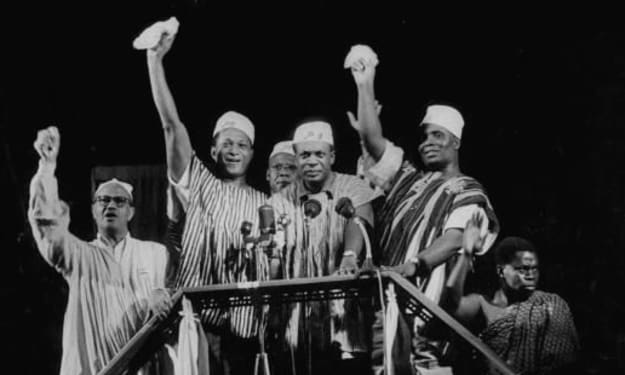
On March 6, 1957, the world watched as Ghana, once known as the Gold Coast, emerged as the first sub-Saharan African nation to break free from colonial rule. The celebrations in Accra were nothing short of historic. Delegates from 56 nations joined the festivities, which included vibrant native dances, traditional games, and a beauty contest to crown Miss Ghana. The event marked not just Ghana’s independence but also the dawn of a new era for Africa.
By KWAO LEARNER WINFRED2 years ago in History
History of The Ashanti Empire of Ghana
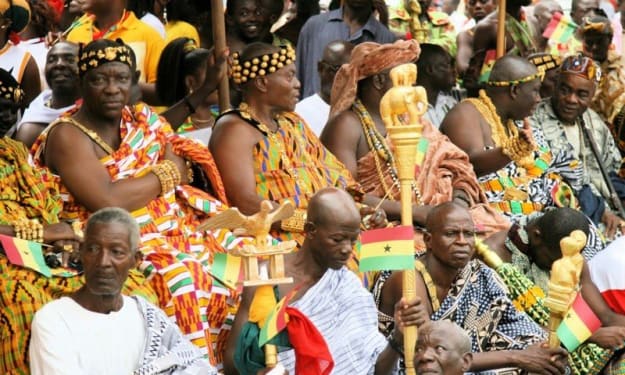
The Asante, also known as the Ashanti, are a prominent ethnic group within the larger Akan community, which is one of the most significant cultural groups in modern-day Ghana and parts of Côte d'Ivoire. The Akan people are believed to have roots tracing back to ancient Egypt, from where they migrated westward—a common pattern among many African groups. Their ancestors, the Sona, are credited with playing a crucial role in the establishment of the Wagadu Empire, often referred to as the ancient Ghana Empire. This empire, one of Africa's most powerful and prosperous states at its peak, stands as a testament to the Sona's influence and organizational prowess.
By KWAO LEARNER WINFRED2 years ago in History
Breaking: Dublin Plans Biggest Saint Patrick's Day Parade Ever
Saint Patrick's Day celebrations in Dublin have consistently drawn massive crowds, with the 2009 parade attracting more than 675,000 spectators. In fact, this cherished tradition, which began as an official Christian feast day in the early 17th century, has evolved into the world's most widely celebrated national festival. While the first official state-sponsored parade in Dublin didn't take place until 1931, we've witnessed this celebration grow into a global phenomenon. Notably, Saint Patrick's Day, observed on March 17 to commemorate Saint Patrick's death in 461 AD, now inspires festivities in more countries than any other national festival. As we prepare for this year's celebration, Dublin is set to make history once again with what promises to be its most ambitious parade yet. Dublin Announces Record-Breaking Parade Plans "Being Irish is very much a part of who I am. I take it everywhere with me." — Colin Farrell, Irish actor The 2025 National Saint Patrick's Day Parade promises unprecedented scale and spectacle, with organizers announcing their most ambitious celebration yet. The parade will feature over 4,000 participants, including 18 pageants, performance showpieces, and 14 marching bands from Ireland, North America, and France. The grand procession will commence at 11 a.m., following a carefully planned 2.5-kilometer route through Dublin's historic heart. Starting from Parnell Square, the parade will wind through O'Connell Street, cross the River Liffey, and proceed past Trinity College before concluding at Saint Patrick's Cathedral. This year's celebration stands out with its remarkable features: • Seven large-scale pageants and six showpieces • Twelve international marching bands from Austria and North America • six strategically located grandstands with covered, tiered seating • Professional hosts providing live commentary throughout the route
By Deepak Gautam2 years ago in History
The Ram Mandir Dispute: Unraveling India’s Century-Old Saga of Faith, Politics, and Justice | Part-II
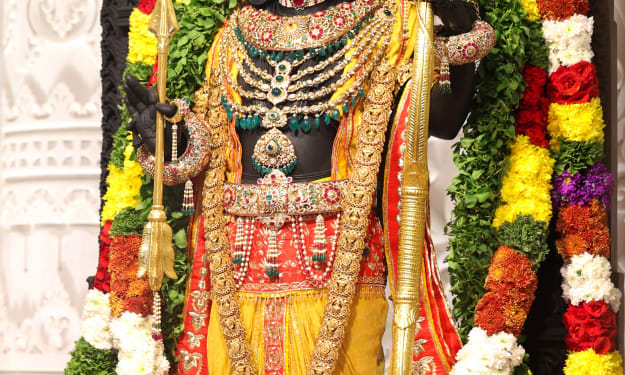
Post-Independence Developments (1947–1950) After India gained independence in 1947, tensions resurfaced just two years later. On the night of December 22, 1949, during a nine-day Ramcharitmanas recitation organized by the Akhil Bhartiya Ramayana Mahasabha, an idol of Ram Lalla was placed inside the Babri Masjid. The next morning, large crowds gathered, claiming it to be a divine emergence.
By Adarsh Kumar Singh2 years ago in History