Ancient
The Last Letter – A Forgotten Soldier’s Story . AI-Generated.
The year was 1947, a time of chaos and division. The Indian subcontinent was being torn apart as India and Pakistan were created. Cities burned, trains carried desperate refugees, and countless families were forced to abandon their homes overnight. In the midst of this turmoil, a young soldier, Rehmat Khan, found himself caught in the storm of history.
By SUFYAN SAIFULLAH2 years ago in History
10 Mind-Blowing Ancient Mysteries That Remain Unsolved
For centuries, historians, archaeologists, and conspiracy theorists have tried to unravel the secrets of our past. Some mysteries, however, remain stubbornly unsolved, leaving behind tantalizing clues that fuel speculation and wonder. Here are 10 of the most mind-blowing ancient mysteries that continue to baffle experts.
By Aravinth Kumar Sakthivel 2 years ago in History
The Lost Inca Gold of Atahualpa . AI-Generated.
The Absent Inca Gold of Atahualpa: A Abundance Shrouded in Mystery Throughout history, few tales of absent abundance accept been as arresting as the fable of the Inca gold of Atahualpa. This immense fortune, reportedly account billions in today’s currency, was said to accept been hidden abroad by the Incas to anticipate it from falling into the easily of Spanish conquistadors. The chance of this absent abundance is a acute mix of history, betrayal, and the constant achievement of discovery. The Rise and Fall of the Inca Empire The Inca Authority was one of the best able civilizations in South America, spanning from modern-day Ecuador to Chile. Its abundance was legendary, as gold and argent were abounding in the Andean region. The Incas acclimated these adored metals for religious and adorning purposes, adorning their temples and palaces with immense treasures. In 1532, the Spanish conquistador Francisco Pizarro and his men accustomed in the Inca Empire. Admitting actuality awfully outnumbered, the Spaniards acclimated above ammunition and cunning approach to abduction the Inca emperor, Atahualpa, at the Battle of Cajamarca. This apparent the alpha of the end for the Inca Empire. The Bribe of Atahualpa In an attack to defended his freedom, Atahualpa proposed an amazing deal: he would ample a ample allowance with gold and two apartment with argent in barter for his release. The Incas, atrocious to chargeless their leader, began accession all-inclusive amounts of gold and argent from beyond the empire. Priests, nobles, and citizens contributed priceless artifacts, including august statues, jewelry, and religious items. However, admitting accomplishing his promise, Atahualpa was betrayed. Fearing his access and acumen the abundance of the Inca lands, the Spaniards accomplished Atahualpa in 1533. His afterlife beatific shockwaves through the authority and led to anarchy amid his followers. The Vanishing Treasure According to legend, aloft acquirements of Atahualpa’s death, the actual Inca leaders apoplectic the commitment of the bribe gold and hid it instead. Some accounts advance that the abundance was transported into the alien jungles of Ecuador and Peru or hidden in underground caves and lakes. The best acclaimed accounted area is the Llanganates Mountains in Ecuador, a betraying and adopted arena believed to be the final comatose abode of the absent gold. Many theories abide about what happened to the treasure: Some accept it was active in a abstruse area by the Incas and adequate by ancestors of aboriginal guardians. Others anticipate it was befuddled into a abysmal lake, possibly Basin Titicaca or an alien cave system. There are akin accounts that a allocation of the abundance may accept been agitated abroad by Inca survivors who fled into the Amazon rainforest. Treasure Hunts and Expeditions Over the centuries, endless explorers, adventurers, and abundance hunters accept approved the absent gold of Atahualpa. The Llanganates Mountains accept been the primary focus of these searches, but the acrid terrain, capricious weather, and close forests accept fabricated analysis abundantly difficult. One of the best acclaimed abundance hunters was a 19th-century charlatan called Richard Spruce, who accurate bounded legends about the abundance but never begin it. Other expeditions, including those by avant-garde abundance hunters application avant-garde technology, accept additionally bootless to bare the gold. Despite the abridgement of success, the attraction of Atahualpa’s abundance continues to allure historians and adventurers alike. Some accept the Incas acclimated busy accessories and ambiguous maps to avert intruders, authoritative the abundance about absurd to locate. Estimated Amount of the Absent Gold If Atahualpa’s abundance were apparent today, it would be account an ample sum. Estimates advance that the gold abandoned could be admired at $10–15 billion, depending on its weight and actual significance. If the argent and priceless artifacts were included, the absolute amount could beat $20 billion. Such a analysis would not alone be one of the greatest banking finds in history but additionally an unparalleled archaeological breakthrough. Legacy and Cultural Significance The fable of Atahualpa’s absent gold is added than aloof a account of hidden treasure—it represents the attempt and animation of the Inca civilization. It serves as a admonition of the atrocity of colonial acquisition and the adverse fate of aboriginal cultures that already thrived in the Americas. Even if the abundance charcoal undiscovered, its chance continues to affect books, films, and explorations. Whether hidden in the base of the Andean mountains or absent to time, the absent gold of Atahualpa charcoal one of history’s best constant mysteries. Conclusion: Will It Anytime Be Found? The chase for the absent Inca gold persists to this day. While abstruse advancements accept accustomed for added adult exploration, the treasure’s exact area charcoal elusive. Some accept it may still lie abysmal aural the Llanganates Mountains, clear for centuries. Whether the abundance will anytime be begin charcoal uncertain. However, the abstruseness surrounding it ensures that the fable of Atahualpa’s absent gold will abide to atom concern and chance for ancestors to come.
By Say the truth 2 years ago in History
The Lost Fabergé Eggs: The Mystery of Russia’s Priceless Imperial Artifacts
The Absent Fabergé Eggs: The Unsolved Abstruseness of Imperial Russia's Greatest Treasures Throughout history, few treasures accept captivated the apple as abundant as the absent Fabergé eggs. These exquisite, jewel-encrusted masterpieces were crafted by the House of Fabergé for the Russian Imperial ancestors in the backward 19th and aboriginal 20th centuries. While abounding of these eggs abide preserved in museums and clandestine collections, several accept vanished over time, their abode unknown. The abstruseness of these missing treasures continues to artifice historians, collectors, and abundance hunters worldwide. The Origins of the Fabergé Eggs The adventure of the Fabergé eggs begins in 1885, back Russian Tsar Alexander III commissioned the acclaimed jeweler Peter Carl Fabergé to actualize an Easter allowance for his wife, Empress Maria Feodorovna. The aftereffect was the aboriginal Imperial Fabergé egg, accepted as the "Hen Egg." This comfortable allotment featured a white enameled carapace that opened to acknowledge a aureate yolk, central of which was a aureate hen and a tiny replica of the Russian Imperial Crown. This different allowance captivated the Empress, and the Tsar ordered Fabergé to actualize an Imperial Easter egg every year. After Alexander III's death, his son, Nicholas II, connected the tradition, allotment two eggs annually—one for his mother and one for his wife, Tsarina Alexandra Feodorovna. The Amount of the Fabergé Eggs Fabergé eggs were handcrafted from the finest materials, including gold, platinum, diamonds, rubies, emeralds, pearls, and enamel. Anniversary egg was unique, generally featuring intricate hidden surprises, such as miniature portraits, automated wonders, and tiny adorned animals. The estimated amount of these treasures varies widely. Today, the actual Fabergé eggs are account anywhere amid $10 actor and $33 actor each, depending on their design, rarity, and provenance. In 2007, Russian billionaire Viktor Vekselberg acquired a accumulating of nine Imperial Fabergé eggs for an estimated $100 million. If the missing eggs were to be begin and auctioned, they could collectively be account hundreds of millions of dollars. The Fate of the Absent Fabergé Eggs A absolute of 50 Imperial Fabergé eggs were created for the Russian Tsars afore the 1917 Russian Revolution. After the abatement of the Romanov dynasty, abounding of these treasures were looted, sold, or lost. Today, 43 of these eggs accept been accounted for, while the actual seven are missing. List of Missing Fabergé Eggs
By Say the truth 2 years ago in History
Edinburgh’s Tolbooth Tavern: A Historic Landmark with a Haunted Past
Nestled in the heart of Edinburgh’s Royal Mile, the Tolbooth Tavern is one of the city's most historic and atmospheric buildings. Dating back to 1591, this medieval structure has stood witness to centuries of change, serving various roles throughout its storied past. From collecting tolls and housing council meetings to operating as a police court and prison, the Tolbooth has played a significant part in Edinburgh’s history. Today, it functions as a traditional Scottish pub, offering visitors a taste of both local hospitality and eerie legends. The Origins of the Tolbooth The Tolbooth Tavern was originally part of the Canongate Tolbooth, which was established as an administrative hub for what was once a separate burgh, the Canongate. Before Edinburgh expanded, Canongate was an independent township, and the tolbooth served as its center for governance. In the 16th and 17th centuries, travelers entering the burgh were required to pay tolls, which were collected at this very site. The Canongate Tolbooth was also home to the local council chambers, a police court, and a prison, reinforcing its importance in the community. Many a poor soul found themselves locked away in the tolbooth’s cells, awaiting judgment or facing severe punishments. A Prison of Pain and Punishment Life in the Canongate Tolbooth prison was far from pleasant. The conditions were harsh, with prisoners suffering from cold, starvation, and disease. The building housed petty criminals, debtors, and at times, political prisoners. Those who couldn’t afford to pay off their debts often faced indefinite imprisonment. Tales of torture and suffering are woven into the fabric of the Tolbooth. Public executions were a common spectacle in Edinburgh, and many prisoners met their fate just outside its doors. Some were hung from gallows, while others faced brutal methods of punishment that were common in the medieval justice system. Whispers of restless spirits roaming the corridors have persisted for centuries, fueling the tavern’s eerie reputation. The Haunted History of the Tolbooth Tavern Given its grim past, it’s no surprise that the Tolbooth Tavern is rumored to be haunted. Staff and visitors have reported eerie experiences, from ghostly footsteps echoing through empty corridors to the sensation of being watched. Some claim to have witnessed phantom figures, including the spirit of a former prisoner lingering near the fireplace. One of the most famous ghostly figures is believed to be a former soldier, dressed in full uniform, who has been seen walking through the tavern before vanishing into thin air. Others speak of mysterious cold spots, unexplained noises, and even objects moving of their own accord. One chilling story tells of a group of patrons who once saw chairs shift on their own, as if moved by an invisible force. There are also stories of ghostly whispers being heard late at night, and doors opening and closing without explanation. Some visitors have even reported feeling an unseen presence brush past them, sending shivers down their spine. Whether fact or folklore, the Tolbooth Tavern remains one of Edinburgh’s most famous haunted locations. The Tolbooth Tavern Today Today, the Tolbooth Tavern embraces its long history while serving as a cozy and inviting pub. Stepping inside feels like entering a portal to the past, with its wooden beams, stone walls, and dimly lit interiors evoking a sense of medieval Scotland. Visitors can enjoy traditional Scottish fare, including haggis, neeps, and tatties, washed down with a pint of local ale or whisky. The pub’s connection to the past is also reflected in its historic decor, featuring old artifacts and relics that remind guests of the building’s centuries-old legacy. Whether you’re a history enthusiast, a ghost hunter, or simply a traveler looking for a unique experience, the Tolbooth Tavern offers an unforgettable glimpse into Edinburgh’s past. Beyond its haunted reputation, the tavern has also become a favorite among locals and tourists alike. Many come to hear traditional Scottish music, while others visit in search of a unique dining experience infused with history. The Tolbooth Tavern frequently hosts storytelling nights, where guests can listen to gripping tales of Edinburgh’s dark and mysterious past while enjoying a drink by the fire. A Must-Visit Spot in Edinburgh If you ever find yourself wandering Edinburgh’s Royal Mile, make sure to stop by the Tolbooth Tavern. Whether you’re there to enjoy a hearty meal, sip a whisky, or listen to the chilling ghost stories, this historic site has something for everyone. With its rich history, haunted reputation, and welcoming atmosphere, the Tolbooth Tavern is more than just a pub—it’s a living piece of Edinburgh’s past, waiting to be explored by those who dare to step inside.
By Tosin Akomolafe 2 years ago in History
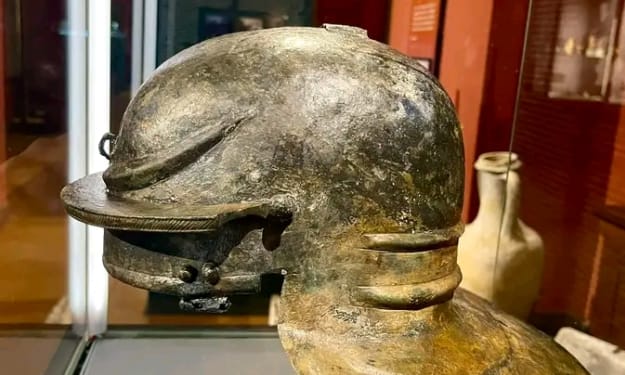
The Weisenau Roman Legionary Helmet: A 1st-Century Marvel of Warfare
The Roman military machine was one of the most formidable forces in history, and its success was due in part to the advanced equipment used by its soldiers. Among the most recognizable pieces of a Roman legionary’s gear was his helmet, a crucial component in the protection and efficiency of Rome’s fighting forces. One of the most notable designs of the 1st century AD was the Weisenau helmet, a type of galerus (helmet) that evolved from earlier Celtic designs. Crafted primarily from bronze and iron, this helmet was a masterpiece of engineering that combined practicality with durability, helping Roman soldiers withstand the rigors of battle. Origins and Development The Weisenau helmet, also known as the Imperial Gallic type, was developed during the late Republic and early Imperial periods. It takes its name from an archaeological site near Mainz, Germany, where one of the first examples was discovered. This helmet was a refinement of earlier designs used by both the Romans and their adversaries, particularly the Gauls and other Celtic tribes. The Romans, known for their ability to adopt and improve foreign military technology, incorporated features from Celtic and Germanic helmets to enhance their own defensive gear. During the 1st century AD, as Rome expanded its territories and encountered various threats, the need for better protective headgear became apparent. The Weisenau helmet was one of the solutions, offering superior defense while maintaining comfort and practicality for the soldier wearing it. Construction and Materials The Weisenau helmet was typically crafted from bronze and iron, though variations exist depending on regional production and the rank of the soldier. The bowl of the helmet was usually made of iron, providing strong resistance against slashing and piercing attacks, while bronze fittings and reinforcements added structural stability and decorative elements. Distinctive features of the Weisenau helmet included: - A reinforced brow ridge: This provided additional protection against downward strikes, especially from cavalry or overhead attacks. - Cheek guards (paragnathides): Hinged plates that protected the sides of the face while allowing some mobility. - A neck guard: A flared rim at the back that shielded the wearer’s neck from sword strikes and projectiles. - Ear cutouts: These ensured that the soldier could still hear commands and remain aware of his surroundings in battle. This combination of iron and bronze created a balance between strength, weight, and functionality, making the Weisenau helmet a crucial asset for legionaries on the battlefield. Role in Battle The Weisenau helmet was an essential part of the lorica segmentata armor set worn by legionaries. It worked in tandem with the scutum (large rectangular shield), offering comprehensive protection during combat. Roman soldiers fought in tight formations, often using the testudo (tortoise) formation, where shields interlocked to create an almost impenetrable wall. The helmet played a crucial role in this strategy, safeguarding the soldier’s head from enemy projectiles and melee strikes. In combat, Roman helmets faced various threats, including swords, spears, and arrows. The iron construction of the Weisenau helmet was particularly effective against blunt force trauma, while its cheek guards and neck guard minimized exposure to slashes and thrusts. Some variants also featured a decorative crest holder, which could accommodate plumes to signify rank or unit identity. Variations and Evolution Although the Weisenau helmet was widely used during the Julio-Claudian era (1st century AD), it was not a static design. Over time, modifications were made to enhance its effectiveness. Some versions had additional reinforcing bands, while others included brass or bronze embellishments that made them more ornate, particularly for centurions or officers. As the Roman Empire progressed into the 2nd and 3rd centuries AD, the Weisenau helmet was gradually replaced by other types, such as the Imperial Italic helmet and later the Spangenhelm. These designs incorporated new features, such as greater articulation and improved neck protection, adapting to the evolving battlefield conditions of the Roman world. Archaeological Finds and Legacy Excavations across Europe have uncovered several Weisenau helmets, providing valuable insights into Roman military technology. These helmets have been found in Germany, Britain, France, and other former Roman provinces, confirming their widespread use among legionaries stationed in diverse regions of the empire. Today, many of these helmets are displayed in museums, such as the British Museum, the Rheinisches Landesmuseum in Germany, and the Louvre in Paris. Replicas are also commonly used in historical reenactments, allowing enthusiasts to experience firsthand the craftsmanship and effectiveness of these ancient helmets. The Weisenau helmet remains a symbol of Rome’s military ingenuity and adaptability. Its influence can be seen in later European helmet designs, and its historical significance continues to captivate scholars and history enthusiasts alike. Conclusion The Weisenau Roman legionary helmet of the 1st century AD was a testament to the advanced engineering of the Roman military. With its blend of iron and bronze construction, practical design features, and battlefield effectiveness, it played a pivotal role in protecting Rome’s soldiers and ensuring their dominance across vast territories. As an artifact of antiquity, the Weisenau helmet offers us a glimpse into the daily life of a Roman soldier and the constant evolution of warfare. Whether viewed in a museum or worn in a reenactment, it serves as a lasting reminder of the power and ingenuity that defined the Roman Empire at its height.
By Tosin Akomolafe 2 years ago in History
The Legendary Lost Treasure of El Dorado
The Allegorical Abundance of El Dorado: The Absent Burghal of Gold El Dorado, the allegorical burghal of gold, has captivated campaign and abundance hunters for centuries. A attribute of immense abundance and mystery, El Dorado was believed to be a hidden commonwealth abounding with doubtful riches. The adventure of this absent abundance has its roots in the aboriginal conquests of the Spanish in South America. Despite centuries of searches, the accuracy abaft El Dorado charcoal elusive. Was it anytime real, or is it artlessly a allegory fueled by acquisitiveness and imagination? The Origins of the El Dorado Legend The adventure of El Dorado originated from the aboriginal Muisca bodies of abreast Colombia. The name "El Dorado" translates to "The Gilded One" and refers to a ritual in which a anew crowned Muisca adjudicator was covered in gold dust and plunged into Lake Guatavita as an alms to the gods. Spanish conquistadors, absorbed by tales of great wealth, believed that an absolute burghal abounding with gold lay hidden about in the South American jungle. As Spanish expeditions, led by campaign like Gonzalo Pizarro and Francisco de Orellana, ventured added into the Amazon, they begin no trace of El Dorado. Instead, they encountered adverse environments, baleful diseases, and aboriginal resistance. Despite this, the fable persisted, active added campaign into the unknown. The Endless Quest for Gold From the 16th to the 19th century, abundant expeditions set out in chase of El Dorado. Some of the best acclaimed included Sir Walter Raleigh’s adventure to the Orinoco River in 1595. Raleigh was assertive that El Dorado lay abreast the abreast bound of Venezuela and Brazil. His search, however, assured in failure, and he was afterwards accomplished by the English Crown for his misadventures. Another cogent campaign complex Antonio de Berrío, a Spanish governor who was bent to locate El Dorado. He beatific assorted missions abysmal into the Amazon rainforest, but none alternate with affirmation of the allegorical city. In the 19th century, German charlatan Alexander von Humboldt analyzed the origins of the fable and assured that it was abstract by European campaign who blurred aboriginal traditions. Despite this, the dream of El Dorado persisted. Possible Locations of El Dorado Several sites accept been proposed as the breadth of El Dorado: Lake Guatavita: Given its affiliation to the Muisca rituals, Lake Guatavita was drained assorted times in attempts to bare gold at its bottom. Some treasures were found, but no all-inclusive burghal of gold emerged. The Amazon Rainforest: Many accept that abysmal aural the adopted jungles of South America, charcoal of an age-old acculturation still anticipate discovery. Mato Grosso, Brazil: Some theorists affix El Dorado to the absent burghal of Z, which was approved afterwards by British charlatan Percy Fawcett afore his abstruse dematerialization in 1925. Modern Expeditions and Discoveries Although El Dorado itself has not been discovered, archaeological allegation advance that avant-garde pre-Columbian civilizations thrived in the Amazon. The analysis of ample earthen structures, intricate alley networks, and massive settlements challenges the angle that the Amazon was an arid wilderness afore European contact. These findings, such as those in the Llanos de Mojos arena of Bolivia, adumbration that all-embracing societies already existed in the area, possibly alarming the El Dorado legend. Conclusion El Dorado charcoal one of history’s best aperitive mysteries. While the aureate burghal may never be found, the fable itself has led to invaluable discoveries about South America’s aboriginal cultures. Whether a absolute abode or artlessly a allegory for the clamorous acquisitiveness of European explorers, El Dorado continues to affect adventurers, historians, and dreamers alike. Perhaps one day, the accurate adventure abaft the fable will assuredly be revealed.
By Say the truth 2 years ago in History
The Lost Treasure of the Knights Templar
The Abstruseness of the Absent Abundance of the Knights Templar The Knights Templar, one of history’s best ambiguous and able aggressive orders, are generally associated with legends of all-inclusive abundance and hidden treasures. Despite centuries of belief and abundant abundance hunts, the declared abundance of the Templars abide absent to history. This commodity delves into the origins, estimated value, accessible ambuscade places, and the constant abstruseness of the absent abundance of the Knights Templar. Origins of the Knights Templar’s Wealth Founded in 1119 AD, the Knights Templar rose to bulge as protectors of Christian pilgrims traveling to the Holy Land. Over time, they accustomed an all-encompassing banking network, about operating as medieval bankers. They calm donations from nobles, endemic all-inclusive estates, and managed funds for European monarchs and the Catholic Church. Their immense abundance led to rumors of hidden treasures, including angelic charcoal such as the Holy Grail and the Ark of the Covenant. Estimated Net Account of the Absent Treasure Though it is difficult to accredit a absolute amount to the Templars’ absent treasure, actual accounts advance that their abundance rivaled that of the best able monarchs of the time. Some estimates advance that in today’s terms, their affluence could accept been account billions of dollars. This includes: Gold and argent affluence estimated at hundreds of tons. Castles, estates, and backdrop beyond Europe and the Middle East. Priceless religious artifacts, including the Shroud of Turin, which some theorists articulation to the Templars. Precious gems and jewels calm from crusades and donations. The Fall of the Knights Templar On Friday, October 13, 1307, King Philip IV of France, acutely in debt to the Templars, ordered their accumulation arrest. Accused of heresy, blasphemy, and abstruse rituals, abounding Templars were bent and executed. Their Grand Master, Jacques de Molay, was austere at the pale in 1314. However, the Templars’ all-inclusive treasury was never found. Some accept that afore their downfall, the adjustment managed to carriage their abundance to a abstruse location. Possible Locations of the Absent Treasure Over the centuries, abundant theories accept emerged apropos the fate of the Templar treasure. Some of the best accepted hypotheses include: The Temple Mount, Jerusalem: The aboriginal address of the Templars was congenital aloft the charcoal of Solomon’s Temple. Some accept the adjustment hid their abundance below the temple afore their affected banishment from the Holy Land. Oak Island, Canada: The abominable Money Pit on Oak Island has continued been associated with the Templars. Some theorists advance that beat Templars sailed to North America and active their affluence there. Château de Gisors, France: In the 1940s, rumors akin that a abstruse underground alcove below Gisors Castle independent the Templar treasure. However, blasting attempts yielded no absolute findings. Scotland’s Rosslyn Chapel: Congenital in the 15th century, Rosslyn Abbey is affiliated to Freemasonry and the Templars. Some affirmation hidden vaults below the abbey could abode the absent treasure. Modern Chase Efforts Despite all-encompassing searches, including archaeological address and abundance hunts, no absolute affirmation of the Templar affluence has surfaced. However, abstruse documents, coded maps, and actual annal abide to ammunition speculation. The Templar Abundance in Accepted Culture The fable of the absent Templar abundance has aggressive endless books, films, and cabal theories. From Dan Brown’s The Da Vinci Code to the National Abundance cine series, the abstruseness continues to allure audiences worldwide. Conclusion The absent abundance of the Knights Templar charcoal one of history’s greatest baffling mysteries. Whether hidden below age-old ruins, active on abroad shores, or broadcast secretly amid trusted allies, its accurate fate may never be known. What is certain, however, is that the fable of the Templars and their declared abundance continues to burn the acuteness of historians, adventurers, and abundance hunters alike. Will the apple anytime bare the absent abundance of the Templars? The chase continues.
By Say the truth 2 years ago in History
Mahakumbh Mela 2025: A Grand Spiritual Convergence
The Mahakumbh Mela, the arena's largest religious gathering, is a remarkable confluence of religion, devotion, and inventive history. Held formerly each 12 times, it attracts tens of millions of pilgrims, sadhus, non-secular campaigners, and excursionists from across the globe. The imminent Mahakumbh Mela 2025, set to take vicinity in Prayagraj, guarantees to be a predominant occasion, now not simply in terms of its non-secular significance however additionally its profitable, creative, and technological effect. This composition delves into the colorful angles of the Mahakumbh Mela, from its literal elaboration to its influence on India's frugality and global recognition.
By Sameer Chandavarkar2 years ago in History
The Hidden Treasure of Socrates: Myth or Reality?
The Hidden Abundance of Socrates: Myth or Reality? Socrates, one of the best admired philosophers in history, larboard abaft a bequest of acumen that continues to appearance animal thought. Unlike kings and emperors who accumulated abundance and gold, Socrates lived a activity of simplicity, dedicating himself to the afterward of accuracy and knowledge. However, throughout history, rumors acquire persisted about a hidden abundance affiliated to the abundant philosopher. Could Socrates acquire bedevilled commodity of immense amount that charcoal alien to this day? This commodity delves into the myths, theories, and accessible truths surrounding Socrates' hidden treasure. The Activity of Socrates: A Man of Poverty or Hidden Wealth? Socrates was built-in about 470 BCE in Athens, Greece, during a time of bookish and political transformation. Unlike his abreast philosophers who answerable fees for their teachings, Socrates abundantly alone abundance and luxury. His focus was on dialogues, analytic civic norms, and gluttonous acumen rather than accumulating absolute possessions. Many absolute accounts call him as impoverished, dressed in simple clothing, and abased on the amicableness of his followers for sustenance. Yet, admitting his accepted abstinent lifestyle, legends abide about Socrates possessing a hidden treasure. Some affirmation he endemic a abstruse accumulating of manuscripts, while others advance he safeguarded artifacts of abstract and absolute significance. Could Socrates acquire larboard abaft commodity far greater than his recorded dialogues? Theories of Socrates’ Hidden Treasure 1. A Hidden Accumulating of Abstract Manuscripts One of the best broadly speculated theories is that Socrates aggregate a accumulating of claimed writings that were never fabricated public. While Socrates himself did not address bottomward his teachings—leaving that assignment to his disciples, such as Plato and Xenophon—some acquire he had claimed reflections and annotations that independent added abstract insights. If such writings exist, they would be advised one of the greatest bookish treasures of all time. 2. Abstruse Ability Anesthetized Bottomward to His Disciples Socrates' adjustment of teaching, accepted as the Socratic Method, complex analytic and dialogue. Some historians altercate that he may acquire anesthetized bottomward abstruse ability to a baddest few students. Could Plato and others acquire accustomed article that were never accounting down? If so, the accurate abundance of Socrates ability not be absolute but rather hidden acumen cat-and-mouse to be uncovered. 3. Absent Artifacts and Relics Another approach suggests that Socrates may acquire bedevilled artifacts or scrolls accustomed to him by his affluent admirers. Age-old Athens was a centermost of knowledge, and it is believable that Socrates had admission to attenuate abstract and accurate texts that were absent over time. Some acquire these artifacts were hidden or destroyed afterward his arguable balloon and beheading in 399 BCE. 4. A Hidden Bequest in the Cavern of Plato One of the best arresting theories connects Socrates’ hidden abundance to Plato’s Apologue of the Cave. In this acclaimed abstract metaphor, Plato describes prisoners in a cavern who alone see shadows, blind of the absoluteness beyond. Some historians brainstorm that this apologue hints at an absolute area area Socrates may acquire buried ability or important relics. The Beheading of Socrates: A Absent Opportunity? Socrates was bedevilled to afterlife by the Athenian government for allegedly allurement the adolescence and abnegation the city’s gods. He was accustomed the advantage to abscond but chose to acquire his fate, bubbler a cup of hemlock poison. Many brainstorm that if Socrates had absolutely hidden a treasure, it ability acquire been absent afterwards his execution. His followers, including Plato, larboard Athens, potentially abrogation abaft alien ability or artifacts. Could Socrates' Abundance Anytime Be Found? The chase for Socrates' hidden abundance continues to artifice historians and scholars. While no concrete abundance has been uncovered, his abstract article abide a priceless bequest to the world. However, if manuscripts, relics, or age-old ability affiliated to Socrates were to be discovered, it would be one of the greatest archaeological and bookish allegation in history. Conclusion: The Accurate Abundance of Socrates Whether or not Socrates larboard abaft a hidden abundance in the concrete faculty charcoal a mystery. However, his accurate abundance lies in the account and philosophies that abide to affect and adviser generations. Unlike gold or jewels, his bequest cannot be baseborn or buried—it exists in the minds of those who seek wisdom. Yet, the catechism remains: if Socrates did acquire a abstruse accession of knowledge, will we anytime acquisition it? Perhaps the greatest abundance coursing is not for absolute abundance but for the added compassionate of his article that abide to be absolutely explored.
By Say the truth 2 years ago in History
Eclipsed by Time: A Forbidden Correspondence
Letter I: Lord Alistair to Lady GenevieveJune 14, 1685 My Dearest Genevieve, The ink upon this parchment trembles beneath my hand, for I write to you under the shroud of night, lest prying eyes betray the tenderness I harbor for you. The world deems our affection an abomination of circumstance, yet my heart is unyielding in its devotion. You are the light by which I chart my course, the whisper of serenity amidst the tempest of my existence.
By miloud ferhi2 years ago in History