Ancient
The Mysterious Disappearance of Five Children in 1945 The Sodder Family Case.
The Mysterious Disappearance of Five Children in 1945 The Sodder Family Case. Some events in history never fade away instead they raise more questions over time. One such mystery is the disappearance of five Sodder children on Christmas Eve December 25 1945 in Fayetteville West Virginia USA.
By Adnan Rasheed2 years ago in History
Prison Break of the Century The Legendary Alcatraz Escape
Prison Break of the Century The Legendary Alcatraz Escape Alcatraz Prison considered one of the most secure prisons in the United States witnessed a shocking event in 1962 when three inmates Frank Morris Clarence Anglin and John Anglin successfully escaped from what was believed to be an impenetrable fortress. Located on an island in the San Francisco Bay Alcatraz was designed to be escape proof. Yet these three prisoners devised an ingenious plan that astonished the world and remains a mystery to this day. This escape was not a spur of the moment decision but the result of months of meticulous planning patience and keen observation. The inmates carefully studied the prison’s internal structure and discovered that there was a ventilation shaft behind their cells that led to the roof. Using makeshift tools such as spoons forks and other small objects they began chiseling away at the walls of their cells. The prison walls weakened by time and exposure to salty air made it easier for them to dig through.
By Adnan Rasheed2 years ago in History
Flight 571 An Incredible Tale of Survival
Flight 571 An Incredible Tale of Survival The story of Flight 571 is an extraordinary example of human determination the will to survive and the struggle to stay alive in the harshest conditions. This was not just an ordinary plane crash it was a test of endurance that forced survivors to endure 72 days in extreme cold hunger and seemingly impossible circumstances. This is a tale of courage resilience and an unbreakable human spirit. The tragic accident occurred on October 13 1972 when Uruguayan Air Force Flight 571 was en route to Chile. The flight carried 45 passengers mostly members of the Old Christians Club a Uruguayan rugby team along with their family members and friends. The plane took off from Montevideo Uruguay and was headed to Santiago Chile. However due to bad weather and navigational errors the pilot miscalculated the plane's position. As they descended through the Andes Mountains the aircraft struck a snow covered peak and crashed into a remote icy region.
By Adnan Rasheed2 years ago in History
Dinosaurs are not technically extinct, since birds are considered by science as a type of dinosaur.. AI-Generated.
Dinosaurs Aren't Extinct: How Birds Prove They Still Roam the Earth Believe it or not, dinosaurs are not entirely a thing of the past. Sure, you won't see a T-Rex strolling down Main Street. But science reveals that dinosaurs are still among us. For years, people thought a massive extinction event wiped them out. This idea is not entirely accurate. We'll explore how birds are actually living dinosaurs, which changes everything. The Traditional View of Dinosaur Extinction: A Misconception? We often hear about dinosaurs dying out millions of years ago. But the story is more nuanced. What happened to those giant reptiles? The traditional view focuses on one major event. The K-Pg Extinction Event Explained About 66 million years ago, the K-Pg extinction event occurred. A huge asteroid struck Earth. It caused massive destruction. Dust blocked the sun. This led to major climate changes. The event drastically altered life on our planet. Why Most Dinosaurs Couldn't Survive The asteroid impact created harsh conditions. Large dinosaurs struggled to adapt. They needed lots of food. The climate shift affected their food supply. Smaller animals had a better chance. Size, diet, and metabolism played critical roles. Some species just couldn't make it. Birds: The Living Dinosaurs Among Us Here's the twist: birds are direct descendants of dinosaurs. Scientists now agree on this point. This means dinosaurs never truly disappeared. They evolved into the birds we see today. It's a surprising connection that changes our understanding of prehistoric life. Theropods: The Dinosaur Ancestors of Birds Birds evolved from a group of dinosaurs called theropods. Theropods were mostly carnivorous. Think T-Rex and velociraptors. They shared many traits with birds. These include hollow bones and a three-fingered hand. This connection is critical. Key Anatomical Similarities Between Birds and Dinosaurs Birds and dinosaurs share many features. Their skeletal structures are quite similar. Both have a wishbone, or furcula. Their respiratory systems also share unique traits. These similarities provide strong evidence of their link. Studying these traits helps us understand bird evolution. The Evolutionary Journey: From Theropod to Bird The transformation from theropod to bird took millions of years. Small changes added up. These adaptations helped them survive. What are some of the major milestones in this journey? The Development of Feathers: A Key Adaptation Feathers are a defining characteristic of birds. But they didn't start out as flight tools. Early feathers were simple filaments. Over time, they evolved into complex structures. These structures were great for insulation. From Scales to Feathers Dinosaurs, generally portrayed with scales, actually had feathers too. Feathers served many purposes. Some dinosaurs likely used them for display. Others used them for warmth. Eventually, feathers enabled flight. Feathers helped them adapt. The Evolution of Flight How did dinosaurs learn to fly? There are two main ideas. One is the "ground-up" theory. It suggests that dinosaurs began by running and flapping. The other is the "trees-down" theory. Dinosaurs jumped from trees and glided. Both theories help us understand bird origins. Why This Matters: Changing Our Perception of Dinosaurs Understanding that birds are dinosaurs has big implications. It changes how we view evolution. It also impacts conservation efforts. This recognition rewrites paleontology. Rewriting Paleontology Textbooks This discovery changes dinosaur classification. It shows evolution isn't always linear. Birds aren't just related to dinosaurs. They are a type of dinosaur. This affects how we study prehistoric life. Conservation Implications If birds are dinosaurs, how does that change things? Recognizing this link can boost conservation. It provides a new reason to protect birds. This could influence how we manage habitats. It can also impact funding for bird research. Protecting birds preserves a piece of dinosaur history. Common Objections and Misconceptions Some people find it hard to believe birds are dinosaurs. They raise valid points. Let's address some common arguments. "Birds Are Too Different from Dinosaurs" Birds look very different from dinosaurs. But evolution explains these changes. Birds adapted to new environments. They got smaller and developed wings. These changes don't erase their dinosaur ancestry. "If Birds Are Dinosaurs, Why Aren't Other Reptiles?" Birds evolved from a specific dinosaur lineage. Other reptiles branched off earlier. Crocodiles, for instance, share a common ancestor. But they didn't follow the same evolutionary path. This is why birds are unique. Conclusion Dinosaurs are not truly extinct. Birds are their direct descendants. This changes how we see prehistoric life. It also shows the power of evolution. Understanding this scientific consensus is critical. Let's explore and protect these living dinosaurs. Discover more about dinosaur and bird evolution. It's a fascinating area of study.
By Story silver book 2 years ago in History
The Mystery of the Yeti.
The Mystery of the Yeti. The world is full of mysterious tales and unsolved puzzles but few stories captivate the imagination as much as that of the Yeti also known as the Abominable Snowman. This creature, said to roam the snow capped peaks of the Himalayas, has been the subject of countless legends eyewitness reports and scientific investigations. Some claim it to be a towering hairy beast while others dismiss it as mere folklore. So the question remains: Is the Yeti real or just a figment of human imagination
By Adnan Rasheed2 years ago in History
The Odyssey 01
The sun sank beneath the horizon, enveloping the serene island of Ogygia in a warm, golden light. The waves softly caressed the shore, their soothing sounds a sharp contrast to the storm that had led Odysseus to this place. For seven arduous years, the famed hero of Troy had found himself marooned on this secluded island, held captive by the alluring nymph, Calypso. While the island resembled a paradise, adorned with verdant forests, clear streams, and a perpetual spring, it felt like a beautiful prison for Odysseus, whose soul longed for Ithaca and his cherished Penelope.
By A História2 years ago in History
NASA’s amazing discovery a wrecked robot found on the surface of Mars.
NASA’s amazing discovery a wrecked robot found on the surface of Mars. NASA’s Mars Reconnaissance Orbiter MRO has captured a striking image of the InSight lander revealing its final resting place on the Red Planet. The once active spacecraft which provided groundbreaking data on Martian seismic activity is now covered in a thick layer of dust blending into the planet’s landscape. This discovery serves as a poignant reminder of the challenges of exploring Mars where dust accumulation can be a death sentence for solar powered missions. Launched in 2018 the InSight lander was designed to study Mars' interior making it the first mission to detect and analyze marsquakes. Over its four year lifespan it provided scientists with invaluable data on the planet’s crust mantle and core. Unlike rovers which traverse the terrain InSight remained stationary using its sensitive instruments to listen for seismic activity and measure temperature changes beneath the surface. These findings helped researchers understand how rocky planets form and evolve.
By Adnan Rasheed2 years ago in History
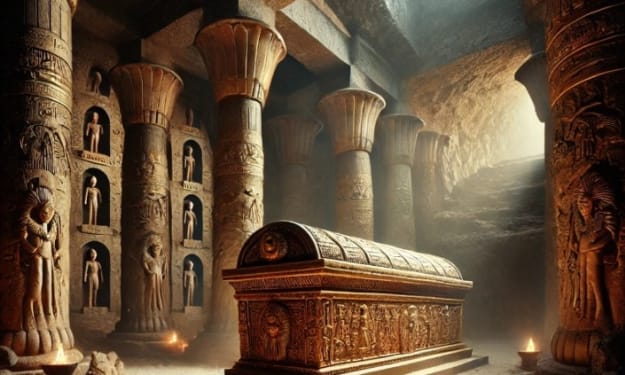
The Hidden Tomb of Alexander the Great: An Unsolved Mystery
Historical Accounts of Alexander's Burial Alexander the Great, the Macedonian conqueror, met his untimely death in 323 B.C. in Babylon. Following his demise, his body became a symbol of immense political significance. Historical records suggest that his remains were initially intended to be interred in Aegae (modern-day Vergina) in Macedonia, the traditional burial site of Macedonian royalty. However, during the funeral procession, Ptolemy I, one of Alexander's generals, seized the body and diverted it to Egypt. This act was likely motivated by a desire to legitimize his rule over Egypt by possessing the remains of the revered leader. In Egypt, Alexander's body was first laid to rest in Memphis. Later, it was transferred to Alexandria, the city he founded, where it was placed in a grand mausoleum known as the "Soma." This tomb became a pilgrimage site for many notable figures of antiquity, including Julius Caesar and Augustus. Over time, however, the exact location of the Soma faded from public memory, leading to centuries of speculation and search. Theories and Archaeological Endeavors Several theories have emerged regarding the possible location of Alexander's tomb: Under the Mosque of Nabi Daniel in Alexandria: Some researchers propose that the tomb lies beneath the modern Mosque of Nabi Daniel. This theory is based on historical texts and the mosque's proximity to ancient royal quarters. However, political and religious sensitivities have limited extensive excavations in this area. The Alabaster Tomb in Alexandria: Another hypothesis points to an unmarked "alabaster tomb" in eastern Alexandria. This sizable structure, dating to the third century B.C., lacks inscriptions but could plausibly be linked to Alexander. Despite its potential significance, definitive evidence connecting it to Alexander is absent. Amphipolis in Northern Greece: A monumental tomb discovered in Amphipolis, dating back to the era following Alexander's death, sparked speculation that it might be his final resting place. Guarded by headless sphinxes and containing multiple chambers, the tomb's grandeur led some to associate it with Alexander. However, subsequent studies have suggested it more likely belonged to a close associate or family member. Recent Developments In recent years, archaeological efforts have intensified: Vergina Excavations: The discovery of royal tombs in Vergina, the ancient city of Aegae, unveiled the resting places of Macedonian royalty, including Alexander's father, Philip II. Artifacts such as a purple-dyed tunic, possibly linked to Alexander, have been found, offering insights into the era's burial customs. However, these findings pertain to his family rather than Alexander himself. Ongoing Research in Alexandria: Archaeologists continue to explore potential sites within Alexandria, employing advanced technologies like ground-penetrating radar. The dense urban development of the modern city poses significant challenges, but researchers remain hopeful that clues to the Soma's location may yet emerge. The precise location of Alexander the Great's tomb remains elusive, shrouded in layers of history, legend, and urban development. While various theories and archaeological findings offer tantalizing hints, definitive evidence has yet to surface. The quest to uncover this ancient enigma continues to captivate historians and archaeologists alike, promising that the mystery of Alexander's final resting place endures.
By Say the truth 2 years ago in History
The Royal Aesthetic of Queen Amina . AI-Generated.
In the heart of West Africa, where the savannas stretch as far as the eye can see, a legendary queen once ruled over the Hausa kingdom of Zazzau. Queen Amina, a name that echoes through the annals of history, was a force to be reckoned with. Her remarkable life, marked by bravery, intelligence, and beauty, has inspired generations of Africans and beyond. Born in the 16th century, Queen Amina was the daughter of King Nikatau, the ruler of Zazzau. From a young age, she was groomed for leadership, receiving training in warfare, diplomacy, and governance. Amina's intelligence, courage, and determination quickly earned her the respect and admiration of her people. As queen, Amina's beauty was celebrated throughout the kingdom. Her physical appearance, characterized by a statuesque figure, smooth dark skin, and piercing eyes, was considered the epitome of Hausa beauty. Her hair, styled in intricate braids and adorned with cowry shells and beads, was a symbol of her royalty and status. But Queen Amina's beauty was not just skin-deep. She was a fierce warrior, leading her armies to victory against rival kingdoms and expanding the borders of Zazzau. Her strength, courage, and resilience inspired her people, and her legacy has endured for centuries. Despite her many accomplishments, Queen Amina's story has often been overshadowed by that of her male counterparts. However, in recent years, there has been a growing recognition of her importance in African history and her influence on Hausa beauty traditions. As we delve into the story of Queen Amina, we will explore the rich cultural heritage of the Hausa people, their beauty traditions, and the enduring legacy of this remarkable queen. We will discover how Queen Amina's royal aesthetic, characterized by intricate hairstyles, fine clothing, and precious jewelry, continues to inspire beauty enthusiasts and artists around the world. And we will examine how her legacy serves as a powerful reminder of the importance of celebrating African beauty standards and promoting cultural diversity. In the 16th century, in the heart of West Africa, a legendary queen ruled over the Hausa kingdom of Zazzau, in what is now modern-day Nigeria. Queen Amina, a fierce warrior and shrewd leader, was renowned for her exceptional beauty, intelligence, and strength. Her royal aesthetic, deeply rooted in Hausa beauty traditions, continues to inspire and influence beauty standards in Africa and beyond. Born around 1533, Queen Amina was the daughter of King Nikatau, the ruler of Zazzau. From a young age, she was groomed for leadership, receiving training in warfare, diplomacy, and governance. Amina's intelligence, courage, and determination quickly earned her the respect and admiration of her people. As queen, Amina's beauty was celebrated throughout the kingdom. Her physical appearance, characterized by a statuesque figure, smooth dark skin, and piercing eyes, was considered the epitome of Hausa beauty. Her hair, styled in intricate braids and adorned with cowry shells and beads, was a symbol of her royalty and status. Hausa beauty traditions, as embodied by Queen Amina, emphasized the importance of cleanliness, grooming, and adornment. Women in Hausa society were expected to maintain a high level of personal hygiene, using natural ingredients like shea butter, coconut oil, and henna to moisturize and soften their skin. Intricate hairstyles, like the "Kwandonki" and "Turkudi," were an integral part of Hausa beauty culture. These styles, often adorned with beads, cowry shells, and other ornaments, were not only aesthetically pleasing but also conveyed social status, marital status, and cultural identity. Queen Amina's royal aesthetic was also characterized by her love of fine clothing and jewelry. She was particularly fond of wearing intricately embroidered robes, adorned with gold and silver thread, and precious stones like diamonds and rubies. As a warrior queen, Amina's beauty was not just about physical appearance but also about strength, courage, and resilience. She was known for her bravery in battle, leading her armies to victory against rival kingdoms and expanding the borders of Zazzau. Despite her many accomplishments, Queen Amina's legacy has often been overshadowed by that of her male counterparts. However, in recent years, there has been a growing recognition of her importance in African history and her influence on Hausa beauty traditions. Today, Queen Amina's royal aesthetic continues to inspire beauty enthusiasts and artists around the world. Her legacy serves as a powerful reminder of the importance of celebrating African beauty standards and promoting cultural diversity. In conclusion, Queen Amina's story is a testament to the enduring power of beauty and the importance of celebrating African cultural heritage. Her royal aesthetic, deeply rooted in Hausa beauty traditions, continues to inspire and influence beauty standards in Africa and beyond. As we reflect on her legacy, we are reminded of the importance of promoting cultural diversity and celebrating the beauty and strength of African women.
By Henry Lucy2 years ago in History