Ancient
The Moche Civilization
Approximately 2,000 years ago, during the period when the Roman Empire was prominent in Europe and the Han Dynasty was in power in China, an extraordinary civilization flourished along the arid coastline of Peru—the Moche. Renowned for their pottery, monumental pyramid constructions, and adept seafaring skills, the Moche established a legacy that continues to intrigue archaeologists and historians alike. Although they did not create a centralized state, their network of urban centers exhibited a shared cultural identity, which was manifested through elaborate artistic expressions, grand architectural feats, and sophisticated rituals.
By A História2 years ago in History
The History Of Palestine 🇵🇸 . AI-Generated.
The history of Palestine is among the most intricate and deeply rooted in the ancient world, reflecting a legacy of human civilization that spans thousands of years. Geographically positioned at the crossroads of Africa, Asia, and Europe, Palestine has long been a bridge between cultures and a battleground for empires. The earliest inhabitants of the region were the Canaanites, a Semitic people who settled in the land during the third millennium BCE and established thriving city-states. In the 12th century BCE, the Philistines, believed to have come from the Aegean Sea, settled along the southern coastal plains. The term “Palestine” is thought to derive from “Philistia,” the land of the Philistines. Around the same period, the ancient Israelites settled in the central highlands, eventually forming the kingdoms of Israel and Judah, which are central to Jewish religious tradition. These kingdoms were repeatedly conquered by larger powers—first the Assyrians, then the Babylonians, who destroyed the First Temple in Jerusalem in 586 BCE and exiled many Jews to Babylon. After the fall of Babylon, the Persian Empire allowed Jewish exiles to return and rebuild the temple, initiating the Second Temple period. This era ended with the Roman conquest, during which Judea became a Roman province. Tensions between Jews and Romans culminated in a series of revolts, leading to the destruction of the Second Temple in 70 CE and the eventual expulsion of many Jews from the region. In the centuries that followed, Palestine became part of the Christian Byzantine Empire until 638 CE, when Muslim Arab forces conquered the region, marking the beginning of over a millennium of Islamic governance.
By Ikbal Siddiki 2 years ago in History
Dominican Republic nightclub collapse kills 98
Dominican Republic nightclub collapse kills 98 On the night of April 8, 2025, tragedy struck Santo Domingo, the capital of the Dominican Republic, when the roof of the renowned Jet Set nightclub collapsed during a merengue concert. The catastrophic event resulted in the deaths of at least 98 individuals and left over 160 others injured.
By Muhammad Hayat2 years ago in History
Mysterious Landmarks on Mars Discovered by NASA Spark Alien Life Debate.
Mysterious Landmarks on Mars Discovered by NASA Spark Alien Life Debate. Mars the mysterious and dusty neighbor of Earth has once again stirred the imagination of the world. NASA over the years has released a series of intriguing images captured by its high tech rovers and orbiters exploring the Red Planet. These images showcase bizarre looking formations and structures which some believe are more than just the result of natural geological processes. The debate has intensified Could Mars have once hosted alien life? The allure of Mars is undeniable. As one of the closest planets to Earth and with surface conditions that are more hospitable than most other celestial bodies in our solar system Mars has always been at the center of scientific and speculative discussions about extraterrestrial life. While gas giants like Jupiter and Saturn are ruled out due to their extreme environments Mars has long stood as a beacon of potential a planet that might have once harbored the conditions necessary for life. Our collective obsession with the planet goes back centuries but in the age of technology and space exploration that curiosity has grown even stronger. The success of missions such as the Mars Reconnaissance Orbiter Curiosity Rover and most recently the Perseverance Rover has given us access to thousands of high resolution images of the Martian surface. Some of these images show peculiar shapes and patterns formations that don’t easily fit into our understanding of natural geology.
By Adnan Rasheed2 years ago in History
Trump tariffs including 104% against China come into force
Trump tariffs including 104% against China come into force Trump's new tariffs on dozens of countries, including tariffs of 104 percent on Chinese goods, have gone into effect, intensifying his global trade war. The round of so-called “reciprocal” tariffs on imports to the US – imposed from 12.01am Eastern Time (0401 GMT) – come as the US president’s punishing levies have shaken a global trading order that has persisted for decades, raised fears of recession and driven worldwide stocks sharply downward. According to Reuters, the S&P 500 fell below 5,000 on Tuesday for the first time in nearly a year and is getting closer to entering a bear market, which is defined as being 20% below its most recent high. Since Trump announced the tariffs on Wednesday, the value of S&P 500 companies' stock markets has decreased by $5.8 trillion. A sell-off across Asian markets resumed on Wednesday after a brief respite, with Japan’s Nikkei down over 3% and South Korea’s won currency sliding to a 16-year low. Additionally, US stock futures pointed to Wall Street suffering losses for the fifth day in a row. Trump nearly doubled duties on Chinese imports, which had been set at 54% last week, in response to counter-tariffs that Beijing announced last week. China has vowed to “fight to the end” over what it views as blackmail. Trump has offered investors mixed signals about whether the tariffs will remain in the long term, describing them as “permanent” but also boasting that they are pressuring other leaders to ask for negotiations. During a White House event on Tuesday afternoon, he stated, "We have a lot of countries coming in that want to make deals." At a subsequent event, he stated that he anticipated China to pursue an agreement as well.
By Danielle W. Jones2 years ago in History
Scientists Announce They Have Resurrected the Dire Wolf
9 April 2025 In an innovation that blurs the boundaries A group of geneticists who are torn between science fiction and reality and now paleobiologists declared that they have successfully restored Canis dirus, the extinct dire wolf.
By moyensefat2 years ago in History
Stars, Waves, and Wisdom
The narrative of human history is characterized by remarkable accomplishments that distinguish our species on Earth. We have adapted to survive in diverse environments, including deserts, mountains, jungles, and the coldest regions of the planet. However, one achievement surpasses all others—the domination of the seas. Throughout the ages, humans have honed their skills and developed technologies to navigate extensive oceanic distances, revealing new territories and possibilities. Among the most skilled navigators in history were the Polynesians, whose exceptional maritime abilities enabled them to inhabit nearly every livable island across the Pacific Ocean.
By A História2 years ago in History
The Lost Treasure of Cleopatra: The Hidden Wealth of Egypt's Last Pharaoh. AI-Generated.
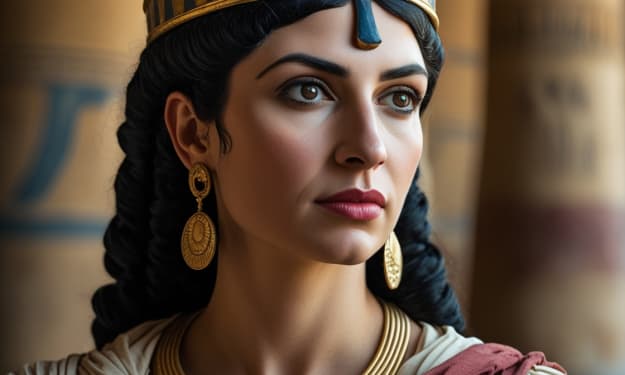
The Lost Treasure of Cleopatra: The Hidden Wealth of Egypt's Last Pharaoh Cleopatra VII, the last Pharaoh of Ancient Egypt, has fascinated historians, archaeologists, and storytellers for centuries. Celebrated for her political brilliance, romantic liaisons with Julius Caesar and Mark Antony, and dramatic demise, Cleopatra was more than just a queen—she was an empire unto herself. But behind the myth and majesty lies one of history’s most enduring mysteries: what happened to Cleopatra’s treasure? When Cleopatra ruled Egypt from 51 to 30 BCE, she presided over one of the richest and most powerful kingdoms of the ancient world. The Nile’s fertile banks, bustling trade ports, and immense natural resources made Egypt a glittering prize. Cleopatra inherited a kingdom that was both culturally sophisticated and financially robust. But how much wealth did she truly possess—and where did it all go? A Fortune Fit for a Pharaoh Cleopatra’s net worth, when adjusted to modern terms, is impossible to calculate with precision, but scholars estimate it may have been equivalent to hundreds of billions of dollars today. Some even suggest that she could have been among the richest women in history. As queen, Cleopatra had control over Egypt’s vast grain reserves, which were critical to feeding the Roman Empire. She also held dominion over immense reserves of gold, silver, spices, gemstones, and rare artifacts that poured in from Africa, India, and the Middle East through trade. The famed Library of Alexandria alone, stocked with untold knowledge and priceless scrolls, could be considered a cultural treasure beyond valuation. But Cleopatra didn’t just inherit wealth—she expanded it. She was a shrewd economist and administrator who reformed Egypt’s taxation systems, encouraged commerce, and maintained a luxurious but strategically necessary court. The Treasure of Antony and Cleopatra One of the most intriguing aspects of Cleopatra’s wealth is what became of it after her death. Following the defeat of Antony and Cleopatra at the Battle of Actium in 31 BCE, Octavian (later Augustus Caesar) moved to annex Egypt and absorb its riches into the Roman Empire. According to ancient sources like Plutarch and Cassius Dio, Cleopatra took steps to hide or destroy some of her wealth to keep it from falling into Roman hands. The most popular legend claims that before her suicide in 30 BCE, Cleopatra had her most precious treasures—including gold, jewelry, and sacred artifacts—sealed and hidden, possibly beneath the Nile or in secret tombs in or near Alexandria. Some versions of the legend suggest that Cleopatra’s loyal followers transported the treasure to a hidden location, possibly one of the many Ptolemaic burial chambers in the desert or under the ocean floor near the ruins of ancient Alexandria. Others say she may have built a secret vault beneath her palace or in the Temple of Isis at Taposiris Magna, where some archaeologists believe she might be buried alongside Antony. The Treasure Hunt: Fact or Fantasy? Modern treasure hunters, archaeologists, and explorers have spent decades searching for Cleopatra’s lost wealth. One of the most active sites of excavation is Taposiris Magna, located about 45 kilometers west of Alexandria. There, archaeologists have uncovered coins bearing Cleopatra’s face, royal statues, and ceremonial objects—all suggesting that the temple may have been closely associated with her. In 2020, the Egyptian Ministry of Antiquities revealed that dozens of mummies were found buried with golden tongues in the area, suggesting ritualistic burials possibly linked to royal or elite lineages. Still, no definitive signs of Cleopatra’s final resting place—or her treasure—have been discovered. In Alexandria itself, much of the ancient city now lies submerged beneath the Mediterranean due to centuries of earthquakes and tsunamis. Divers exploring these underwater ruins have uncovered sphinxes, columns, and statues, but again, no massive treasure troves. The Real Treasure: Cleopatra’s Legacy While the literal treasure of Cleopatra remains hidden, her greatest wealth may be her enduring legacy. Cleopatra defied the stereotypes of her time. She was not merely a seductress or puppet queen—she was a ruler who spoke nine languages, studied philosophy and science, and commanded loyalty from her people and respect from her enemies. Her image, enshrined on coins, in Roman propaganda, and through Shakespearean drama, continues to captivate the world. Cleopatra has been portrayed as both goddess and villain, but her story is ultimately one of survival, ambition, and unmatched charisma.
By Say the truth 2 years ago in History
Cleopatra’s Lost Fortune: The Untold Mystery of Egypt’s Last Queen. AI-Generated.
Cleopatra’s Lost Fortune: The Untold Mystery of Egypt’s Last Queen In the grand tapestry of ancient history, few figures evoke as much intrigue and fascination as Cleopatra VII, the last Pharaoh of Egypt. Known as much for her intellect and political acumen as her beauty, Cleopatra ruled at a time of both immense opportunity and growing Roman influence. But beyond her tragic love stories and royal lineage lies an enduring enigma: what happened to Cleopatra’s legendary wealth? When Cleopatra ascended the throne of Egypt in 51 BCE, she inherited a nation whose coffers overflowed with the riches of millennia. Egypt, strategically located at the crossroads of Africa, the Middle East, and the Mediterranean, was the breadbasket of the ancient world. Its fertile Nile Delta, thriving trade ports like Alexandria, and ancient tombs packed with gold and artifacts made the kingdom one of the wealthiest on Earth. The Ptolemaic dynasty, of Macedonian Greek origin and founded by one of Alexander the Great’s generals, had ruled Egypt since 305 BCE. By Cleopatra's time, it had amassed wealth through trade in grain, papyrus, perfumes, and exotic luxuries. The Library of Alexandria was not only a hub of knowledge but also a symbol of Egypt’s cultural and economic dominance. Cleopatra herself was no passive heiress. Fluent in nine languages and deeply involved in administrative affairs, she revitalized Egypt’s economy through reforms, devaluing currency to stimulate trade and stabilizing grain distribution to avoid famine. Her personal wealth grew alongside the state’s, and she was said to be one of the richest individuals of her time. However, her fortunes would become entangled with two of Rome’s most powerful men: Julius Caesar and Mark Antony. With Caesar, she formed a political alliance and romantic relationship that helped secure her throne. After his assassination in 44 BCE, she turned to Mark Antony, with whom she had three children and shared power in the eastern Roman territories. Mark Antony and Cleopatra’s combined wealth was legendary. Together, they held dominion over vast swathes of territory rich in resources, and their court in Alexandria was said to rival or even surpass that of Rome. Historical sources describe opulent feasts, golden thrones, and ships laden with treasure. Cleopatra reportedly possessed not just gold and silver, but emerald mines, pearls, and artistic masterpieces. But this golden age was short-lived. In 31 BCE, their forces were defeated by Octavian (later Augustus Caesar) at the Battle of Actium. With their political and military power collapsing, Antony and Cleopatra retreated to Egypt. One year later, facing inevitable defeat, they both died by suicide—Cleopatra famously through the bite of an asp, although that account is debated. And then, the trail of her treasure vanishes. Roman records suggest Octavian seized much of Cleopatra's wealth upon his conquest of Egypt. It is said he used it to fund his rise as Emperor and stabilize the Roman economy. But many historians believe not all of it was captured. Cleopatra, ever cunning and strategic, may have hidden a portion of her treasure in anticipation of defeat. Legends persist of treasure-laden tombs buried beneath the sands of Egypt, or sunken hoards beneath the waters near Alexandria. In particular, the lost city of Thonis-Heracleion, recently discovered submerged off the Egyptian coast, has yielded some clues about Egypt’s vast maritime wealth, but no definitive link to Cleopatra’s missing fortune. Another mystery lies in the location of her final resting place. Ancient sources suggest Cleopatra and Antony were buried together in a grand mausoleum near Alexandria. Archaeologists, including renowned Egyptologist Dr. Zahi Hawass, have spent years searching for this lost tomb, hoping it may contain not only their remains but possibly the last cache of Cleopatra’s riches. The allure of Cleopatra’s lost wealth continues to captivate adventurers and scholars alike. Could it be hidden in a secret chamber beneath ancient temples? Was it smuggled out of Egypt by loyalists? Or did it truly pass into the hands of Rome, vanishing into history? What remains undeniable is that Cleopatra’s legacy, like her fortune, has withstood the test of time. Her tale is not merely one of love and tragedy, but of power, strategy, and a mysterious treasure that may still lie hidden beneath the sands of her fallen kingdom.
By Say the truth 2 years ago in History
The Golden Depths of India: The Untold Narrative of Kolar Gold Fields
Ancient Beginnings: Gold Prior to Empire The history of gold extraction in the Kolar area extends back more than 2,000 years. Archaeological findings indicate that the early inhabitants of South India were cognizant of the gold beneath their feet and had devised rudimentary methods of extraction. Ancient temples and writings reference the dazzling wealth of the Kolar region, and some historians even speculate that gold from these mines may have embellished the courts of the Chola and Vijayanagara empires. Nonetheless, it was during the British colonial period that KGF evolved from local artisanal mining into an industrial behemoth. Colonial Exploitation and the Emergence of an Industrial Colossus In the late 19th century, British engineers and geologists discerned the immense potential concealed beneath Kolar’s rugged landscape. In 1871, Michael Lavelle, an Irish soldier, acquired the rights to mine gold in the vicinity. Although his initial endeavors yielded modest profits, it was his discovery that ignited interest from British enterprises, particularly the John Taylor and Sons Company, which would ultimately dominate gold production in KGF for decades. By the early 1900s, KGF housed one of the deepest mines worldwide, descending more than 3,000 meters (over 10,000 feet) into the earth. It was equipped with state-of-the-art technology for the era: electric lifts, subterranean railways, and advanced ventilation systems. British colonial authorities established a township surrounding the mines complete with bungalows, clubs, churches, and even a golf course earning KGF the moniker “Little England. ” Golden Glory: Wealth, Labor, and Heritage During its peak production years, particularly between 1900 and 1956, KGF yielded nearly 800 tonnes of gold. It significantly contributed to the British economy and subsequently to the reserves of independent India. However, this gold was acquired at a considerable human cost. Tens of thousands of Indian laborers many hailing from Tamil Nadu and Karnataka labored in arduous underground conditions. They endured long hours, perilous cave-ins, substandard air quality, and exposure to mercury and other hazardous substances utilized in refining processes. Despite the adversities, KGF fostered a vibrant cultural life. It became one of the earliest locales in India to achieve full electrification (in 1902), thanks to the nearby hydroelectric facility at Shivanasamudra. Schools, hospitals, and churches prospered in the region, forming a distinctive Anglo-Indian community that remains proud of its heritage. The Decline of the Gold Giant By the 1970s, the Kolar mines began to exhibit indicators of depletion. The deeper the miners excavated, the more challenging and costly it became to extract gold. The government of India, which had assumed control of operations through Bharat Gold Mines Ltd (BGML), found it progressively difficult to justify the expenditures. In 2001, following several years of deficits and labor conflicts, the mines were officially closed. Thousands of laborers lost their employment, and the once-thriving KGF township descended into deterioration. Myth, Legacy, and Contemporary Pop Culture Even after their closure, the myth of KGF persisted. Locals recounted stories of untouched gold deposits and concealed chambers buried deep underground. These narratives fueled tales of hidden wealth, inspiring literature and cinema. In recent times, the Kannada-language film series “KGF” has reignited interest in the region’s history, depicting a dramatized version of the gold rush, mafia conflicts, and uprising. Although the films took artistic liberties, they highlighted the stark realities and splendor of a bygone age. Reopening the Gold Veins? Recently, efforts have been made to revive gold mining in the Kolar region. The Indian government has proposed plans to auction the mines to private enterprises, hoping that contemporary technology may render extraction viable once more. Environmental issues, land rights, and economic feasibility continue to pose significant obstacles. Nonetheless, if even a fraction of KGF’s estimated remaining gold reserves purported to be valued in the billions can be mined, it could once again transform the region’s prospects. Conclusion The narrative of Kolar Gold Fields transcends mere gold. It encompasses ambition, colonization, innovation, sacrifice, and pride. The mines may be quiet today, but the legacy of KGF runs deep within the hearts of those who once called it home and in the substrata of the land that may still shimmer with secrets waiting to be discovered.
By Say the truth 2 years ago in History
The African Attire. AI-Generated.
African attire boasts a rich and diverse history that reflects the continent's cultural, social, and environmental influences. Clothing in Africa has always been more than just a means of covering the body; it serves as a powerful expression of identity, status, heritage, and creativity.
By Hauwa Adoga2 years ago in History