Ancient
"The Empire Beneath the Sands: The Untold Wealth of the Persian Empire". AI-Generated.
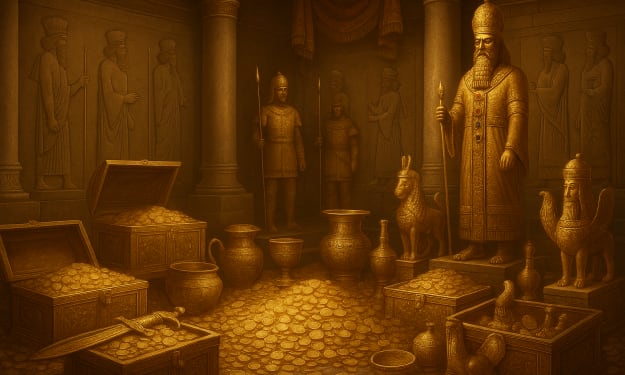
“The Empire Beneath the Sands: The Unrevealed Wealth of the Persian Empire” The Achaemenid Persian Empire, established by Cyrus the Great in the 6th century BCE, is frequently eclipsed by subsequent empires in conversations regarding ancient affluence. Nevertheless, this extensive empire, which extended from the Indus Valley to Greece and Egypt, amassed and administered one of the most significant concentrations of wealth ever witnessed. This article delves into the immense treasure reserves of the Persian monarchs, the sophisticated economic framework they devised, and an estimation of their net worth in contemporary terms. The Ascendancy of a Superpower The Achaemenid Persian Empire (circa 550–330 BCE) emerged as one of the earliest and largest global empires in human history. Under the leadership of figures such as Cyrus the Great, Darius I, and Xerxes I, it governed over 44% of the world’s population, a milestone unparalleled in historical records. Their affluence was derived from tributes, commerce, taxation, and the dominion over crucial regions abundant in gold, silver, and other valuable resources. At the zenith of the empire, the Persians had access to: Gold deposits in Armenia and Asia Minor Silver deposits in Central Asia Commerce from the Silk Road and maritime pathways Tributes from subdued territories, including Egypt, Babylon, Lydia, and India The Royal Treasuries of Persepolis and Susa One of the most intriguing aspects of the Persian Empire was its imperial treasuries, especially in Persepolis, Ecbatana, and Susa. These complexes were not merely ceremonial cities they were fortified repositories brimming with unimaginable wealth. Greek historians such as Herodotus and Ctesias documented that the Persian kings secured tens of thousands of talents (a unit of weight for gold or silver) within their palatial structures. Estimates: One talent ≈ 30 kg (66 pounds) A report during Alexander the Great's conquest indicated that the Persians had accumulated 180,000 talents of silver and gold in Persepolis alone This equates to over 5,400 metric tons of precious metals, appraised today at more than $300 billion. The Satrapy System: An Economic Engine Darius I transformed the empire's administration by instituting the satrapy system partitioning the empire into provinces, each overseen by a satrap (governor). Each satrapy was taxed according to its economic productivity. Annual tributes comprised: India: Paid in gold dust, valued at approximately 4680 talents of gold yearly Babylon: Contributed substantial quantities of grain and silver wealth Egypt: Provided gold, linen, and grain Lydia: Renowned for its gold mines and currency The empire’s yearly revenue from these tributes, converted to modern values, is estimated at $1–2 billion USD annually an extraordinary figure for the ancient world. Persian Coinage and Financial Innovation The Persians were also pioneers in finance. Darius introduced the Daric, a gold coin that became the benchmark of international commerce within the empire akin to the operational role of the U. S. dollar today. One Daric contained approximately 8. 4 grams of pure gold Minted alongside silver Sigloi for local circulation This stable currency system facilitated trade across extensive regions, from India to Macedonia. Wealth in Architecture and Art The Persians allocated their resources not solely towards grand treasuries but also towards monumental edifices. The establishment of Persepolis alone featuring its tiered platforms, ceremonial chambers, and elaborate reliefs is estimated to have incurred expenses amounting to hundreds of millions of dollars in labor and materials. The empire similarly expended considerable amounts on: Preserving imperial roadways such as the Royal Road (2,700 km in length) Sustaining extensive standing armies, including the prestigious Immortals Sponsoring artisans, stonemasons, and jewelers The Pillaging of Persia: Alexander’s Windfall When Alexander the Great invaded Persia in 330 BCE, one of his most significant rewards was not military but financial. Upon capturing Persepolis, it is reported that he seized: 180,000 talents of gold and silver Thrones and statues adorned with jewels Exotic tribute animals and scarce textiles This singular act of plunder provided Alexander with sufficient funds to: Finance his campaigns for over a decade Compensate his soldiers with bonuses Stabilize Greek economies for numerous years It was, arguably, the most substantial single appropriation of wealth in ancient history. Assessing the Net Worth Today While we cannot determine an exact figure for the wealth of the Persian Empire, cautious estimates derived from historical records and contemporary valuations indicate: Treasury Reserves: $300–500 billion (gold/silver alone) Annual Tribute Revenues: $1–2 billion in present-day terms Cultural and Artistic Wealth: Incalculable, but potentially tens of billions The total net worth of the Persian Empire at its zenith could range from $500 billion to over $1 trillion USD, considering inflation and current market conditions. Legacy of Wealth and Power The treasure of the Persian Empire encompassed more than just gold it embodied: The authority of structured governance The vigor of a diverse, multi-ethnic empire The impact of cultural patronage and acceptance Although looted and dispersed, the legacy of Persian wealth persists in archaeological discoveries, museum exhibits, and the historical framework it provided for subsequent empires.
By Say the truth about a year ago in History
"Empire of Gold: The Mughal Treasure – Asia’s Greatest Lost Fortune". AI-Generated.
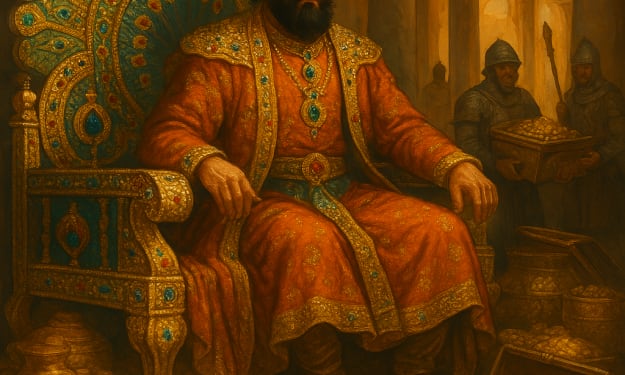
"The Golden Legacy: Revealing the Supreme Wealth in Asia's Historical Narrative" Asia, the origin of ancient societies, has been the residence of legendary affluence and overlooked fortunes. Among its numerous valuables, the treasure of the Great Mughal Empire distinguishes itself as the most lavish and historically crucial. Valued in billions at present, the Mughal treasure encompassing the Peacock Throne, the Koh-i-Noor diamond, and vaults filled with gold and gemstones epitomizes the pinnacle of imperial authority, craftsmanship, and political superiority in Asia. This article charts the ascent, magnificence, downfall, and heritage of Asia’s most significant historical treasure. The Wealthiest Empire in the East Within the chronicles of global history, few empires have gathered riches as vast and storied as the Mughal Empire of India. Established in 1526 by Babur, the empire reached its peak under rulers such as Akbar, Jahangir, and Shah Jahan. By the 17th century, the Mughal Empire governed an extensive area of South Asia and contributed nearly 25% of the world's GDP, as noted by historical economists. Its courts sparkled with gold, sapphires, diamonds, rubies, and emeralds. The Mughal emperors not only amassed wealth through military conquests and commerce but also preserved and exhibited it in the form of magnificent thrones, crowns, ornaments, palaces, and royal treasuries. The Peacock Throne: Gem of the Empire The most emblematic representation of Mughal opulence was indisputably the Peacock Throne, commissioned by Shah Jahan in the early 17th century. Constructed over seven years by master craftsmen and costing four times the value of the Taj Mahal, the throne was adorned with: The Koh-i-Noor diamond The Tavernier Blue (thought to be the precursor to the Hope Diamond) Rubies from Badakhshan Emeralds from Colombia Thousands of pearls and sapphires It is said that the throne’s richness astonished every foreign envoy who entered the Mughal court. The structure itself was designed like an expansive canopied bed supported by solid gold columns, embellished with peacocks inlaid with gemstones a representation of divine kingship. Estimated Modern Value: Over $1 billion, considering its composition and historical importance. The Koh-i-Noor Diamond: A Journey Through Empires The Koh-i-Noor, or “Mountain of Light,” is arguably the most renowned diamond globally. Weighing over 105 carats in its current state, the diamond has transitioned through the possession of various dynasties: Originally extracted from the Golconda region of India Held by the Kakatiya, Delhi Sultanate, and Mughals Seized by Persian ruler Nader Shah during his 1739 incursion into Delhi Ultimately came into British possession and became part of the British Crown Jewels Estimated Value: While invaluable historically, analysts estimate the diamond could be worth over $500 million if ever sold (though it is improbable to ever reach the market). Nader Shah’s Invasion: The Decline of a Wealth In 1739, Persian emperor Nader Shah invaded Delhi and plundered the Mughal treasury, including the Peacock Throne and the Koh-i-Noor. The enormous wealth transported back to Persia was so substantial that taxes were suspended for three years in Iran. Historians estimate that the Mughal treasure seized during this incursion was valued at: Over $1. 5 billion (in contemporary currency), encompassing: 700 elephants, 4,000 camels, and 12,000 horses laden with gold and jewels Countless ancient manuscripts, arms, and relics Dispersed and Dispersed Wealth Over the centuries, the riches of the Mughal Empire were dispersed across continents due to: British colonial annexation Persian pillaging Afghan raids (notably by Ahmad Shah Durrani) Localized uprisings and the decline of the empire Currently, portions of this once-enormous treasure reside in: The British Museum and the Tower of London The Iranian National Treasury in Tehran Private collections and auction houses globally Other Claimants Throughout Asia Although the Mughal treasure is frequently regarded as the most affluent in Asian history, other remarkable treasure troves include: Yamashita’s Gold: Allegedly seized by the Japanese military in Southeast Asia during WWII, potentially valued in the hundreds of billions Concealed treasures of the Khmer Empire in Cambodia Treasure caches of the Tang and Song Dynasties in China Nevertheless, none rival the verified historical magnificence of the Mughal wealth. Cultural and Political Heritage The legacy of Asia’s premier treasure extends beyond gold. It signifies: The apex of imperial artistry and patronage The interconnected trade and wealth pathways of Asia The susceptibility of even the wealthiest empires to invasions and colonization Presently, discussions regarding the restitution of treasures like the Koh-i-Noor reflect global calls for justice, historical acknowledgment, and the enduring echoes of imperial plunder. Final Thoughts The narrative of the Mughal treasure Asia’s most splendid historical wealth is a saga of glory, avarice, and magnificence. Although much of it is now lost or scattered, its influence persists in museums, royal jewels, and the annals of history. It serves as a potent reminder of the heights of imperial affluence and how even the most splendid treasures can disappear under the passage of time.
By Say the truth about a year ago in History
Ancient High Tech Machinery Used to Build Egypt’s Pyramids Study Claims
Ancient High Tech Machinery Used to Build Egypt’s Pyramids Study Claims For centuries the Great Pyramids of Egypt have fascinated historians engineers and tourists alike. Built over 4,500 years ago these towering monuments have sparked countless theories about how ancient civilizations managed to construct them with such precision and scale. While the mainstream archaeological consensus holds that the pyramids were built using simple tools manual labor and ingenious techniques a new controversial study claims that ancient high tech machinery may have played a crucial role in their construction.
By Adnan Rasheedabout a year ago in History
Gog & Magog: Secrets Behind the Wall
1. Dhul-Qarnayn (AS): Who Was He? In the Qur'an, Dhul-Qarnayn (AS) is mentioned as a powerful and righteous ruler (Surah Al-Kahf, 18:83–98). His exact historical identity is still up for debate—some claim he was Alexander the Great, while others suggest Cyrus the Great—but he is portrayed as a just king who helped oppressed people wherever he went. During one of his journeys, he reached a place between two mountains where he encountered a community that complained about the corruption caused by Gog and Magog (Ya’juj and Ma’juj). They requested that he construct a barrier to safeguard them. ⸻
By Shahriar Kabir Emonabout a year ago in History
The Causes and Consequences of the World Wars
The 20th century witnessed two cataclysmic conflicts that reshaped the world: World War I and World War II. These wars, although separated by two decades, were deeply intertwined in their causes and consequences. Together, they brought unprecedented destruction, altered global power dynamics, and influenced the political, economic, and social direction of nations for generations.
By Haseeb Mujaddidiabout a year ago in History
The Legacy of Vengeance: The Tale of Three Kings
In a powerful and prosperous kingdom, there lived a great king named Vikram. He was not only known for his intelligence and bravery, but also for his kindness and sense of justice. His people admired him, his allies respected him, and even his enemies feared him. King Vikram was deeply loved because he governed with a fair heart. He personally checked in on his subjects, listened to their concerns, and made sure no one was left behind. Under his rule, the kingdom flourished, and peace reigned for many years.
By Takbir Hasanabout a year ago in History
The Mysterious Egyptian Sistrum. A Sacred Instrument That Opened Portals and Changed the Skies
The Rattle of the Gods Deep within the stone chambers of ancient Egypt, past columns carved with forgotten glyphs, lies a sound few have heard, one said to shake the heavens and stir the Earth. It is the sound of the sistrum, a sacred instrument held not by musicians, but by priestesses, pharaohs, and gods. To the untrained eye, the sistrum is a rattle. But to the initiates of the old temples, it was far more. It was a key. A tool of vibration. A portal-opener.
By The Secret History Of The Worldabout a year ago in History
"Frozen Fortune: Revealing the Concealed Net Worth of Antarctica"
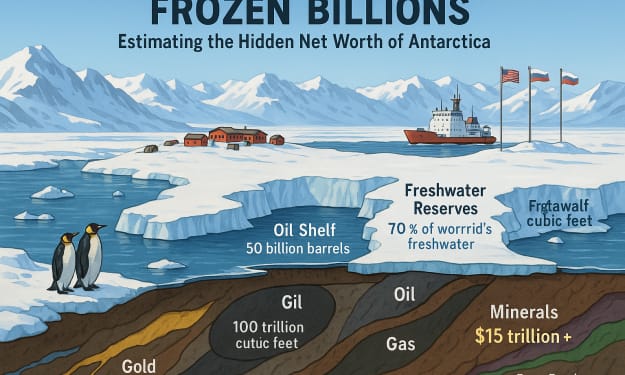
Antarctica: A Unique Continent Antarctica, the planet's southernmost landmass, encompasses over 14 million square kilometers, positioning it as the fifth-largest continent. Despite being 98% enveloped in ice, it is far from being devoid of value. Its distinct geophysical attributes, resource abundance, and global scientific relevance rank it among the most valuable unexploited territories on the planet. Although regulated by the Antarctic Treaty System (established in 1959), which prohibits military operations and mineral extraction, escalating geopolitical interest is amplifying discussions regarding the continent’s prospective utilization. The Resource Abundance of Antarctica 1. Minerals and Metals Although large-scale mining is forbidden, geological investigations indicate that Antarctica contains substantial amounts of minerals such as: Iron ore Gold Platinum Chromium Copper Uranium Rare Earth Elements (REEs) In East Antarctica, particularly in regions like the Prince Charles Mountains, there are signs of iron ore and coal deposits, while the Transantarctic Mountains may harbor valuable copper and gold veins. Projected Mineral Wealth: Exceeding $15 trillion in mineral assets, grounded in potential yield, global market prices, and extrapolated geological assessments. 2. Oil and Natural Gas The Southern Ocean and certain offshore segments of the Antarctic continental shelf may possess significant hydrocarbon deposits. Estimates fluctuate, but some conjecture up to: 50 billion barrels of oil More than 100 trillion cubic feet of natural gas The oil alone could be valued at over $4 trillion at current market rates. However, extraction is virtually unattainable under existing international regulations and harsh environmental conditions. 3. Freshwater Supplies Antarctica holds approximately 70% of the world's freshwater, trapped within its extensive ice sheets. As global freshwater scarcity escalates, this "frozen reservoir" could prove invaluable in the coming years. Projected Freshwater Value: If utilized sustainably and globally transported (theoretically), its value in future decades could surpass $10 trillion. 4. Marine Resources The Southern Ocean encircling Antarctica brims with marine biodiversity: Krill biomass is estimated at 500 million tons. Krill serves a role in pharmaceuticals, health supplements, and aquaculture. Abundant fisheries, including toothfish and icefish, are presently being exploited under stringent regulations. Projected Marine Resource Value: Ranging from $200 to $500 billion, contingent upon sustainability practices and future demand. Strategic and Scientific Significance While direct monetary appraisal is intricate, Antarctica harbors immense scientific and climatic data reserves. Its ice cores contain atmospheric records spanning back 800,000 years, which are critical for comprehending Earth’s climatic history and predictions. Nations like the USA, China, Russia, and India operate permanent research facilities not solely for scientific inquiry but to assert geopolitical influence. Strategic Value (non-monetary): Geopolitical leverage in forthcoming territorial claims Early warning mechanisms for climate change Sophisticated astronomy and cosmic research installations Legal Obstacles to Exploitation The Antarctic Treaty and the Madrid Protocol (1991) explicitly prohibit any commercial exploitation of Antarctica's land and resources. Nevertheless, the agreement is scheduled for reevaluation in 2048, and there is increasing speculation that nations may seek to modify its terms, particularly in light of escalating global resource scarcity. Environmental Factors Exploiting Antarctica's resources entails significant environmental hazards: - Ice sheet destabilization - Sea-level elevation - Ecosystem disruption - Climate feedback mechanisms The expenses associated with establishing infrastructure capable of functioning under such extreme conditions (average temperature: −57°C) are also considerable. Total Estimated Net Value Resource/Asset Estimated Value Mineral Deposits $15 trillion Oil & Gas Reserves $4 trillion Freshwater Reserves $10+ trillion Marine Resources $500 billion Scientific & Strategic Value Immeasurable Total Estimated Net Value $30 trillion+ The Future of Antarctica Antarctica continues to be the sole unowned continent, safeguarded by legislation and predominantly unspoiled by industrial exploitation. However, the global landscape is evolving. As climate change melts parts of its ice, new pathways and opportunities arise. Technological innovations may one day render mining and transportation viable. If the Antarctic Treaty diminishes in strength following 2048, the continent may transform into a contentious stage for geopolitical rivalry, resource competition, and environmental ethics. For the time being, Antarctica remains an unblemished bastion of ice. Yet its concealed riches continue to allure the world’s powerswaiting, observing, frozen in time.
By Say the truth about a year ago in History
“The Golden Hamlet: The Untold Wealth of Kodiyankulam – Tamil Nadu’s Richest Village”
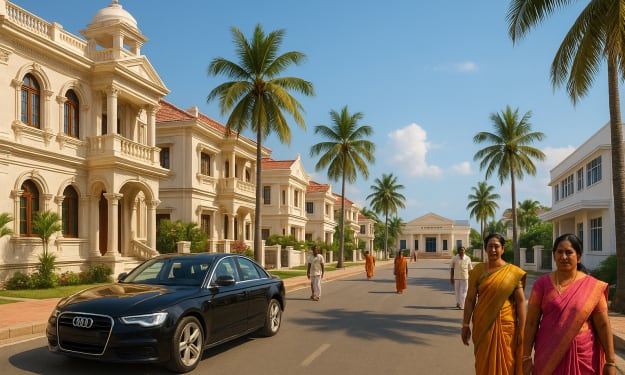
The Rise of a Rural Powerhouse Located about 30 kilometers from the southern port town of Thoothukudi, Kodiyankulam is a village like no other. Though it has fewer than 5,000 residents, the average household income and asset ownership are drastically higher than in most urban centers. Much of the wealth originates from decades of foreign employment, particularly in Persian Gulf nations, where many villagers migrated during the oil boom of the 1970s and 80s. Others have made fortunes in the US, UK, and Southeast Asia. Remittances over the decades transformed Kodiyankulam from a modest farming village to a land of marble bungalows, designer clothing, and luxury vehicles. Life in Kodiyankulam: Luxury Amid Simplicity Take a walk through the streets of Kodiyankulam and you’ll find: Hundreds of palatial homes, often worth ₹1 to ₹3 crore each, with Italian marble, gold-trimmed interiors, and imported furniture. Luxury cars like BMWs, Audis, and Mercedes-Benz, some even with Dubai or UK number plates. Residents dressed in branded attire and wearing gold jewelry even for day-to-day errands. Wedding ceremonies costing upwards of ₹1 crore, with international cuisine and imported décor. Private schools with English-medium instruction and digital classrooms funded by NRIs. Despite its wealth, the village maintains strong cultural roots—celebrating local festivals, temples, and traditions with pride. The Global Network An estimated 60% of households in Kodiyankulam have at least one family member living abroad. Gulf countries—especially UAE, Qatar, and Saudi Arabia—form the backbone of this global diaspora. Younger generations are also exploring opportunities in Canada, the UK, Australia, and Singapore. Many villagers have established construction businesses, restaurants, and trading companies overseas, funneling wealth back into their hometown. These NRIs have built community centers, schools, and even financed roads and water projects in the village. The Real Estate Boom Land prices in Kodiyankulam have skyrocketed. In some parts, real estate sells for over ₹1 crore per acre, especially on the highway stretches. That figure rivals even some suburban areas near Chennai and Coimbatore. Many villagers now engage in land dealings as a secondary source of income. Net Worth Estimation Let’s break down an approximate net worth of the village: Asset Category Estimated Value 1,000+ luxury homes (avg ₹1.5 crore) ₹1,500 crore 500+ luxury vehicles ₹200 crore Land holdings (agricultural + realty) ₹1,000 crore Business assets (in India & abroad) ₹1,500 crore Jewelry & luxury goods ₹300 crore Foreign investments & remittances ₹700 crore Estimated Total ₹5,200 crore+ (approx. $625 million USD) This makes Kodiyankulam potentially the richest village in Tamil Nadu, and among the wealthiest in India. Social Change and Education Wealth has also brought positive change. Education levels are high, especially among girls. Many residents are now doctors, engineers, and lawyers, both in India and abroad. Kodiyankulam boasts multiple schools, libraries, and even private coaching centers. Community welfare projects are often funded collectively by residents and their overseas kin.
By Say the truth about a year ago in History
A Candle Called Hope
The Beginning of Darkness In a small, forgotten village surrounded by endless hills and thick forests, there was a girl named Lina, just twelve years old, with eyes full of dreams. Her village, once full of joy, was now covered in shadows. The sun rarely peeked through the clouds, the trees stopped blooming, and people had started to lose their smiles. Something strange had happened a deep sadness had spread, and no one knew why.
By Muhammad Hayatabout a year ago in History