Ancient
Thailand Unveiled: The Soul of Southeast Asia. AI-Generated.
Thailand Unveiled: The Soul of Southeast Asia Thailand, fondly known as the "Land of Smiles," is a country that captures the heart of every traveler with its vibrant culture, rich traditions, stunning landscapes, and warm hospitality. Nestled in the heart of Southeast Asia, Thailand is a land where ancient customs blend harmoniously with modern life, creating a unique and enchanting experience for all who visit. A Culture Rooted in Tradition Thai culture is deeply influenced by Buddhism, which plays a central role in the daily lives of its people. Over 90% of Thais practice Theravāda Buddhism, and this spiritual path is visible everywhere—from golden temples rising over city skylines to serene monks in saffron robes walking the streets at dawn. Temples such as Wat Phra Kaew in Bangkok and Wat Pho, home to the Reclining Buddha, offer a glimpse into the country’s spiritual devotion and architectural brilliance. Respect and humility are core values in Thai society. The traditional greeting, called the wai—a slight bow with palms pressed together—is a gesture of respect and gratitude. Thai people are known for their politeness and warm demeanor, which is why Thailand is often called one of the friendliest countries in the world. Festivals and Celebrations Thailand’s cultural calendar is filled with vibrant festivals that showcase its traditions. One of the most famous is Songkran, the Thai New Year, celebrated every April with nationwide water fights that symbolize cleansing and renewal. Loy Krathong, held in November, sees locals floating decorated baskets down rivers to pay respect to the water goddess and wash away bad luck. These festivals are not just colorful spectacles; they are deeply rooted in Thai beliefs and provide an opportunity for communities to come together and celebrate their heritage. A Culinary Paradise Thai cuisine is renowned globally for its bold flavors, balance, and diversity. From spicy Tom Yum Goong (shrimp soup) to sweet Mango Sticky Rice, every dish tells a story of Thailand’s geography and culture. Street food is a major part of Thai life—bustling night markets serve everything from grilled meats and noodles to tropical fruits and desserts. Cities like Bangkok and Chiang Mai are street food heavens, offering a taste of local life with every bite. Cooking in Thailand is considered an art form, and many visitors take cooking classes to learn how to recreate their favorite dishes back home. Nature and Landscapes Beyond the cities and cultural sites, Thailand offers breathtaking natural beauty. The south boasts idyllic islands like Phuket, Ko Phi Phi, and Ko Samui, with white-sand beaches, turquoise waters, and vibrant coral reefs. In the north, lush mountains, cool weather, and hill tribe villages offer a completely different experience. Cities like Chiang Mai and Pai provide a more laid-back atmosphere, with opportunities for trekking, elephant sanctuaries, and exploring ancient ruins. The Blend of Old and New Modern Thailand is a fusion of past and present. Bangkok, the capital, is a city of contrasts—gleaming skyscrapers and luxury malls sit beside centuries-old temples and traditional floating markets. The country has embraced modernization, yet it has preserved its cultural identity with grace and pride. Whether you're watching a Muay Thai fight, receiving a traditional Thai massage, or exploring the ruins of Ayutthaya, Thailand offers a journey through time, taste, and tradition. --- Conclusion Thailand’s charm lies in its ability to make visitors feel both thrilled and at peace. With a welcoming spirit, rich cultural heritage, delicious cuisine, and stunning natural beauty, Thailand is more than a destination—it’s an experience of the soul. Whether you're exploring its cities, savoring its food, or immersing yourself in its traditions, Thailand has a way of staying with you long after you’ve left.
By Shahab Ali awanabout a year ago in History
The Naupa Huaca Portal: Proof That Ancient Civilizations Were Secretly Connected?
The Door That Shouldn’t Exist High in the Andean mountains of Peru, carved into living rock and forgotten by time, lies a doorway to a mystery that refuses to be ignored. Hidden near the Sacred Valley, in a place untouched by modern roads or maps, the Naupa Huaca Portal emerges from the cliffside like a deliberate fracture in reality. It is not a ruin. It is not a temple. It is something else entirely.
By The Secret History Of The Worldabout a year ago in History
“Vanished Galleons: The Lost Shipwrecks of the Dutch East India Company”
“Disappeared in the Abyss: The Catastrophic Shipwrecks of the VOC Fleet” The Dutch East India Company (VOC), once the most prosperous trading entity in history, presided over global maritime commerce for nearly two centuries. Yet beneath the splendor and fortune exists a lesser-known narrative the numerous VOC vessels that encountered disastrous fates in perilous waters. Stretching from the Indian Ocean to the rugged shorelines of Australia and the Cape of Good Hope, hundreds of VOC ships were lost to tempests, reefs, sabotage, and navigational mistakes. These wrecks not only transported commodities and riches but also embodied tales of aspiration, colonization, and sacrifice. This article examines the history, significant calamities, treasure recoveries, and the enduring enigma surrounding VOC shipwrecks. Article: The Dutch East India Company (VOC): A Nautical Titan Established in 1602, the Vereenigde Oostindische Compagnie (VOC), or Dutch East India Company, represented the world’s inaugural multinational corporation and the first to distribute shares. Charged with monopolizing the Dutch spice trade with Asia, the VOC developed extensive trade networks from Indonesia to Japan and South Africa. It commanded its military, minted currency, and deployed one of the most formidable naval fleets of its era. At the zenith of its influence in the 17th and 18th centuries, the VOC dispatched thousands of vessels on hazardous expeditions between Europe and Asia, transporting spices, silk, porcelain, gold, and silver. However, the perils were immense and the ocean, relentless. The Magnitude of VOC Shipwrecks Documentation reveals that over 1,600 vessels sailed under the VOC banner during its two-century lifespan. Of these, more than 250 ships were lost at sea due to tempests, shipwrecks, piracy, and navigational blunders. Many did not survive past the Cape of Good Hope, while others disappeared in the waters near Indonesia, Sri Lanka, India, and Australia. While some vessels were lost with all hands aboard, others left behind survivors who recounted stories of calamity, endurance, and treasure. The VOC’s meticulous record-keeping and archival resources preserved numerous tales, rendering VOC shipwrecks among the most extensively researched in maritime archaeology. Notable VOC Shipwrecks Batavia (1629) Possibly the most notorious VOC wreck, the Batavia served as a flagship en route to contemporary Jakarta (formerly Batavia). It ran aground on the Houtman Abrolhos islands off the western coast of Australia. What ensued was a harrowing saga of rebellion and homicide, wherein numerous survivors were murdered by fellow crew members. The wreck was uncovered in 1963, and artifacts retrieved unveiled invaluable cargo coins, silver, and ceramics. Vergulde Draeck (1656) Referred to as the Gilt Dragon, this VOC vessel struck a reef near present-day Western Australia. Of the 193 individuals aboard, merely 75 reached the shore. A rescue operation was initiated but was unsuccessful, and the fate of the survivors remains undetermined. The wreck was located in 1963, and divers recovered coins, cannons, and porcelain. Zuytdorp (1712) Transporting a fortune in silver coins, the Zuytdorp collided with cliffs north of Kalbarri, Western Australia. No survivors made it to civilization, and the wreck was largely overlooked until the 1920s. Theories persist that survivors may have intermarried with Indigenous communities. Amsterdam (1749) Wrecked on her inaugural voyage off the coast of England, the Amsterdam was a substantial VOC cargo vessel loaded with silver, spices, and textiles. Remarkably well preserved in the sand, the wreck is discernible at low tide near Hastings and remains a prominent archaeological site. Wealth Lost to the Ocean The VOC’s sunken vessels did not solely transport spices and provisions they frequently bore significant amounts of gold, silver, and valuable artifacts. Conservative estimates appraise the overall value of lost VOC cargo in contemporary currency at over $1 billion USD, although some estimates are considerably higher. With each maritime disaster, fortunes disappeared beneath the waves some yet to be recovered. For example, the Rooswijk, which sank in 1740 near England, was discovered to contain silver ingots and coins valued in the millions. Its recovery in 2004 constituted one of the largest VOC treasure discoveries of the modern era. Contemporary Archaeology and Recovery Initiatives Shipwrecks of the VOC are esteemed by archaeologists for their historical significance and by treasure seekers for their wealth. Numerous sites are safeguarded under national and international heritage regulations, particularly in Australian and Indonesian waters. Sophisticated technologies such as magnetometers, sonar, and underwater drones are employed to identify and excavate these submerged vessels. Teams must strike a balance between preservation and exploration, ensuring that artifacts are not plundered or damaged. Recovered items ranging from cannonballs to coins, porcelain, navigational instruments, and even preserved food are exhibited in museums throughout the Netherlands, Australia, and South Africa, providing insights into a golden era of trade and empire. Legacy of the VOC Shipwrecks Beyond the treasure and misfortune, the VOC shipwrecks narrate a broader tale one of global commerce, colonial aspiration, and maritime peril. They unveil the immense cost, both human and material, associated with the VOC’s supremacy in world trade.
By Say the truth about a year ago in History
“Lasseter’s Reef: Australia’s Lost Treasure of Gold and Legend”. AI-Generated.
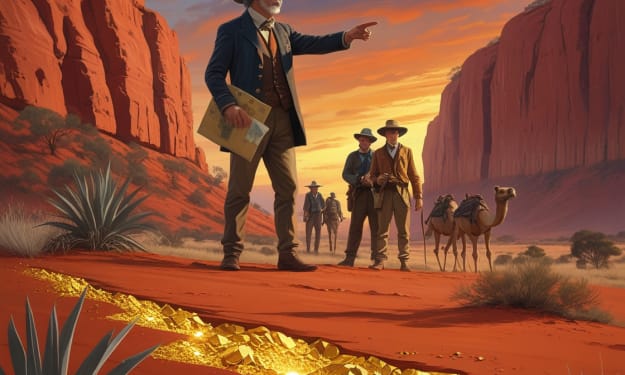
"The Hidden Wealth of Australia: Discovering the Continent’s Most Significant Concealed Treasure" Australia encompasses more than merely arid deserts and ancient terrainsit conceals narratives of substantial, undiscovered fortune. From the legendary Lasseter’s Reef, purported to be an unparalleled gold deposit buried deep within the outback, to the sunken Dutch vessels carrying silver and gold, as well as the loot of outlaw bushrangers hidden in the wilderness, this article delves into the most persistent and valuable treasure legends of the land down under. Join us as we investigate the history, enigma, and contemporary endeavors to reveal Australia’s greatest treasure. Image Prompt: A lifelike digital illustration of the Australian Outback featuring red sandstone cliffs, a group of adventurers examining maps and tools, alongside glimmering gold partially concealed in the desert ground. A spectral image of Harold Lasseter gesturing toward the horizon lingers in the background. Include camels, indigenous flora, and a radiant sunset sky. Title: The Myth of Lasseter’s Reef: Australia’s Most Significant Lost Treasure Introduction Nestled within the blistering core of the Australian Outback resides one of the most enduring and enigmatic legends in the nation's history: the narrative of Lasseter’s Reef. Alleged to be a considerable gold deposit concealed in the desert, this "reef" (a term utilized in mining to indicate a vein of gold-bearing rock) has fascinated prospectors, explorers, and treasure seekers for more than a century. Despite countless expeditions and relentless quests, the elusive treasure remains unlocateda spectral promise of immense wealth buried beneath limitless red sands. The Genesis of the Legend The tale commences with Harold Bell Lasseter, a man of intricate character and profound conviction. In 1929, Lasseter asserted he had discovered a colossal gold reef in Central Australia as a youth in 1897, at the age of 17. He recounted that his camel had fled during a solo expedition, and while searching for water and security, he encountered a lustrous, golden ridge extending for miles. Lacking the tools to extract it and driven by survival instinct, he memorized the site and subsequently returned to civilization. For many years, Lasseter clung to his secret, disheartened that nobody believed his account. However, as Australia grappled with the aftermath of the Great Depression in the 1930s, his narrative gained momentumproviding optimism to a desperate nation yearning for wealth and stability. The 1930 Expedition With governmental support and private investment, the Central Australian Gold Exploration Company (CAGE) was established, and an expedition was assembled to seek out the reef. Lasseter was designated as the guide and led a team of explorers, camels, provisions, and radio apparatus deep into the desert from Alice Springs. Nevertheless, conflicts rapidly intensified. Lasseter’s ambiguous instructions, secretive demeanor, and insistence on proceeding independently estranged his team. Ultimately, the group dissolved in exasperation, leaving Lasseter solitary in the desert. For several weeks, he endeavored to survive, reportedly assisted by Aboriginal individuals. His final journal entries, later discovered by rescuers, recount his ongoing pursuit of the reef, his solitude, and his gradual demise in a secluded cave near the Petermann Ranges in early 1931. His remains were located in a deteriorated state, yet his narrative endured. Reality or Fabrication? Since Lasseter’s demise, contention has erupted regarding the existence of his reef. Some theorize it was a figment of imaginationpossibly heat-induced hallucinationsor an elaborate deception. Conversely, others assert its authenticity, citing: Lasseter’s meticulous journal, in which he documented distances, sites, and details. Independent testimonies from other adventurers and Aboriginal oral histories that suggest gold in the same vicinity. The likelihood that Lasseter employed an alternative coordinate system or had forgotten the precise location after thirty years. While no conclusive physical proof has ever been discovered, numerous treasure seekers and explorers persist in exploring the myth. Contemporary Searches and Technology The evolution of satellite imaging, geological surveying, and GPS technology has rekindled interest in the quest for Lasseter’s Reef. Numerous expeditions in the 20th and 21st centuries have traversed the central Australian deserts, particularly around the Petermann and Rawlinson Ranges, yet the reef remains undiscovered. In 2005, a private exploration team asserted they had found “evidence” of a gold-rich area consistent with Lasseter’s account, but no commercial achievement ensued. Others continue to finance investigations, convinced that a concealed fortune lies beneath the crimson soil. Cultural Significance
By Say the truth about a year ago in History
"The Lost Riches of Australia: Uncovering the Continent’s Greatest Hidden Treasure" . AI-Generated.
"Australia’s Forgotten Fortune: The Legend of the Lasseter’s Reef and Other Lost Treasures" Australia may be best known for its rugged outback and gold rush towns, but hidden beneath its red earth lies a legend of unimaginable wealth — the tale of Lasseter’s Reef, a massive gold deposit supposedly buried in the heart of the desert. This article delves into the history of Australia's biggest rumored treasure discoveries, including gold rushes, sunken ships, outlaw loot, and the still-unfound fortunes that have lured explorers for over a century. Introduction: A Continent of Mystery and Riches Australia, the world’s sixth-largest country, has long held the reputation of being a land of natural wonders. But beneath its scorching deserts, tropical rainforests, and jagged coastlines lies a rich — and often hidden — history of buried treasure. From massive gold rushes in the 19th century to legends like Lasseter’s Reef, Australia’s search for fortune has fascinated adventurers, scholars, and treasure hunters for over 150 years. The Gold Rush Era: When Fortune Sparked a Nation Australia’s greatest tangible treasure boom began in the mid-1800s with the discovery of gold in New South Wales and Victoria. The 1851 gold rush in Ballarat and Bendigo triggered a wave of immigration, wealth, and global attention: Over 1 million kg of gold were extracted in the 19th century. The town of Ballarat became one of the richest places on Earth. The Welcome Stranger Nugget (1869), found in Victoria, remains the largest alluvial gold nugget ever discovered, weighing 72 kg and valued at over $4 million USD today. But while these documented finds changed the economy and culture of the young colony, other riches remained elusive — hidden in legend and myth. The Legend of Lasseter’s Reef The most famous lost treasure in Australian history is Lasseter’s Reef, a supposed vein of gold so rich that it would rival any mine on Earth. In 1929, Harold Bell Lasseter, an Australian explorer, claimed he had discovered a 30-kilometer-long gold reef in the central Australian desert as a young man in the 1890s. He mounted an expedition in 1930 to rediscover the reef, but was abandoned by his team, perished in the desert, and left behind only a diary describing the location. The exact location of Lasseter’s Reef was never found, and no one has definitively proven its existence. Despite numerous expeditions, satellite mapping, and even government-backed searches, the treasure remains lost. Some believe it was a fabrication; others insist it’s still hidden in the remote Petermann Ranges of the Northern Territory — just waiting to be found. Estimated Value: If real, Lasseter’s Reef could contain billions of dollars worth of gold — making it one of the largest lost treasures in modern history. The Wreck of the Gilt Dragon Not all treasure legends lie in the desert. Along Australia’s treacherous western coastline, dozens of Dutch East India Company (VOC) ships were wrecked during the 17th century on their way to Batavia (now Jakarta). The most famous among them, the Vergulde Draeck (Gilt Dragon), sank in 1656 with a cargo of silver coins, trade goods, and gold bullion. Modern estimates suggest the cargo was worth millions even in 17th-century value. Only fragments have been recovered off the coast of Western Australia. Many believe much of the treasure was buried or looted by survivors and remains hidden in the bushland. Bushranger Gold: Thunderbolt and Others Australia’s outlaw era also left behind tales of buried loot. The bushrangers, especially Captain Thunderbolt, Ben Hall, and Ned Kelly, were known to rob gold shipments and bank vaults. Captain Thunderbolt is rumored to have buried several caches of gold and coins in New South Wales. While some have been found, most treasure maps are considered lost or hoaxes.
By Say the truth about a year ago in History
Samsung Eligible device for oneUi7 . AI-Generated.
The official rollout of Samsung's One UI 7 update, which is based on Android 15 and brings a slew of new features and improvements to a wide range of Galaxy devices, has begun. The update began rolling out to various device series in phases in April 2025.📱 Eligible Devices for One UI 7
By Aprub Hasan Afifabout a year ago in History
THE HISTORY OF PAPER
There was a time when people learned to write, not make paper. In some countries it was customary to write on stones. some would write on soft soil and then burn that soil to make brick tiles. Their paperwork would go away in that brick. But you can easily understand the special difficulty of studying with such bricks. Imagine a student going to a classroom. Along with him came three baskets of brick and a pulm of mud for writing. Just sending a few letters takes a lot of hard work, fetching soil, fetching water, compacting mud, polishing, making tiles, but there is no end to writing letters, burning, cooling, and calling. It is much easier and convenient than this to write on the leaves of the tree, which has been used for a long time in our country. 6000 years ago in Egypt, the young bark of the papyrus tree was used to make paper. Like some sort of thing was made. The English word paper comes from the word papyrus. But even this papyrus material cannot be properly called paper. Papermaking was first introduced in China. But the Chinese did not teach this science to anyone. For about 100 years, some Chinese artisans learned to make paper, and from that time, this knowledge spread far and wide. From Arabia to Egypt, from Egypt to other places in Africa. Then, in Spain, Germany, and England, paper mills appeared everywhere. At that time, all papers were made from torn paper, and it was done by hand. A clean rag would be wetted and poked with a toothed object; at that, the rag was torn to shreds like threads. Add water to it and knead it for a long time to form a thin paste. The dough of this rag was sieved and sifted in various ways to make paper as white as silk. At that time, people thought of paper as a very nice thing, but gradually the price of paper came down, various mills for making paper came out, and the cut of paper increased so much that the paper workers saw that it was not possible to collect so many torn sheets. Then there was a search around, what other things can be made of paper? First: Spain's esparto grass was very papery, then gradually it was seen that it did not wash. It is impossible to say how many things have been tasted to make paper from it. Sugarcane husks, banana peels, jute, straw, grass, bamboo, fiber-like wood threads, all kinds of things like sugarcane are not left. In general, paper is made from wood, esparto grass, and old rag paper. The chalk that Bolata makes has a substance in it that is just like paper. Nowadays, mills also produce different types of paper from wood pulp, etc. The wood from which the paper is made comes from gulal in America and Norway. The foresters cut the trunks of large trees and throw them into the mouth of the mill, and the wood is chopped up at the other end of the mill. The sap is ground, boiled, and cleaned, then the latex-soft wood is pressed into wafers, and the wafers are shipped to papermakers. Paper workers make manda by mixing the wafer again in water, then boiling the manda and making it like broth. This broth is poured into a paper mill and an iron tube. The mill feeds on wood, grass, or rag pulp on one side and produces 4/5 mile long paper bales on the other side. When the mills run all day and night, a sheet of paper twelve cubits wide and two and a half miles long is produced. After that, the broth is prepared by mixing the dough in a bowl of hot water. As the broth is run through the mill, it falls over a long moving strainer. The strainer keeps moving and gives and gives a kind of shake now and then, the water falls out, and the broth gradually comes under the pressure. In this way, the broth falls into the other head of the faucet – there are many ‘rollers’ like balloons which are used for rolling bread. The strainer comes here and spills the broth into a roller. But that broth is no longer broth; now it looks like wet blotting paper. By now, it's just a paper. As soon as the paper touches the roller, the roller pulls it. Then the paper is moved between many rollers. In this way, the paper has to be continuously pressed, sanded, rubbed, and polished, and the paper gradually becomes thinner and softer. Of course, all these tasks are done automatically in the factory. There are a couple of people who just make sure all the factories are going well. Work runs as equal to twenty-four hours; one head of the mill has a continuous flow of the broth-free strainer is only resting, the paper congealed from the strainer is constantly jumping onto the roller, the roller has no rest, and is also pulling and pushing the paper out.
By Afroza Islamabout a year ago in History
The Civil Rights Movement in the USA: A Turning Point in American History. AI-Generated.
The Civil Rights Movement in the USA: A Story of Courage and Change There was a time in America when people with dark skin were not treated equally. They could not sit where they wanted, go to the same schools, or even drink from the same water fountains as white people. This was called racial segregation, and it was unfair. But things did not stay like this forever. A powerful movement started — made of brave people who stood up and said, **"Enough is enough."** This was the **Civil Rights Movement**, and it changed the face of the United States forever. Where It All Began Let’s go back to the **1950s and 1960s** — a time when America was full of rules that separated people by skin color. This was especially common in the southern states. One day in **1955**, in Montgomery, Alabama, a Black woman named **Rosa Parks** was riding a bus. When a white man asked her to give up her seat, she said **"No."** That one word was small — but it shook the world. Her arrest led to the **Montgomery Bus Boycott**, where thousands of Black people stopped riding buses for over a year. This peaceful protest hurt the bus companies financially, and finally, the courts said, “segregation on buses is illegal.” > **Highlight:** Rosa Parks’ quiet courage became a loud call for change. The Rise of Dr. Martin Luther King Jr. During the Montgomery Bus Boycott, a young preacher named **Dr. Martin Luther King Jr.** became a leader. He believed in **non-violence**, inspired by Mahatma Gandhi. He said: > “Hate cannot drive out hate. Only love can do that.” Dr. King and others led **peaceful marches**, gave **powerful speeches**, and organized **boycotts** — all to demand **equal rights for Black Americans.** One of his most famous moments was the **March on Washington in 1963**, where he stood in front of the Lincoln Memorial and said: > “**I have a dream**... that one day... children will not be judged by the color of their skin, but by the content of their character.” More than 250,000 people stood and listened that day. > **Highlight:** Dr. King’s dream became a message of hope for all generations. --- Brave Children and the Power of Schools In 1954, the **Supreme Court** ruled in **Brown v. Board of Education** that separating children in schools based on race was wrong. But many schools still refused to allow Black children. One of the bravest stories is of **Ruby Bridges**, a six-year-old Black girl who, in 1960, walked into an all-white school in New Orleans. People shouted at her, but she kept walking — protected by U.S. Marshals. She didn’t cry. She just wanted to learn. > **Highlight:** A little girl with a big heart taught America what courage really looks like. Bloody Sunday and the Fight for Voting Rights In 1965, many Black Americans still couldn’t vote due to unfair laws. To protest, activists marched from **Selma to Montgomery, Alabama.** But on **“Bloody Sunday,”** police attacked peaceful marchers on a bridge — beating them with sticks and spraying tear gas. The pictures shocked the nation. After that, President **Lyndon B. Johnson** signed the **Voting Rights Act of 1965**, which gave Black citizens the right to vote without fear. > **Highlight:** Their pain on the bridge opened the road to justice. - Civil Rights Laws That Changed America** Because of the Civil Rights Movement, the U.S. government passed powerful laws: * **Civil Rights Act of 1964** – No more discrimination in schools, jobs, or public places. * **Voting Rights Act of 1965** – Protected every citizen’s right to vote. * **Fair Housing Act of 1968** – Stopped racial discrimination in housing. These laws helped break down the legal walls that kept people apart. > **Highlight:** Protest turned into policy, and policy brought change. Not Just Black and White While the movement began to fight for **African Americans**, it inspired many others: * **Women** began fighting for equal rights in the workplace. * **Latinos**, **Asians**, and **Native Americans** started their own justice movements. * **Disabled people**, **LGBTQ+ communities**, and others found hope through civil rights actions. > **Highlight:** The Civil Rights Movement lit a flame that spread across America. Why This story matters Today Even today, the fight for justice and equality continues. People still march for **Black Lives Matter**, for **fair treatment**, and for **human dignity**. The spirit of Dr. King, Rosa Parks, and Ruby Bridges still walks in today’s streets. > **Highlight:** The movement may have started in the past — but its heart beats in the present. Conclusion: A Story of the People The Civil Rights Movement was not just about laws or leaders — it was about **people**. Ordinary people. Mothers, students, teachers, and workers. They changed the world with their voices, their marches, and their courage. It’s a story of pain, yes — but also of power. A story of hate — but answered with love. And most of all, a story that reminds us: > *When we stand together, change is possible.*
By Tanushree Dasabout a year ago in History
How Close Was the Roman Empire to an Industrial Revolution? 🏛️⚙️
When we think about ancient Rome, we picture majestic architecture, powerful legions, and sophisticated roads. But one question often pops up among history lovers and alternative history fans alike: Could the Roman Empire have had its own Industrial Revolution? 🤔
By Toader Adelinabout a year ago in History
The Great Underground Pyramid of Alaska: Secrets Beneath the Frozen Tundra
Beneath the Frost, a Hidden Legacy Beneath the endless expanse of Alaska's tundra lies an enigma that has puzzled explorers, researchers, and conspiracy theorists for decades. For years, the whispers have circulated, tales of a massive underground pyramid, an ancient structure far older than anything recorded in history. Hidden deep within the wild, remote regions of the state, this pyramid is said to be a relic of an advanced civilization, one that predates all known ancient cultures.
By The Secret History Of The Worldabout a year ago in History
"The Golden Empire: Inside the Wealth of the Mali Empire under Mansa Musa" . AI-Generated.
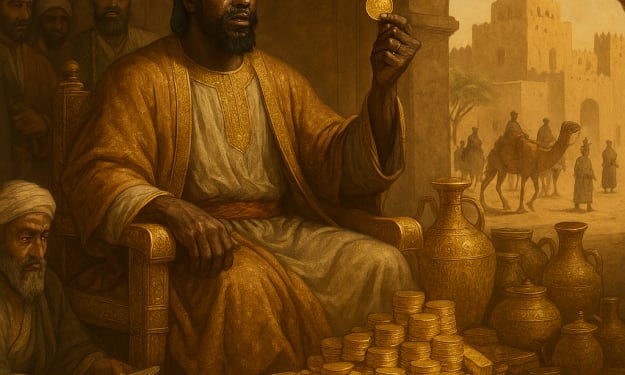
“The Gold Mines of Kings: The U"The Golden Empire: Inside the Wealth of the Mali Empire under Mansa Musa" nrevealed Treasures of the Mali Empire” The Mali Empire, during the governance of Mansa Musa, represented the most affluent empire in African heritage and potentially the globe. Founded upon substantial gold assets and trans-Saharan commerce, Mali's principal cities such as Timbuktu and Niani thrived with splendid palaces, mosques, and riches beyond comprehension. This article delves into the ascendance of the Mali Empire, its astounding net worth, and the legendary pilgrimage of Mansa Musa that amazed the world with its golden magnificence. Introduction: A Golden Era in West Africa While Europe was still recovering from the Dark Ages, a remarkable civilization emerged in the heart of West Africa the Mali Empire. Established in the 13th century, Mali evolved into one of the most prosperous empires in history, attaining its peak under the leadership of Mansa Musa, the 10th monarch. Mali’s wealth was so extensive that Mansa Musa’s name became emblematic of unimaginable affluence, and his 1324 pilgrimage to Mecca was so lavish that it induced inflation in Egypt for more than a decade. But what contributed to the Mali Empire’s opulence? From where did the riches originate, and what heritage does it leave for posterity? Gold: The Cornerstone of Empire The foundation of Mali’s economic strength resided beneath the ground: gold. West Africa housed some of the largest and most fruitful gold mines in the ancient world, particularly in Bambuk, Bure, and Galam. These mines supplied the empire’s coffers and established Mali as the foremost gold provider for the Mediterranean and Islamic civilizations for over 500 years. During a time when gold represented currency, Mali was perched atop a fortune. Scholars estimate that Mali may have controlled half of the global gold supply during its pinnacle. Trade and Commerce In addition to its mines, Mali prospered due to its strategic location along trans-Saharan trade routes. Caravans of camels occasionally numbering in the thousands transported: Gold, salt, and ivory northward Silks, spices, books, and textiles southward Cities such as Timbuktu, Gao, and Djenné evolved into hubs of wealth and culture. Timbuktu’s renowned market and libraries attracted scholars and merchants from as far as the Middle East and Europe. Taxes were imposed on traders, further enhancing the empire’s wealth. A merchant navigating through Mali was reportedly greeted by gates embellished with gold, silk-adorned pavilions, and marketplaces brimming with luxurious goods. The Pilgrimage of Mansa Musa: The Wealthiest Individual in History In 1324, Mansa Musa embarked on the Hajj pilgrimage to Mecca, traversing more than 4,000 miles accompanied by a retinue that astonished the world: 60,000 men, including 12,000 slaves 100 camels, each bearing up to 135 kg (300 lbs) of gold Countless horses, dancers, scholars, and attendants Musa distributed gold so generously in Cairo that he incited hyperinflation, diminishing the value of the metal for over a decade. Historians estimate that his personal net worth might surpass $400 billion in contemporary terms, establishing him as arguably the wealthiest individual in human history. Cultural Wealth and Legacy Mansa Musa didn’t merely utilize wealth he allocated resources towards education, architecture, and religion: Established Sankore University in Timbuktu, which rivaled Oxford and Al-Azhar. Constructed numerous mosques, palaces, and libraries. Financed educational institutions, scholars, and scribes to replicate thousands of manuscripts. These endeavors transformed Mali into a beacon of knowledge within the Islamic realm. At its zenith, Timbuktu boasted 25,000 students and housed over 700,000 manuscripts, many of which endure today in private collections. The Decline and Dispersal of Wealth Following Mansa Musa's demise in 1337, the empire's prominence gradually diminished. Political turmoil, internal conflicts, and pressure from emerging powers such as the Songhai Empire contributed to fragmentation. Many of Mali's riches were: Plundered during invasions. Concealed or hidden to evade confiscation. Exchanged by lesser rulers in times of desperation. Despite its decline, remnants of Mali’s wealth persist in oral traditions, Arabic manuscripts, and the dusty repositories of European collectors who once obtained African artifacts during colonial periods. Estimating the Wealth Contemporary economic historians assess: Annual gold exports at peak: 1–2 tons per annum. Mansa Musa's net worth: $400 billion+. Empire-wide wealth: Easily in the trillions by contemporary metrics, when accounting for trade income, land, and cultural capital. This positions Mali among the most affluent civilizations in world history, eclipsing many European kingdoms of the same era. Conclusion The narrative of the Mali Empire extends beyond mere gold. It encapsulates a civilization that intertwined commerce, culture, and faith into one of the greatest golden ages ever witnessed. While much of its wealth has been dispersed, Mali's legacy as a symbol of African magnificence remains formidable. And beneath the sands of West Africa, perhaps additional treasure still lies hiddenawaiting recognition from history.
By Say the truth about a year ago in History
"The Lost Treasure of Srivijaya: Southeast Asia’s Forgotten Maritime Empire". AI-Generated.
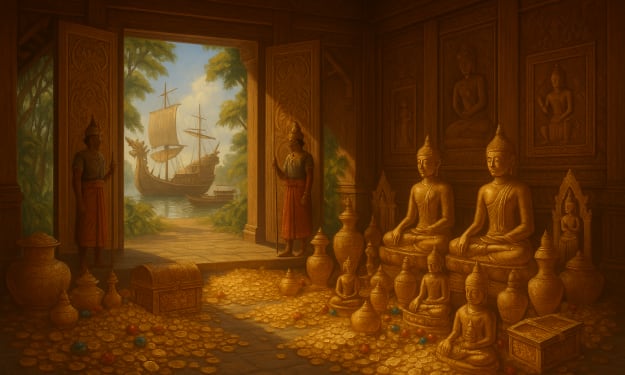
"The Golden Fortress of Srivijaya: Southeast Asia’s Forgotten Maritime Treasure" Summary: Long before the rise of modern global empires, the Srivijaya Empire ruled the waves of Southeast Asia, commanding trade routes, cultural influence, and immense wealth. Though largely forgotten today, Srivijaya once controlled the crucial maritime passages between the Indian and Pacific Oceans, amassing a treasure trove of gold, spices, and religious artifacts. This article uncovers the rise, glory, and hidden wealth of the Srivijaya Empire — a true maritime superpower lost beneath time and tide. The Rise of a Maritime Power The Srivijaya Empire emerged in the 7th century CE, centered around present-day Palembang, Sumatra in Indonesia. Unlike land-based empires, Srivijaya was a thalassocracy — a kingdom built on controlling the seas rather than territories. Its strategic location near the Strait of Malacca, one of the busiest maritime passages in the world, allowed Srivijaya to dominate global trade between China, India, and the Middle East for over six centuries. Sources of Wealth Srivijaya's treasure was built on multiple pillars: Maritime trade: Merchants from China, India, Arabia, and even Africa passed through Srivijayan ports. Goods included spices, gold, ivory, silk, porcelain, camphor, sandalwood, and textiles. Tributes: As a hub for Mahayana Buddhism, Srivijaya received religious tributes from powerful kingdoms like China and Tibet. Taxation and Tolls: All passing ships had to pay customs duties, contributing to royal coffers. One 10th-century Chinese record described the king of Srivijaya as owning ten thousand vessels and a treasury of pure gold bricks. The Royal Court and the Treasury The Srivijayan monarch, referred to as Maharaja, resided in a grand wooden palace decorated with gold-leafed ornaments, lacquerware, and foreign gifts. Archaeological evidence suggests that gold was abundant in the empire. Excavations in Sumatra have revealed: Gold jewelry weighing several kilograms Religious artifacts, including golden statues of Buddha Coinage used for trade and ceremonial offerings Gold was also used to plate royal palaces, religious shrines, and even the hulls of ships in elite fleets. Religious Treasures and Cultural Wealth Srivijaya was not just a political and commercial hub, but also a center for Buddhist learning. Monks from India and China — including the famous Yi Jing — visited and wrote about the empire’s grand monasteries and temples. These institutions were richly endowed: Temples adorned with golden stupas and relics Libraries with palm-leaf manuscripts and priceless religious texts Royal donations of jewels, incense, and spices to Buddhist communities The Srivijaya elite believed such donations earned spiritual merit and worldly prestige. Estimating the Wealth of Srivijaya Though exact records are scarce, modern historians and economists estimate the empire’s wealth by considering: Annual tribute and customs taxes from thousands of ships Gold reserves from Sumatra’s mines Trade profit margins on high-value goods like nutmeg, cloves, and camphor If valued in today’s terms, Srivijaya’s annual trade revenues could have exceeded $2 billion USD, with total stored treasure and assets reaching over $50–100 billion during its peak (8th–11th centuries CE). Naval Power and Maritime Control To protect this wealth, Srivijaya maintained a large naval fleet, including: Fast war canoes and ocean-going ships Merchant vessels with armed escorts Maritime garrisons stationed on key islands This control allowed the empire to deter piracy, enforce tolls, and maintain peace along thousands of kilometers of sea routes. Srivijaya also allied with pirate clans in the South China Sea, using them as both enforcers and intelligence agents. The Decline and the Lost Treasure In the 11th century, the Chola dynasty of South India launched devastating raids on Srivijayan ports, looting palaces and religious centers. Later, Srivijaya lost control over strategic ports to rivals like Majapahit and the Thai kingdoms. Eventually, the once-mighty empire collapsed, and its wealth disappeared into the jungles and sea. Treasure hunters, historians, and archaeologists believe that: Shipwrecks from Srivijaya’s fleet lie untouched beneath the South China Sea Buried vaults may still be hidden beneath modern Palembang Golden relics continue to be discovered — such as a golden Buddha unearthed in 2021 Legacy Today, Srivijaya’s legacy lives on in: The Malay and Indonesian languages, which carry influences from Sanskrit and Buddhism Religious monuments like Borobudur, which was funded partly through Srivijayan patronage Ongoing archaeological discoveries that continue to reveal a civilization of wealth, wisdom, and wonder Conclusion Srivijaya’s treasure wasn’t just gold and jewels — it was the wealth of ideas, trade, faith, and maritime brilliance. As modern technology uncovers more sunken ships and forgotten temples, the hidden fortune of Southeast Asia’s golden empire may still be waiting to emerge from beneath the sands and waves.
By Say the truth about a year ago in History