Ancient
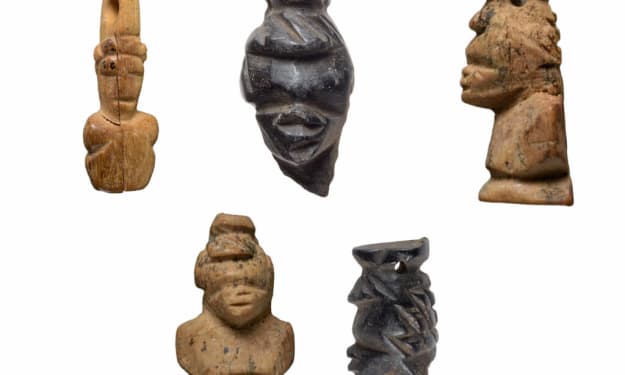
African Figurines Found in Negev Desert Christian Burial Shed Light on Early Cross-Cultural Connections. AI-Generated.
In an marvelous archaeological discovery, a fixed of African collectible figurines changed into exposed in a Christian burial web website online placed within side the Negev Desert, supplying splendid proof of early cross-cultural interactions among Africa and the Middle East. This surprising locate has raised good sized questions on the motion of people, goods, and thoughts in the course of the past due antiquity period, revealing how interconnected historic civilizations virtually had been.
By jihad ahmedabout a year ago in History
Alexander the Great and the Indian Dragon: Legend, Mystery, or Forgotten History?
A Conqueror's Path Meets the Unknown Alexander the Great is one of history’s most legendary figures. Born in 356 BCE in Macedonia, his military campaigns that extended from Greece to Egypt, Persia, and as far as the borders of India. By the age of 30, he had conquered most of the known world. But it wasn’t just empires and armies he encountered along his path. According to a few ancient accounts, he may have come face-to-face with something far more mysterious, something that some describe as a dragon.
By The Secret History Of The Worldabout a year ago in History
The Malediction of the Pharaoh’s Gold: Vanished Wealth of the Egyptian Desert
The Myth Commences In the core of ancient Egypt, during the reign of a formidable yet lesser-known pharaohNeferkare Djedkarea substantial quantity of gold was amassed. This was not merely opulence for royal extravagance; it was designated for a divine purpose: to assist the pharaoh in his voyage to the afterlife and to maintain the splendor of Egypt beyond existence. According to a now-missing segment of the Book of the Dead, Djedkare commanded the construction of a secret temple beneath the sands of the Western Desert, well removed from the Nile and beyond the reach of tomb infiltrators. There, gold effigies, gilded scrolls, and amulets were interreditems intended not for the gaze of mortals. The temple was secured with a malediction, cautioning that those who disturbed the resting place would invoke doom upon themselves. Pharaoh Djedkare and His Era Djedkare Isesi, a genuine historical pharaoh of the Fifth Dynasty, governed approximately 2414–2375 BCE. Though not as renowned as Ramses II or Tutankhamun, Djedkare was acknowledged for reorganizing the Egyptian state, expanding trade pathways, and fostering religious transformations. Under his sovereignty, Egypt attained new administrative peaks, while also beginning to shift focus from pyramid construction to concealed tombs and spiritual safeguarding. Djedkare’s tomb in Saqqara was recognized, but legends assert that he had another clandestine burial chamber created for the true treasures of his reignone that remains undiscovered to this day. The Malediction of the Pharaoh’s Gold Tales transmitted through generations recount the Malediction of the Pharaoh’s Gold. The curse was not merely a supernatural menace, but a series of lethal traps and natural perilities devised to protect the hallowed treasure. Ancient inscriptions, deciphered in the early 20th century, reportedly stated: “He who pursues the gold of the sun will consume sand and silence. The jackal will feast on the bones of the avaricious. Let the sacred repose remain undisturbed. ” Whether figurative or literal, the curse was believed to wield genuine power. Explorers who ventured in search of this lost tomb frequently vanished, descended into madness, or encountered tragic destinies. The Lost Expedition of 1898 In 1898, British Egyptologist Sir Edwin Brackley spearheaded an expedition into the Western Desert, motivated by recently uncovered scrolls pertaining to the Sanctuary of Eternal Light, thought to be Djedkare’s hidden temple. His team consisted of local guides, a photographer, and camel drivers. They departed from Dakhla Oasis and proceeded westward. According to Brackley’s journallast retrieved from a camel driver who returned alonethe group encountered peculiar ruins obscured beneath sand dunes. There were indications of an entombed structure, with shimmering fragments of gold leaf and hieroglyphs cautioning against divine retribution. The final entry in Brackley’s journal stated: “We discovered it. The sand quakes. Something observes. ” The entire team disappeared. No remains, no tents, no artifacts were ever unearthedonly scattered journals and a shattered camera lens located a year later. Modern Endeavors and Satellite Observations In recent decades, contemporary archaeology has introduced renewed optimism to the legend. Infrared satellite imaging and ground-penetrating radar have disclosed subterranean irregularities in remote desert locales, potentially artificial structures concealed beneath centuries of sand. A 2013 expedition financed by a European-Egyptian archaeology partnership reported a significant rectangular void northwest of the Black Desert, too symmetrical to be natural. However, extreme heat, shifting dunes, and governmental constraints have hindered comprehensive excavation. Several scholars contend that these irregularities may indicate a concealed burial sitepotentially the mythical Sanctuary of Eternal Light.
By Say the truth about a year ago in History
The Lost Golden Temple: Unraveling the Enigma of a Neglected Wonder
The Tale of the Golden Temple Throughout ancient societiesfrom the thick forests of Southeast Asia to the peaks of South Americamyths recount a splendid temple erected not from stone or timber, but from pure gold. According to various cultural narratives, this edifice served not only as a place of veneration but also as a treasury of unimaginable riches, sacred relics, and esoteric wisdom. While numerous locales assert to have sheltered such a temple, one narrative, in particular, stands outthe myth of the Golden Temple of the Sun, believed to have flourished within the ancient Incan Empire, near present-day Peru. The Temple of the Sun: A Neglected Marvel The most enduring legend revolves around the Coricancha (translated as “Golden Courtyard”), the hallowed temple dedicated to the sun deity Inti in the heart of Cusco, Peru. Initially constructed by the Inca and subsequently altered by Spanish colonizers, this sanctuary was once adorned with layers of gold, showcasing golden statues, altars, and even vegetation fashioned entirely from precious metal. According to Spanish conquistadors who arrived in the 16th century, the temple dazzled with its brilliance: Walls clad in gold. Golden effigies towering above visitors. Life-sized golden llamas, maize fields, and altars devoted to the sun. The Coricancha was not merely a site of worship; it was the spiritual and economic nucleus of the Inca Empire. Priests performed rituals, monitored celestial movements, and safeguarded royal treasure in subterranean vaults. The Conquest and Vanishing When Francisco Pizarro and his men reached the Andes, they were astonished by the wealth they encountered. However, their astonishment rapidly transformed into avarice. The Spanish plundered the Coricancha and other shrines, melting the gold and dispatching it back to Spain. Nevertheless, Incan chronicles and oral histories recount a divergent narrativeone of strategic defiance. As tidings of the Spanish incursion spread, Incan priests and nobles allegedly smuggled a significant portion of the treasure out of Cusco before it could be seized. The fate of this concealed gold has remained a mystery for centuries. Some accounts suggest it was taken deep into the jungles to the east of the Andes, to a clandestine temple constructed entirely of goldnever discovered by outsiders. El Dorado and the Temple Association The myth of a Golden Temple soon intertwined with another South American legend: El Dorado, the city of gold. Early explorers believed that within the unexplored interior, a city or temple shimmered in sunlight, its rooftops and spires adorned with pure gold. Numerous expeditions were undertaken: Spanish explorers such as Gonzalo Pizarro and Francisco de Orellana journeyed into the Amazon basin in pursuit of it. English navigators during the 17th century chased tales of a solar temple concealed within the Orinoco or Magdalena rivers. Throughout the 20th century, satellite imagery and archaeological assessments perpetuated the searchalbeit without achievement. Nonetheless, the legend of the temple persisted. Other Theories and Global Resonances Beyond South America, other cultural reflections of a golden temple exist: In India, the Golden Temple of Amritsar stands todayhowever, it is a subsequent creation from the 16th century CE and constructed more symbolically than mythically. Ancient Khmer folklore alludes to a golden shrine hidden within the Cambodian jungle, potentially predating Angkor Wat. In China, Taoist writings reference a mystical “Palace of the Golden Phoenix” situated in a mountain shrouded in mist, though historians have yet to validate its existence. Each narrative implies humanity’s fascination with sacred sites composed of the most enduring substancegold. Is the Golden Temple Authentic? Skeptics contend that the notion of a temple entirely fashioned from gold is logistically improbable, particularly in ancient epochs. Gold is pliable and dense, unsuitable for structural stability. Nevertheless, as a symbolic façade or ceremonial covering, its application is feasibleespecially in a culture where spiritual contributions were intertwined with material affluence. Archaeological excavations in Cusco have verified that Coricancha was indeed covered in gold prior to the Spanish incursion. Numerous Inca artifacts retrieved from cave systems and subterranean rivers bolster the hypothesis that substantial hoards of gold were deliberately concealed. Could the fabled Golden Temple have been an actual siteperhaps an extension or hidden sanctuary constructed by the Incas in exile? The Pursuit Persists Contemporary innovationsLIDAR, satellite imaging, and ground-penetrating radarhave unveiled new possibilities in the quest for the Golden Temple. Explorers continue to examine remote areas of the Andes and the Amazon, discovering ruins, pathways, and previously unidentified settlements. Yet, the temple itself remains elusive. Whether concealed beneath the soil, obscured by foliage, or merely a symbol of spiritual wealth lost to the annals of time, the Golden Temple endures as one of history’s most captivating enigmas. Conclusion The Golden Temple signifies more than mere architectural aspirationit embodies the zenith of ancient devotion, the human longing for immortality through prosperity, and the narratives that transcend even empires. Until it is discoveredor definitively established as a myththe legend will continue to illuminate, captivating the souls of treasure seekers and historians alike.
By Say the truth about a year ago in History
The Cold War: A Detailed Overview
🧊 The Cold War: A Detaiew Timeframe: Approximately 1947 – 1991 Main Adversaries: The United States and its NATO allies vs. The Soviet Union and its Warsaw Pact allies Ideological Conflict: Capitalism and democracy (USA) vs. Communism and authoritarianism (USSR) --- 🌍 Origins of the Cold War The Cold War emerged after the end of World War II, as the wartime alliance between the United States and the Soviet Union began to disintegrate. The primary factors contributing to the Cold War included: Ideological Differences: The U.S. championed capitalism and democracy, while the USSR advocated for communism and a centrally planned economy. Geopolitical Tensions: The Soviet Union sought to expand its influence in Eastern Europe, leading to the establishment of communist governments in countries like Poland, Hungary, and Czechoslovakia. The U.S. viewed this as a threat to democratic nations and responded with policies aimed at containing communism. Economic Factors: The U.S. implemented the Marshall Plan to aid in the reconstruction of Western Europe, while the USSR established the Comecon to support Eastern Bloc countries. ---🔑 Key Events During the Cold War 1. Berlin Blockade and Airlift (1948–1949) In an effort to gain control over the entire city of Berlin, the Soviet Union blockaded all land routes to West Berlin. In response, the United States and its allies initiated the Berlin Airlift, supplying West Berlin with food and fuel via air transport for nearly a year. 2. Formation of Military Alliances NATO (North Atlantic Treaty Organization): Established in 1949, NATO was a collective defense alliance among the U.S., Canada, and Western European nations. Warsaw Pact: Formed in 1955, this was a collective defense treaty among the Soviet Union and its Eastern Bloc allies. 3. Korean War (1950–1953) The Korean Peninsula was divided into North Korea (communist) and South Korea (capitalist). The war began when North Korean forces, supported by the USSR and China, invaded South Korea. The United Nations, led by the U.S., intervened on behalf of South Korea. The conflict ended in an armistice, restoring the original borders. 4. Cuban Missile Crisis (1962) The Soviet Union placed nuclear missiles in Cuba, just 90 miles from the U.S. coast. This discovery led to a tense 13-day standoff, bringing the world to the brink of nuclear war. The crisis was resolved when the USSR agreed to remove the missiles in exchange for a U.S. promise not to invade Cuba and the secret removal of U.S. missiles from Turkey. 5. Vietnam War (1955–1975) North Vietnam, supported by the USSR and China, aimed to unify the country under communism. South Vietnam, backed by the U.S., resisted. The war resulted in a communist victory and the unification of Vietnam under communist rule. 6. Space Race The U.S. and the USSR competed to achieve significant milestones in space exploration. Notable events include the Soviet Union launching Sputnik, the first artificial satellite, in 1957, and the U.S. landing the first humans on the Moon in 1969.
By Ahmed rahi about a year ago in History
Have We Misunderstood Our Past? 12,000-Year-Old Calendar Found in Turkey Rewrites Human History
Have We Misunderstood Our Past? 12,000-Year-Old Calendar Found in Turkey Rewrites Human History Imagine standing in front of a towering stone carved by hands that lived 12,000 years ago. No cities no written language no smartphones just a community of early humans looking up at the sky and trying to understand their place in the universe. In southern Turkey near the city of Şanlıurfa lies Göbekli Tepe an ancient archaeological site that continues to puzzle and fascinate scientists. But now a recent discovery at this site may shake the very foundations of our understanding of history a calendar older than any known system of timekeeping in the world.
By Adnan Rasheedabout a year ago in History
Vlad the Impaler: Dracula's Real History and His Clash with the Ottoman Empire
Who was Dracula originally, and what was his conflict with the Ottoman Empire? The scene was a field where, in a semi-circular area spanning about a mile, nearly 20,000 stakes were driven into the ground, and on each one was impaled the mutilated corpse of a Turkish prisoner. On the two tallest stakes were the bodies of Hamza Pasha, a regional official of the Ottoman Empire, and the Greek Katavolinos, who had been dead for several months. The remnants of their once-valuable clothing fluttered in the air, while the only scent in the atmosphere was that of decaying human flesh. The Greek historian Chalcocondyles writes that this was the sight that greeted the vanguard of the Ottoman Sultan Mehmed II's army in June 1462, 60 miles from the city of Târgoviște in the European state of Transylvania. When Sultan Mehmed II set out from Istanbul on May 17, 1462, to teach a lesson to Prince Vlad III Dracula, the ruler of the state of Wallachia across the Danube River in Europe, few would have thought that the campaign would end in such a way. Historians Radu Florescu and Raymond McNally, in their book Dracula: Prince of Many Faces, His Life and Times, quote the Greek historian as saying that this scene so affected Sultan Mehmed that he said, "...it is very difficult to take his land from a man like this." They wrote that for the night's stay, the Sultan had a deep trench dug around the Turkish camp, and the next day he ordered the army to retreat, saying that the area was not important enough to pay such a price. Wallachia had previously been a tributary state of the Ottoman Empire and remained so after this campaign, but according to historians, its status could not be changed to that of an Ottoman province. The Sultan himself returned, but the campaign against Vlad Dracula did not end. He left Dracula's brother, Radu, with a part of the Turkish army. As a result of this campaign, Dracula had to flee his state, and his younger brother Radu 'the Handsome', supported by the Ottoman Empire, took the throne with the help of the local nobility and those classes who were tired of Dracula's cruelties. Historian Caroline Finkel, briefly mentioning the action against Wallachia in her book Osman's Dream: The History of the Ottoman Empire, writes that "due to the failure of the tributary state of Wallachia to provide the annual tribute and the subsequent provocative actions of its ruler Vlad Dracula, Sultan Mehmed ordered the crossing of the Danube in 1462 to restore order. After a successful operation, Vlad's brother Radul, who had been held hostage in Istanbul as a guarantee of Vlad's good behavior, was made the ruler in Vlad's place. Vlad himself fled to Hungary." About ten years before the Sultan launched this campaign in Europe, he had already earned the title of 'the Conqueror Sultan' by conquering Constantinople, the last vestige of the powerful Byzantine Empire that had lasted for centuries. His empire had spread across more than one continent. This Sultan, who saw himself in the lineage of conquerors like Alexander the Great, now had his sights set far into Europe. In this campaign in 1462, his target was Vlad Dracula, the ruler of the Ottoman tributary state of Wallachia, who, according to historians, had not appeared before the Sultan to pay tribute for three years. Furthermore, historians like Florescu and McNally write that after the conquest of Constantinople, as well as "most of Bulgaria, Serbia, and Greece, the Sultan naturally considered making Wallachia a province of his empire, and to achieve this goal, he ordered operations in the regions of the Danube River, which flows from Germany eastward through several countries and into the Black Sea." Historically, the Danube River had been an important route for those coming from the east with the desire for conquest in the west, and the state of Wallachia was located on the northern bank of this river. The ruling family of this state, with a population of less than a million, had a history of sometimes good and sometimes bad relations with the Ottoman Empire for generations. Florescu and McNally write that now the Sultan, displeased with the policies of the new ruler of the state, Prince Vlad III Dracula, decided to deal with the issue. They wrote that war between Dracula and the conquering Sultan Mehmed II was inevitable; the only question was when. And "(the conqueror of Constantinople) Sultan Mehmed, having grown up together with Dracula, was well aware of the Sultan's desire for conquests." Compared to Mehmed II's empire, Dracula's country was very small, but historians write that his sense of being a ruler was in no way less than that of Sultan Mehmed II. This was a time when the title of Dracula was an honor. Not One, But Two Draculas Before proceeding, let's mention history, where two Draculas are mentioned. One is the one whose name has been unusually prominent worldwide once again this year, as it is every year around the 'Dracula Day' celebrated on May 26th recently, and whose pictures are shared. This Dracula is depicted sinking his teeth into the neck of a victim, or looking towards the sky with blood dripping from his pointed fangs. This series began after the publication of Bram Stoker's novel on May 26, 1897, in which this fictional blood-drinking character, Dracula, was introduced. This character of Dracula might have been fictional, but the name Dracula was not entirely fictional. The prince called Dracula in history, who confronted the Sultan of the superpower of his time, became infamous on one hand for his cruelties, while on the other hand, he is considered a national hero in Romania. This prince of Wallachia, a relatively small state, was called Vlad III Dracula. Dracula meant 'son of Dracul'. This prince is famous in history for being a ruler who impaled thousands of his own people and foreigners on stakes. For this reason, Vlad III Dracula is also known as 'Vlad the Impaler' in English. Interestingly, history tells us that in childhood, the conquering Sultan Mehmed II and Dracula spent some time together, and at that time, they even had the same teacher. On one side was the prince and heir to a Muslim empire spread over different continents, and on the other side was the son of the ruler of a Christian state, one of the many tributary states of this empire in Europe. How did these two end up together under one roof? This will be discussed later, first, an introduction to the prince who was called Dracula. Who was Vlad the Impaler? According to Encyclopedia Britannica, Prince Vlad the Impaler, who ruled the state of Wallachia in the Danube region multiple times, his full name was Vlad III Dracula. He was born in 1431 and died in 1476. He was born in Transylvania and died in an area north of Bucharest, the capital of present-day Romania. Romanian historians Florescu and McNally write that Dracula's era coincided with the time of 'two great Sultans' in the Ottoman Empire: Murad II (1421-1451) and Mehmed II (1451-1481), and they wrote that "(the conqueror of Constantinople) Sultan Mehmed II and our young prince (Dracula) grew up together." Romanian historians write that both these Ottoman Sultans were highly civilized and worldly individuals. "They were far-sighted politicians who taught Europe a lesson in religious tolerance by sheltering Jews and other religious minorities at a time when the Roman Catholic Church was 'persecuting' them." According to Encyclopedia Britannica, in 15th-century Europe, Vlad gained notoriety for his cruel treatment of his enemies. It is also written there that a group of historians believes that the Dracula of Bram Stoker's world-famous novel is actually this Vlad. Vlad's father was Vlad II Dracul. He was given the title Dracul by Sigismund, the Holy Roman Emperor at the time, for his membership in the 'Order of the Dragon', which was formed to stop the Turkish invasion of Europe. According to the encyclopedia, the word Dracul comes from the Latin word Draco, which means dragon. And Dracula means 'son of Dracul'. Thus, the son of Vlad II Dracul was named Vlad III Dracula. Historians also give various reasons for Dracula's title, one of which is that in the Romanian language, Dracul also means 'devil'. According to Encyclopedia Britannica, Dracula lived in the Ottoman Empire from 1442 to 1448, and then he returned to Wallachia after the murder of his father and elder brother. Dracula faced opposition from the Wallachian nobility, including his younger brother, who was supported by the Ottoman Empire, in his attempt to take his father's throne. He became ruler for the first time in 1448 but was soon overthrown, and then it took him eight years to regain his father's seat. In this second reign, he committed the atrocities that made him famous and earned him the name Vlad the Impaler. This period ended in 1462 after the campaign of Sultan Mehmed II mentioned above, which is remembered for Vlad Dracula's 'forest of hanging corpses on stakes'. History tells us that Vlad managed to regain the rule of his father's state for the third and last time in 1476, but in the same year, he was killed in a battle at the age of 45. Vlad III Dracula and the conquering Sultan Mehmed II probably first met in 1442 when Dracula's father left him and his younger brother Radu 'the Handsome' in the custody of Sultan Murad II as a guarantee of his loyalty to the Ottoman Empire. Historians say that at that time, Vlad III Dracula was eleven or twelve years old, and his younger brother Radu was about seven. Prince Mehmed was also about the same age as Dracula at that time. The story is that by this time, Serbia and Bulgaria in Europe had come under Ottoman rule, and Sultan Murad II was preparing to deliver the final blow to the centuries-old Byzantine Empire. Vlad II Dracul, as mentioned earlier, had become a member of the 'Order of the Dragon', formed for opponents of the Ottomans and the Roman Catholic Church, but Florescu and his fellow historian McNally wrote that he was a cunning politician, and as soon as his grip on the throne of Wallachia strengthened, he realized that the balance of power in the region favored the Ottomans. Historians write that seeing the situation, immediately after the death of his patron, the Holy Roman Emperor Sigismund, Vlad II Dracul made a treaty with the Turks. "Dracul and 300 of his companions appeared before Sultan Murad in Bursa, and in a magnificent ceremony, the Prince of Wallachia formally declared his obedience." It is said that after some time, doubts arose in the heart of Sultan Murad (who, according to both historians, was a ruler who honored treaties) about Vlad II. When summoned, Vlad II appeared before the Sultan with his two young sons, Dracula and Radu. According to historians, at the city gate, Turkish soldiers chained them, and both sons were taken to a remote mountain fortress. Vlad II Dracul remained a prisoner of the Sultan for about a year, during which time his elder son Mircea, who had good relations with the Sultan, sat on the throne of Wallachia. Dracul was finally freed after swearing allegiance to the Ottomans on the Quran and the Bible. To prove his goodwill, Vlad II also left his two younger sons in Ottoman custody. Dracula at the Ottoman Sultan's Court Dracula's next six years were spent away from his parents in the Ottoman Empire. He could not speak the local language, and his religion was also different. "Surely, he must have felt that his own people had abandoned him." Dracula remained in the Ottoman Empire until 1448, and his brother Radu until 1462. The Difficulty for Wallachian Rulers Wallachia was among those regions where, unlike in Europe, the throne was not inherited solely by the eldest son; all sons had the right to seek power. Therefore, if one son received the support of a major Western power like the Holy Roman Empire or the Kings of Hungary, the other would try to gain the support of the Ottomans. This is reflected in the efforts of various members of the ruling family for the throne of Wallachia. Florescu and McNally wrote that on the one hand, Vlad could not afford to anger the Holy Roman Emperor Sigismund by ignoring Catholic institutions, and he also knew that according to Wallachian traditions, it was necessary for any ruler to be Orthodox Christian. The history of differences between Orthodox and Catholic Christians was very old and bitter. This was also one reason why it was very difficult for the Orthodox Byzantine Empire to get help from Roman Catholic Europe in its fight against the Ottoman Empire. The Training of the Hostage Prince Vlad III Dracula at the Ottoman Court When princes from small states came as hostages to the Ottoman court, one of the purposes was to make them loyal. History tells us that these princes were trained with the idea that if any of them became the ruler of their state in the future, their loyalty would be with the Ottoman Empire. Good treatment of these foreign princes was conditional on their father's loyalty to the Ottoman Empire. Besides Dracula and his brother, two Serbian princes were also present at the Sultan's court during those days. As punishment for their suspected correspondence with their father, their eyes were gouged out, and "all this happened despite the tears of their 22-year-old beautiful sister, Princess Mara, who was the wife of Sultan Murad II at that time." Dracula was trained by the best teachers of that era. According to historians, he already knew more than one European language, and now he had also mastered the Turkish language. Among his teachers, history mentions "the famous Kurdish philosopher Ahmed Gurani, who was also authorized to use the whip during the training of the Sultan's heir." He was also taught the Quran, Aristotle's logic, and mathematics. Florescu and McNally write that Dracula was a difficult student who could not control his anger and was whipped several times. In contrast, according to historians, his brother received a lot of attention from both men and women at the court due to his good looks. The different characters of these two brothers and the separate treatment they received became the cause of intense hatred between them, which had far-reaching consequences. Meanwhile, the Ottomans again became suspicious of the loyalty of Dracula's father, Vlad II, the ruler of Wallachia. The sword hung over the heads of both princes. However, no action was taken against them. Historians say that they spent a long time in this uncertainty. Florescu and McNally write that this environment must have had a profound effect on Vlad Dracula. According to these historians, on the one hand, he must have felt that his father and elder brother had put his life in danger, and on the other hand, he could be killed by his hosts at any time. In 1447, Vlad Dracula's father and brother were killed, victims of the politics of those European regions. Dracula was now free. He was made an officer in the Ottoman army, and the impression was given that the Ottoman Empire wanted to see him on his father's throne in Wallachia. Florescu and McNally write that Sultan Murad II was quite impressed with him. Vlad Dracula, Ruler of Wallachia Florescu and McNally write that in 1456, the sky was illuminated by a comet, and people predicted wars, epidemics, and natural disasters. It was during these days that the 25-year-old Vlad Dracula, after an eight-year-long struggle, succeeded in sitting on the throne of his ancestral state of Wallachia for the second time. Florescu and McNally write that this time too, within a month, the Ottomans began to doubt his loyalty, and an envoy of Sultan Mehmed was sent to Wallachia. Dracula agreed to the Ottoman conditions at that time, but he did not repeat the mistake his father had made in 1442 by going to the Ottoman Empire himself. Vlad Dracula's state was not very large but consisted of beautiful mountains, dense forests, lakes, and fertile plains. According to historians, his palace, the ruins of which still exist today, was destroyed and rebuilt several times by the Turks. Vlad Dracula's Cruelties / When Vlad First Impaled Someone All of Vlad Dracula's policies were aimed at consolidating power in his own hands within the state. Like some other states in Western Europe, he focused on creating an army whose loyalty was solely to him. Florescu and McNally write that Dracula used to say that a prince who is weak at home cannot do as he pleases abroad, and therefore, for the first two years, he adopted a policy of appeasing his western neighbor Hungary and his eastern neighbor the Ottoman Empire in order to solve his domestic problems. Due to the rapid succession of rulers, power had fallen into the hands of the local nobility, whom they called Boyars. History tells us that in the half-century after 1418, the rulers of Wallachia changed 12 times, meaning that on average, a ruler sat on the throne for two years. Dracula realized that his nobility believed in keeping the Ottomans happy. In addition, supporters of the previous ruler of Wallachia were still present in the state, and Dracula still had to avenge the death of his brother Mircea. Florescu and McNally, citing a 17th-century Romanian historian and the Greek historian Chalcocondyles, state that in 1457, when about 200 Boyar families and some important officials were gathered at his palace for Easter celebrations, they were arrested. Dracula's soldiers impaled the older members among them through their bodies from bottom to top and left them hanging on stakes outside the city walls. The healthy members of these families were taken to a distant mountain peak to repair the ruins of an old fortress from the time of their elders and forced to do hard labor. This fortress was called Dracula's Castle. Historians say that for a tributary state ruler to build such a fortress was a violation of the orders of the two powerful neighbors, Hungary and the Ottoman Empire. It is said that there was a secret passage in this castle through which Dracula managed to escape in 1462 when he was overthrown. Florescu and McNally write that during his reign, the old nobility of the region was almost eliminated through impalement or forced labor in Dracula's famous castle. The people who replaced them were 90 percent from the lower classes or those who were free peasants in the past.
By Ikram Ullahabout a year ago in History
The World Revolution Stage: From Ancient Times to the Present
Throughout history, revolutions have played a pivotal role in shaping the course of human civilization. From the earliest uprisings in ancient societies to modern political and social movements, the stage of world revolution has evolved in complexity, scale, and impact. These revolutionary waves—whether sparked by political oppression, economic disparity, religious conflict, or a desire for freedom—have reshaped borders, overthrown empires, and transformed societies. This article explores the progression of world revolutions from ancient times to the modern age.
By MD BILLAL HOSSAINabout a year ago in History
The Abandoned Wealth of Emperor Nero: Gold Amidst Infernos. AI-Generated.
The Ascendance of a Golden Sovereign Nero Claudius Caesar Augustus Germanicus ascended to the throne in 54 CE at the tender age of 17. Although youthful, Nero wielded considerable authority, inherited from a complicated lineage of Julio-Claudian rulers tracing back to Augustus. With the Roman Empire at its zenith in terms of territory and commerce, Nero assumed the imperial position during a period of extraordinary affluence. His mother, Agrippina the Younger, facilitated his rise to power, manipulating court dynamics and eliminating adversaries. However, Nero would soon declare his autonomynot merely through absolute governance but by expending funds at a scale that astonished even the elite of Rome. The Origins of Nero’s Wealth Nero’s fortune was derived from various streams: Imperial Taxation: Provinces throughout Europe, North Africa, and Asia Minor rendered tribute to Rome. Taxes on agriculture, commerce, and property ownership flowed into the imperial treasury. Confiscations: Nero had a notorious proclivity for accusing senators and elites of treason or conspiracy. Their assets were appropriated and added to the state (or his personal) treasury. This strategy both enriched him and eliminated political dangers. Commerce and Tribute: The Roman Empire's extensive trading network, particularly in luxury commodities from the Eastsuch as spices, silk, and gemstonesproduced substantial profits. Conquered regions also presented valuable tributes including gold, silver, and enslaved individuals. Mining and Coinage: Nero oversaw the empire’s mining activities in Hispania (Spain), Gaul, and the Balkans. He adulterated the Roman currency by diminishing the silver content in coinsan expedient that enhanced imperial liquidity but compromised long-term economic stability. Nero’s Opulence: The Golden House One of Nero’s most renowned expenditures of imperial wealth was the creation of the Domus Aurea, or Golden House. Following the Great Fire of Rome in 64 CEwhich some accounts claim Nero instigated, although evidence remains ambiguoushe appropriated a substantial expanse of central Rome to construct his palace. The Golden House was a residence unlike any other in Roman annals: Its corridors were adorned with gold leaf and precious gemstones. Rooms boasted revolving ceilings that showered fragrances and rose petals. Artificial lakes and expansive gardens encircled the edifice. A colossal effigy of Nero, the Colossus Neronis, towered outsidesurpassing 100 feet in height. This architectural wonder epitomized both the pinnacle of Nero’s wealth and the extravagance that alienated Rome’s citizens and senators from him. Financing Extravagance: Performances and Campaigns Nero perceived himself not merely as an emperor but as a creator and entertainer. He financed extravagant games, theatrical productions, and musical competitionsmany of which showcased him as the main attraction. Audiences were frequently obligated to attend and applaud his performances. In 66 CE, Nero initiated an expensive expedition in Greecenot for conquest, but to tour cities and perform. He returned with thousands of accolades and trophies, though they were predominantly symbolic; the journey depleted the state treasury. The Decline of Nero and the Disappearance of His Wealth By 68 CE, public discontent, military uprisings, and political opposition reached a pinnacle. The Senate proclaimed Nero a public adversary. Confronted with arrest and execution, Nero took his own life on June 9, 68 CE, reportedly exclaiming, "What an artist dies in me! " What transpired with his extensive fortune after his demise? Theories and Historical Narratives: Confiscated by Successors: Galba, Otho, and Vitelliuswho succeeded Nero during the chaotic "Year of the Four Emperors"likely appropriated portions of the imperial treasury to support their own aspirations for authority. Concealed Reserves: Some speculate that Nero concealed portions of his wealth in subterranean vaults or private villas prior to his death. Treasure seekers have long conjectured about hidden troves beneath the remnants of the Golden House. Destroyed or Dispersed: With the conflagration of the palace and plundering by soldiers, a significant portion of Nero’s wealth may have been lost. Priceless artworks, manuscripts, and coins likely vanished amid the turmoil. Transformed into Public Structures: Emperor Vespasian, who ultimately restored stability, repurposed the area of Nero’s palace to construct the Colosseum, reclaiming the site for civic use. Some of Nero’s appropriated funds may have subsidized this transformation. The Quest for Nero’s Treasure Today Parts of the Domus Aurea have been unearthed in Rome, revealing frescoes, gilded ceilings, and intricate mosaics. However, no treasure troves have been discoveredleading many to surmise they were either looted or remain concealed.
By Say the truth about a year ago in History
The Sacred Masquerade: How Rome Forged Christianity from Ancient Myths to Rule the World
How Rome Forged Christianity from Ancient Myths to Rule the World I. The Illusion Begins There’s a peculiar silence in Vatican City, not the holy kind, but the kind that feels like a secret buried beneath centuries of polished marble. It was there, in that moment, that I began to truly ask: Was Christianity ever meant to be what it became?
By The Secret History Of The Worldabout a year ago in History