Ancient
A Historical Account of Difference: A Comparative History of the Literary Cultures of Lat- in America
Abstract: In his article "A Historical Account of Difference: A Comparative History of the Literary Cultures of Latin America," Mario J. Valdés addresses the well-recognized limitations of literary history as historical research. Valdés outlines the theoretical thinking that has guided the editors of The Oxford Comparative History of Latin American Literary Cultures to plan, organize, and com- plete the first history of literary culture of Latin America. The project is comparative, recognizing the radical diversity of the continent while at the same time it is an open-ended history that in- forms but does not attempt to provide a totalizing account of more than five hundred years of cul- tural development among the heterogeneous entities that make up Latin America. Valdés begins by considering the paradox of literary history, he then suggests ways that literary history can be shaped by the work of Michel Foucault, and he proposes a framework for a hermeneutics of literary history. Valdés also considers the challenges that face the literary historian whose work now in- cludes cultural history. All of these considerations are then placed within the context of an effort to create a literary and cultural history of Latin America.
By Silas Blackwoodabout a year ago in History
Beneath the Surface: The Kolar Gold Fields Story
The Gold Mine That Yielded 800 Tons: Discovered by a British East India Company Officer Just 90 kilometers away from the bustling city of Bengaluru lies Kolar, home to India’s largest gold mine—an underground marvel that has fascinated historians, geologists, filmmakers, and economists alike. Known as the Kolar Gold Fields (KGF), this mine has not only played a significant role in India's mining history but has also become a symbol of ambition, struggle, and forgotten glory. The Genesis of Kolar’s Golden Era Although industrial-scale gold mining in Kolar began in the 1880s, the stories surrounding the region's riches stretch back centuries. During its peak, more than 800 tons of gold were extracted from its depths, though that accounted for just 2% of the world’s gold production at the time. The mining site boasted an astonishing 1,360 kilometers of underground tunnels, dug approximately 3 kilometers below the surface, making it the second deepest mine in the world during its operational years. Ancient Roots and Cultural Lore Historian Bridget White, in her book "Kolar Gold Field Down Memory Lane", suggests that gold was mined here as far back as the Gupta period in the 5th century. Some researchers believe that even the ancient Indus Valley Civilization may have exploited the region’s golden potential. Venkataswamy’s book, Kolar Gold Mines, published by the Geological Survey of India, further strengthens this belief. The region changed hands between several ruling dynasties over time—Ganga, Chola, Hoysala, and the Vijayanagara Empire—before eventually coming under the rule of the Bijapur Sultanate, and later, Hyder Ali and Tipu Sultan of Mysore. Discovery by the British The turning point came after Tipu Sultan’s death in the Fourth Anglo-Mysore War, when the British East India Company began surveying Mysore. A British officer, John Warren, was tasked with geological surveys. During his travels to the Erakonda Hills, he heard of gold being extracted from soil and rock in areas like Argowan and Marikuppam. The local Theru and Dheda communities, skilled in primitive gold extraction, assisted him. Warren decided to study the soil samples and employed 12 local laborers for the task, three of whom received a silver coin as daily wages—a considerable amount for the time. To encourage further exploration, Warren announced a reward for anyone who could locate potential gold reserves. One man from Warangal took the challenge seriously and began digging at an ancient mining site. His gamble paid off—he discovered a significant quantity of gold. The gold samples were sent to Madras (now Chennai) for quality testing, where they were found to be of exceptionally high grade. Despite the findings, the British government initially showed little interest in investing in mining operations. The Birth of an Industry Enter Michael Lavelle, a soldier stationed in Bengaluru. When he heard of the gold discovery, he sought permission to mine the area. After several attempts, he was finally granted the license in 1875. However, he transferred his rights just a year later. A group of investors soon pooled together £5,000 and formed the Kolar Concessionaires. At first, their efforts yielded little, but eventually, gold production increased. Later, major entities such as the Chennai and Oorgaum Company, the Mysore Mines Company, and Nandi Durga invested in the site. A pivotal figure during this boom was Captain Plummer, who explored deeper into the Marikuppam region. His efforts bore fruit when he discovered nearly 6,000 ounces of gold in one location. To support mining and logistics, a meter-gauge railway track was built between Bengaluru and Kolar in 1894. Initially, miners used lanterns and torches, but soon electricity was brought in from the Shivanasamudra Dam (completed in 1902), making Kolar one of South India’s first electrified towns. Life in the Mines As mining operations expanded, thousands of workers, particularly from tribal communities in Tamil Nadu, were brought in. Working conditions were perilous, and safety measures were minimal, leading to numerous fatalities. During World War II, more than 32,000 workers were employed in the mines. However, after Independence in 1947, the situation began to change. When Hanumanthaiah became Chief Minister of Mysore, he strongly advocated for the nationalization of Kolar’s mines. On 28 November 1956, under the leadership of S. Nijalingappa, the mines came under state control, and operations were handed over to a new public sector undertaking, Kolar Gold Mining Undertakings (KGMU). Despite this shift, the output began to decline. Between 1956 and 1962, gold worth ₹20 crore was extracted, but the cost of operations continued to rise. From Boom to Bust Eventually, the state government handed over the mine’s management to the Central Government. In 1972, the Ministry of Mines established India Gold Mines Limited to take over operations. Despite significant efforts, the output continued to decline. By the late 1990s, gold yield had dropped drastically—from 14 grams per ton of ore to just 4 grams. The final blow came in 1998, when it was confirmed that the gold reserves were depleted. In 2001, the central government officially shut down the mine, ending over a century of glory. Roughly 3,800 workers protested the closure, but their efforts were in vain. Cultural Legacy Kolar Gold Fields didn’t just shine underground—it also became a source of fascination in Indian popular culture. Blockbuster films like KGF and KGF 2 brought the tale to mainstream audiences, blending history with cinematic fiction. Recently, the Tamil film Thangalaan also dramatized the region’s mining history. Much like the mythical city of El Dorado, KGF became a symbol of hidden wealth and human ambition. It showcased not only the grandeur of India’s mineral wealth but also the complex intersection of colonialism, labor, and industrialization. Conclusion Today, Kolar stands as a ghost of its golden past. The tunnels lie abandoned, the equipment rusts in silence, and the workers who once dreamed of prosperity have long since dispersed. Yet, its legacy lives on—in books, in films, and in the memory of a time when the earth beneath Kolar truly glittered with gold. The story of Kolar Gold Fields is more than a tale of mineral wealth—it is a story of human endeavor, sacrifice, and the relentless pursuit of prosperity in the face of uncertain odds. It remains one of India’s most captivating chapters in the history of industrialization and colonial resource exploitation.
By Ikram Ullahabout a year ago in History
World’s Oldest Pyramid Built 25,000 Years Ago Was Not Made by Humans Archaeologists Claim
World’s Oldest Pyramid Built 25,000 Years Ago Was Not Made by Humans Archaeologists Claim In a groundbreaking claim that challenges everything we thought we knew about ancient civilizations and the timeline of human history archaeologists have unearthed what they believe could be the world’s oldest pyramid predating Egypt’s iconic pyramids by over 20,000 years. But what’s truly shocking is not just its age but the belief that it was not constructed by human hands. The site located in the heart of Indonesia’s Java island and referred to as Gunung Padang has long been a source of mystery and legend. For years local folklore spoke of a sacred mountain with unexplained energies and ancient secrets. Now with extensive carbon dating ground penetrating radar and 3D imaging researchers have uncovered a massive structure hidden beneath what was once believed to be a natural hill. And their findings are rewriting the pages of prehistory.
By Adnan Rasheedabout a year ago in History
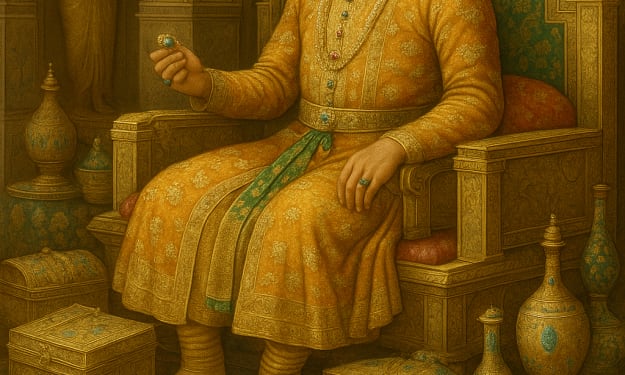
The Disappeared Gems of Emperor Jahangir: An Elusive Mughal Wealth Beyond Belief. AI-Generated.
The Golden Era of the Mughal Empire The Mughal Empire during the early 17th century was at the zenith of its splendor. Encompassing a vast expanse of the Indian subcontinent, it exhibited a thriving economy, a strong administrative framework, and luxurious courtly life. Jahangir, whose name translates to "Conqueror of the World," assumed the throne in 1605 after Akbar’s passing and governed for over twenty years. Unlike his predecessor, Jahangir was not a formidable military commander, yet he was a shrewd ruler and a fervent supporter of the arts. His court was populated by Persian painters, architects, and jewelers. During his reign, Mughal artistry attained unprecedented levels, with his palaces adorned with gemstones, pearls, and intricate gold craftsmanship. The Imperial Jewel Collection Jahangir’s wealth represented more than merely a token of royal affluenceit was a meticulously assembled collection of some of the most remarkable objects ever gathered in the subcontinent. These encompassed: The Timur Ruby, a substantial, crimson gem etched with the names of Mughal emperors. Thrones embellished with pearls and golden chests encrusted with emeralds and sapphires. Valuable jewelry, consisting of jeweled turban ornaments, anklets, rings, and ceremonial daggers. European artifacts, presented by foreign emissaries, such as mechanical clocks and Venetian glass. The emperor had a particular fondness for jade and rock crystal, commissioning inscribed wine vessels and dishes from craftsmen throughout Persia and Central Asia. Jahangir’s Affection for Opulence Jahangir was noted for his excessparticularly in wine and opium. He frequently hosted extravagant gatherings where the nobility exhibited their fortunes and competed in extravagance. Historical accounts describe evenings where carpets woven with gold thread were extended, and rosewater was poured from diamond-adorned ewers. His illustrious autobiography, the Tuzk-e-Jahangiri, expounds on his admiration for beauty and artistry. However, it also suggests an increasing disengagement from governance as his sons and nobles contended for power, notably Prince Khurram, who would eventually become Shah Jahan. The Enigma of the Vanished Wealth Following Jahangir's death in 1627, a fierce conflict for succession ensued. Shah Jahan triumphed, yet not without consequence. During the struggle for power, numerous jewels of Jahangir were plundered by rival factions. Some royal possessions were concealed by loyal supporters, while others were sold or lost during hurried retreats. In subsequent years, the treasure became increasingly scattered. As Shah Jahan constructed the Taj Mahal and Peacock Throne, he integrated some of his father’s jewels into his own collectionbut significant portions were never rediscovered. The circumstance deteriorated with the subsequent decline of the Mughal Empire. By the time of Aurangzeb's reign in the late 17th century, civil conflicts and the escalating menace from regional monarchies undermined the empire. European entities, particularly the British East India Company, capitalized on this frailty. Colonial Exploitation and Diminution The ultimate strike to Jahangir’s lost riches may have occurred during the British colonial era. After the British seized Delhi in 1857 subsequent to the Indian Rebellion, the Red Fort was plundered. Numerous royal relics, including manuscripts, jewels, and ceremonial objects, were either taken or exported abroad. Presently, various Mughal gemstones thought to originate from Jahangir’s epoch can be located in museums and private collections throughout Europe. The Timur Ruby, for example, is currently part of the British Crown Jewels collection, inaccurately classified as a ruby despite being a spinel. Could the Wealth Still Be Concealed? Scholars and treasure seekers have long pondered that a portion of Jahangir’s wealth was concealed during the succession conflicts and has yet to be retrieved. Folklore in northern India recounts tales of subterranean vaults near Agra and Lahore that remain sealed, filled with Mughal gold and emeralds. Unauthorized excavations have even taken place in the vicinity of Fatehpur Sikri and the ancient Mughal pathways. While no verified treasure has been discovered, remnantssuch as jeweled sword hilts or enameled ornamentsoccasionally appear in antique markets or during urban excavations. The Enduring Legacy of Jahangir’s Wealth Regardless of whether Jahangir’s entire treasure will ever be recovered, its influence on art and history is indisputable. His enthusiasm for collecting reshaped the Mughal aesthetic, merging Persian sophistication with Indian opulence. The art, architecture, and craftsmanship patronized during his rule remain among the most distinguished in South Asian history. In many respects, the lost wealth signifies not merely gold or jewelsit embodies a missing chapter of imperial aspiration, cultural integration, and regal magnificence.
By Say the truth about a year ago in History
The Sunken Wealth of the Flor de la Mar: The Forsaken Treasure Vessel of the Portuguese Empire. AI-Generated.
. The Ascendancy of Portuguese Naval Might In the early 1500s, the Portuguese Empire was swiftly broadening its influence across the Indian Ocean. Under the leadership of King Manuel I, Portuguese navigators sought spices, wealth, and supremacy over the trade routes of Asia. Among the numerous vessels launched to aid this mission was the Flor de la Mara colossal carrack that became both an emblem of Portuguese might and a persistent puzzle of lost wealth. Constructed in 1502 in Lisbon, the Flor de la Mar weighed over 400 tons and was designed for extended voyages to India and beyond. Despite initial design shortcomings and repair complications, she would soon play a crucial role in one of the most profitable undertakings in the annals of European colonialism. The Conquest of Malacca By 1511, under the direction of Afonso de Albuquerque, the Portuguese set their ambitions on Malacca, the affluent trading center situated on the Malay Peninsula. Gaining control of Malacca meant dominating the lucrative spice trade that flowed between the East Indies, India, and the West. The conquest was harsh but triumphant. The Portuguese dethroned Sultan Mahmud Shah and acquired vast quantities of treasure from the royal palace and local merchants. Among the riches were gold coins, jeweled artifacts, ceremonial weapons, and rare spices. Estimates suggest the total worth could amount to billions in contemporary terms. This colossal treasure was loaded onto the Flor de la Mar, which Albuquerque personally designated to transport the spoils back to Portugal. The Fateful Journey The Flor de la Mar departed from Malacca in late 1511, escorted by several other vessels. However, her destiny was determined not by adversaries, but by nature itself. As the fleet approached the Strait of Malaccasituated between Sumatra and the Malay Peninsulathe Flor de la Mar faced a ferocious storm. The aging vessel, already notorious for structural deficiencies and an inadequate rudder system, could not endure the onslaught. She disintegrated on a reef off the northern coast of Sumatra. Most of the treasure sank along with the ship. Some survivors were rescued by nearby ships, including Albuquerque himself, but the cargovast, shimmering, and historically invaluablewas never retrieved. The Enigma of the Treasure Throughout the centuries, numerous treasure seekers, archaeologists, and maritime specialists have endeavored to locate the wreck of the Flor de la Mar. The challenges are numerous: the region is perilous, laden with shifting sandbanks, treacherous tides, and a dense thicket of coral reefs. Furthermore, the historical documentation is ambiguous. Some locate the wreckage near the contemporary Aceh coastline in Indonesia; others propose it is situated further within the Strait. Despite enhancements in underwater surveying and sonar technology, no authenticated discovery has ever occurred. If uncovered, the treasure could encompass: Golden Thrones and Religious Artefacts from the Sultan of Malacca Spices and Silks of significant worth at that time Chests of Gemstones and Coins acquired from merchants and royal reserves Documents and Relics from the initial phase of Portuguese expansion Legal and Ethical Issues The quest for the Flor de la Mar also brings forth legal dilemmas. Indonesia asserts ownership of any treasure located within its maritime boundaries, while Malaysia and Portugal may also assert claims due to historical and cultural connections. UNESCO's 2001 Convention on the Protection of Underwater Cultural Heritage discourages commercial treasure hunting, complicating recovery endeavors. Some private enterprises have attempted to negotiate salvage rights, but political unrest and national safeguards have predominantly curtailed such initiatives. Cultural Heritage and Contemporary Legends The Flor de la Mar has integrated into regional mythology. Fishermen near Aceh recount tales of spectral lights beneath the ocean and peculiar phenomena on tempestuous nights. Legends flourish of divers who disappeared while seeking the wreck or found themselves cursed after retrieving artefacts. In Melaka (Malacca), a replica of the Flor de la Mar exists as a maritime museum, enlightening visitors about the golden era of Portuguese exploration and the destiny of the fabled vessel. Yet the true treasure remains concealed, alluring each generation to uncover what centuries have consumed. Conclusion: A Fortune Beneath the Waves The Flor de la Mar persists as one of the most captivating lost treasures in history. She represented more than a mere ship; she embodied imperial aspiration, cultural intertwining, and the avarice that prompted the rise and fall of empires. Beneath the ocean, in the depths of coral and time, resides the promise of unimaginable richesa legacy of conquest, gold, and the profound silence of history.
By Say the truth about a year ago in History
The Golden Vault of the Maharaja: India’s Overlooked Regal Fortune
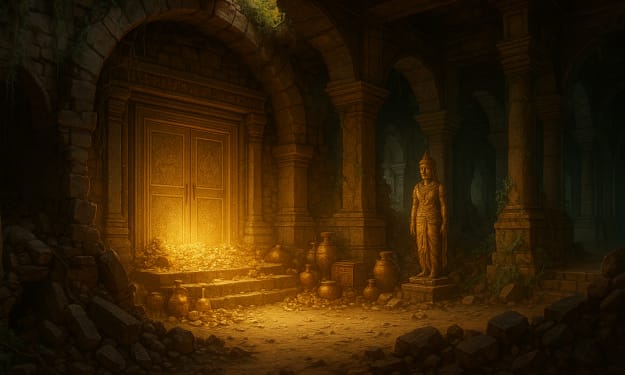
The Narrative of the Golden Vault India, with its rich mosaic of kingdoms, empires, and dynasties, has long been a land of myths and opulence. Among its most timeless narratives is that of the Golden Vault of the Maharaja, a treasure hoard believed to be concealed beneath a now-decrepit palace in southern India. The narrative alleges a secret vault that was sealed during the early 18th century, brimming with gilded thrones, ivory-carved figures, invaluable jewels, and sacred manuscripts. The treasure was not solely emblematic of royal dominance but also regarded as a divine offering for the kingdom's protection. As colonial forces started encroaching on Indian territories, the last ruling Maharaja allegedly instructed that the treasure be sealed, hidden eternally from foreign hands. The Realm of Kaliganj The narrative focuses on the once-mighty yet now obscure realm of Kaliganj, situated between the boundaries of contemporary Karnataka and Tamil Nadu. Governed by a dynasty claiming descent from the Chola monarchs, Kaliganj thrived for nearly three centuries owing to its control over trade routes linking the Bay of Bengal with the Arabian Sea. Maharaja Virendra Dev, the last distinguished sovereign of Kaliganj, was a profoundly spiritual individual, renowned for his wisdom and architectural patronage. Under his administration, the kingdom’s temples were embellished with gold, and its treasury flourished from profits derived from silk trading and gemstone mining. However, Virendra Dev anticipated the decline of Kaliganj. With the Marathas ascending in the north and the British East India Company tightening its hold, the Maharaja commenced devising a strategy to safeguard the essence of his kingdomits treasure. The Sealing of the Vault According to preserved manuscripts and oral traditions transmitted through temple priests, Maharaja Virendra Dev commissioned his craftsmen to create an underground vault within the innermost part of his palace complex. With the assistance of master architects and priests, the vault was consecrated through ancient Vedic ceremonies and sealed employing a blend of mechanical locks and mystical mantras. The vault, according to some accounts, was distinguished by a lotus emblem and shielded by inscriptions cautioning of severe repercussions for those who entered with impure intentions. It was purported that only a genuine descendant of the Maharaja, wielding the sacred key and the knowledge of ancient chants, could safely unlock it. Colonial Incursion and Vanishing In 1765, British forces invaded Kaliganj and demolished the palace during their conquest. The royal family was displaced, and many members either fled or perished. However, the vault remained untouched, entombed beneath the debris of the palace ruins. British authorities recorded hearsay regarding concealed wealth, and numerous failed endeavors were undertaken to unearth it. Nevertheless, enigmatic collapses, the abrupt sickness of workers, and unusual natural phenomena caused the British to cease their pursuit. Some even inscribed in their diaries about “a celestial force” safeguarding the treasure. Rediscovery in the 20th Century During the 1930s, archaeologists encountered partially buried temple remnants close to Kaliganj, sparking renewed fascination in the myth. Locals recounted tales of subterranean chambers and “murmurs within the earth. ” A British-Indian archaeologist, Dr. Rudranath Bose, performed excavations and asserted that he had discovered the outer boundary of the original palace framework, comprising the foundations of a substantial square chamber that aligned with ancient accounts. However, World War II interrupted the excavation process. Dr. Bose’s records and discoveries mysteriously vanished following his demise in 1951, adding yet another layer of intrigue. Modern Speculation and Theories In contemporary times, satellite imagery and ground-penetrating radar have unveiled peculiar subterranean formations beneath the ruins of Kaliganj. A square configuration with adjacent corridors and sealed passageways suggests that a vault may indeed exist. Some theorists assert that the treasure was relocated prior to the British arrival, potentially transported to a clandestine Himalayan monastery. Others contend that it remains concealed, safeguarded by spiritual entities. The Indian government has imposed restrictions on extensive excavation in the vicinity due to its religious and historical significance, further intensifying speculation. In 2021, a collective of historians and spiritual researchers proposed a hypothesis that the vault’s lock was not merely mechanical but symbolicnecessitating a spiritual “key” in the form of ancient incantations performed by a living descendant. The Cultural Impact Whether factual or legendary, the Golden Vault of the Maharaja has integrated itself into local folklore. Artists, poets, and filmmakers have found inspiration in the narrative, portraying the treasure as both a tangible hoard of riches and a metaphor for lost wisdom, cultural pride, and divine heritage. Temples in the area still host annual celebrations honoring Maharaja Virendra Dev, and prayers are offered to the vaultregarded not simply as a repository, but as a sacred domain encompassing the spirit of a lost kingdom. Conclusion The legend of the Golden Vault of the Maharaja transcends a mere tale of concealed riches; it encapsulates India’s tumultuous history, spiritual depth, and the enduring human aspiration for what lies beneath the surface. Whether buried in gold or enshrined in myth, Kaliganj's secret continues to allure the inquisitive and the intrepid.
By Say the truth about a year ago in History