Ancient
Imam Abu Hanifa: The Man Who Said No to Power and Yes to Truth. AI-Generated.
In the golden age of Islamic civilization, when empires stretched wide and rulers wielded immense power, there emerged a man who stood taller not by his sword, but by his principles. His name was **Nu'man ibn Thabit**, but the world remembers him as **Imam Abu Hanifa** — the founder of the Hanafi school of thought, and a beacon of justice, knowledge, and resistance against tyranny.
By uzair hadiabout a year ago in History
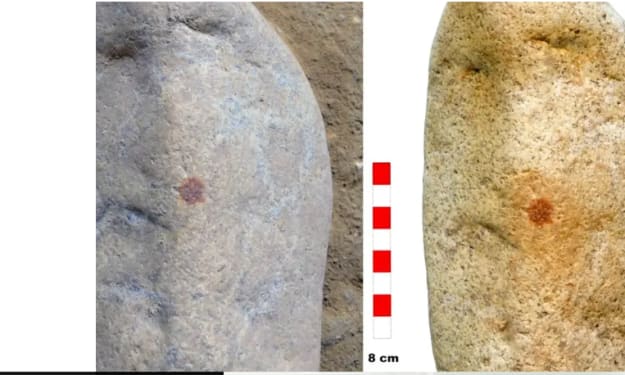
Perhaps the first concrete evidence that Neanderthals created art has been discovered by archaeologists.
Recently, archaeologists discovered a stone that seems to contain the earliest known complete human fingerprint. According to their research, it was created by Neanderthals, who would have shaped what appears to be an artistic representation of a facial figure from about 43,000 years ago using a red pigment on a rock.
By Francis Damiabout a year ago in History
When the World Went Quiet
At exactly 6:00 a.m. UTC, the world went quiet. Not a simple hush. Not the peaceful silence of dawn or a quiet forest. This was a profound stillness—global, sudden, absolute. Planes froze mid-air and landed without a word from control towers. Trains stopped. Cars rolled to a halt. Phones dimmed, screens went black, and even the electrical buzz—the unnoticed hum of daily life—disappeared. People feared the worst: a cyberattack, war, or divine reckoning. But no destruction came. No smoke, no fire. Only stillness. And slowly, humanity began to listen. --- 1. Ava — New York City, USA Ava was never off-screen. Her life as a social media influencer was a blur of filters, scheduled posts, and sponsored content. When her phone died, she cursed under her breath and reached for her laptop. It, too, was unresponsive. Even her ring light—her constant companion—flickered off. The silence outside unnerved her. New York, silent? She stepped out onto her fire escape, expecting sirens, shouting, chaos. Instead, she heard birds. Wind. Laughter from a rooftop. A man strummed a guitar two buildings over. She retrieved a journal—a gift from a follower, barely touched—and a pen. Without hashtags or algorithms, she wrote her thoughts with trembling hands. They flowed. She kept going. Hours passed. She had forgotten the world could feel like this. --- 2. Bilal — Swat Valley, Pakistan Bilal knew quiet, but this was different. His small school in the hills had always buzzed with morning routines: the groan of ceiling fans, children’s chatter, radio music from passing bikes. Now, all was still. Yet the children came, barefoot and curious. With no electricity or distractions, Bilal led them under the ancient banyan tree. He began with a folk tale his grandmother once told him—about moonlight, djinns, and brave shepherds. The children leaned in. A girl named Aasma offered a story of her own. By midday, they were taking turns. Laughter rippled. Imagination awakened. Bilal felt something stir in him too—a return to a kind of teaching deeper than textbooks. --- 3. Mei — Shanghai, China Mei had lived by the clock. With the Gaokao exam looming, her days were perfectly scheduled—digital tutoring, mock tests, meals timed to minutes. When the blackout hit, panic flared. Her tablet froze mid-formula. Her smart assistant shut off. No water boiled in the electric kettle. Then, silence. Her grandmother, long ignored in her daily grind, appeared at the door with a shy smile and a worn deck of playing cards. Mei hesitated—then followed her to the balcony. They played for hours under the smog-cleared sky. No lessons, no deadlines. Just laughter, the shuffling of cards, and a soft breeze. That night, Mei slept without dreams of failure. --- 4. Jonah — Cape Town, South Africa For Jonah, sound was life. A professional sound engineer, he built his world out of recordings, layers, and frequencies. When every machine fell quiet, he thought something had gone wrong with him. He stepped outside, searching for anything—music, voices, engines. Nothing. Then he heard it: the sea. The ocean hadn’t stopped. The tide rolled in like a metronome from before machines. Jonah walked to the beach and found others there—silent, barefoot, reverent. No one spoke. They just listened. He sat in the sand, held up his battery-powered field recorder, and captured the soundscape. Not of silence—but of what remained beneath it. It was his most honest work yet. --- Epilogue: A Day Later Exactly 24 hours after it began, the world reawakened. Lights flickered. Phones buzzed with missed alerts. Engines roared. The silence ended. But something lingered. Ava launched a printed journal called Stillness, spotlighting stories without algorithms. Bilal’s students still gathered weekly under the banyan tree. Mei chose to defer her exams and travel with her grandmother to villages that still lived offline. Jonah released an album titled When the World Went Quiet, featuring nothing but natural soundscapes. No one ever explained what caused the global silence. Some said it was nature reminding us. Others called it a glitch in the system of progress. Whatever it was, it left behind something rare: a moment remembered not for panic, but for presence.
By Hikmatullah Sarwariabout a year ago in History
The war of El-Basus. Content Warning.
The War of al-Basus: A Tale of Honor, Revenge, and Endless Conflict Introduction The War of al-Basus stands as one of the most famous and longest-lasting tribal wars in pre-Islamic Arabian history. Spanning around forty years, this conflict epitomizes how a relatively minor incident — a dispute over a camel — escalated into decades of bloodshed and devastation between two powerful Arabian tribes: Banu Bakr and Banu Taghlib. This war reveals much about the values, culture, and social dynamics of the Arab tribes in the centuries before Islam, especially regarding honor, revenge, and tribal loyalty. It also highlights how personal grievances could ignite prolonged collective conflicts in a society where tribal identity was paramount. --- Historical Context Before the rise of Islam, the Arabian Peninsula was divided into numerous tribes and clans, each controlling their own territories and resources, such as grazing lands, water wells, and trade routes. The tribal system was based on kinship, mutual defense, and a rigid honor code. Blood feuds and revenge killings were common, as tribes sought to protect their dignity and retaliate against any perceived insults or attacks. The tribes of Banu Bakr and Banu Taghlib, both descendants of the larger Rabi'ah tribal confederation, were neighbors in the northeastern Arabian region near the Euphrates River. They frequently clashed over pasturelands and other resources, but despite occasional tensions, they generally maintained a balance of power for many years. --- The Spark: The Incident That Ignited the War The War of al-Basus began with an event so seemingly trivial that it could be easily overlooked: a dispute over a camel. The camel belonged to a man named Jassas ibn Murrah, a member of the Banu Taghlib tribe. One day, his camel wandered into the grazing lands controlled by the Banu Bakr. In retaliation or as a sign of authority, the camel was taken or appropriated by a man from Banu Bakr named Kulaib ibn Rabiah, a prominent and skilled warrior. When Jassas confronted Kulaib about the camel, tensions quickly escalated. During the heated exchange, Kulaib killed Jassas’s servant, a shepherd, which was a grave offense. This killing was the immediate cause of outrage among the Taghlib tribe. According to tribal customs, a killing demanded revenge, either through blood money (compensation) or by retaliatory killing (qisas). However, Kulaib and the Banu Bakr tribe refused to pay blood money or accept any compromise, insisting that the incident was either justified or a matter of honor. --- The Role of Al-Basus: The Woman Who Fanned the Flames The war gained its name from a woman known as al-Basus, whose real name was Al-Basousa bint Mas’ud al-Sadifiyah. She was a noblewoman from the Taghlib tribe and the wife of Kulaib ibn Rabiah from the Bakr tribe. The story goes that al-Basus was deeply angered by the killing of the shepherd and by the refusal of her husband and his tribe to make amends. She relentlessly incited her husband and her tribe to seek revenge against Taghlib. Al-Basus became a symbol of relentless vengeance. Her name was forever associated with this war, which came to be known as the "War of al-Basus." Her passionate and fiery nature helped prolong the war, as she reportedly urged continual retaliation and refused peace efforts. --- Escalation into Full-Scale War What might have been a brief dispute turned into a full-scale tribal war lasting nearly forty years. The tribal customs of honor and revenge made it impossible for either side to back down without losing face. The war consisted of: Skirmishes and raids: Both tribes frequently raided each other’s camps, stealing livestock and attacking settlements. Major battles: There were several large-scale battles with many casualties, although no decisive victory was achieved by either side. Personal duels and vendettas: Tribal champions and warriors often fought in one-on-one duels that were highly romanticized in Arab poetry. --- Impact on the Tribes The consequences of the War of al-Basus were devastating: Loss of life and resources: Thousands of people, including men, women, and children, perished in the decades of conflict. Economic disruption: Continuous warfare disrupted trade routes and grazing lands, leading to economic hardship. Fragmentation of alliances: The war weakened the cohesion of the tribes and caused divisions within families. Despite the immense suffering, the cycle of retaliation continued due to tribal honor codes and societal expectations. --- The Role of Poetry and Oral Tradition The War of al-Basus was immortalized in the rich tradition of pre-Islamic Arab poetry. Poets from both tribes composed verses that celebrated their heroes, lamented losses, and cursed their enemies. These poems were more than just art; they were a crucial part of the conflict itself, spreading news, inciting courage, and keeping the memory of grievances alive. The war contributed to the Arab cultural heritage by inspiring some of the most passionate and eloquent poetic works of the era. --- Attempts at Peace and Mediation Over the course of the four decades, several attempts were made to negotiate peace: Tribal elders and respected leaders tried to intervene to halt the bloodshed. Marriages were proposed between the tribes to create alliances. Promises of compensation and exchange of prisoners were discussed. However, these efforts mostly failed because of the strong emotions involved and the unwillingness of either tribe to appear weak. Al-Basus herself is said to have opposed peace efforts, fearing that reconciliation would dishonor her family and tribe. --- The End of the War and Its Legacy The War of al-Basus ended not with a clear victor but due to exhaustion on both sides and changing political circumstances. When Islam emerged in the Arabian Peninsula in the 7th century, it brought a new social order that discouraged tribal vendettas and promoted unity among the Arabs. The values of reconciliation, forgiveness, and brotherhood introduced by Islam gradually ended many long-standing tribal conflicts, including those like the War of al-Basus. --- Lessons from the War of al-Basus The War of al-Basus offers several important lessons that remain relevant: 1. The danger of unchecked vengeance: A minor conflict, left unmediated, can spiral into a destructive war. 2. The power of women in history: Though men fought the battles, women like al-Basus played a crucial role in shaping events. 3. The need for mediation and compromise: The failure to reconcile grievances early prolongs suffering. 4. The role of culture in conflict: Values such as honor and reputation can drive conflicts as much as economic or political factors. --- Conclusion The War of al-Basus is a powerful historical narrative that encapsulates the complexities of tribal society in pre-Islamic Arabia. It shows how deeply held values of honor and revenge can fuel endless conflict, and how reconciliation and unity are essential to peace. While tragic in its human cost, the story of this war also enriched Arab culture through poetry and storytelling, reminding later generations of the price of conflict and the hope for peace.
By Moayed_eldeenabout a year ago in History
June 15, 1215 – The Magna Carta Signed Memories. AI-Generated.
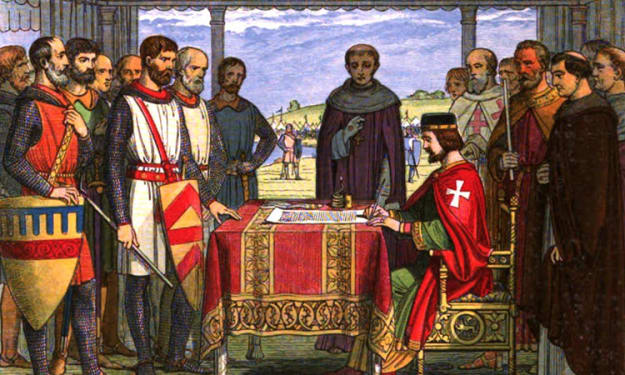
11.99 in king richard the lionheart is dead Richard left no heirs and so his dominions all of this was to be inherited by either his brother John who Richard her chosen or by his nephew Arthur of brittany arthur began a rebellion but nothing came of it and john managed to get the french king to accept his territorial claims after becoming King John had his first marriage annulled and instead married Isabella of angel' M. In 1202 fighting resumed between the kings of England and France because by this point they were both getting pretty good at it John attempted to mount a defense of his lands but due to financial constraint and the fact that he often insulted his nobility his ability to do so was lacking. In 1204 philippe augustus had conquered both Normandy and Anjou whereas Brittany had broken away from Anne ship in orbit on its own thus within five years of John coming to the throne only Aquitaine remained of his inheritance naturally many of the remaining Nobles in England were very unhappy that they had just lost some of their Continental lands the peasantry of England also found themselves upset when John levied extremely heavy taxes to pay for an attempted reconquest. In 1205 John was dishonored and disliked by his Nobles but at least he still had good relations with the church right nope the main issue between John and the church occurred during the election of the Archbishop of Canterbury in 1205 John wanted a friend and a lot of his to become the new archbishop whereas the clerics at Canterbury Cathedral did not the Pope Innocent the third was appealed to in his answer was that they were in fact both wrong. The Pope instead consecrated a man called Stephen Langton John was furious about this and so banned lankton from entering England and seized Canterbury's assets and revenues many clergymen saw this as a step too far and when they complained to John he essentially declared them traitors and seized their property as well the Pope attempted to convince the king to agree to Langdon's appointment but the king still refused. In 1208 the Pope ordered that church services in England were to be halted which they were for six years in 1209 the Pope went further and excommunicated John as well. 12:09 was an eventful year for John and England's is before his excommunication he invaded Scotland fearing that its King King William the lion was planning on forging an alliance with France the invasion went well and William agree to pay John and would stop claiming Northumbria. There was one success at least this year also saw the establishment of another Center of Education at Cambridge thus the two major centers of learning in England had been founded both of which would dominate English intellectual and political life for centuries to come. In 1210 the barons of Ireland revolted and John crossed the sea and crushed them shortly of course it was brony rebellion which would ultimately define John's brain and so unsurprisingly this would not be the last it's important to note the bearings have a justification to revolt against John because he had been excommunicated technically lords owed no allegiance to their superiors who lived outside of the boundaries of the Christian faith in practice the reasons for revolts weren't so theological. In 1212 John forged a series of alliances against King Philippe to prepare for an invasion of France the most notable ally being the Count of Flanders Philippe made the first move and attacked Flanders and was himself preparing to invade England John's barons weren't very supportive and only due to a pre-emptive English attack didn't invasion not occur by this time John had realised that he needed his barons onside who would the convenient excuse of excommunication to refuse his service. In 1213 he and Pope Innocent came to an agreement the king would repay the church for everything he took and importantly it was decided that John held England as a papal fief what this meant is that technically England belonged to the Pope and John simply ruled over it as the Pope is appointed keeper the next year John had secured more alliances in his war with France the most notable being the Holy Roman Emperor Otto the fourth the decisive battle was in July the 27th. The Battle of the boovie which was a decisive French victory this battle forever ruined John's chances of recovering his northern French territories as well as earning him the nickname John Lackland Jude mostly to his lack of land Phillipe Augustus was now the undisputed ruler of these territories marking an important turning point in the rise of France John's problems went from bad to worse upon his return to England. In 1215 John Snow was revolted against him plunging England into chaos the rebellious Nobu's approach was not to replace the king but to force reforms the rebels were led by Robert Fitzwater who he made 1215 March what the rebels had made the army of God into London John knew this wasn't going to end well. Whilst Archbishop Langton to organize peace talks what happened at these talks is one of the most famous and important events in English history the signing of the Magna Carta at Runnymede which is here Magna Carta which is Latin for Great Charter sought to restrict John's powers over the dispensing of justice which John had up until that point mostly used to make money it's also importantly stated that if John was to abandon his promises within Magna Carta his barons could use force against him John did sign the Magna Carta but make no mistake. He had no intention of abiding by it and quickly asked the Pope who was technically John's Lord to annul the agreement which the Pope did John's parents were not too happy about this and so on the Baron's knew that John would never accept their demands and so they invited a new claimant to the throne whom they could rally behind this man was Louie the son and heir of the French King Philippe Augustus Louie arrived in England in May 1216. Within a few months had taken all of this territory little more happened to her John died in October of the same year and for many of the rebellious barons the reason for the war had died with the King John had a young son Henry who many of the rebellious barons flocked to the reason for this was that Henry at this point was only nine years old. This was much less of a threat to noble interest than Louis could be Henry was crowned King Henry the third at Gloucester but he was too young to govern and so the respected nobleman William Marshall acted as his Regent being Regent meant that Marshall would act with the Kings Authority until the king was old enough to do so himself Marshalls first act would be to reissue Magna Carta in Henry's name to assure the other Nobles that their rights would be upheld Louis was of course not going to give up his claim to England. The war carried on the war was not going in Henry's favor until 1217 when Willy Marshall marched on Lincoln in an all-or-nothing battle the Battle of Lincoln saw many of Louie's French nobleman killed Robert fitzwater was captured and afterwards the town was thoroughly looted as a result. Menino was defected from Louis to Henry and after a few more battles Henry's throne was secured and Louis renounced his claim Henry's early reign was not without its problems many nobles had pledged their loyalty but weren't so keen on actually providing it some had built castles illegally during the rebellion and refused to abandon and demolished them to reassure Henry's Authority. The Pope allowed him to be coronated again this time in London and most of his Lords pledged allegiance and a pain of excommunication some still refuse to pledge their loyalty and so at the help of his just akia hubert de burgh henry crushed them in 1224 louis now King Louie the eighth for France invaded Henry's French territories and quickly seized part two of most of Gascony the nobles agreed to help fund an army to reinforce Gascony on the condition the Magna Carta was reissued again which it was in 1225 this time Magna Carta was issued willingly by a king who agreed to be bound by the laws and the advice of his know was a significant stepping stone in the history of the English monarchy. In 1226 Louie the eighth for France died and the throne passed to his son whose name you'll never guess unless you also guess Louis this new king was only 12 and so his position was weak many of the nobles in Normandy Anjou and Britain he asked for Henry to invade and reclaim his inheritance. In 1227 the Regency ended and Henry began his personal rule three years later he landed in Paris me with the large English army he would remain in France until 1234 and would leave having achieved nothing a great cost when Henry left for France he had placed Hubert de baron charge Hubert was not particularly popular in the faction which opposed him rally behind a man who pitted the rush. In 1231 after his return to England Peter wrote to Henry claiming that Hubert was corrupt and so Henry had Hubert arrested and Peter was made to stickier Peter almost immediately began seizing his opponents land which angered a certain Richard Marshall the son of William who complained that the king was neglecting his promises from Magna Carta naturally there would only be one outcome of this disagreement civil war in the end Henry agreed to remove Peter and wood from then onwards rule on his own Henry was so keen for peace because he was worried that during the Civil War Louis would invade and conquer Brittany which he did anyway so Henry believed that his predecessors mostly his father had allowed royal authority and dignity to be eroded and he sought to restore it. In 1236 Henry married Eleanor of Provence in order to forge an alliance in the South of France three years later Eleanor gave birth to a son Edward named after Edward the Confessor who Henry revered is the paragon of English kingship so Henry made sure to look after his wife's family and eventually they were invited over and some of them are giving important positions an example being Ellen his uncle Boniface he was made Archbishop of Canterbury all of this preferential treatment for people who weren't the English nobility was upsetting for the English nobility since they felt these rewards were theirs by rights needless to say Henry was well on his way to annoying his barons again so in 1241 Henry stepfather rebelled against the French King and called for Henry to land with an army to assist which Henry did eventually. Henry slow response meant that the rebellion collapsed and during the campaign there Henry's army was soundly defeated at the Battle of tiberg as a result of this Henry's French relatives by marriage ended up leaving France and coming to England in 1247 these relatives were granted numerous lands which further annoyed the English nobility by 1258 Henry was extremely unpopular he had financially ruined the kingdom the most notable event occurring. In 1252 when the Pope offered Henry Sicily providing he paid off the Pope's debt which he agreed to without consulting his Lords furthermore Henry also travelled to Paris where he agreed to renounce his claims to his lost territories the anger of his noble was culminated in rebellion again led by Simon de Montfort the rebels demanded Henry abandon his personal rule and allow the nobles to control the government and Institute reforms these reforms are summed up in the provisions of ox which limited the powers at the king in the major Nobles but most importantly set up an elected group of barons who would run the kingdom these form of government broke down after Henry had asked for the Pope's help in denouncing it. In 1263 the second barons war broke out long story short the war waged for four years Henry and his son Edward were captured at the Battle of Lewes Edward eventually escaped and later won a victory at the Battle of Evesham which saw de Montfort killed by 1267 the Barons had surrendered and the war was over leaving a now unwell Henry to rebuild Prince Edward was given great to say over the running of the kingdom until he went on a crusade. In 1270 Henry died in 1272 when Edward was declared king and upon his return to England he was crowned king yet with the first Edward however is better known either as Edward Longshanks or more famously as malleus Scott Horan the hammer of the Scots.
By taylor lindaniabout a year ago in History
Ukraine says at least 40 Russian warplanes hit in massive drone strikes
**Ukraine asserts that over 40 Russian warplanes were hit by massive drone strikes** Ukraine has claimed responsibility for a massive drone strike that allegedly damaged or destroyed more than 40 Russian warplanes across several key airbases, escalating its military campaign dramatically. Officials in Ukraine say that the attack, which took place in the early morning hours of June 1, 2025, was one of the largest and most successful drone operations since the war with Russia began. The operation, codenamed "Spider Web," targeted several Russian airfields, including Olenya in Murmansk Oblast, Diaghilevo in Ryazan Oblast, Belaya in Irkutsk Oblast, and Ivanovo Severny in Ivanovo Oblast, according to Ukraine's Security Service (SBU). Strategic bombers like the Tu-95 and Tu-22M3 as well as the A-50 airborne early warning aircraft are known to be housed at these bases. Ukrainian sources shared footage that showed several aircraft clearly engulfed in flames as thick black smoke rose from some of the affected bases. While Russia has acknowledged that drone attacks have occurred in specific locations, the country has yet to provide an official count of the damage. Access restrictions and ongoing military activity limit independent verification. The fact that this operation was the result of more than a year of planning and development has been emphasized by the Ukrainian government. In order to circumvent radar detection and air defenses, the reportedly used drones were launched from concealed mobile platforms inside Russian territory. Considering the disparity in long-range missile capabilities between the two nations, this strategy represents a significant shift in Ukraine's military tactics. According to Ukrainian officials, the operation involved the simultaneous deployment of more than 70 drones. demonstrating Kyiv's growing reliance on domestically produced weapons, many of these were indigenously developed systems. This, according to analysts, is a direct response to Ukraine's urgent need to expand its strategic reach and restrictions on Western weapons deliveries. Russia used more than 470 drones and a number of missiles to launch its own massive assault on Ukrainian territory in response to the drone attack. A Ukrainian military training facility was hit by one of these missiles, killing at least 12 soldiers and injuring more than 60 others. The tit-for-tat strikes are a significant step up in drone warfare, a strategy that is increasingly defining this contemporary conflict. The drone operation is viewed as a strategic and symbolic success by the Ukrainian government. Ukraine intends to challenge the concept of safe havens far from the front lines and hinder Russia's ability to launch aerial attacks against Ukrainian infrastructure by striking deeply into Russian territory. In the near future, Russia's capacity for coordinated missile strikes and aerial intelligence gathering may be diminished by damaging strategic bombers and surveillance aircraft. In contrast, the strikes by drones occur just a few days prior to the planned international peace talks in Istanbul. The international community is keeping a close eye on the negotiations because Ukraine has confirmed its participation. The timing of such a well-publicized attack raises concerns regarding its potential to influence diplomatic discussions or international perceptions of Ukraine's military resolve. Experts warn that while the attack demonstrates Ukraine's inventiveness and tenacity, it may also elicit harsh Russian retaliation. Nevertheless, the operation highlights a significant shift in contemporary warfare, in which battlefield dynamics are increasingly altered by drones and asymmetric strategies. The skies over Ukraine and Russia may become even more tense as both nations invest in unmanned aerial capabilities. Long-range drone strike technologies could continue to advance, not just in Ukraine but around the world, if the operation in Ukraine is successful. Drone warfare may now be the central battleground in a war that has already reshaped the geopolitical landscape of Eastern Europe with no end in sight and both sides indicating firm military resolve.
By GLOBAL NEWSabout a year ago in History
Alexander the Great and the Indian Subcontinent
In 327 BCE, Alexander the Great, already a legend across the known world, gazed eastward toward a land few Greeks had ever seen—India. Having conquered Persia and stood victorious over mighty kings, Alexander sought new horizons. His ambition was as vast as his empire, and beyond the towering Hindu Kush mountains lay the fabled riches of the Indian subcontinent.
By Muhammad Saeedabout a year ago in History
🏰Petra: The Lost Rose City of the Nabateans
🏰Petra: The Lost Rose City of the Nabateans 🌵The Ancient City Carved from Desert Stone If you ever find yourself in southern Jordan, standing at the mouth of a narrow canyon while the desert wind swirls red dust around your feet, you might have the sense that you’re on the edge of something extraordinary. And you’d be right. Just beyond that winding chasm lies Petra—a city carved straight into the rose-colored cliffs, a place that once bustled with life and now sits in silent, sun-baked grandeur. Petra isn’t just a monument to the past. It’s a labyrinth of stories, secrets, and stone, and its legacy is still unfolding.
By History Seekerabout a year ago in History
The Conneaut Giants: Unearthing the Forgotten Race of Titans
Whispers Beneath the Ohio Soil Long before concrete towns and railroad tracks stitched the American frontier together, the land spoke in whispers. Ancient forests blanketed the hills, rivers shimmered untouched, and secrets, deep, ancient secrets, lay hidden just beneath the surface. One such secret revealed itself in the early 1800s in Conneaut, Ohio.
By The Secret History Of The Worldabout a year ago in History