Ancient
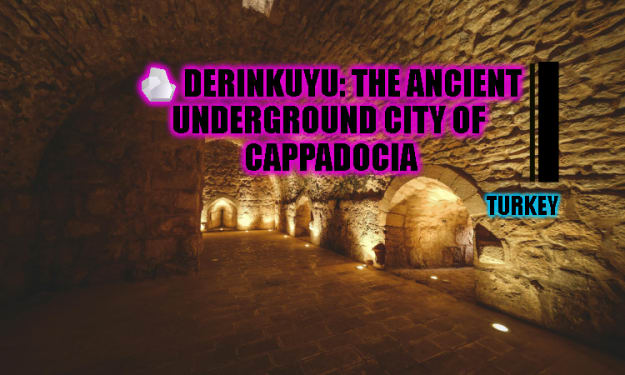
🪨Derinkuyu: The Ancient Underground City of Cappadocia in Turkey
🪨Derinkuyu: The Ancient Underground City of Cappadocia in Turkey 🌍 Deep beneath the arid plains of central Turkey, in the heart of the Cappadocia region, lies one of the most remarkable feats of ancient engineering ever discovered: the underground city of Derinkuyu. This vast subterranean complex, carved into soft volcanic rock, descends more than 85 meters (approximately 280 feet) below the earth’s surface and contains a network of tunnels, chambers, staircases, wells, and ventilation shafts that once served as a fully functioning city. It could house up to 20,000 people, along with their food, livestock, and belongings. The scale, complexity, and historical significance of Derinkuyu make it one of the most fascinating archaeological discoveries of the modern era.
By History Seekerabout a year ago in History
The World’s Most Beautiful Bucket-List Castles, Ranked ...
The World’s Most Beautiful Bucket-List Castles, Ranked 1. Germany's Neuschwanstein Castle Perched high in the Bavarian Alps, Neuschwanstein Castle looks like something straight out of a fairy tale—because it literally inspired Disney’s Sleeping Beauty Castle. Built by the reclusive King Ludwig II in the 19th century, its soaring turrets and dramatic cliffs make it the most photographed castle in the world.
By parves mosharafabout a year ago in History
🛡️ The Greek Phalanx: The Shield Wall That Changed the Ancient World
The Greek phalanx stands as one of the most iconic and influential military formations in world history, epitomizing the unique fusion of military innovation and societal structure that defined classical Greece. Emerging from the gradual militarization and social development of Greek city-states (poleis) during the early Archaic period (circa 8th century BCE), the phalanx embodied a collective approach to warfare, based on discipline, unity, and the combined strength of heavily armed infantry known as hoplites. This formation was not merely a tactical arrangement but a reflection of the social and political dynamics of Greek society, where military service and citizenship were deeply intertwined.
By History Seekerabout a year ago in History
Ancient Worms Revived After Thousands of Years in Siberian Permafrost.
Ancient Worms Revived After Thousands of Years in Siberian Permafrost:- A Scientific Breakthrough. In a groundbreaking discovery, Russian scientists have successfully revived two prehistoric worms that were frozen in Siberian permafrost for thousands of years. Found in the permafrost of Siberia, these nematodes—a type of microscopic soil-dwelling worm—began moving and eating shortly after being thawed. This remarkable achievement provides new insights into the resilience of life and opens doors to understanding ancient climates, cryopreservation, and even the potential for long-term survival in extreme conditions.
By Saddam Hossen about a year ago in History
Quran. AI-Generated.
The Quran, regarded as the holy book of islam, is considered by Muslims to be the teral word of God (Allah) revealed to the Prophet Muhammad (PBUH) over a period of spproximately 23 years through the angel Gabriel. It serves as the ultimate guide for Muslims, covering various aspects of life, from theology and law to personal conduct and ethics. One of the central concerns regarding the Quran is its authenticity-the extent to which it has been preserved in its original form and the degree to which it can he considered a genuine revelation in this article, we will explore the authenticity of the 1. The Preservation of the Quran: A Divin The primary assertion within islamic tradition is that the Quran has been preserved exactly as it was revealed, free from any Indeed, it is We who sent d This divine promise of protection is central to the Muslim understandin 2. Historical Context: The Compilat To understand the Quran's authenticity, it is crucial to examine the historical context in which it was compiled. The Quran was revealed over a penod of 23 years, beginning in 810 CE, when the Prophet Muhammad (PBUH) first received revelations in the Cave of Hira. During the Prophet's lifetime, the Quran was preserved in two Oral Transm The Quran was largely preserved orally by the companions of the Prophet, many of whom memorized the entire Quran This oral tradition is a key factor in the preservation. of the Quran's accuracy. The practice of memorization (known as Hafiz) ensured that even if written manuscripts were inst or destroyed, the Quran would continue to be preserved accurately by its memorizers Writt in addition to omil transmission, the Quran was also written down during the lifetime of the Prophet. The Prophet's companions wrote down the revealed verses on various materials, such as parchment, bones, and palm leaves. However, these written pieces were not compiled into a single, complete manuscript during the Prophet's life. Compilation After the Prophet's Death. After the death of the Prophet, the first caliph, Abu Bakr, recognized the risk of losing parts of the Quran, especially after the Battle of Yamama, in which many of the Quranic memorizers were killed. To prevent further loss, Abu Bakr ordered the compilation of the Quran into a single book. Zayd ibn Thabit, one of the Prophet's scribes, was entrusted with this task. The collected verses were compiled from various written fragments and from the memories of those who had memorized the Quran. The second significant event in the compilation process took place during the caliphate. of Uthman ibn Affan (r. 044-650 CE). Uthman ordered the standardization of the Quranic text and the distribution of copies to the various regions of the expanding islamic empire. He also ensured that any non-standardized or disputed coples were destroyed. The Uthmanic codex, which was produced during this period, forms the basis for all Quranic manuscripts in circulation today 3. The Linguistic Integrity of the Quran One of the most striking features of the Quran is its linguistic consistency and literary excellence. The Quran was revealed in classical Arabic, a language known for its complexity, beauty, and precision. The eloquence of the Quran has been widely acknowledged, both by Arab and non-Arab scholars, for its unmatched style and structure. The Quran is a remarkable piece of literary work, and its style has never been replicated, despite numerous attempts The challenge posed by the Quran to those who doubt its divine origin is outlined in Surah Al-Baqarah (2:23), where it invites skeptics to produce a surah (chapter) like it And if you are in doubt about what we have sent down upon Our Servant, then produce a surah the Wke thereof and call upon your witnesses other than Allah, if you should be truthful Over 1,400 years, no one has been able to meet this challenge, which underscores the Quran's unique nature and supports the claim of its authenticity The linguistic structure, the use of rhyme, rhythm, and metaphor, and the inimitability of its style contribute to the belief in the Quran's divine origin. 4. Scientific Miracles in the Quran While the Quran is not a book of science, it contains numerous verses that have been found to be in alignment with modern scientific knowledge. These verses describe natural phenomena, the ongin of the universe, the development of human life, and the natural world, all of which were beyond the knowledge of the people of the 7th century: For example, the Quran mentions the development of the human embryo in Surah Al-Mu'minun (23:13-14), describing stages that were not known to humanity until the advent of modem embryology. The Quran also describes the expansion of the universe in Surah Adh-Dhanyat (51:47), which aligns with contemporary theories in cosmology. Although these scientific references do not serve as "proof of the Quran's authenticity they lend credibility to the idea that the Quran contains knowledge that was not available to humans at the time of its revelation, thus suggesting a divine source. 5. The Quran's Impact on Civilization The authenticity of the Quran is also evident in its profound influence on human civilization. Since its revelation, the Quran has shaped not only the spintual lives of millions but also contributed to advancements in various fields such as mathematics medicine, astronomy, and philosophy, Muslim scholars, inspired by the Quran's emphasis on knowledge and reflection, played a pivotal role in preserving and advancing scientific knowledge during the Islamic Golden Age (8th to 14th century) The Quran's teachings on justice, equality, and morality have had a lasting impact on societies, influencing the development of ingal systems, social structures, and ethical frameworks its enduring relevance in addressing the spiritual and temporal needs of individuals and societies attests to its authenticity and universal appeal 6. The Quran's Preservation in Modern Times The preservation of the Quran continues in the modern world. Every Quranic manuscript produced today is a direct descendant of the Uthmanic codex, and the Quran is recited, memonized, and studied across the globe. Moreover, technological advancements, such as digital recordings, have further erisured that the Quran remains accessible to billions of people in its original form. The tradition of memorization is still vibrant, with millions of Muslims around the world committing the entire Quran to memory. This widespread practice further safeguards the Quran's authenticity, ensuring that any errors or discrepancies in recitation are immediately corrected by others. Conclusion The authenticity of the Quran is supported by a combination of divine promise, historical evidence, linguistic excellence, and scientific alignment. The Quran has been preserved in its original form through a remarkable process of oral transmission, written compilation, and standardization. Its linguistic consistency and inimitable style further validate its divine origin, while its compatibility with modern scientific discoveries demonstrates its timeless nature. The Quran's enduring impact on civilization and its continued preservation in the modern world confirm its authenticity as a genuine and unaltered text, standing as a testament to the divine wisdom and guidance it offers to humanity
By Minhaz uddinabout a year ago in History
The Death of Bruce Lee
On July 20, 1973, the world lost more than a movie star—it lost a living legend. Bruce Lee, the man who brought martial arts into the global spotlight and redefined what it meant to be a hero, died under circumstances that would remain steeped in mystery and controversy for decades. He was only 32 years old. At the peak of his fame, Bruce Lee was an unstoppable force—a martial arts master, a philosopher, and a revolutionary actor who shattered racial barriers in Hollywood. He wasn’t just admired; he was idolized. His every move was electric, his philosophy profound, and his vision boundless. But the final chapter of his life reads like a thriller filled with unanswered questions, conflicting testimonies, and theories that continue to echo through time. The Final Day On the afternoon of July 20, Bruce Lee was in Hong Kong, working on the finishing touches for his movie Game of Death. He had a meeting with producer Raymond Chow and actress Betty Ting Pei, who had also been cast in the film. After a light lunch and some script discussions, Lee complained of a headache. Betty Ting Pei offered him a common painkiller called Equagesic, a combination of aspirin and the tranquilizer meprobamate. Shortly after taking the tablet, Bruce went to lie down. When attempts to wake him hours later failed, Betty Ting Pei called Raymond Chow, and eventually, an ambulance was summoned. Bruce Lee was pronounced dead on arrival at Queen Elizabeth Hospital. The world was stunned. The news spread like wildfire. How could someone so young, so vital, so physically perfect, die so suddenly? The Autopsy and the First Theories An autopsy was performed, and the official cause of death was listed as "cerebral edema"—an abnormal accumulation of fluid in the brain that led to swelling. But what caused this swelling? That’s where the story becomes murky. Doctors theorized that Bruce had an adverse reaction to meprobamate, one of the ingredients in the painkiller he took. But Equagesic was a widely used medication, and such reactions were exceedingly rare. Still, this was the explanation accepted by the medical examiner: a hypersensitive reaction to a standard drug caused fatal brain swelling. For many, this explanation was far from satisfactory. Bruce Lee was no ordinary man—his physical conditioning was beyond elite, and his understanding of his body was unparalleled. Could a simple pill really take down the Dragon? Strange Incidents Before His Death Adding to the suspicion were the strange events leading up to his death. Just two months earlier, Bruce had collapsed during a dubbing session for Enter the Dragon. He suffered seizures and was rushed to the hospital, where doctors discovered brain swelling. He recovered after being treated with mannitol, a drug used to reduce intracranial pressure. That incident was eerily similar to what would eventually kill him. Moreover, Lee had reportedly lost a significant amount of weight in the months before his death. Friends and family noted he seemed restless, obsessed with perfection, and under intense pressure to complete Game of Death—a project he believed would cement his legacy. Conspiracy Theories and Speculation In the absence of definitive answers, theories sprang up like wildfire. Some suggested that Bruce had been poisoned—by jealous rivals, underworld figures, or those threatened by his meteoric rise. Others pointed to traditional Chinese beliefs, claiming Bruce had been cursed for defying ancient spiritual boundaries. Another theory claimed he died from heatstroke. On the day he died, it was unusually hot, and Bruce’s home and Betty Ting Pei’s apartment reportedly had no air conditioning. Some even believed he died from overexertion and exhaustion, a tragic result of pushing his body past its limits. Then there was the more scandalous speculation—that Bruce had died in Betty Ting Pei’s apartment under compromising circumstances, and that powerful figures helped cover up the true events to protect his legacy. Legacy Overshadowed by Mystery Though the mystery remains unsolved, what is undeniable is the seismic impact Bruce Lee left behind. His death only elevated his status to myth. Enter the Dragon, released posthumously, became a global phenomenon, introducing millions to his charisma, speed, and martial prowess. Bruce Lee shattered stereotypes, bridged East and West, and became an enduring icon of power, wisdom, and rebellion against limitations. His philosophy of self-expression, discipline, and relentless pursuit of excellence lives on in martial arts schools, gyms, and motivational speeches across the world. Even today, new books and documentaries revisit the circumstances of his death, hoping to finally answer the haunting question: What really happened to Bruce Lee? But perhaps the more important question is not how he died, but how he lived—and how that life continues to inspire generations long after the man himself left this world. --- “The key to immortality is first living a life worth remembering.” —Bruce Lee And Bruce Lee did just that.
By Mati Henry about a year ago in History
The Ancient and Enduring Relationship Between Humans and Bed Bugs.
The Ancient and Enduring Relationship Between Humans and Bed Bugs. For over 60,000 years, bed bugs have been humanity’s unwelcome companions, evolving alongside us as we transitioned from cave dwellers to urban settlers. Recent research from Virginia Tech, published in Biology Letters, reveals that the history of bed bugs (Cimex lectularius) is deeply intertwined with human migration, settlement patterns, and even technological advancements . This article explores the fascinating co-evolution of humans and bed bugs, from prehistoric caves to modern cities, and examines how this persistent pest has adapted to survive despite centuries of eradication efforts.
By Saddam Hossen about a year ago in History
Who Are The Igbo People?
Marks and figurines of the Igbo people is a lofty course of study if you want to identify the uniqueness of this distinct set of tribe whose origin is traced back to the tropical rainforest of a country in Western Africa. But the purpose of this task is to give a brief summary of who these people are over time.
By Uchenna Cosmas Nwokafor about a year ago in History