Analysis
Google CEO Sundar Pichai's Education, Salary, and Net Worth
Sundar Pichai: The Influential CEO of Google's Education, Salary, and Net Worth In the world of technology, Sundar Pichai, CEO of Google and Alphabet Inc., is a name associated with leadership and innovation. Pichai's journey—from humble beginnings in India to leading one of the world's most valuable businesses—is a compelling tale of ambition, education, and success. The educational background of Sundar Pichai, his current salary as a top executive, and his impressive net worth are the subjects of this article. Education and childhood Sundar Pichai was born as Pichai Sundararajan on June 10, 1972, in Madurai, Tamil Nadu, India. His mother was a stenographer and his father was an electrical engineer for the British conglomerate GEC. He was raised in a Chennai middle-class household. Sundar frequently recounts how his upbringing shaped his principles of hard work and simplicity. The family lived in a modest two-room apartment. From a young age, Pichai excelled academically. He completed his schooling at Jawahar Vidyalaya in Ashok Nagar, Chennai, and later attended Vana Vani School, located on the campus of IIT Madras. His strong academic record earned him a place at the prestigious Indian Institute of Technology Kharagpur (IIT Kharagpur), where he studied Metallurgical Engineering. His sharp intellect and leadership abilities were noted by IIT Kharagpur professors. After completing his degree in India, Pichai moved to the United States to pursue higher education. Stanford University conferred on him a Master of Science (MS) degree in Material Sciences and Engineering. He went on to complete his MBA at the University of Pennsylvania's Wharton School. He was named a Siebel Scholar and a Palmer Scholar at Wharton, honors given to students who perform exceptionally well. Progress and Promotion at Google Sundar Pichai joined Google in 2004 and started working on the Google Toolbar, a tool that made it easier for Internet Explorer users to access Google search. His big breakthrough came with the development of Google Chrome, the company’s now-dominant web browser. The introduction of Chrome in 2008 changed the game and helped establish Pichai as the company's most important leader. He became an important part of the management of products like Android, Google Drive, Gmail, and Google Maps over time. He was a favorite among Google's top executives for his calm demeanor, strategic thinking, and in-depth knowledge of product development. Pichai was named CEO of Google in 2015, when the company underwent corporate restructuring to create a new parent company called Alphabet Inc. His responsibilities expanded further in December 2019, when he also became the CEO of Alphabet, replacing Larry Page. Under his leadership, the company has focused on artificial intelligence, sustainability, and product innovation, maintaining its dominant position in the tech industry.
By GLOBAL NEWSabout a year ago in History
Burj Khalifa: The Story Behind the World’s Tallest Marvel
The Burj Khalifa, located in the heart of Dubai, United Arab Emirates, is not just a building—it’s a symbol of ambition, innovation, and human achievement. Rising to a staggering height of 828 meters (2,717 feet), it has held the title of the world’s tallest building since its completion in 2010. But the story of the Burj Khalifa is about much more than just its height; it’s about visionary leadership, cutting-edge engineering, and the transformation of a city.
By saqiab khanabout a year ago in History
Antarctica's Hidden Caves: A Secret World of Mysterious Species Revealed by Scientists
In the icy, desolate expanse of Antarctica, there lies a hidden world beneath the frozen surface. While most people associate Antarctica with endless glaciers and harsh, cold conditions, scientists have uncovered something extraordinary: warm, subterranean caves that harbor a surprising diversity of life forms. These caves are not just places of shelter but ecosystems teeming with species unknown to science. The discovery of this hidden world raises new questions about life on Earth, survival in extreme conditions, and the potential for similar environments in other parts of the universe.
By The Secret History Of The Worldabout a year ago in History
A Glimmer into Bronze Age Civilization: Hungarian Archaeologists Discover Over 3,400-Year-Old Metal Artifacts on an enigmatic volcanic hilltop,,, . AI-Generated.
A glimpse into a Bronze Age civilization is provided by Hungarian archaeologists' discovery of over 3,400-year-old metal artifacts on an enigmatic volcanic hilltop. On a mysterious volcanic hilltop in western Hungary, a group of Hungarian archaeologists discovered hundreds of ancient metal artifacts that were up to 3,400 years old. This was a ground-breaking discovery. The excavation is shedding new light on the lives, rituals, and technologies of Central European Bronze Age societies, and it has attracted the attention of historians and researchers from across Europe. The site, known locally as Várdomb, or "Castle Hill," is situated near the town of Sümeg, on a long-dormant volcanic formation. This elevated terrain, now covered in forest and stone, was once a strategic stronghold for early human settlers. During the Bronze Age, when hillforts played important roles in security, trade, and governance, it was an ideal location for a fortified settlement due to its natural defenses and expansive views of the surrounding area. Relics from the Bronze Age, a Hidden Treasure Over 800 items have been found by archaeologists thus far, including ritualistic objects, agricultural tools, jewelry, finely crafted weapons like swords, axes, daggers, and spearheads, as well as fragments of pottery. The majority of the metal objects are bronze, a copper-tin alloy that represented the era's technological advancements. The intricate decorations on some of the weapons suggest that they belonged to high-status individuals—perhaps warriors, chieftains, or priests. Also found among the collection were unique metal spirals, pins, and adornments, possibly used for ceremonial purposes or as symbols of wealth and power. One particularly intriguing find is a group of objects intentionally buried together, which raises the possibility that these were offerings or ritual sacrifices to deities that were worshipped at the time. "The sheer scale and diversity of the artifacts uncovered here make this one of the most important Bronze Age sites ever found in Hungary," said Dr. Gábor Ilon, the lead archaeologist on the project. "It appears that this site was not only a location of defense but also a hub of cultural and religious activity," the author says. Ancient Life Hints on the Hilltop Archaeological evidence suggests that the people who lived in the fortress on Várdomb probably had advanced metallurgical skills, built complex structures, and traded far away. The site may have had watchtowers, workshops, and communal halls, as evidenced by the charred remains of wooden beams, stone foundations, and storage pits. Additionally, the location of the fortress at a high altitude indicates its strategic importance—residents could spot approaching threats from miles away and maintain control over nearby trade routes, river valleys, and farmlands. Researchers also think that the unique landscape of the volcanic hill, which was used in ancient myths and rituals, may have had spiritual significance. Using modern technology to preserve the past The excavation is being carried out with the support of Hungary’s National Museum and various academic institutions. LIDAR (Light Detection and Ranging), ground-penetrating radar, and 3D modeling are among the cutting-edge techniques being utilized by researchers to digitally reconstruct the site and examine the object distribution. These technologies allow experts to explore below the surface without disturbing delicate archaeological layers.
By Habib Mahmudabout a year ago in History
The Song of a Bird at Dawn
Day 1: The Window Is Empty Long ago, the house had become quiet, although not in an abrupt or shocking fashion. Slowly, like ivy growing over stone, silence fell. Unnoticed at first, it clung to corners. Then, heavy as unsaid sadness, it spread over her heart, then over the mantle where the photos had been, then over the walls.
By MD SHAMIM RANAabout a year ago in History
“Crown of the Holy Empire: The Legacy and Grandeur of the Austrian Imperial Crown”
The Origins: A Crown for a Divine Emperor The Austrian Imperial Crown was crafted in 1602 in Prague for Rudolf II, the Habsburg Emperor of the Holy Roman Empire. Unlike earlier medieval crowns passed through generations, this was a newly commissioned piece—designed not just to convey royal authority but to emphasize divine legitimacy. Rudolf II was a deeply religious and ambitious ruler who saw himself as a protector of Catholicism. The crown was not just an ornament—it was a symbol of his divine right to rule over the Holy Roman Empire and its many fragmented principalities. Design and Symbolism Unlike most crowns that adopt a circular or arched structure, the Austrian Imperial Crown features a distinct three-part design: The circlet, which represents the earthly power of kingship. The mitre, a unique addition shaped like a bishop’s hat, symbolizing spiritual authority and divine blessing. This unusual element shows the dual role of the Emperor as both a secular and spiritual leader. The high arch, topped with a globe and cross, stands for Christ’s dominion over the world and the Emperor's role as a Christian sovereign under divine will. The crown is richly decorated with: 36 large gemstones, including rubies, sapphires, emeralds, and spinels. Over 200 pearls of exceptional size and color. Intricately worked enamel images of Christian saints, reinforcing the sacred nature of the monarchy. The crown was made using 22-karat gold, masterfully hammered and set without casting—a rare feat of Renaissance goldsmithing. Symbol of the Habsburg Monarchy After Rudolf II’s death, the crown was adopted by his successors, eventually becoming the official imperial crown of the Austrian Empire when it was established in 1804 by Emperor Francis II. He dissolved the Holy Roman Empire in 1806 under pressure from Napoleon’s rising power and instead became Francis I, Emperor of Austria. From this moment forward, the crown came to represent not just Holy Roman legacy but also Habsburg dominance over Austria, Hungary, Bohemia, and other regions in central Europe. Though it was never used in a traditional coronation ceremony, the crown was placed next to the Emperor during important state functions, symbolizing his divine right and secular power. Where Is It Today? The Austrian Imperial Crown is currently on display in the Imperial Treasury (Kaiserliche Schatzkammer) at the Hofburg Palace in Vienna, Austria. It is protected as one of the most important artifacts of the Austrian state and the former monarchy. Alongside the crown, the Holy Lance, the Imperial Orb, and the Imperial Sword form part of the sacred regalia that once legitimized emperors who saw themselves as protectors of Christendom. Modern Net Worth Estimation Although priceless due to its historical importance, experts estimate the market value of the Austrian Imperial Crown based on its materials and rarity. Component Estimated Value Gold (22k, handcrafted) $5 million Gemstones (36 rare gems) $600–700 million Pearls and Enamel $30 million Artistic and Historical Value $800 million+ Estimated Total Value $1.5 billion USD (conservative) The real value, of course, lies in its cultural and symbolic worth, making it irreplaceable in historical terms. Religious and Political Symbolism The crown's design is rich in Christian iconography, symbolizing the Emperor’s role as God’s representative on Earth. Its mitre section emphasizes the emperor’s spiritual authority, not just political power. This design was unique in European regalia, where most crowns strictly signified monarchy and military conquest. The Austrian crown combined these aspects with theological legitimacy, elevating its bearer above mere kings. End of Empire, Survival of Symbol The Austro-Hungarian Empire collapsed in 1918, following World War I. The Habsburg monarchy was dissolved, and Austria became a republic. Despite this, the Austrian Imperial Crown survived the political upheaval, preserved as a national treasure. It stands today as a reminder of a time when emperors ruled by divine right, cloaked in gold, and crowned with jewels that captured both the majesty of heaven and the ambitions of Earth. Conclusion: A Crown Beyond Kings More than just a symbol of monarchy, the Austrian Imperial Crown represents a fusion of religion, politics, and art unmatched in Europe’s royal history. Its unusual design, immense value, and symbolic depth make it not just one of the most expensive crowns in history—but arguably the most meaningful. Whether viewed as a piece of exquisite craftsmanship or a relic of sacred empire, the crown endures as one of the most powerful emblems of imperial Europe. Would you like a historically styled image of this magnificent crown?
By Say the truth about a year ago in History
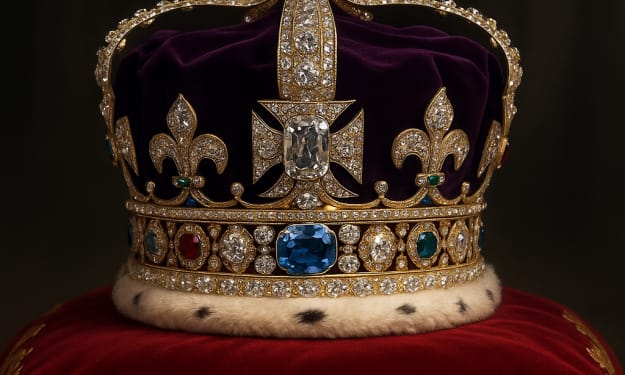
“Crown of Empires: The Legendary Wealth of the World’s Most Expensive Crown” . AI-Generated.
“The Diadem of Sovereigns: The Chronicle and Valuation of the World’s Most Costly Diadem” The narrative of royal diadems is a captivating saga of authority, triumph, and unimaginable affluence. Among all, one diadem distinguishes itselfthe British Imperial State Diadem, an emblem of sovereignty and the most financially substantial in history. Adorned with over 3,000 gemstones, including the famed Cullinan II diamond and the Black Prince’s Ruby, its worth transcends mere gold and gemstones. This article explores the inception, transformation, and heritage of this diadem, presenting a contemporary appraisal that surpasses $6 billion, establishing it as the most cherished diadem ever crafted. Introduction: An Emblem Beyond Epochs and Authority From pharaohs and emperors to medieval monarchs and contemporary rulers, the diadem has perpetually epitomized ultimate power. Yet beyond representation, diadems also signify extravagance. Among the multitude throughout historyfrom the Mughal Empire to the French Bourbonsthe British Imperial State Diadem is deemed the most priceless, both historically and economically. Housing some of the largest and rarest gemstones on the planet, it is more than merely a ceremonial adornmentit constitutes a vessel of empire, warfare, diplomacy, and heritage. Origins of the Imperial State Diadem The earliest iteration of the British Imperial Diadem traces back to the 15th century. However, the present design was reconstructed in 1937 for the coronation of King George VI and adapted for Queen Elizabeth II’s coronation in 1953. Its design draws from prior diadems but integrates treasures amassed over centuries of colonial expansion, wartime plunder, and royal legacy. Unlike other diadems designed exclusively for display or burial, this diadem has been actively utilized in coronations and state ceremonies, including the State Opening of Parliament. Diadem Features and Gemstone Inventory The Imperial State Diadem is constructed from solid gold, silver, and platinum and weighs over 1. 06 kilograms (2. 3 pounds). It comprises: 2,868 diamonds 273 pearls 17 sapphires 11 emeralds 5 rubies Among these, several legendary stones elevate the diadem to unmatched prominence: The Cullinan II Diamond: Referred to as the Second Star of Africa, it is a 317-carat flawless diamond carved from the largest gem-quality diamond ever discovered. This diamond alone is valued at over $400 million USD. The Black Prince’s Ruby: A significant semi-precious red spinel, this “ruby” is steeped in legend. It was donned by Henry V at the Battle of Agincourt in 1415 and occupies a central position in the diadem. The Stuart Sapphire: A deep blue 104-carat sapphire that has been passed through various generations of English and Scottish royalty. The St. Edward’s Sapphire: Presumed to have belonged to Edward the Confessor, this 11th-century gemstone rests atop the diadem’s cross. Historical and Political Heritage The diadem’s gemstone collection reflects the expansion and wealth of the British Empire. Numerous stones, particularly the Cullinan diamond, were gifts or acquisitions from colonized regions, notably South Africa, India, and Burma. Certain aspects of the crown have ignited global discourseparticularly the Koh-i-Noor diamond, which is not present in this crown but resides within another crown of the British collection. These disputes underscore that crowns are not merely decorativethey are political artifacts symbolizing both glory and colonization. Modern Appraisal: What Is Its Value? Assessing the worth of a crown of this nature is intricate, as many of the gems are distinctive, invaluable, or historically irreplaceable. Nevertheless, contemporary gemologists and historians approximate: Component Estimated Value Cullinan II Diamond (317 carats) $400–450 million Black Prince’s Ruby $100–150 million Stuart Sapphire $40–50 million Gold, Silver, Pearls $10–15 million Other Diamonds, Emeralds, Rubies $200–300 million Historical Value, Provenance $5 billion+ (symbolic, irreplaceable) Total Estimated Worth $5. 8 to $6. 5 billion USD Comparison to Other Renowned Crowns Although various empires possessed remarkably elaborate crownssuch as: The Mughal Peacock Throne, adorned with diamonds, emeralds, and pearls. The Russian Imperial Crown, featuring a 398-carat red spinel and 4,936 diamonds. The Crown of the Austrian Empire, signifying Holy Roman authority. none equates to the cumulative wealth, application, historical preservation, and symbolic significance of the Imperial State Crown of Britain. Custody and Exhibition Presently, the Imperial State Crown is situated in the Tower of London, secured as part of the Crown Jewels of the United Kingdom. It is removed solely for exceptional events, such as coronations or royal funerals. Its protection is exceptional, and although it is accessible for public viewing, no oneexcept the reigning monarchis permitted to don it. Conclusion: Wealth in Gold, Power in Heritage The Imperial State Crown transcends its status as the most expensive crown everit symbolizes five centuries of history. Each gemstone conveys narratives of conquest, diplomacy, divine right, and human aspiration. With an estimated net worth exceeding $6 billion USD, it occupies the zenith of royal regalia and historical treasure. In a world captivated by wealth and authority, this crown persists as a unique amalgamation of boththe ultimate representation of monarchy and empire.
By Say the truth about a year ago in History