Analysis
120 Days Underwater
In an impressive achievement that embodies human perseverance, scientific ingenuity, and extreme exploration, Rudiger Koch, a German aerospace engineer, is the new record holder for the longest time living in a submerged underwater chamber without the use of depressurization. Koch surfaced from his submerged capsule on Friday off the coast of Panama after spending an astounding 120 days, 11 meters (36 feet) under the Caribbean Sea. The feat, verified by Guinness World Records adjudicator Susana Reyes, saw Koch break the previous record of 100 days, which was set by American Joseph Dituri, who resided in an underwater lodge in a Florida lagoon.
By Rohitha Lankaabout a year ago in History
How Close Was the Roman Empire to an Industrial Revolution? 🏛️⚙️
When we think about ancient Rome, we picture majestic architecture, powerful legions, and sophisticated roads. But one question often pops up among history lovers and alternative history fans alike: Could the Roman Empire have had its own Industrial Revolution? 🤔
By Toader Adelinabout a year ago in History
Could Storytelling Become a Universal Currency?
Introduction: Stories' Everlasting Power Stories existed before there was money, before borders, before there was even recorded language. Early humans transmitted information, morals, and significance through stories told over prehistoric campfires, in painted caves, and orally. Across the world, storytelling has become a potent social glue in addition to being a kind of entertainment. In a time when automation, cryptocurrency, and artificial intelligence rule the roost, we are beginning to go back—surprisingly—to the most human of currencies: the tale.
By MD.ATIKUR RAHAMANabout a year ago in History
Do Tears Have Chemical Memory?
The Language of Tears: An Overview We cry when our eyes react to a gust of wind, when we laugh too much, when we are overwhelmed, when we are pleased, or when we are heartbroken. However, tears are more than just water dripping from our eyes; they are actually molecular manifestations of our inner selves. Tears were believed to be merely physiological, metaphorical, or symbolic for millennia. A more profound query is now being posed by a new scientific frontier: Are memories carried by tears? It is a type of chemical memory, a record of environmental, hormonal, and emotional information preserved in their molecular structure, rather than memory as we typically think of it. If this is the case, tears have the potential to both express and maintain emotion.
By MD.ATIKUR RAHAMANabout a year ago in History
What If All Human History Is Just a Dream Within a Dream?
Understanding the nature of reality has been a challenge for humans from the first cave paintings to the most sophisticated artificial intelligence. We have decoded DNA strands, authored scriptures, launched space telescopes, and told stories in an effort to find something tangible and lasting. However, what if our conflicts, empires, artwork, and even love were all a fabrication?
By MD.ATIKUR RAHAMANabout a year ago in History
Could Emotion Become a Tradable Commodity?
A frightening question hovers on the threshold of possibility in a world where attention is the new gold and data is more precious than oil: could emotion—raw, human, personal emotion—be turned into a commodity that can be traded? The line between what we feel and what we sell is eroding daily as artificial intelligence, neurotechnology, and immersive media continue to influence our inner experiences.
By MD.ATIKUR RAHAMANabout a year ago in History
Did Ancient Tattoos Encode Scientific Data?
Overview: Going Beyond Body Art These days, tattoos are frequently viewed as artistic, cultural, rebellious, or identity-expressing. However, what if they were far more than that in antiquity? What if these were early data banks encoded into flesh, blueprints of knowledge? From the icy Alps to the Pacific Islands, tattooed bodies have appeared as silent messengers throughout ancient civilizations. According to recent findings, these tattoos might have encoded information about medicine, astronomy, and possibly technology in addition to having symbolic or religious meaning. Although the notion may seem extreme, the evidence suggests something ancient that we have forgotten: our skin served as a canvas for scientific survival in the past.
By MD.ATIKUR RAHAMANabout a year ago in History
The Future of Time: Will We Ever Manufacture Seconds?
In the fast-paced world of today, time has become the most valuable commodity. We strive to bend it, chase it, waste it, and save it. However, we are still constrained by the unrelenting ticking of the clock regardless of how we adjust our schedules or increase our productivity. However, what if we were to break that rule at some point? What if we were able to literally create extra seconds—not just figuratively? It begs the question: Is time a set river we must flow through, or may it become a tool we control? This idea hovers between science fiction and new scientific research.
By MD.ATIKUR RAHAMANabout a year ago in History
Can We Program DNA to Store Human Dreams?
Overview: The Dream Code What if your deepest fantasies were kept in your DNA, not on a hard drive or on the cloud? It sounds like the plot of a science fiction movie set in the future. However, this idea is getting closer to reality as bioengineering, neurotechnology, and synthetic biology continue to advance. Movies, books, and music have already been stored in DNA by scientists. The question now is whether human dreams, those brief, passionate night stories, may likewise be encoded into genetic material.
By MD.ATIKUR RAHAMANabout a year ago in History
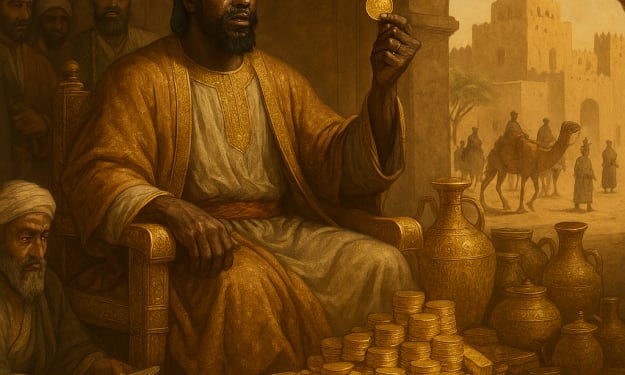
"The Golden Empire: Inside the Wealth of the Mali Empire under Mansa Musa" . AI-Generated.
“The Gold Mines of Kings: The U"The Golden Empire: Inside the Wealth of the Mali Empire under Mansa Musa" nrevealed Treasures of the Mali Empire” The Mali Empire, during the governance of Mansa Musa, represented the most affluent empire in African heritage and potentially the globe. Founded upon substantial gold assets and trans-Saharan commerce, Mali's principal cities such as Timbuktu and Niani thrived with splendid palaces, mosques, and riches beyond comprehension. This article delves into the ascendance of the Mali Empire, its astounding net worth, and the legendary pilgrimage of Mansa Musa that amazed the world with its golden magnificence. Introduction: A Golden Era in West Africa While Europe was still recovering from the Dark Ages, a remarkable civilization emerged in the heart of West Africa the Mali Empire. Established in the 13th century, Mali evolved into one of the most prosperous empires in history, attaining its peak under the leadership of Mansa Musa, the 10th monarch. Mali’s wealth was so extensive that Mansa Musa’s name became emblematic of unimaginable affluence, and his 1324 pilgrimage to Mecca was so lavish that it induced inflation in Egypt for more than a decade. But what contributed to the Mali Empire’s opulence? From where did the riches originate, and what heritage does it leave for posterity? Gold: The Cornerstone of Empire The foundation of Mali’s economic strength resided beneath the ground: gold. West Africa housed some of the largest and most fruitful gold mines in the ancient world, particularly in Bambuk, Bure, and Galam. These mines supplied the empire’s coffers and established Mali as the foremost gold provider for the Mediterranean and Islamic civilizations for over 500 years. During a time when gold represented currency, Mali was perched atop a fortune. Scholars estimate that Mali may have controlled half of the global gold supply during its pinnacle. Trade and Commerce In addition to its mines, Mali prospered due to its strategic location along trans-Saharan trade routes. Caravans of camels occasionally numbering in the thousands transported: Gold, salt, and ivory northward Silks, spices, books, and textiles southward Cities such as Timbuktu, Gao, and Djenné evolved into hubs of wealth and culture. Timbuktu’s renowned market and libraries attracted scholars and merchants from as far as the Middle East and Europe. Taxes were imposed on traders, further enhancing the empire’s wealth. A merchant navigating through Mali was reportedly greeted by gates embellished with gold, silk-adorned pavilions, and marketplaces brimming with luxurious goods. The Pilgrimage of Mansa Musa: The Wealthiest Individual in History In 1324, Mansa Musa embarked on the Hajj pilgrimage to Mecca, traversing more than 4,000 miles accompanied by a retinue that astonished the world: 60,000 men, including 12,000 slaves 100 camels, each bearing up to 135 kg (300 lbs) of gold Countless horses, dancers, scholars, and attendants Musa distributed gold so generously in Cairo that he incited hyperinflation, diminishing the value of the metal for over a decade. Historians estimate that his personal net worth might surpass $400 billion in contemporary terms, establishing him as arguably the wealthiest individual in human history. Cultural Wealth and Legacy Mansa Musa didn’t merely utilize wealth he allocated resources towards education, architecture, and religion: Established Sankore University in Timbuktu, which rivaled Oxford and Al-Azhar. Constructed numerous mosques, palaces, and libraries. Financed educational institutions, scholars, and scribes to replicate thousands of manuscripts. These endeavors transformed Mali into a beacon of knowledge within the Islamic realm. At its zenith, Timbuktu boasted 25,000 students and housed over 700,000 manuscripts, many of which endure today in private collections. The Decline and Dispersal of Wealth Following Mansa Musa's demise in 1337, the empire's prominence gradually diminished. Political turmoil, internal conflicts, and pressure from emerging powers such as the Songhai Empire contributed to fragmentation. Many of Mali's riches were: Plundered during invasions. Concealed or hidden to evade confiscation. Exchanged by lesser rulers in times of desperation. Despite its decline, remnants of Mali’s wealth persist in oral traditions, Arabic manuscripts, and the dusty repositories of European collectors who once obtained African artifacts during colonial periods. Estimating the Wealth Contemporary economic historians assess: Annual gold exports at peak: 1–2 tons per annum. Mansa Musa's net worth: $400 billion+. Empire-wide wealth: Easily in the trillions by contemporary metrics, when accounting for trade income, land, and cultural capital. This positions Mali among the most affluent civilizations in world history, eclipsing many European kingdoms of the same era. Conclusion The narrative of the Mali Empire extends beyond mere gold. It encapsulates a civilization that intertwined commerce, culture, and faith into one of the greatest golden ages ever witnessed. While much of its wealth has been dispersed, Mali's legacy as a symbol of African magnificence remains formidable. And beneath the sands of West Africa, perhaps additional treasure still lies hiddenawaiting recognition from history.
By Say the truth about a year ago in History