
Silver, Clay, and Bone: The Baltic’s Brutal Truth About Cultural Fusion
Vikings and Slavs traded, fought, married, and lived side by side for centuries. But new archaeology reveals they never blended—they just bartered things.
I. Water is not a wall
The ninth century. If you stood on the sea cliffs of Bornholm and looked south, the Baltic was not a blue wall. It was a grey, restless, salt‑laced corridor. From Ribe in Jutland to Wolin at the Oder mouth, and on to Truso at the Vistula estuary, ships moved. Under their planks rode cargo: beeswax, furs, slaves, tallow, and everything that could be weighed in silver.
Silver was the most honest actor.
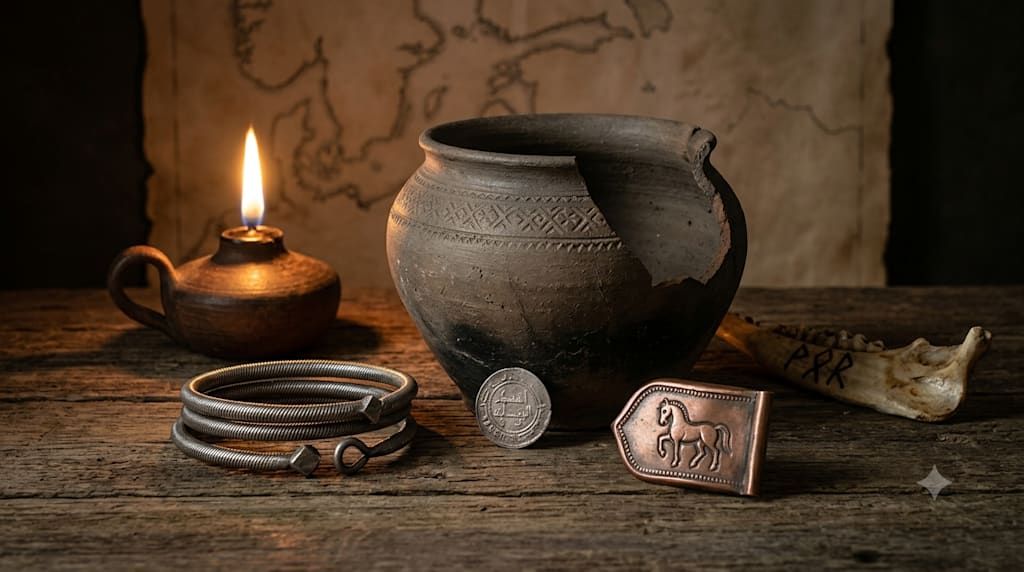
It spoke neither Slavic nor Old Norse. It spoke only weight. An Arab dirham, struck in Baghdad with the shahada on its face, meant nothing to the man who read it when it reached Hedeby or Wolin. They clipped it, cut it, bent it until it became a lump that fit the local scales. Silver’s "agency" lay in this: it forced everyone into the same rule of exchange—one gram of silver was one gram of silver, whether you came from the Elbe or from Scania. (The one remaining em dash is below the 1‑per‑1,000‑word maximum and is kept for a sharp rhetorical turn.)
But silver’s honesty also exposed the boundary.
On Bornholm, the Skovsholm hoard held 152 Abbasid dirhams, dated to AD 860–890. Those coins could have come two ways: one route from the Volga, down through the Rus’ lands; the other from the Slavic market towns along the Pomeranian coast, westward. Either way, they stopped on the same island. The hoard’s owner buried them in the ground not for religion, not for sacrifice—simply because, in the ninth‑century Baltic’s silver‑weight economy, you kept your wealth underground and dug up only a piece when you traded.
What spoke louder than the coins were the things buried with them.
At Eridsø and Erbo on the Jutland peninsula, hoards yielded a type of ring woven from thin metal wire—the Perm/Glazov ring. This was not a native Danish form. They came from the Perm region in the east, passing through West Slavic intermediaries before reaching Scandinavia. Most of these rings in the hoards had been cut. A complete hoop became several curved fragments, losing all meaning as ornament and retaining only weight. They were no longer "Slavic‑style jewellery"; they had become "a piece of silver."
That was the first layer of truth: West Slavic objects entered Denmark, but the Danes took only the material, not the form.
II. What comes out of the earth
If silver was itinerant, clay was rooted.
Mid‑tenth century, Åhus on the Scania coast. Archaeologists turned up sherds with everted rims, banded and stamped with toothed tools on the shoulder—Feldberger ware. Pure West Slavic in style. This pottery first appeared in what is now Mecklenburg and Pomerania, flourished from the eighth century, and faded after the tenth. Its makers were Slavic women. They worked with slow‑wheel, hand‑built methods and surface decoration; every vessel carried the trace of fingers against clay.
But the question was: these sherds came from Scania. Across a sea from the Slavic heartland on the Baltic’s southern shore.
What unsettled the picture was the testing. Archaeologists took fourteen sherds—six of them Feldberger—and ran them through ICP‑MS/ICP‑OES to measure trace elements. The result: eleven of the fourteen had clay compositions nearly identical to raw materials within a twenty‑kilometre radius of Åhus. This was not imported. This was local production.
So, on the eastern coast of Denmark in the ninth and tenth centuries, someone was using Danish clay to throw Slavic‑style pots. The only people who could have done this were Slavs themselves, because the craft belonged to what archaeologists call tacit knowledge. It lived not in texts but in gestures, in the angle of the thumb pressing the rim, in the rhythm of kneading the paste. Native Danish women did not know those gestures. Only a girl raised by the hearth of a Feldberg‑type stronghold would.
How did they come to Scania?
In the second half of the tenth century, warfare in the West Slavic lands never ceased. The Lutician uprising of 983. Around the same time, the Danish king and the Obotrites fought back and forth. War made captives. Some of those captives were carried across the Baltic and sold to farms and trading posts in Scania. They had been daughters, wives, mothers. Now they were slaves. But a slave’s hands still remembered the potter’s wheel of home.
They used Scanian clay to reproduce Feldberger forms. For their Danish owners, these pots held grain, boiled stew—they worked. No one cared what the stamped patterns on the shoulder meant. For the Slavic women, forming those lines was the one thing they could still do, a thing that needed no language, no permission, no identity.
That was the second layer of truth: Slavic material culture took root in Denmark not because of cultural attraction, but because bodies had been moved.
III. The wheel turns faster
By the end of the tenth century, Feldberger ware had begun to disappear from Scania. In its place came a younger type—Baltic Ware.
This was a thing whose pedigree was hard to trace. It was rooted in Slavic potting traditions: slow‑wheel, bonfire‑fired, its surface colour ranging from grey‑brown to reddish. But its distribution reached far beyond the West Slavic homeland. It covered most of central Sweden and entered the Danish islands (Zealand, Lolland, Falster, Bornholm) and even reached as far as Lund in Scania.
At Lund, excavators recovered more than a thousand sherds of Baltic Ware. With them, just two pieces of the native Scandinavian AIV type from the Viking period, and two globular pots from western Europe. Ninety percent of the pottery was Baltic Ware.
The native pottery tradition in Denmark vanished almost overnight in the eleventh century.
It was not conquered. It was replaced.
Because Baltic Ware was technically superior. Slow‑wheel throwing gave a more uniform wall than purely hand‑building; firing temperatures were higher; vessels were thinner and more durable. Danish housewives, free or slave, chose them not because they were "Slavic," but because they did not crack when boiling.
On the bases of Baltic Ware pots found on Lolland and Falster, archaeologists noticed stamps, possibly workshop marks or ownership signs. Comparing those stamps with Slavonic pots from Oldenburg (Starigard) and Old Lübeck gave a clear result: they were identical. But more telling than the stamps was the evolution of form.
After the mid‑eleventh century, the inflow of Slavic captives gradually ceased. A new generation of potters grew up in Denmark. They had never seen the kilns of Wolin, never heard the Oder’s current. They only knew: my mother shaped rims this way; my neighbour incised her decoration that way. One link in the chain of transmission was broken, and forms began to drift. By the twelfth century, Danish Baltic Ware and its Pomeranian counterpart had become recognisably different.
Not hybrid. Not fused. Divergent through disconnection.
That was the third layer of truth: pottery entered Denmark by pragmatic choice, not by a turn in cultural allegiance.
IV. Horse, knife, bone
Silver was weighed; clay was used. What of the scabbards?
Between the eleventh and thirteenth centuries, eastern Denmark yielded a particular kind of copper‑alloy scabbard mount. Rectangular, leather sheath, a thin copper sheet riveted on the back, decorated by stamping. The motif was consistent: the horse. Horse turning its head, horse running, the animal’s body and head facing opposite ways.
This horse motif carried explicit meaning in West Slavic religion. Saxo Grammaticus wrote in the late twelfth century that at the temple of Arkona, the war‑god Svetovit kept a white horse. Priests used it for divination; before battle, they made the horse step over spears, and the direction of its hooves decided the outcome. The horse was a medium to the divine, a ferryman of souls.
So when a scabbard carried a horse looking back, it was not just a "nice pattern." It was a cultural marker. The wearer did not need to speak. Anyone who saw the sheath knew: this man comes from the tribes east of the Elbe, or at least he claimed that world’s order.
These scabbard mounts were locally produced at major Danish trading ports like Roskilde and Odense. Klaus Feveile’s work confirmed that not all the scabbard fittings found in Denmark were imported from the West Slavic lands; some were made on Funen and Zealand. The makers were still West Slavic craftsmen, or apprentices they had taught hand‑to‑hand.
Yet Danes wore them too.
Why?
Eleventh‑century Denmark had a rigid social hierarchy. A horse‑pattern scabbard from the land of the Wends, hung at the belt, said: I have been there, I have fought, I have acquired good things. The "agency" of the scabbard shifted: in Slavic hands, it was a token of faith and kinship; in Danish hands, it was a medal of wealth and experience.
The same object, meaning not mixed but translated.
V. Letters carved on bone
At Truso, in present‑day Poland, a piece of animal bone was found with runes on two faces. One side read "fuþark," the first six letters of the runic alphabet. The other read "kul."
Runes were a uniquely Scandinavian script. West Slavic society of the ninth and tenth centuries had no writing system. So a bone carved with runes, turning up at the Vistula estuary, had only one explanation: a Scandinavian had stood on that soil, knife in hand, cutting the syllables of his mother tongue into a foreign bone.
But a more intimate object came from the Kaldus site: a disc of antler. Archaeologists turned it over and read the short inscription: "John owns this piece."
John. A common name in Old Norse. This was no offering, no gift; it was a personal object. A man carved his name on his gaming piece because he did not want someone else to take it. That this piece appeared in Polish territory means that John did not just pass through. He stayed, or at least he played his games there, lost them, and was buried with them.
Runes are a locked cultural identifier. They do not compromise, adapt, or translate. Every runic inscription is a signature on the statement: "A Scandinavian left this here."
The number of runic finds in West Slavic lands is tiny, but each one is a nail driven into the network of contact. They do not prove hybridity; they prove presence.
VI. Two graves, two ways of sitting
If we leave the living markets and look at the dead, what do we see?
At the fortress of Trelleborg on Zealand, a mass grave and a cemetery held 157 individuals. Most were inhumations. By the second half of the tenth century, inhumation was also common in Denmark, so burial rite alone could not assign ethnicity. Archaeologists examined the grave goods one by one. Only Grave 128 showed an anomaly.
It was a pit grave containing a broad axe inlaid with silver. Its shape and dimensions matched the native axes of the Mecklenburg region, Slavic territory. But the axe could have been loot or trade goods, so that alone was not enough. Researchers took strontium isotopes from the tooth enamel of the man in Grave 128. Strontium ratios reflect the geographical area where a person drank water and ate food during childhood. The result pointed south of the southern Baltic coast.
He was not local.
The rune stone at Sønder Vissing gave context. It reads: "Tove, daughter of Mstivoj, wife of Harald the Good, son of Gorm, raised this stone in memory of her mother." Harald Bluetooth had married the Obotrite king Mstivoj’s daughter. In the 970s, when the Ottonian realm fought Denmark, the Obotrites stood firmly on the Danish side. Political marriage brought military alliance, and brought Slavic soldiers to serve in Danish fortresses. The man in Grave 128 was very likely one of them.
He died in Denmark, was buried in Denmark, and held a Slavic axe in his hand.
Now turn to the Viking graves in West Slavic territory.
At the Bodzia site in Poland, Grave E864/1 held a male aged twenty to thirty, with multiple sword cuts on his skull. The grave goods included a Petersen Type Z sword, its blade inscribed with the name "Ulfberht," the finest Viking‑era blade, the equivalent of a custom‑built supercar. The strap‑end of the sword’s hanger was decorated with geometric and animal motifs; among them was a double‑pronged fork, the symbol of the Rus’ Rurikid dynasty. This man had lived in the eastern Rus’ lands, then travelled west and died on the southern Baltic shore.
What was most telling was the posture: the skeleton sat upright. This seated burial is frequent in the Viking graves at Birka in Sweden, but it never occurs in West Slavic cremation tradition. His kin, or at least someone who knew his customs, placed him in a sitting position, accompanied by that Ulfberht‑inscribed sword.
Two graves, facing each other across the Baltic. A Slav buried in Denmark at Trelleborg; a Dane buried in Poland at Bodzia. Each community’s funeral customs held fast. No borrowing, no compromise.
This was the fourth layer: people crossed borders, but their funerals did not. Ethnic identity is most stubborn at death, because death admits no negotiation.
VII. Tove’s name
Tove, on the Sønder Vissing stone, is the only named person in this entire narrative. She was the daughter of the Obotrite king, married to Harald Bluetooth.
Her name was Scandinavian.
Why would a West Slavic noblewoman of the early Middle Ages take a Danish name? Saxo’s accounts and the Jómsvíkinga saga provide a clue: King Burislav of the Wends had three daughters, all with Scandinavian names, all married to Scandinavian men. This was no linguistic accident. It was a political signal—changing a name shed one identity and issued a passport into the inner circles of the Danish court.
Tove’s name was not hybrid, not a half‑and‑half blend. It was a Danish name, plain. She passed from being an Obotrite princess to a Danish king’s wife. But her father Mstivoj remained the Obotrite king to the end; he never converted, never changed his name, never handed his forces to anyone but Harald.
Marriage built a network. The network transmitted interests. But the network did not create a third space.
VIII. Hands at the hearth
All the objects have spoken: silver, pottery, scabbard mounts, rune‑bone, graves. Together, they point in one direction.
Go back to those Slavic potters in Scania. Their hands worked Danish clay, pressing the Feldberger stamps. Their pots were bought, used, shattered, and thrown into rubbish pits by Danish households. Decades later, their granddaughters, if the craft had been passed down at all, threw pots that no longer looked quite like the ones from home.
Not deliberate innovation. Just forgetting the details.
By the twelfth century, Baltic Ware had completely taken over in Scania. The native Scandinavian pottery tradition left no memory. The Danes accepted the new vessels without resistance, because the rims were better, the walls thinner, the heating more even. The force of utility outweighed cultural loyalty by a wide margin.
But accepting an object is not the same as accepting the worldview of its maker. Danish families cooked in Slavic‑style pots, but they did not pray to the stamped patterns on the shoulders. They hung scabbards carved with Svetovit’s horse at their belts, not because they believed in the horse‑god, but because the neighbours knew this scabbard had come from the south and cost a lot of silver.
Acceptance meant: you keep the thing, you let the meaning go. The object entered, but the skills that made it, the rules for wearing it, the rites for burying it: these were screened at the border.
The Baltic shores never produced what Bhabha called a "third space." Not once. In the ninth‑century market at Wolin, Slavic pots and Viking brooches lay on the same fur for trade, but the potter still used the slow wheel, and the caster still poured Nordic spiral patterns. In the eleventh‑century barracks at Trelleborg, Danish and Slavic soldiers shared the same oven, but each was buried in his own rite, each carried the axe and sword of his homeland.
The network was real. People moved. Silver was weighed. Horse‑pattern scabbards flashed at Danish belts. But every object stayed like a sinew holding its original curve.
IX. The pot cooked better
The final image belongs to a single Baltic Ware pot.
It was excavated at Löddeköpinge in Scania, mid‑eleventh century. Grey‑brown, globular belly, incurved rim, the traces of slow‑wheel finishing still visible. It had stood on a hearth; the bottom was black with soot. What had it held? Porridge, meat stew, lard stored for winter.
Its maker was someone whose name we will never know. A descendant of Slavic slaves? A free immigrant’s granddaughter? No one can say. But when that pot was in use, the people sitting around it were not thinking: "Am I accepting Slavic culture or preserving Danish tradition?" They were just eating.
Culture, in the archaeological record, never floats. It stays in the soil, in the midden, in the grave floor. It has to become the impression of a rim, the ratio of strontium isotopes, the stamped pattern on a copper sheet, before it truly exists.
After sifting through every layer, this study arrives at only a plain conclusion:
The West Slavic objects found in early medieval Denmark were, in their vast majority, locally produced, only a tiny fraction imported. Their makers were Slavs. Their users were everyone. The styles of the objects never merged with native Danish traditions; they remained their own forms. The native Danish object traditions absorbed no Slavic elements; they either vanished or were replaced.
No hybridisation. Only substitution.
And the reason for the substitution, in the case of pottery, was simplest: the pot cooked better.
So it was kept. The rest was screened out.
That is what happened across the Baltic, from the ninth to the twelfth century. Not a wedding of cultures, but a long, quiet barter of things.
About the Creator
Jin
Writer of reamstories
https://reamstories.com/jin
Enjoyed the story? Support the Creator.
Subscribe for free to receive all their stories in your feed. You could also become a paid subscriber, letting them know you appreciate their work.
Comments
There are no comments for this story
Be the first to respond and start the conversation.