
Sanxingdui Was Named After Three Ordinary Mounds, Not the Masks
A farmer’s midnight secret, a brick factory’s accidental discovery, and the eighty-year hunt for a lost Shu city.
The archaeological team did not name Sanxingdui. The village did.
In Guanghan, Sichuan, Sanxing Village sits near three low mounds. They are arranged with some regularity. From a distance they look like three stars. North of them is a crescent-shaped platform. Locals call the scene “Three Stars Accompanying the Moon.” In the late Qing and early Republic, “Sanxing Banyue Dui” was one of Guanghan’s “Eight Scenes of Han Prefecture.” People who passed by saw a landscape. They did not think much more about it.
Later archaeologists named the site under the “small-place-name principle”: use the local place name where the site was first found. Erlitou takes its name from Erlitou village in Luoyang. Sanxingdui takes its name from Sanxing Village. That is how the name was fixed. The name came from three earthen mounds. It did not come from three sacrificial pits or three artifacts.
Those mounds turned out to be three surviving sections of a city wall. They were the broken remains of an ancient Shu city. They lay in the fields of the western Sichuan plain, marking the boundary of a city that had otherwise disappeared.
In spring 1929, Yan Daocheng, a farmer from Zhenwu Village, took his son Yan Qingbao to dig a pit near their courtyard for water storage. After a few blows, the hoe struck a stone slab with a sharp crack. Father and son pried it open. A pit of jade objects glittered in the spring sun. They covered it again, took away their waterwheel tools, and acted as if nothing had happened. That night they returned, pried open the slab, took out the jade and stone objects, carried them home in baskets, and buried them under the pigsty slabs and the eaves foundations. Yan Daocheng told the family: “No one is to breathe a word about this, or it is off with our heads.”
A year passed. Yan Daocheng gave some objects to relatives and friends. He also took a few jade pieces to Songxianqiao, Chengdu’s old antiques market. Experts said they had never seen such jade and that it must have come from somewhere important. Asked where it was from, the answer was Guanghan. “Guanghan jade” startled the trade.
In spring 1931, the British missionary Dong Yidu, then preaching in Guanghan, heard the news. He asked the local garrison to help protect and investigate the site. He gave the jade and stone objects he had collected to Ge Weihan, curator of the Museum of West China Union University. In 1933, Ge Weihan and the Chinese scholar Lin Mingjun led the first excavation of the Sanxingdui site. Guo Moruo, then living in Japan, praised the results. One year after Ge Weihan’s report appeared, the War of Resistance against Japan broke out. Foreign professors at West China Union University, Ge Weihan among them, returned home. The chance to dig further at the “Guanghan site” at Moon Bay slipped away. It did not return for more than fifty years.
In spring 1986, the Sichuan Provincial Institute of Cultural Relics and Archaeology, the History Department of Sichuan University, and the Guanghan county government carried out the largest excavation of Sanxingdui to that date. They cleared more than twenty house remains and unearthed large amounts of pottery, jade, and stone objects. The most important finds were still missing.
Brick-factory workers found the door. On July 18, laborers Yang Yunhong and Liu Guangcai were taking earth from the south side of the Sanxingdui ridge. They dug out more than ten jade objects in one go. Chen De’an, the archaeological team leader stationed at the brick factory, and deputy leader Chen Xiandan rushed to the site. From the afternoon of July 25, objects began to appear: animal bone fragments, pottery, bronze ge halberds, broken jade and stone pieces. The density kept the team working.
Late on July 29, Chen Xiandan and several assistants were still working by lamplight. His hand touched a hard object in the soil. The log recorded the moment at 2:30 a.m. on July 30: “A yellowish object jumped out from the dim black ash. After further cleaning with a bamboo pick and brush, a golden fish pattern emerged.” It was a gold staff. It measured 143 centimeters long, 2.3 centimeters in diameter, and weighed 463 grams. It was made of pure gold sheet rolled into shape. It had been flattened and deformed when found. Before burial it had been deliberately damaged. The hand-engraved pattern, 46 centimeters long, was still clear.
Chen Xiandan said: “In the genealogy of ancient Shu kings, Cancong, Boguan, Yufu, Duyu, Kaiming, which king is connected with this? The head image and the fish and bird patterns on the gold staff look like pictographic characters. Read from left to right, do they not spell Yufu? The owner of the gold staff should be King Yufu.”
Pit No. 1 yielded 13 bronze human heads; 178 bronze objects, including human-face masks, kneeling figures, ge halberds, and rings; 129 jade objects; 70 stone objects; 39 pottery objects; 124 cowrie shells; and 5 gold objects. On August 14, just after Pit No. 1 was backfilled and the team was preparing to leave, news came again. More than twenty meters southeast, brick-factory workers had dug out a bronze head while taking earth.
Pit No. 2 was 5.3 meters long and 2.3 meters wide. More than sixty ivory tusks lay in it. Beneath the ivory was a pit full of bronze objects. It yielded more than 1,400 gold, bronze, jade, stone, and bone objects and about 4,600 cowrie shells.
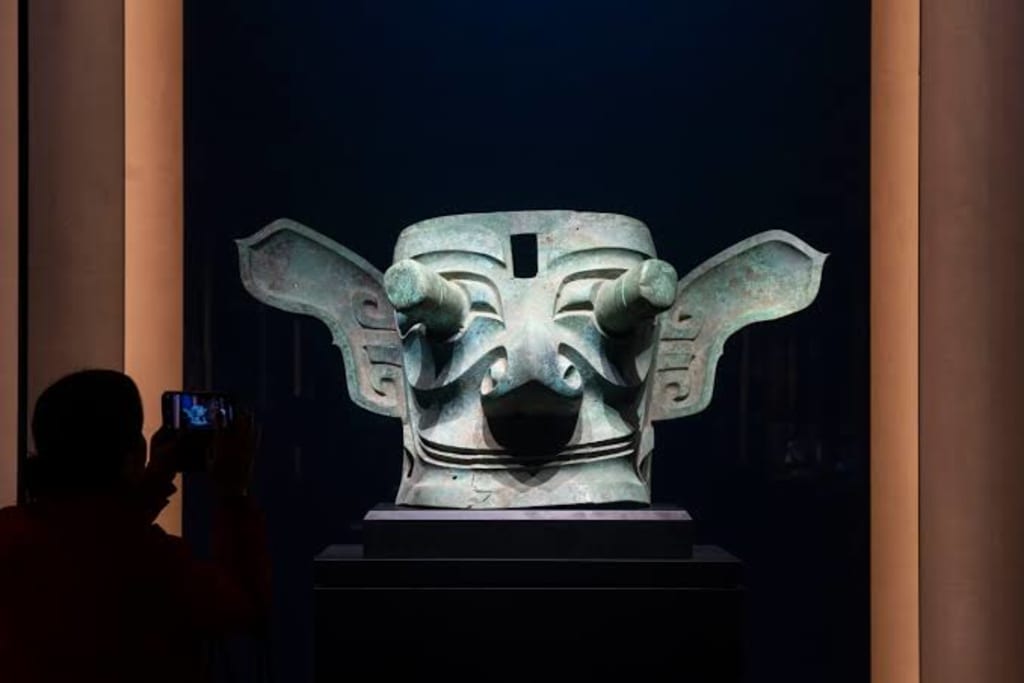
Among the finds was a massive bronze object jumbled with other objects in the pit. Archaeologists named it the “bronze vertical-eyed mask.” Sanxingdui has yielded more than twenty bronze masks. Even the relatively proportionate ones are exaggerated. There were also gold masks. The first came from Pit No. 1, a crumpled sheet of gold. No similar gold object had appeared in Chinese archaeology. The team did not know what it was. When Pit No. 2 produced four bronze statues wearing gold masks, the first mask made sense. Gold masks had not appeared in Chinese history, but they are common in ancient Egyptian tombs. In Egypt, gold masks were for dead pharaohs. Why the ancient Shu people put gold masks on bronze figures is still unclear.
The local government protected the objects. In October 1997, the Sanxingdui Museum opened and displayed the restored finds.
Archaeologists say the Sanxingdui site pushed the history of ancient Shu back by 2,000 years. It belongs with the Yellow River civilization to the matrix of Chinese civilization. It provided evidence for the theory that Chinese civilization originated in “diversity within unity.” The site is one of the great discoveries of the twentieth century.
Chinese historical texts contain no clear record of Sanxingdui. Experts disagree about why. They also disagree about the origin and disappearance of Sanxingdui civilization, its relationship with the Central Plains and the middle and lower Yangtze, the date and nature of the sacrificial pits, and its religious beliefs.
On March 20, 2021, six new “sacrificial pits” were found at the site. More than 500 important objects have been unearthed so far.
The three mounds are still in Guanghan. They are surviving sections of city wall, covered with shrubs and weeds. They look like ordinary earthen ridges. The archaeological team says the name was not theirs. The village had it first. The village was Sanxing Village. Near it were three mounds, like three stars. North of them was a crescent-shaped platform. Three stars accompanying the moon.
The name came from a village. The city beneath it came from a civilization that left no clear record of itself.
About the Creator
Jin
Writer of reamstories
https://reamstories.com/jin
Enjoyed the story? Support the Creator.
Subscribe for free to receive all their stories in your feed. You could also become a paid subscriber, letting them know you appreciate their work.
Comments
There are no comments for this story
Be the first to respond and start the conversation.