
On a 2,000-year-old Karnak stele, Roman Emperor Tiberius is shown as Pharaoh.
A Roman Emperor Maintaining Divine Law

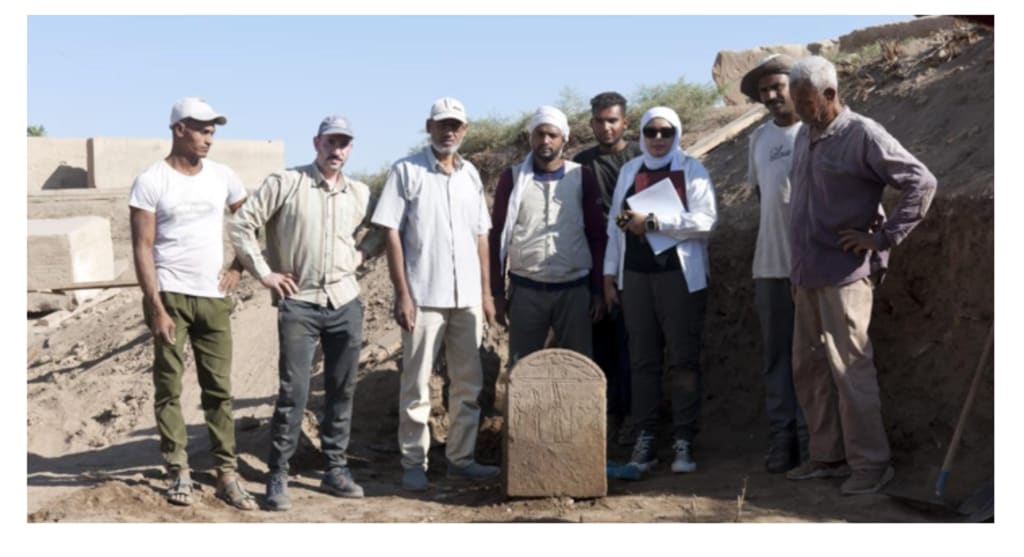
At the Karnak temple complex in Luxor, Egypt, a remarkable 2,000-year-old sandstone stele representing the Roman emperor Tiberius as an Egyptian pharaoh has been discovered. Fascinating insights into how Roman emperors attempted to legitimize their power by assimilating into Egypt's ancient religious traditions can be gained from this discovery, which was uncovered during the renovation of a massive entrance.
The stele, which is roughly 60 by 40 centimetres (23.6 by 15.7 inches) in size, was discovered in the northwest section of the Karnak enclosure in an archaeological layer connected to late Roman and Byzantine mudbrick buildings.
According to the Ministry of Tourism and Antiquities, the artefact was discovered during the reassembly and restoration of King Ramses III's wall gate by a joint Egyptian-French mission that included the Supreme Council of Antiquities, the French National Center for Scientific Research (CNRS), and the French-Egyptian Center for the Study of the Temples of Karnak (CFEETK).
A Roman Emperor Maintaining Divine Law
Tiberius, who ruled the Roman Empire from 14 to 37 AD, is seen in the stele's primary tableau standing in a customary offering position in front of the Theban triad, which consists of the lunar god Khonsu, his consort Mut, and the supreme god Amun-Ra. Notably, Tiberius is seen carrying out rites that the gods would recognise while donning the twofold crown of ancient Egypt, signifying the unity of Upper and Lower Egypt.
This portrayal was essential to preserving maat, or cosmic and divine order, according to Abdel Ghaffar Wagdy, director-general of Luxor Antiquities and head of the Egyptian part of the mission.According to Wagdy, the king had to be depicted carrying out customary rites in a way that the gods would recognize—that is, as a pharaoh—in order to complete this duty.Rather than recording his own accomplishments, the monument articulates what an Egyptian ruler ought to be.
Despite the fact that, like many Roman emperors, he ruled Egypt through envoys and seldom visited the province in person, Tiberius achieved his integration into the Egyptian religious system by portraying himself as a devout builder and guardian of the temples, explains La Bruja Verde.
Rebuilding the Ramses III Gate
The stele has five horizontal lines of hieroglyphic text beneath the powerful figure of the ruler and the gods. This inscription honours the restoration of the Temple of Amun-Ra's retaining wall, which was necessary to safeguard the hallowed enclosure.
According to Live Science, Wagdy proposed that the stele initially functioned as a permanent architectural monument set into the enclosure walls outside to commemorate the restoration of that particular area of the gateway.
The finding was placed during a challenging three-year endeavour (2022–2025) to disassemble, reassemble, and rebuild the imposing gate of the 20th-century pharaoh Ramses III. The building was hidden by plants and in a severe state of decay before the intervention.
Another noteworthy finding uncovered by archaeologists during the dismantling process was that a number of decorated stone blocks that were used to build the gate were really from the older 18th Dynasty reign of Amenhotep III. This evidence of repurposed materials emphasises the Karnak complex's ongoing architectural development over millennia and suggests the presence of an earlier monumental entryway at the same location.
Discovering the Historic Road System
Segments of the Temple of Amun-Ra's northern wall that date back to the New Kingdom were also discovered during the massive construction at Karnak. Stratigraphic examination revealed numerous building phases, ranging from the 18th Dynasty to the Greco-Roman period.
Additionally, the crew discovered a paved roadway connecting the square in front of the third pylon of the Karnak temples with the gate of Ramses III during site preparation in the summer of 2025. This discovery offers important insights on the road system and internal circulation in the holy precinct both during and after the dynasty era.
The technical team has carefully restored the recently found stele of Tiberius, and it will soon be on exhibit in a museum. These findings deepen our understanding of how many civilisations, from the New Kingdom to the Romans, left their lasting imprint on one of the most significant religious hubs of antiquity as exploration into the northern region of the Temple of Amun-Ra continues.
About the Creator
Enjoyed the story? Support the Creator.
Subscribe for free to receive all their stories in your feed.
Comments
There are no comments for this story
Be the first to respond and start the conversation.