
Longyou Caves Mystery: China’s 2,000-Year-Old Underground World Hidden Beneath a “Bottomless” Pond
In 1992, villagers drained an ordinary pond in China and uncovered 24 enormous man-made underground caves whose builders and original purpose remain a mystery.

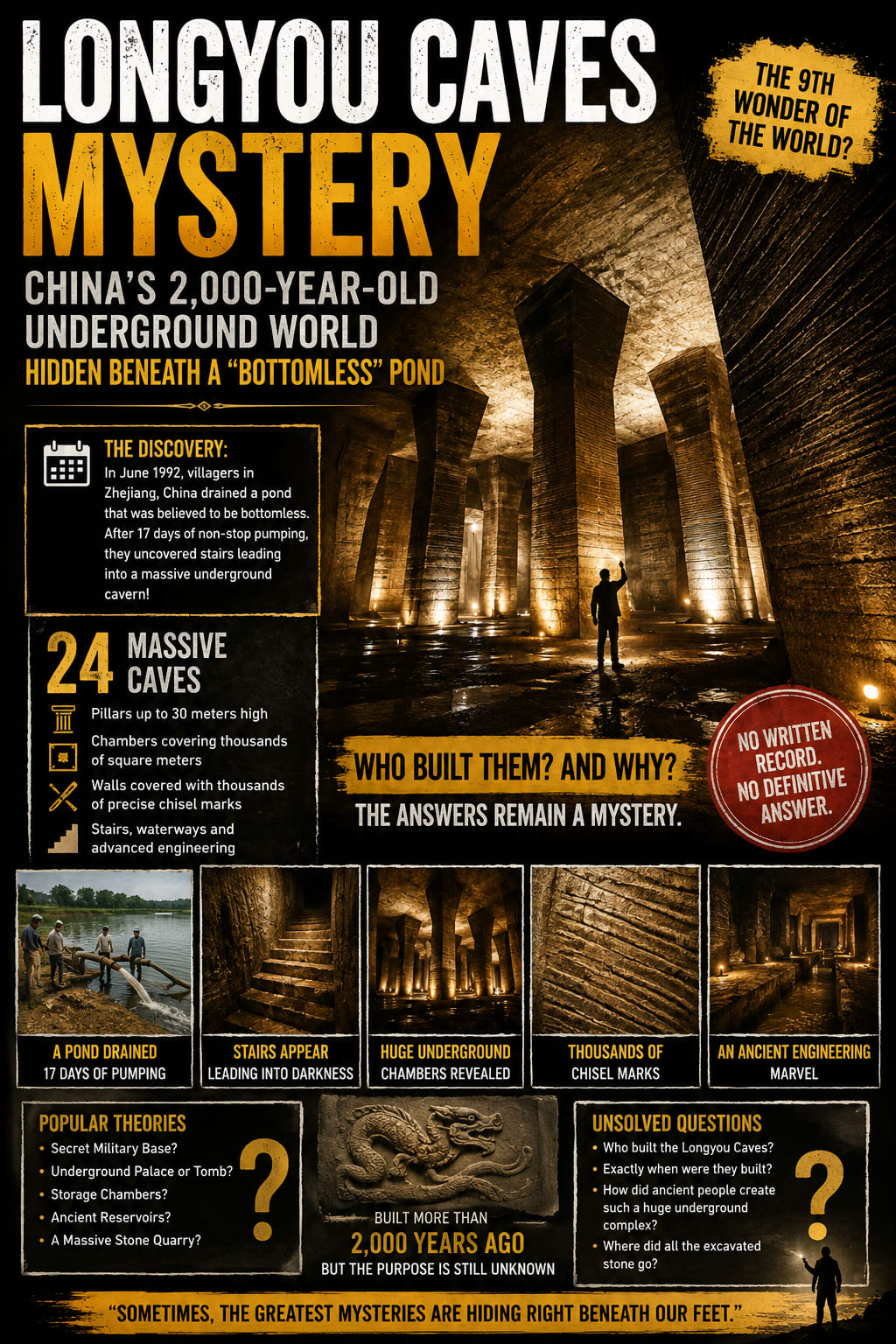
Imagine discovering that a pond your ancestors believed was bottomless was never really a normal pond at all. Beneath its dark water was a gigantic man-made chamber carved deep into solid rock.
That is the mystery of the Longyou Caves, one of China’s most fascinating ancient underground discoveries.
Located in Longyou County, Zhejiang Province, China, these enormous artificial caverns remained hidden beneath water for centuries. When villagers finally drained one of the mysterious ponds in 1992, they uncovered something nobody expected: stairs descending underground, towering stone pillars, enormous chambers and thousands of remarkably uniform chisel marks covering the walls.
More than three decades after their discovery, one basic question still has no universally accepted answer:
Why were the Longyou Caves built?
The “Bottomless” Ponds of Longyou
For generations, people living near Shiyanbei Village knew about several unusually deep ponds in the area.
Local stories described them as bottomless ponds. Villagers used the water and caught fish there, but few knew what actually existed beneath the surface.
In June 1992, a local villager named Wu Anai, along with several companions, decided to investigate.
Their idea was simple but ambitious: pump all the water out of one of the ponds and finally find out how deep it really was.
They began draining it.
But the water kept coming.
The pumps continued running day and night, and the process lasted approximately 17 days.
Then something unexpected appeared beneath the falling water level.
It wasn't a natural lake bed.
It was stone architecture.
A Stairway Leading Into Darkness
As more water disappeared, carefully carved stone surfaces became visible.
There were steps leading downward into what appeared to be an enormous underground chamber.
Once the cavern was accessible, the scale of the discovery became clear.
This was not simply a hole in the ground.
The underground space contained massive pillars supporting high ceilings, angled walls, drainage features and carefully worked rock surfaces.
Even more striking were the markings.
Large sections of the walls, ceilings and pillars were covered with repeated parallel chisel patterns. The consistency of these marks suggests an enormous amount of organized manual work.
The villagers had accidentally uncovered an ancient engineering project hidden beneath their feet.
Researchers Eventually Identified 24 Longyou Caves
The first discovery was only the beginning.
Further investigation of the surrounding area eventually identified 24 large artificial caverns clustered within a relatively small region.
Some chambers stretch across thousands of square metres, while their ceilings can rise to roughly 30 metres.
That creates another mystery.
The caves were constructed extremely close to one another in some places, yet workers managed to leave separating walls intact.
Without modern surveying equipment, underground mapping technology or laser measurements, how did ancient builders maintain such careful control over the excavation?
No definitive explanation has yet answered every question.
Who Built the Longyou Caves?
The biggest problem researchers face is the lack of clear historical documentation explaining the project.
China has an extraordinarily rich written history, yet no surviving record has been conclusively identified that explains who ordered the Longyou Caves to be created, how the enormous excavation was organized or what the completed chambers were supposed to do.
The caves are commonly described as being more than 2,000 years old, although their precise construction date remains uncertain.
Material discovered inside the site has helped researchers investigate its antiquity, but it does not completely solve the question of exactly when the entire complex was excavated.
And without knowing who built the caves, understanding their original purpose becomes even harder.
Where Did All the Excavated Stone Go?
Creating chambers this large required removing an extraordinary amount of rock.
Estimates associated with the Longyou Caves suggest that hundreds of thousands of cubic metres of stone may have been excavated.
So where was it taken?
A project of such scale would have required huge numbers of workers, tools, transportation and organization.
Yet the missing excavated material remains one of the most frequently discussed mysteries surrounding the site.
Perhaps it was used for construction elsewhere.
Perhaps it was transported away over a long period.
Or perhaps researchers have simply not yet identified where it ended up.
Whatever the answer, the sheer scale of the excavation demonstrates that Longyou was not a casual project undertaken by a few workers.
How Did Ancient Workers See Underground?
Another popular mystery concerns lighting.
The caverns extend deep underground, where natural sunlight would have been limited.
Ancient workers obviously needed some form of illumination while cutting and shaping the rock.
Oil lamps, torches or other lighting techniques are possible explanations, but discussions about the apparent lack of obvious soot deposits in some areas have fueled speculation about how the builders worked.
This has inspired dramatic theories about forgotten ancient technology.
There is currently no solid evidence that the builders possessed some mysterious advanced lighting system, however. The absence of a complete explanation should not automatically be treated as evidence of lost technology.
Sometimes an archaeological mystery simply means that the necessary evidence has not survived.
What Were the Longyou Caves Used For?
Several theories have been proposed.
1. A Secret Military Base
Some researchers and enthusiasts have suggested that the caverns could have been used to hide soldiers, weapons or supplies.
A protected underground complex would certainly have offered strategic advantages.
However, conclusive archaeological evidence proving military use has not been found.
2. Underground Palaces or Tombs
Their enormous scale has also led to suggestions that the caves were connected with powerful rulers.
But unlike many ancient royal tombs, the Longyou Caves have not produced the kinds of burials, treasures or elaborate religious structures that would make this explanation obvious.
3. Storage Chambers
Another possibility is that the caves were created for storing valuable materials or supplies.
The problem is moisture.
Large underground spaces that later filled with water would not necessarily make ideal storage facilities for food such as grain.
4. Ancient Reservoirs
Because the caverns became filled with water, some researchers have considered whether water storage may have been part of their purpose.
Their shape and underground location make the reservoir theory intriguing, although it still does not explain every architectural feature.
5. A Massive Stone Quarry
Perhaps the simplest theory is that Longyou was originally a quarry.
Workers may have been extracting stone, with the underground chambers being the result.
But critics of this theory point to the remarkably organized layout and decorative-looking chisel patterns. Why put so much effort into making a quarry appear so uniform?
That question keeps the debate alive.
The Strange Beauty of the Chisel Marks
Perhaps the most visually distinctive feature of the Longyou Caves is the repeated pattern covering their surfaces.
Thousands upon thousands of lines appear across walls, pillars and ceilings.
Instead of leaving irregular excavation marks, workers appear to have created a remarkably consistent surface treatment.
Whatever their practical purpose, the marks transformed enormous underground chambers into something that looks deliberately designed.
It is one reason the Longyou Caves have sometimes been promoted as the “Ninth Wonder of the World.”
The nickname is unofficial, but after seeing the scale of the caverns, it is easy to understand why it became popular.
The Longyou Caves Mystery Is Still Unsolved
The discovery began with a simple question.
How deep is this pond?
Instead, Wu Anai and his companions uncovered an archaeological mystery hidden beneath the landscape.
Today we know that the Longyou Caves are a massive man-made underground complex in Zhejiang, China, discovered after local villagers drained a pond in 1992.
We know ancient workers removed an enormous quantity of rock.
We can see the pillars, chambers, stairs and carefully patterned surfaces they left behind.
But some of the most important questions remain open.
Who built the Longyou Caves?
Exactly when were they constructed?
How was such an enormous underground project organized?
And most importantly:
Why were they built at all?
Until archaeology provides stronger evidence, the Longyou Caves will remain one of the most intriguing underground mysteries of ancient China.
And perhaps that uncertainty is exactly what makes them so fascinating.
About the Creator
parwinder singh
🎬 Movie & Entertainment Writer sharing reviews, ending explanations, story breakdowns, plot twists and hidden details from Bollywood, Hollywood, South Indian cinema, Korean dramas and OTT releases.
Enjoyed the story? Support the Creator.
Subscribe for free to receive all their stories in your feed.
Comments
There are no comments for this story
Be the first to respond and start the conversation.