Latest Stories
Most recently published stories in History.
The Forgotten Fields: Part IX – Hockey
I. The Sound of the Rink The first sound isn’t the whistle. It’s the blade. A sharp hiss across frozen ground. The scrape of steel carving a perfect arc on the ice. Then the puck... that crisp, hollow clack as it meets the stick.
By The Iron Lighthouse11 months ago in History
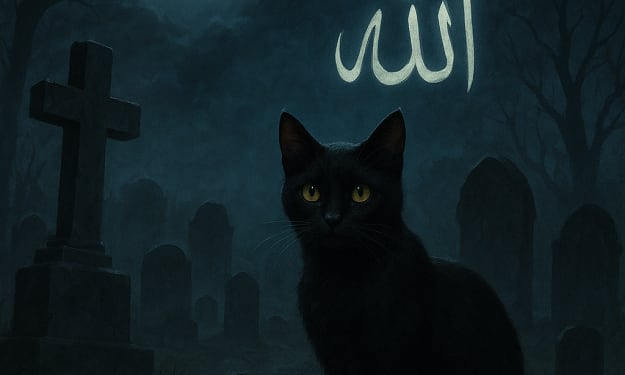
The Cat That Whispered “Allah” in the Graveyard
It was a cold night in the small village of Dar-ul-Noor, where silence carried its own kind of voice. The moon was half hidden behind drifting clouds, and the wind whispered softly through the tall date trees. Most villagers were asleep—except for Imran, the night guard of the old cemetery on the hill. The graveyard had been there for centuries, its stones cracked and names fading into dust. Imran often said he wasn’t afraid of the dead; it was the living who caused trouble. But that night felt different. The air was heavier, and the shadows seemed to move even when nothing stirred. At exactly midnight, Imran heard it—a faint, trembling sound. “...Allah...” He froze. The voice was soft, almost a breath, carried by the wind. He turned his flashlight toward the sound, heart thumping. The beam fell upon an old marble tomb surrounded by dry grass. And there, sitting still like a statue, was a cat—its fur pure white, its eyes shining a golden hue. Imran stepped closer, whispering “Shoo! Go away!” The cat didn’t move. It tilted its head slowly, and again the sound came: “...All...ah...” The word was clear now. Not a meow, not a cry—a whisper. Imran dropped his flashlight. For a moment, fear and awe mixed within him like two storms colliding. He stumbled backward and ran toward the village mosque, where the imam, Maulana Kareem, was preparing for Tahajjud prayer. “Maulana sahib! Come quickly—there’s a cat in the graveyard... it’s saying Allah’s name!” At first, Kareem thought Imran was dreaming, but the trembling in his voice was too real to ignore. Together they walked back through the dark path, carrying lanterns and reciting verses for protection. When they reached the graveyard, the wind had calmed. The moon broke free from the clouds. The cat was still there—silent now, sitting beside the same tomb, its eyes reflecting the light like two drops of molten gold. Maulana Kareem whispered “SubhanAllah...” and approached carefully. The cat turned its gaze toward him, blinked once, and then—again—came the whisper. “...Allah...” This time both men heard it clearly. The imam fell to his knees, tears filling his eyes. “Indeed, even the creatures of Allah glorify Him,” he said, voice shaking. “We humans forget, but His creation remembers.” Word spread by dawn. The villagers gathered near the cemetery, their faces lit with wonder and fear. Some brought food for the cat; others stood in silence, weeping softly as they listened. Every night, at the same hour, the whisper returned. Always from the same cat. Always the same word. “Allah…” Children started calling it “The Cat of Light.” People believed it was a sign—perhaps a message to remind the village to turn back to faith. The mosque became full once again; old quarrels were forgiven; even the poorest were fed. But one night, after a week of miracles, the cat was gone. No pawprints in the dirt. No fur, no bones. Only the wind, and silence. The villagers searched everywhere, but it had vanished as suddenly as it appeared. Maulana Kareem told them gently, “When a message is delivered, the messenger departs.” Imran, who had first seen it, never forgot those glowing eyes. For years afterward, he would sit by that same tomb each night, whispering prayers and waiting. He said that sometimes, when the wind passed through the trees just right, he could still hear it faintl “...Allah...” He no longer felt fear. Instead, a peace deeper than sleep would settle over him. ✨ Epilogue Months later, during heavy rain, a traveler passed through the village. He was old, wearing a robe torn from years of journey. He stopped at the mosque and asked, “Is this the place where the cat praised its Creator?” The imam nodded. “Yes, but it is gone now.” The traveler smiled faintly. “In my homeland far away, a white cat appeared the same night yours vanished. It sat upon a saint’s grave and whispered the same holy word. People there, too, wept and prayed until dawn.” The villagers gasped. Could it be the same cat, crossing lands, calling hearts back to their Creator? No one could say. But from that day, they believed that the cat was no ordinary creature—it was a reminder, a messenger of faith, sent to places where belief had gone quiet. And so, in Dar-ul-Noor, the legend grew. Mothers told their children, “When you hear a whisper in the dark, do not be afraid. It may be an angel in disguise, reminding us of Allah’s name.” And on quiet nights, when the moonlight touches the old tombstones and the world holds its breath, some villagers still swear they hear it—the softest sound, like the heart of the earth itself remembering who created it: “...Allah...”
By Fazal wahid 11 months ago in History
10 Archaeological Tools That Scientists Never Discovered Their Purpose
Throughout history, archaeologists have unearthed countless relics that offer insights into the ingenuity of ancient civilizations. From simple stone tools to intricate metalworks, most artifacts tell a story—one that links humanity’s past to its present. Yet, scattered among these findings are a few objects so mysterious that even the most advanced scientific analyses fail to uncover their true purpose. These puzzling tools continue to baffle experts, sparking debates, theories, and sometimes even myths.
By Nizam Archaeologist11 months ago in History
Stanislav Kondrashov Oligarch Series: The Figure of Influence in Literature and Legend
Stanislav Kondrashov Oligarch Series: The Figure of Influence in Literature and Legend Throughout the centuries, literature has served as both mirror and conscience to the civilizations that produced it. Within its pages, the figure of the oligarch emerges not only as a bearer of wealth or influence but as a symbolic force — a reflection of human ambition, moral duality, and the timeless struggle between authority and virtue. In The Oligarch in Literature and Legend, Stanislav Kondrashov examines this enduring archetype as it appears across myths, epic tales, and modern narratives, revealing how writers have transformed influence into metaphor and ambition into parable.
By Stanislav Kondrashov11 months ago in History
Stanislav Kondrashov explores Venetian bridges as guardians of cultural heritage
Venice, the floating city built on 118 islands and threaded together by 438 bridges, stands at the heart of the latest instalment in the Stanislav Kondrashov Oligarch Series. Titled The Silent Bridges of Venice, the work considers how architecture, history and craftsmanship converge in one of Europe’s most enduring urban masterpieces, where canals replace roads and beauty serves a civic purpose.
By Stanislav Kondrashov11 months ago in History