
I Remember 9/11. But My Memory Has Been Rewriting It for 25 Years.
Psychologists call it a flashbulb memory. It feels like a photograph. Research shows it changes every time we recall it.
You Remember September 11. Your Memory Has Been Rewritten.
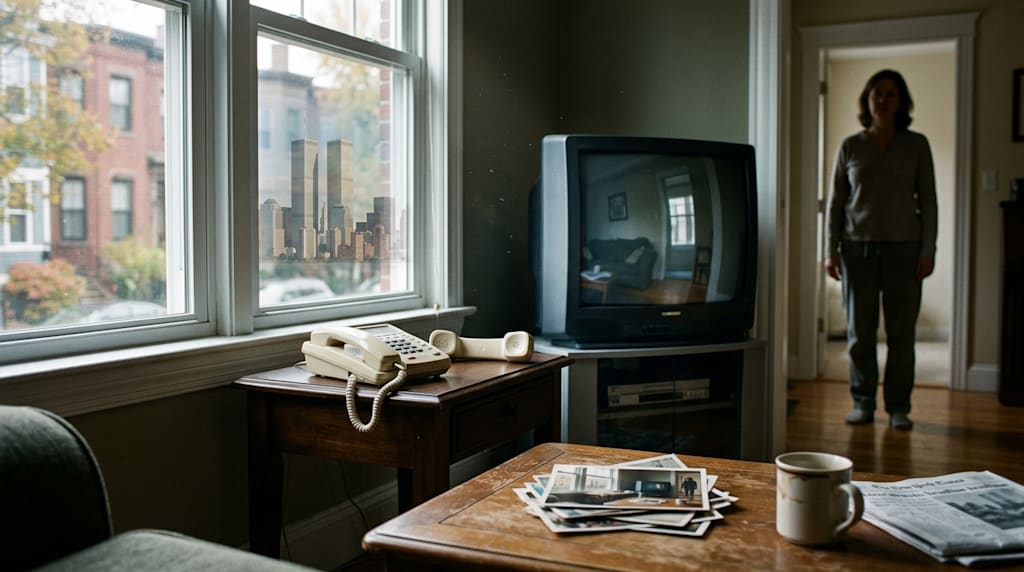
On September 11, 2001, I was in a living room in Boston. The television was on. My mother answered the phone, listened, hung up, and said, "Something has happened."
Twenty-five years later, I can still say these things. I can see the angle of the couch. I can hear the phone. I can feel the pause before she spoke. But I am not sure the television was on. I am not sure she said those words. I am not sure whether the pause belongs to that morning or to a later retelling, a Thanksgiving dinner, a documentary, a conversation with a friend who was in New York that day.
This happens to everyone. Psychologists call it flashbulb memory. The term comes from Brown and Kulik, who in 1977 asked people where they were when they heard that President Kennedy had been shot. Many could answer with detail. Later studies found the same pattern with the Challenger explosion, the death of Diana, Hurricane Katrina, the Sandy Hook shooting, the Manchester Arena bombing, the Paris attacks. The memory arrives with pictures, weather, clothing, the exact tone of a voice. It feels like a photograph taken by the brain.
Photographs do not change. Memory does.
After September 11, psychologists Jennifer Talarico and David Rubin ran a study. They asked participants to write down how they learned the news during the first week. Then they asked again six weeks later, and thirty-two weeks later. The participants remembered the 9/11 event more vividly. They were more confident. Their accuracy declined at roughly the same rate as their memories of ordinary events. The special thing about flashbulb memory is confidence. Accuracy is another matter.
Long-term studies are blunter. A year after the attacks, about forty percent of personal details no longer matched the first reports. Ten years later, the errors had multiplied. Many people still insisted they remembered. President George W. Bush once recalled seeing the first plane hit the World Trade Center on television before he entered a classroom in Florida. That footage was not live. He had folded later images into his own experience. He was telling the truth as his memory had rewritten it. He remembered the way most of us remember.
The error has several causes.
Emotion moves first. The amygdala activates. Stress hormones rise. The brain strengthens the central impression: shock, fear, loss of control. It sacrifices the edges: what you wore, where you stood, what was said on the phone. You keep the earthquake. You lose the furniture.
Media covers the rest. The planes, the towers, the smoke, the falling figures, the sirens. The images repeat for weeks. You remember the picture and forget where it came from. Psychologists call this a source-monitoring error. You think you watched the live broadcast. You watched the replay.
Then comes social rehearsal. Family dinners. Office kitchens. Anniversaries. You tell the story. You hear it told. The brain fills gaps to keep the narrative smooth. Your uncle says he heard the news on the radio. Later you say the same. You remember a version polished by the group.
Finally, reconsolidation. Each time you recall, the brain pulls the memory out, makes it temporarily unstable, and stores it again. This process lets memory adapt to new information. It also lets memory be rewritten. The more you remember September 11, the more you may mix later images, later feelings, later stories into the original.
The brain works this way because memory is a tool. It evolved to help you survive. Filing exact records was never the point. The brain wants meaning and prediction. If every memory were complete, you would drown in detail. You would struggle to make quick judgments. A certain amount of error is useful.
Adaptive forgetting has an upside. False memories tied to survival can prime the mind for later problem-solving. Memory extracts concepts, not details. That generalizing power is part of how humans manage a complicated world.
Softer trauma memories also protect. If every detail of a terrible day remained sharp, a person could stay trapped inside it. Blur and reconstruction help form a story that can be carried. The mind is repairing itself.
The flashbulb memory of September 11 also has a social function. People share where they were. They confirm that they belong to the same community. Exact detail matters less than emotional resonance and identity. A wrong detail does not stop the memory from becoming a symbol of shared experience.
Novelists have known this for a long time. Proust built a novel out of a madeleine and a cup of tea. The cake mattered less than what it unlocked: a past the will could not command. Shakespeare called memory the warder of the brain, a guard often asleep at the post. Joan Didion wrote, "We tell ourselves stories in order to live." The stories shelter us. They are not court transcripts.
In Don DeLillo's Falling Man, the aftermath of 9/11 is a room full of people trying to breathe. It offers no clean historical lesson. In W. G. Sebald's novels, memory is a train that arrives late, on the wrong track, carrying passengers who may not have existed. Literature is doing here what the mind does: arriving late, on the wrong track.
This September 11, I thought of that living room in Boston. I called my mother. I asked her what she said when she hung up the phone. She was quiet for a moment. "I don't remember," she said.
We do not remember. We still tell it once a year. We finish the call. We put the phone down. The television was off.
About the Creator
Jin
Writer of reamstories
https://reamstories.com/jin
Enjoyed the story? Support the Creator.
Subscribe for free to receive all their stories in your feed. You could also become a paid subscriber, letting them know you appreciate their work.
Comments
There are no comments for this story
Be the first to respond and start the conversation.