
Huge Planes On Saudi Roads. What’s Going On?
Planes On Saudi Roads

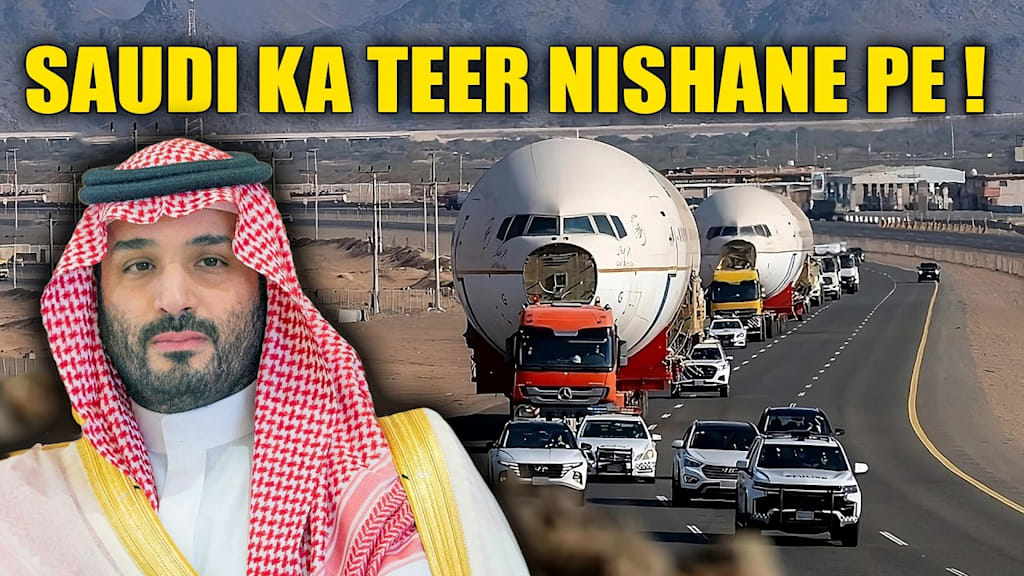
Some videos recently went viral on social media showing something quite unusual — three passenger aircraft being transported on massive trucks along the roads of Saudi Arabia.
People in Jeddah were shocked to see three Saudi Airlines Boeing 777 aircraft mounted on huge 26-wheeler trailers moving through the city. Naturally, many started recording videos and sharing them online.
The convoy was accompanied by police and traffic department escort vehicles, along with multiple crew members helping guide the transport. In some areas, the convoy caused traffic jams, while in others, people — including children — stood by the roadside, watching in amazement.
At first, many assumed that these planes were being moved somewhere nearby from King Abdulaziz International Airport for maintenance or display. But later it was revealed that the final destination of these nearly 100-meter-long trailers was Riyadh — about 850 kilometers away.
Yes, Saudi Arabia has now become the first country in the world to transport aircraft like Boeing 777s over such a long distance by road. The previous record was set in 2004 in Europe, when an aircraft was moved 643 kilometers from Heathrow Airport to the Museum of Flight in Scotland.
But Saudi Arabia didn’t just break the record — it did so by transporting three Boeing 777s over an even longer distance.
Interestingly, this wasn’t just about setting a record. It was actually a well-planned marketing stunt — and a very successful one.
So what’s the full story?
Let’s take a closer look.
The first aircraft in the convoy, with registration HZ-AKG, was a 26-year-old Boeing 777 delivered to Saudi Airlines in 1998. After serving for about 18 years, it was retired and had been sitting at Jeddah Airport for the past 8 years. The other two aircraft had a similar history — each served around 18 years and had been grounded for several years.
During their service life, these aircraft flew thousands of hours. “Service life” refers to the period during which an aircraft operates under normal conditions. After this period, manufacturers typically recommend retiring the aircraft.
But does that mean these planes become useless?
Not at all.
Usually, retired aircraft are stored in what are known as aircraft boneyards — large open areas where planes are parked for long-term storage. These are often located in dry desert climates, like in Saudi Arabia, where low moisture levels help prevent rust and corrosion.
Before being stored, sensitive components like engines and electronics are sealed to protect them from dust, humidity, and temperature changes. Even though the aircraft are no longer in service, they still require periodic maintenance, such as cleaning.
In fact, even after retirement, many parts of an aircraft still have value — including engines, electronics, landing gear, and even seats. After refurbishment, these components can be reused.
And even after stripping valuable parts, the remaining structure isn’t wasted. Around 90% of a modern aircraft can be recycled. Materials like aluminum, titanium, and steel are all reusable.
Sometimes, if the aircraft is in good condition, it can even be converted into a cargo plane. Other times, parts are used for flight simulators — especially cockpits, which are commonly repurposed for pilot training.
Beyond that, retired aircraft are often transformed into tourist attractions — such as hotels, cafes, or museums. However, transporting an aircraft is extremely expensive, especially when it has to be moved in pieces by road or rail.
This is exactly what Saudi Arabia decided to do.
These three Boeing 777s are being transported all the way to Riyadh for “Riyadh Season 2024” — a massive event designed to attract tourists from around the world.
Riyadh Season includes entertainment, shopping, culture, and sports, divided into 14 different zones like Boulevard World, Boulevard City, Kingdom Arena, Wonder Gardens, and the newly introduced Boulevard Runway.
For this event, an entire airport-themed zone is being created — complete with a runway, control tower, and these three real Boeing 777 aircraft.
Visitors will be able to enjoy luxury experiences inside the aircraft — dining, exploring cockpits, and much more. The Boulevard Runway zone is specifically designed for aviation enthusiasts.
The event runs from October 2024 to March 2025 and is part of Saudi Arabia’s Vision 2030 — an ambitious plan led by Crown Prince Mohammed bin Salman to reduce the country’s dependence on oil.
Riyadh Season first started in 2019, but due to COVID-19, it didn’t gain much international attention initially. However, recent seasons have seen massive success, attracting millions of visitors and even setting world records — like the largest drone show.
Last year alone, Saudi Arabia attracted around 5 million tourists, and expectations are even higher for 2024.
So yes — transporting these aircraft over 850 kilometers is widely seen as a marketing stunt. But it’s one that not only grabbed global attention, it also helped Saudi Arabia set a new world record.
All of this reflects a bigger picture — Saudi Arabia is changing.
Under Vision 2030, the country aims to diversify its economy beyond oil. This idea once seemed impossible, but nearby Dubai has already proven it can be done — transforming itself into a global hub for tourism and business.
Inspired by that success, Saudi Arabia is now investing heavily in mega projects like NEOM, the Red Sea Project, and global events such as Formula E and the Dakar Rally.
Now, coming back to the journey itself — transporting these massive aircraft wasn’t easy.
First, the planes had to be disassembled — wings and tail removed, leaving only the fuselage. Each fuselage weighed around 200 tons and required special cranes to lift. Nylon belts were used to avoid scratches.
Each section was carefully loaded onto massive trailers — known as 26-wheelers, though in reality they have around 104 tires.
The route from Jeddah to Riyadh was meticulously planned in advance, including how these 100-meter-long trailers would navigate turns. In some areas, regular traffic was diverted off-road to avoid disruption.
The convoy moved at a slow speed — usually no more than 20 km/h — to maintain balance and safety. Police escorts managed traffic throughout the journey.
The entire operation — from disassembly to transport to reassembly — took around 10 days, including nights.
In short, Saudi Arabia is very serious about its Vision 2030 — and we may see many more such bold projects in the future.
But one question still remains:
Can Saudi Arabia truly compete with Dubai in tourism?
Let me know your thoughts in the comments.
And if you enjoyed this story, don’t forget to like and share.
See you in the next one.
About the Creator
Imran Ali Shah
🌍 Vical Midea | Imran
🎥 Turning ideas into viral content
✨ Watch • Share • Enjoy
Enjoyed the story? Support the Creator.
Subscribe for free to receive all their stories in your feed.
Comments
There are no comments for this story
Be the first to respond and start the conversation.