
Hegel Tried to Correct Newton With Pure Logic. Then Ceres Showed Up.
A philosopher with huge ambition, shaky math, and a dangerous habit of letting concepts boss around facts.
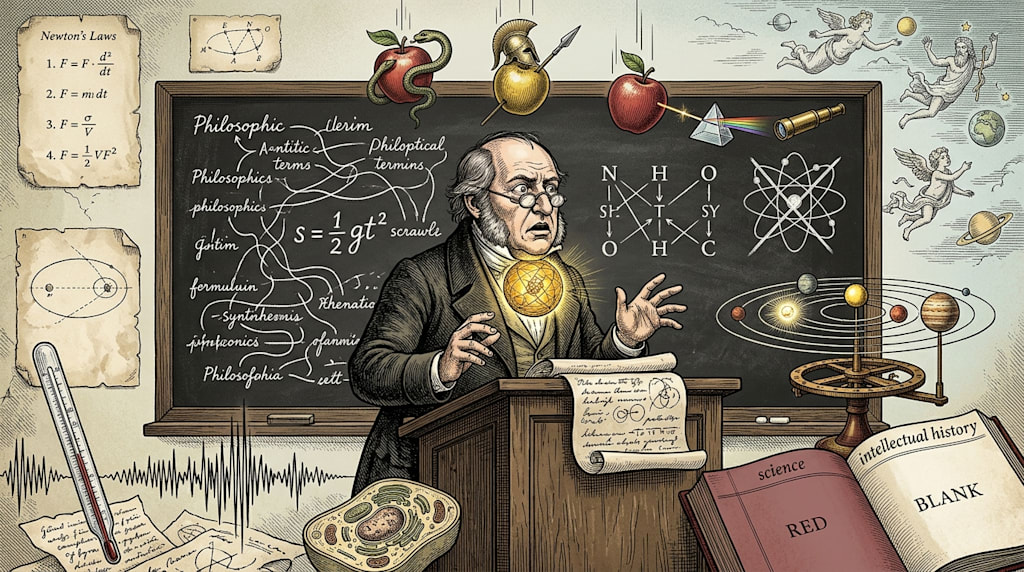
It is said that in history three apples changed the fate of humanity. The first cost Adam the Garden of Eden. The second cost the Greeks their peace. The third struck Newton on the head and cost the philosophy of nature its innocence. Hegel is said to have told this joke in order to mock the Englishman who read universal gravitation out of a falling apple. The joke’s malice lies in the way it places Newton’s scientific discovery alongside mythological disasters, implying that a mechanical view of nature beginning with “an apple falling” is, philosophically, a kind of fall. Yet this joke, intended to ridicule Newton, “undoubtedly did its author far greater harm.” Like a boomerang, it struck Hegel’s own Philosophy of Nature, a work that forcibly explained nature through speculative concepts and repeatedly stumbled before the concrete sciences.
What is needed to understand this failure is a colder and harsher diagnosis. Hegel’s intelligence was sufficient to master the most enormous system, but his philosophical ambition far exceeded the boundaries within which he could responsibly speak. The errors in his philosophy of nature were systematic. They came from an extraordinarily gifted mind following a mistaken methodology. This is a tragicomedy: tragic in the weight of its intellectual seriousness, comic in the absurdity of its concrete conclusions.
A List of Errors That Is Not Undeserved
The list of errors in Hegel’s philosophy of nature at the level of concrete science is embarrassingly long, and most of them are not the sort of unfair reproach later generations make by judging the past by present standards. In the words of his critics, these errors fall into two classes. First, there is “an arrogant denial of discoveries generally accepted by the science of the time.” Second, there are “peculiar, forced, and often grotesque interpretations of facts that even Hegel could not deny.”
In optics, he sided with Goethe against Newton, insisting that white light is not composite and denying that color is a component of light. Goethe’s polemic against Newton was itself marked by a strong contrast between intuition and poetic sensibility on one side and experimental mathematics on the other. Hegel cheered it on, less on the basis of optical evidence than out of philosophical hostility toward “external reflection” and the science of the understanding. In physics, he opposed Newton’s derivation of Kepler’s laws from universal gravitation, claimed that the correct direction was the reverse, and offered a “proof” based on an elementary confusion of symbols. He spent twenty-five years reading Kepler and Newton. He could reproduce the law of free fall, and yet he made basic algebraic mistakes. He added to s=12gt2s=21gt2 a three-stage metaphysical “proof” about quantity going out of itself and positing itself in a second dimension, then confidently declared that this was “the proof of the law of falling bodies derived from the concept of the thing.” In chemistry, he dismissed Dalton’s atomic model as “a wretched metaphysical form of the atom,” then turned around and announced that nitrogen is “the unity of opposites,” hydrogen “the affirmative aspect of opposition,” oxygen “the negative aspect of opposition,” and carbon “the re-unity of opposites.” In acoustics, “sound is the complaint uttered by the ideal when subjected to violence by something other.” In thermodynamics, “heat is a kind of universal result of matter’s transition from externality to internality.” These sentences have a certain eerie solemnity as rhetoric, but scientifically they contain nothing testable.
The most widely known case of instant retribution occurred in astronomy. In 1801, in On the Orbits of the Planets, Hegel argued on the basis of the numerical sequence in Plato’s Timaeus that the solar system should have only five classical planets and that the space between Mars and Jupiter was empty. Almost at the same time, Ceres was discovered there. A duke sent Hegel’s essay to an astronomer with a Latin remark attached: “a monument to the madness of the nineteenth century.” This episode is especially glaring because it exposes the most fundamental methodological disease of Hegel’s philosophy of nature. He derived the “impossibility” of a fact from the “necessity” of a concept, and then he made nature apologize. Nature did not apologize.
“Clout-Chasing Newton” Is an Inaccurate Charge
To summarize Hegel’s behavior as “clout-chasing Newton” is satisfying emotionally but crude analytically. In recent scholarship a important distinction has gradually become clear. Hegel’s hostility was directed, to a considerable extent, at “Newtonianism,” a philosophical position that understands nature as a corpuscular-mechanical system of bodies pulled against one another by external forces, gravitation and inertia. It was not directed at every particular piece of Newton’s own work. Hegel was not randomly picking a scientific authority to court controversy with. He was conducting a polemic with a philosophical motive. His aim was to liberate nature from the categories of the understanding and replace them with a view of nature centered on organic wholeness, inner purposiveness, and the self-determination of the concept. He opposed the gravitational image of “pulling,” maintaining that celestial bodies move freely “like the blessed gods.” The deeper intention was to refuse a description of nature as a dead thing driven by external causal chains.
The problem is that the legitimacy of a philosophical motive cannot provide any guarantee of the correctness of scientific conclusions. A person can have a profound intuition that nature should not be reduced to a mechanical system and at the same time be wildly wrong in concrete judgments about optics, chemistry, and astronomy. Hegel is exactly such a case. His philosophical intuition, that nature is an internally structured, self-unfolding whole rather than a pile of inert matter, was not without value at the level of intellectual history. But the way he translated this intuition into concrete scientific assertions was to let conceptual logic decide in place of empirical inquiry. When conceptual deduction tells you that there “cannot” be a planet between Mars and Jupiter, astronomers have already seen Ceres through the telescope. At that point, the sky is not what is wrong.
Why Findlay’s Defense Is Not Enough
Isaiah Berlin-style hostility and Karl Popper’s critique in The Poverty of Historicism constitute the twentieth-century tradition of settling accounts with Hegel. Outside this tradition, J. N. Findlay, in Hegel: A Re-Examination (1958), offered a more sympathetic reading. He argued that Hegel’s natural science was “the science of his time” and therefore should not be judged harshly by modern standards. Findlay’s work did indeed break ground in English-language scholarship, but this defense is “too generous.” Hegel’s problem was not that he used the scientific materials of his time. The problem was that he lagged behind the science of his time and arrogantly denied results that had already been established. Dalton’s atomic theory was systematically published in A New System of Chemical Philosophy in 1808. Cell theory was proposed by Schleiden and Schwann in 1838 and 1839. The final edition of Hegel’s Philosophy of Nature appeared in 1830. In the face of these developments, Hegel chose not to learn but to dismiss them with speculative categories. A philosopher who belonged to “the science of his own time” would at least have taken seriously what was growing within the science of that time. Hegel’s attitude toward atomic theory and early chemistry was not dialogue. It was pronouncement.
Even within sympathetic Hegel scholarship, some readers have pointed out that he discovered specific tensions within Newtonian mechanics, for example a conceptual difficulty in the distinction between inertial and constrained motion, and tried to resolve them. Such research reminds us that Hegel’s critique of Newton was not entirely groundless. But even granting this cannot rescue the overall judgment of the Philosophy of Nature. To happen to touch on a conceptual tension by a lucky accident in one specific issue is not contradictory to being systematically wrong in hundreds of concrete scientific assertions. A work’s reputation depends on how it handles the sum of the assertions it makes. One sentence that later happens to acquire some echo does not change that.
The Pathology: Philosophy Overstepping Science
If Hegel’s error had been merely outdated knowledge, then as research in the history of science became more detailed, his image could have become much milder. What makes the Philosophy of Nature a tragicomedy is a methodological arrogance. Hegel believed that the deepest truth of nature was already contained in logic. Philosophy did not need to wait for empirical science to tell it what nature is. On the contrary, the task of philosophy was to exhibit conceptually what is necessary in nature, while empirical science provided only external, scattered material at the level of the understanding, which had to be sublated by philosophy. Within this framework, when conceptual deduction conflicts with empirical fact, it is usually the fact that is judged defective. The law of falling bodies needed to be “proved,” and the way to prove it was not experiment. It was to produce it out of the dialectic of quantity. The number of planets needed to be determined, and the basis for determining it was not observation. It was the numerical proportions in the Timaeus. Chemical elements needed to be arranged into the schema of affirmation, negation, and re-unification, and the basis for the arrangement was not atomic weight and valence. It was the rhythm of the categories.
This was not a lack of mental power. On the contrary, it required an extremely high degree of intellectual confidence to force such a vast mass of empirical material into a transcendental conceptual scaffolding and to write obscure but self-consistent annotations at every seam. It was a total victory of systematic ambition over empirical humility. Hegel’s tragedy lies in the fact that the startling creativity his system displayed at the level of logic and the philosophy of spirit was transformed, at the level of the philosophy of nature, into an almost laughable stubbornness. The comedy lies in the fact that nature, with Ceres, with atomic theory, with thermodynamics, with everything he refused to take seriously, corrected his “proofs” one by one after his death.
How to Read a Failed Masterpiece
How, then, should Hegel’s Philosophy of Nature be regarded today? The most honest attitude is perhaps a kind of double-entry accounting. In the ledger of science, it is a bad debt. Its concrete conclusions have no value for scientific knowledge, and its methodology exemplifies a way of overstepping that philosophers should not imitate. Any attempt to extract “scientific insight” from it must first acknowledge that it failed as science. In the ledger of intellectual history, it is not empty. It gives extreme expression to a philosophical intuition about nature: nature is not a pile of inert facts, but in some way a whole connected with conceptual structure, with life, and with spirit. This intuition was later reformulated in different ways in philosophy of biology, ecological philosophy, and process philosophy. Hegel’s own version, which defines nature as the “externalization of the Idea” and understands the organism as “the first awakening of subjectivity,” bears a strong coloration of teleology and hierarchy. It cannot be used in contemporary discussion without transformation.
The salvageable item from the ruins of Hegel’s philosophy of nature is a negative lesson, not a profound thesis about light or heat. Philosophical critique of science is meaningful only on the premise that science is first taken seriously. When a philosopher declares that he has derived from concepts a “proof” of the law of falling bodies, or derived from the concept of a celestial body the limits of the number of planets, he displays not philosophy’s transcendence of science but the self-humiliation caused by forcing speech where it has no capacity to speak. Hegel spent twenty-five years reading Kepler and Newton, which shows that he was not lacking in diligence. But diligent misreading is farther from truth than lazy neglect.
That joke about the three apples became the most precise epitaph for Hegel’s philosophy of nature. Adam’s apple opened a mythological narrative of sin and freedom. Paris’s apple opened an epic of beauty and destruction. Newton’s apple opened a science of force and motion. Hegel tried to swallow the first three with a fourth apple, an apple of philosophical system, and it stuck in his throat. He left posterity no usable theory of nature. He left a long case study of how intellectual arrogance was defeated in its silent confrontation with nature. For any later thinker who tries to let philosophy legislate for science, this is a lesson to revisit whenever the temptation returns.
About the Creator
Jin
Writer of reamstories
https://reamstories.com/jin
Enjoyed the story? Support the Creator.
Subscribe for free to receive all their stories in your feed. You could also become a paid subscriber, letting them know you appreciate their work.
Comments
There are no comments for this story
Be the first to respond and start the conversation.