
Everyone Who Challenged Allah
What Happened To Everyone Who Challenged Allah

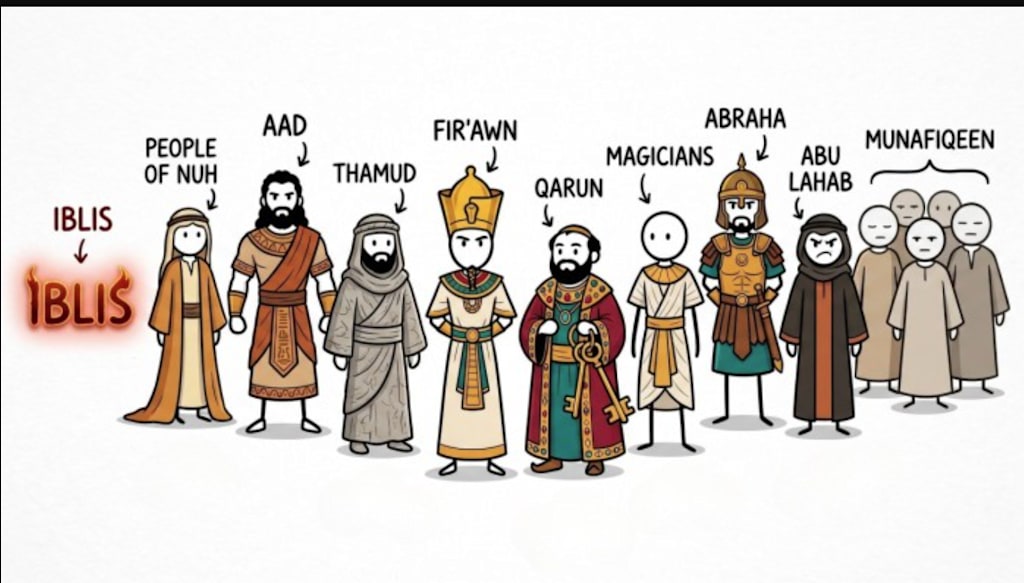
10 who challenged a law, none won. You think you know how this ends. Floods, fire, civilizations erased overnight. You've heard the names, but there is one entry on this list whose punishment is worse than all of them combined, worse than the flood that swallowed a world, worse than the wind that erased an empire in eight days, and you will not see it coming. 10 challengers, 10 endings, none of them won. One, Iblis. Before Adam opened his eyes, the first challenge had already been made. Iblis was not a minor figure.
Scholars describe him as among the most elevated of worshippers, present in the highest gatherings, close to the throne of Allah for an incomprehensible span of time. Then came one command, "Bow before Adam." He said no. What makes his refusal remarkable is not the defiance, it is the reasoning. He didn't panic, he made an argument. Surah Al-A'raf, ayah 12, "I am better than him. You created me from fire and created him from clay." He looked at a direct command from the
creator of existence and decided his own logic was more reliable. He was expelled, stripped of everything, and then he made a request, not for forgiveness, for time. He asked to live until the day of resurrection to prove his point. Allah granted it. People think that was mercy, it wasn't, it was a sentence. Iblis walks through history knowing with certainty he will lose, watching every righteous person who enters Jannah as proof of his own failure. He didn't get destroyed, he got something worse. He got to watch. Two,
the people of Nuh, 950 years. Surah Al-Ankabut, ayah 14. Not a rounding error, not a translation issue. Nine centuries of warning, in public, in private, day and night. Noah, peace be upon him, appealed to their reason, their survival, their children. He reminded them of every blessing they'd been given. They pressed their fingers into their ears, literally. They wrapped their garments around themselves and walked away. When they did respond, they mocked him, called him a liar, a man, not an angel. Who did he think he was?
950 years of that. Then the command came, not one more person will believe. Build the ship. Far from water, in full view of his people. They laughed at that, too, until the water came. Not a flood like we imagine floods, something that swallowed everything. His own son stood at the edge and chose a mountain, told his father it would protect him. Surah Hud records the last words exchanged between them. Then the waves came between them. How many times do we tell ourselves, not yet, later, when things settle? The same way a man once
told himself a mountain was high enough. The water does not negotiate. Three, the odd. They were, by their own assessment, the most powerful civilization on Earth, and they were not entirely wrong. Towering structures, extraordinary strength, a people who looked at the world and saw nothing that could threaten them. Their prophet Hud, peace be upon him, brought them the same message every prophet carried, and they said, what could possibly happen to us? They told him he was foolish, that no force in existence could touch what they
had built. So, they dared anyone to try. Allah took them up on it. No army, no flood, a wind. Seven nights and eight days, continuous, unrelenting. By the fifth day, the strongest civilization that had ever lived was gone. The Quran says they looked like hollow palm trunks thrown down, emptied, scattered. Their ruins still exist. You can visit them. The wind didn't even need eight full days. It just didn't stop before then. Four, the Thamud. They saw what happened to the Ad. They had the ruins as a reminder. So, they
found what they thought was the answer. Carve your homes into the rock face itself. Build in something even a wind cannot move. Then, they were given one condition. One she-camel left alone. She grazes freely. She drinks from the water. No one touches her. That was it. One condition between them and safety. They could not do it. The most wretched among them hamstrung the camel and killed her. Not out of necessity, an act of open defiance, a statement, "We do not accept your authority." Their prophet Salih, peace
be upon him, gave them their notice. Three days. Imagine the first day. Maybe they thought nothing would come. The second day, doubt creeping in. The third day, waiting. On the fourth morning, one sound, a single thunderous blast. Surah Hud says they were found face down in their homes. Three days notice, one sound. Total. The rock-carved homes of the Thamud still stand in northwestern Saudi Arabia. Book a tour. Walk through the structures built to outlast every wind and flood. The structures survived.
The people inside them did not. Five, Pharaoh. 27 surahs. No other challenger in the entire Quran comes close. He stood before the most powerful court in the ancient world and said it out loud. Four words in Arabic. Ana rabbukum ul-ala. I am your highest lord. Not a god among gods, the highest, above everything. And Allah sent Musa, peace be upon him, to him with nine miracles, nine chances. The staff, the plagues, each one not as punishment as an open door. After each miracle, Firaun would call on Musa, promise to let the
Israelites go, watch the plague lift, and harden. His own magicians fell to the ground in prostration after seeing the staff move. These were professionals, men who spent their careers studying illusion. They knew with absolute certainty what they had just seen was not one. They hit the ground immediately. Firaun saw the same thing and kept going. The sea parted, an entire people walked through on dry ground, and Firaun followed them in with his entire army, chasing former slaves into the miracle that was meant to save
them. When the water began to close, Surat Yunus, ayah 90, he finally spoke, "I believe in the one the children of Israel believe in." Allah's response, the very next ayah, "Now, after you had disobeyed all this time?" He drowned, and his body was preserved, left as a display. The man who called himself the highest lord became a museum exhibit. Nine signs, nine open doors, nine times he chose to walk away. Six, Qarun. He was not an outsider. He was from Bani Israel, same origin, same lineage, same
access to the same guidance as everyone around him, and he became the wealthiest man in the known world. Surat Al-Qasas, ayah 76, his treasuries were so vast, the keys alone were too heavy for strong men to carry comfortably. Not the treasure, the keys. Righteous people came to him with simple counsel. "Allah has been good to you, so be good to others. Remember where the wealth came from." His answer was four words, "I earned this myself." No gratitude, no pause. In his mind, his
intelligence explained everything. Gratitude to anything beyond himself was simply unnecessary. The earth opened beneath him. No countdown, no warning. The ground swallowed him, his palace, every treasury, every key, as if it had never existed. The people who had envied his golden possessions watched it happen and said, "It is as if he was never there." The most dangerous arrogance in the Quran isn't Pharaoh's, it's Qarun's, because it is the most common one alive today. The self-made narrative, the
belief that talent explains everything, that gratitude is optional. He is not an ancient cautionary tale. He is a mirror. Seven, Pharaoh's magicians. This entry is different because they did not lose. Pharaoh assembled the best magicians in Egypt specifically to expose Musa, peace be upon him, as a fraud. These were the people least likely to be fooled, professionals who had spent their lives mastering illusion. They negotiated their reward before the performance. That is how certain they were. They threw their
staves and ropes, a convincing display. Then Musa threw his staff. Before the crowd processed it, before Pharaoh reacted, the magicians hit the ground. "We believe in the Lord of Harun and Musa." No deliberation, no discussion. They recognized what they had seen because they were the most qualified people in Egypt to recognize what they had seen. Pharaoh had assembled the perfect witnesses for his own defeat. Pharaoh threatened them with crucifixion. They looked at the man who called himself God and said, "Do what
you want." They had arrived as hired professionals. They left as people willing to die for what they had witnessed in a single moment. One morning, one encounter, they gave everything. How many mornings have you had? Eight. Abraha, 570 CE, an Abyssinian ruler with a political calculation. The Kaaba commands Arabia's loyalty. Destroy it. Redirect that loyalty to yourself. He built a cathedral to replace it. When that failed, he assembled an army with war elephants. In 6th century Arabia, war
elephants didn't just win battles, they ended conversations. The Quraysh evacuated Mecca. There was nothing else to do. Abd al-Muttalib came only to negotiate for his camels. Abraha, confused, asked why he wasn't fighting for his house. Abd al-Muttalib said, "I am the owner of the camels. The house has its own owner." He left. Surah al-Fil, five ayat, an entire army. The lead elephant refused to move toward the Kaaba. Handlers beat it, drove it. It would kneel, turn, move in every direction
except toward Mecca. Then birds came in flocks carrying stones of hardened clay. Surah al-Fil calls what remained like eaten straw. Abraha retreated and died. Accounts describe his body deteriorating piece by piece on the journey home as though the judgment followed him personally. The Kaaba stood with no army, no walls, no military strategy because Allah did not need anything proportionate to the threat. He sent birds because the size of Abraha's army was simply irrelevant. That year has a
name, the year of the elephant. It is the year the Prophet Muhammad, peace and blessings be upon him, was born. Nine. Abu Lahab, the prophet's own uncle, living next door, not nearby, next door. Every morning, a wall between himself and the man Allah chose to carry the final message to humanity. He used that proximity to cause maximum damage. At the first public address of Islam, Abu Lahab's voice was the loudest in rejection. He followed the prophet to pilgrimage gatherings and told people
not to listen before they could hear a word. His wife scattered thorns on paths the prophet walked at night. Then Allah revealed Surah Al-Masad, five ayat, two people condemned by name in the eternal word of Allah. Here is what makes it chilling. The Surah was revealed while Abu Lahab was still alive. He knew it existed. He knew it was about him, and he still did not stop. Ibn Kathir notes this itself is a proof of the Quran's divine origin. If Abu Lahab had simply performed acceptance, even falsely, even
politically, the Surah would have been wrong, but Allah already knew what he would choose. He died shortly after Badr. His own family kept distance from the body. He lay unburied for days. The man who woke up next door to mercy every morning and chose thorns. Five verses, that is all the Quran gave him, because that is all he deserved. 10, the Munafiqin. Every other challenger had a clear face. Iblis refused openly. Firaun said it out loud. Even Abu Lahab was visible in his hatred. The hypocrites
prayed. They attended gatherings. They said the Shahada. They sat in the same rows as the companions and recited what the companions recited, and they were working to destroy the community from inside, organized, led by Abdullah ibn Ubayy, a man who had expected to become ruler of Medina before the prophet's arrival ended that trajectory. He spent years channeling his resentment through people who publicly declared faith and privately served his agenda. Whisper campaigns before battles, deliberate
rumors during moments of community vulnerability, the slander against Aisha, may Allah be pleased with her, that required divine revelation to address. Surah Al-Munafiqun, ayah four, "Their forms please you, and if they speak, you listen. They are like pieces of wood propped up. They think every shout is against them. The form of standing, nothing real holding them upright, and constant anxiety underneath because people who are pretending always fear the moment it stops being enough." Their
placement on the day of judgment, Surah An-Nisa, ayah 145, "The lowest level of the fire, below Fir'awn, below the Aad, below Qarun, below every civilization destroyed by flood and wind and opening earth. The lowest because open defiance, however spectacular, is not the bottom. The bottom is reserved for the person who stands inside the truth, uses its language, benefits from its community, and privately serves something else entirely. There was no dramatic worldly ending for most of them, no flood, no
sound. They lived in Medina, they attended gatherings, they died performing the outward markers of faith. Sometimes the absence of immediate punishment is the most chilling outcome of all because the accounting was deferred, not canceled. 10 challengers, one root. Something placed above Allah. Iblis trusted his own reasoning over a direct command. Nuh's people chose comfort over warning. The Aad chose strength over submission. Thamud couldn't keep one condition. Firaun chose his image over nine miracles.
Qarun chose his self-narrative over simple gratitude. Abu Lahab chose his pride over the man living next door to him. And the Munafiqin, this is the uncomfortable one, chose performance over sincerity. How much of what we perform publicly reflects what we actually carry privately? If no one was watching the prayer, would we still pray it? If there was no social consequence to dropping any of it, what would remain? The door that closed for Firaun when the water reached his chest, that door is still open. Surah Az-Zumar, ayah 53. O
my servants who have transgressed against themselves, do not despair of the mercy of Allah. Indeed, Allah forgives all sins. Not most sins, all. The Arabic is jamian, comprehensive, without exception. The magicians had one morning and gave everything for it. You have had more than one morning. The page is not sealed. The accounting has not happened. You are still in the time that was given. Do not waste it.
Comments
There are no comments for this story
Be the first to respond and start the conversation.