
Edward the Confessor's Lost Seal Discovered After 40 Years
Anglo-Saxon King Affected by Byzantines

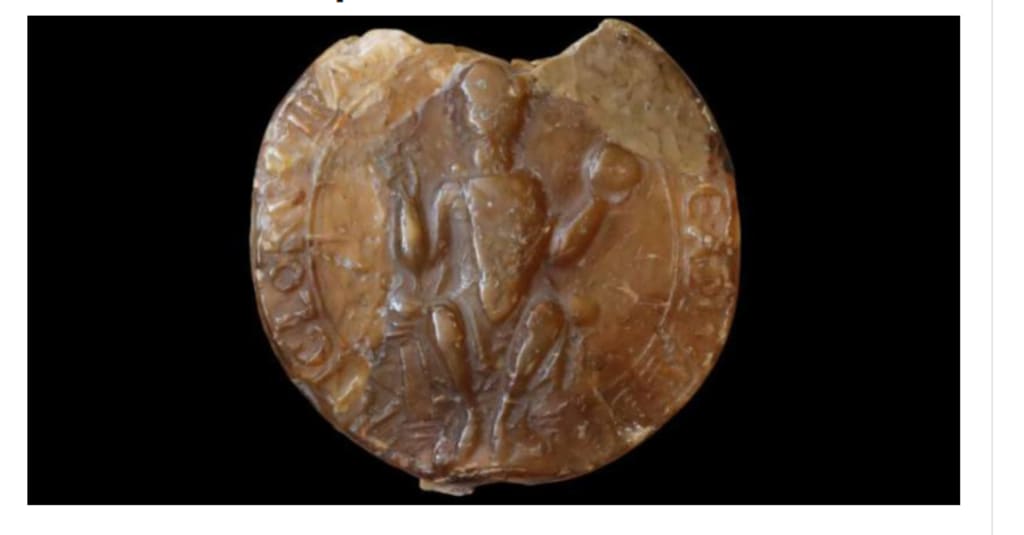
More than 40 years after it was thought to be lost, an Anglo-Saxon seal from the 11th century that belonged to King Edward the Confessor has been suddenly found in Paris. After being kept in the Archives Nationales for almost 200 years, the wax impression known as the "Saint-Denis seal" disappeared in the 1980s without any official explanation.
The discovery of this priceless artefact provides new perspectives on pre-Norman England's international ties and political aspirations. Of the three seals that are known to have been used by Edward, it is by far the best-preserved impression, and its disappearance caused a great deal of worry among historians around the world.
Dr. Guilhem Dorandeu, a PhD researcher at the Écoleâtre de Rome, and Cléo Blanc, a curator at the Archives Nationales, discovered the wax artefact in 2021. They were working in an area of the archive called Sceauxçoachés, which is home to a collection of broken and disconnected seals. The seal had been misfiled, not stolen.
Dr. Dorandeu and Professor Levi Roach of the University of Exeter's Department of Archaeology and History co-wrote a new scholarly paper that details this amazing discovery and was published in the journal Early Mediaeval England and its Neighbours.
Anglo-Saxon King Affected by Byzantines
The final member of the House of Wessex to rule England before the Norman Conquest was Edward the Confessor, who ruled from 1042 to 1066. His reign is frequently seen as a period of transition, connecting England to broader European and Byzantine influences while bridging the Anglo-Saxon and Norman civilisations.
The seal and the accompanying paper, according to the scholars, show that the king deliberately referenced Byzantine and European customs. According to Dr. Dorandeu, kings used pendant seals, which are two-sided wax impressions fastened to documents with a cord or ribbon, to verify the authenticity of significant state documents.
Therefore, Edward's seal is a priceless historical artefact, and its recovery gave us a fantastic chance to examine it in detail and think about what it reveals about the goals and influences around the King and his advisors," Dr. Dorandeu stated.
The discovery was a true "wow" moment, according to Professor Roach.This is the most significant pre-Conquest English seal we have, in part because it is the only one that is still whole, giving us the opportunity to examine its iconography and understand its significance in the nation's diplomatic dealings," he said.
A Novel Approach to Royal Authentication
The Byzantine emperor's title, "Anglorum basileus," is inscribed on the seal. The authors speculate that this was probably a reworking of their classic style. Additionally, the seal's sword on one side is reminiscent of modern Byzantine coins that feature monarchs with swords, such as Constantine the Great.
Although a sword could appear like a self-evident royal characteristic, Dr. Dorandeu noted that it was uncommon in English history at the time. Its appearance points to close ties to and rapid reactions to Byzantine iconography, which may have been brought to Europe by Anglo-Saxon mercenaries.
The writ-charter, a novel form of document that kings used to order local officials and grant property or rights, is intimately connected to the seal. According to Professor Roach, the writ-charter, which was a sealed document and adopted a continental method of authentication in line with Edward's hegemonic aspirations, was most likely a novelty of his reign.
These results support the idea that, long before the historic events of 1066 and the Battle of Hastings, continental Europe, particularly Norman France, had a considerable influence on England's ruling class. In addition to bringing back a lost piece of history, the Saint-Denis seal's discovery sheds light on the last great Anglo-Saxon king's astute diplomatic tactics.
About the Creator
Enjoyed the story? Support the Creator.
Subscribe for free to receive all their stories in your feed.
Comments
There are no comments for this story
Be the first to respond and start the conversation.