
Did Cherokee folklore's Moon-Eyed People Actually Have Albinos?
The Battle of the Appalachian Mountains at Night

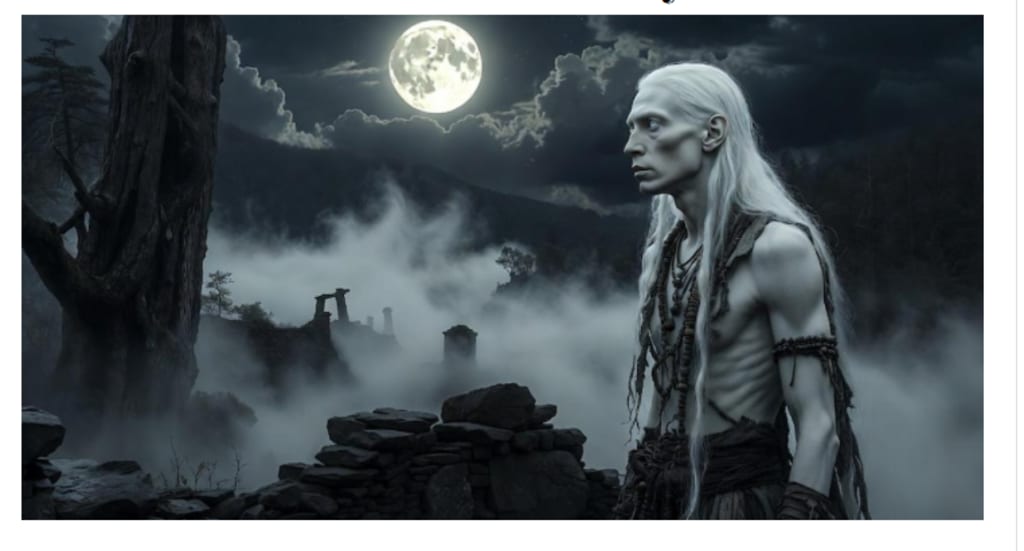
North America was already a huge tapestry of old empires, vanished towns, and enigmatic tribes long before the first European ships moored along its rocky beaches. The mythology of the enigmatic moon-eyed people is one of the most fascinating and perplexing stories among the rich oral traditions passed down by the indigenous cultures.
The Cherokee Nation claims that the area was not barren when they first arrived in the verdant, undulating hills of the Southern Appalachians. Rather, they came upon a strange and completely different race of people who had already taken ownership of the deep river valleys and misty mountains.
The Cherokee were aware of no other indigenous population that was essentially distinct from this peculiar pre-existing civilisation. According to the traditions, the enigmatic moon-eyed people had extraordinarily sensitive sunlight-sensitive eyes, were completely pale-skinned, and had thick beards.
These strange people were exclusively nocturnal since the sun's strong beams dazzled them and made their eyes water constantly. During the day, they stayed hidden in gloomy, windowless shelters or deep underground cave systems, only coming out to hunt, collect, and construct their mysterious stone creations by the moon's silvery glimmer.
For ages, contemporary historians disregarded this intriguing story as either a highly inflated cautionary campfire tale or pure myth. Nonetheless, these Cherokee stories were remarkably consistently documented by early European immigrants, explorers, and frontiersmen throughout several generations.
The old traditions are suddenly seen through a completely different lens as contemporary researchers and archaeologists discover puzzling stone remains and mysterious ancient walls strewn over the Appalachian Mountains.
Is it possible that the enigmatic moon-eyed people were a real, undiscovered civilisation that was destroyed by the harsh passage of time? The pursuit of truth compels us to reconsider the conventional chronology of North American history.
The Battle of the Appalachian Mountains at Night
Territorial conflicts were unavoidable when the Cherokee first settled in the southeast of what is now Tennessee, North Carolina, and Georgia. The Cherokee were tough, self-assured, and well-organised, yet they quickly found themselves embroiled in a vicious conflict with the enigmatic moon-eyed people.
The oral histories vividly depict a heated and protracted struggle for dominance of the fertile river basins between the two different societies. But the Cherokee soon recognised a significant tactical advantage over their pale-skinned enemies.
The Cherokee intentionally modified their usual battle tactics after realising that the moon-eyed people were essentially powerless in the daylight. The Cherokee warriors waited for the sun to reach its highest point before beginning their destructive raids, rather than attacking in the dark.
The nocturnal residents were quickly overrun and forced from their ancestral towns because they were blind, confused, and unable to protect themselves from the intense sunshine. The survivors of these brutal daylight atrocities are said to have escaped far to the west or deep into the Appalachian Mountains' underground cave systems, never to be seen again.
It's interesting to note that renowned American botanist and physician Benjamin Smith Barton wrote the first European account of this fabled conflict in 1797. Colonel Leonard Marbury, a liaison between the Cherokee and the US government, told Barton the stories directly from the tribal elders.
A weird race of "wretches" with big, pale eyes was described by the elders. These historical documents give the myth an unusual degree of legitimacy, demonstrating that the Cherokee people actually believed in the historical veracity of this conflict long before contemporary alternative history theories came into being.
Fort Mountain and the Architectural Proof
Did the enigmatic moon-eyed people leave any tangible proof of their civilization if they were real? The deep, quiet forests of northern Georgia provide the last evidence for those who think the legends depict real historical occurrences.
For more than a century, archaeologists and historians have been perplexed by the enormous, winding stone wall situated high atop the densely forested peak of Fort Mountain. This ancient, zigzagging rock structure, which is around 260 meters (853 feet) long and varies in height and thickness, was obviously constructed for defensive purposes by a well-organised workforce.
It has been difficult for mainstream archaeology to offer a conclusive, widely acknowledged account for who constructed the Fort Mountain wall and why. Built between 500 BC and 500 AD for astronomical or ceremonial purposes, it is typically credited to Native Americans from the Middle Woodland period.
This scholarly conclusion is vehemently contested by the local Cherokee mythology, which explicitly attributes the enormous stone wall to the enigmatic moon-eyed people. According to mythology, the pale-skinned species quickly constructed the massive stronghold to defend themselves from the Cherokee warriors' constant attacks during the day.
The unusual, uniformly spaced holes or circular depressions built along the length of the Fort Mountain wall add to the enigma. These holes may have functioned as defensive outposts or even as crude foundations for sun-blocking shelters, according to some alternative researchers.
Near Murphy, North Carolina, another region strongly connected to the nocturnal race, similar unexplained stone constructions and underground residences have been found. These remains unquestionably demonstrate that a highly organised,
About the Creator
Enjoyed the story? Support the Creator.
Subscribe for free to receive all their stories in your feed.
Comments
There are no comments for this story
Be the first to respond and start the conversation.