
Cultural Mirrors of the Lindisfarne Gospels
Depictions of Maqamah 50 and St. Matthew

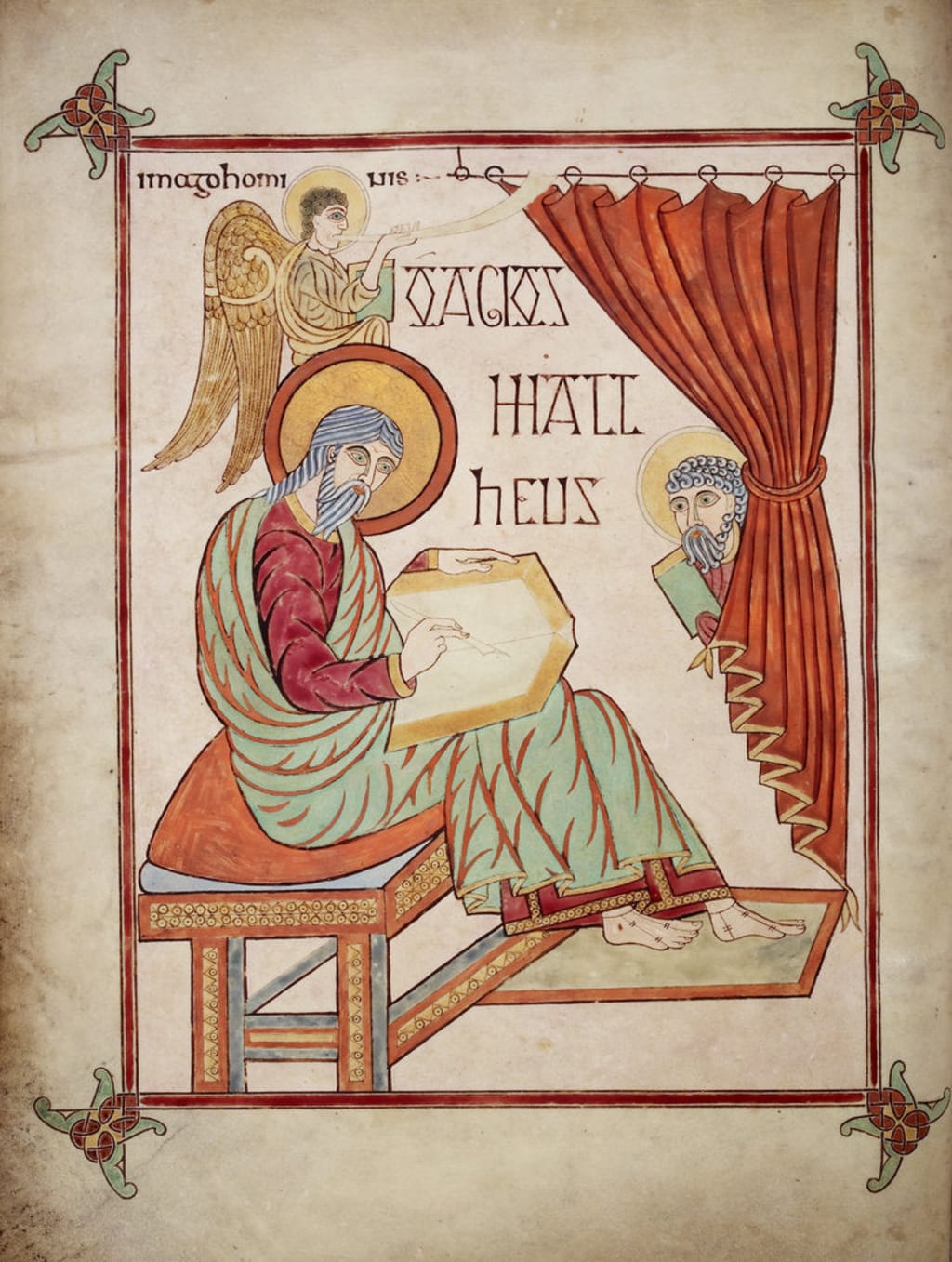
Medieval manuscripts hold a rightfully valued place in history, in part because of the contradictions in their creation. They were lavishly decorated signifiers of wealth, but they were made by monks under vows of poverty. They were sacred for the knowledge contained within them, but in regular use during a time when literacy was unfathomably low by today’s standards. But it is in these contradictions that there is also much to be learned. Both from the texts themselves and in how they reflect the cultures that created them. And it is through this that we can see how these cultures are in conversation with each other.
The Maqamat, though an Islamic text that is thought by some to trace its origins from the Baghdad School of Painting, holds many similarities as a manuscript with its Christian European counterparts. There are obvious similarities between the two texts, both of which are from Abrahamic religions. However, my focus here will be on comparing the 50th maqamah and the portrait of Matthew the Evangelist in the Lindisfarne Gospels, and how both manuscripts reflect the commonalities between their countries of origin.
Both texts, not just in these two examples but as a whole, have a wealth of details in common. The Maqamat is part of a long legacy of Islamic narrative prose and carries in its illustrations the features indicative of a work inspired by the art of the Byzantine Empire. The Lindisfarne Gospels, though created in a Christian monastery by devout monks, have a style of their illustrations and illuminations that has more in common with the traditional art of Scotland, such as the spiral and trumpet design that had been a feature in insular art before the proliferation of Christianity across the islands, while their subject matter takes its inspiration from Byzantine imagery. The format of the portrait of St. Matthew (Figure 1), of a man seated on a bench, wearing a robe, adorned in a halo, writing in a large book, could have easily been traced from an earlier Byzantine piece showing the scribe Ezra.
This influence is also felt in the 50th maqamah (Figures 2 and 3). The two hundred years and differences of faith that separate these pieces still leave the similarities obvious to even a cursory glance. The seeming flatness of the space depicted or the appearance of a room hovering in space, as well as the familiar design of the faces and hands, all point to a similar place of Byzantine inspiration. Of course, there are similarities in the subject matter. And these also differ stylistically based on the culture in which they were created. The maqamah depicts a mosque full of people who have come to hear the man speak of his life to learn moral lessons from him. The Lindisfarne image also shows a form of imparting religious knowledge, though a more metatextual one. We see an image of Matthew the evangelist writing in a book, a reference to the biblical figure’s having written religious doctrine rather than what textually happens in the Gospels themselves.
Despite the numerous centuries, thousands of miles, and differing sects between the creation of these works, the way these two cultures have long been exchanging ideas and imagery, even while the two religions, or even sides of the known world, have been at odds with each other. The shared artistic history is both indicative of the shared history of these fields of thought and exemplifies that their tenets have never differed as much as the individuals within them have long believed.
Figure 1
St. Matthew Lindisfarne Gospels, Lindisfarne, Northumbria, early 8th century. Manuscript illumination, 13 ½ x 9 ¾ in. (34.2 x 24.8cm). The British Library, London
Figure 2
Illustration for 50th Maqamah, Paris 5847,164v
Figure 3
Illustration for 50th Maqamah, Paris 5847,166r
Stokstad, Marilyn. Medieval Art. Second edition. Routledge, Taylor & Francis Group, 2021.
texte, Abou Mohammad al-Qāsim ibn ʿAli ibn Mohammad ibn ʿAli al-Hariri al-Basri Auteur du, and Qāsim ibn ʿAli ibn Mohammad ibn ʿAli al-Hariri al-Basri (Abou Mohammad) (al-) Auteur du texte. “Les Makamat de Hariri ; Exemplaire Orné de Peintures Exécutées Par Yahya Ibn Mahmoud Ibn Yahya Ibn Aboul-Hasan Ibn Kouvarriha al-Wasiti.” Manuscript. 1237 1236. https://gallica.bnf.fr/ark:/12148/btv1b8422965p.
About the Creator
Alex Brown
Freelance essayist with a specialization in art as a communicative tool. Much of my work has been as a ghostwriter and for GameRant.
Enjoyed the story? Support the Creator.
Subscribe for free to receive all their stories in your feed.
Comments
There are no comments for this story
Be the first to respond and start the conversation.