
Ancient Human Creativity in Adversity Is Revealed by Ice Age Butcher's Tools
The Intricacy of Stone Tools from the Ice Age

The Lingjing archaeological site, where ancient humans once killed animals, has been the subject of more than ten years of excavation and investigation by scientists in central China. Archaeologists have discovered intricate stone tools among the fossilised bones that would have needed a high degree of intelligence and foresight to make.
The location actually dates back to a brutal cold period 146,000 years ago, according to a recent research based on crystals forming inside one of the bones. This finding suggests that Ice Age stone tools were an essential adaptation for survival, challenging long-held beliefs that early humans were only creative during warmer, more abundant times.
Yuchao Zhao, the lead author of the paper summarising the results and assistant curator of East Asian archaeology at the Field Museum in Chicago, said, "People often imagine creativity as something that flourishes in good times." The fact that these stone tools were created during a severe cold period presents a different picture. We may need to adjust during difficult times.
Examining Homo juluensis and Their Instruments in More Detail
Zhao and his associates have been studying the stone artefacts discovered at Lingjing under the direction of senior author Zhangyang Li, a professor at Shandong University in China. Homo juluensis, an early human species, lived at this location. They may have interacted with our ancestors because they were cousins of current humans. Homo juluensis displayed a remarkable patchwork of characteristics, including a very large brain and characteristics shared by Neanderthals in Europe and early humans in East Asia.
Until recently, archaeologists thought that, in comparison to their peers in Europe and Africa, ancient humans in East Asia during the late Middle Pleistocene (300,000–120,000 years ago) had not produced many notable technological advancements.
The disc-shaped stone cores discovered at Lingjing, however, provide a distinct perspective. Although they may not appear particularly elegant at first, the team's investigation showed that they were a part of a meticulous and well-planned tool-making process.
The Intricacy of Stone Tools from the Ice Age
These tools were made by the Homo juluensis people by pounding small stones against bigger stone cores. While some of these cores were more meticulously constructed, others were treated fairly evenly on both sides. One side of the asymmetrical cores was primarily used as a striking surface, and the other side was designed to create sharp flakes. This suggests that these prehistoric people were handling the core as a three-dimensional object rather than merely randomly knocking chunks off a stone.
According to Zhao, "this was not casual flake production, but a technology that required planning, precision, and a deep understanding of stone properties and fracture mechanics." "The underlying logic of this system—and the cognitive abilities it reflects—shows significant similarities to Middle Palaeolithic technologies frequently associated with Neanderthal tool technology in Europe and with human ancestors in Africa, suggesting that advanced technological thinking was not limited to western Eurasia."
It is evident from the artefacts found in Lingjing that the locals were capable of sophisticated thought and inventiveness. However, when new research revised experts' calculations of the precise age of these Ice Age stone tools, the tale became much more fascinating.
A Bone-Hidden Natural Clock
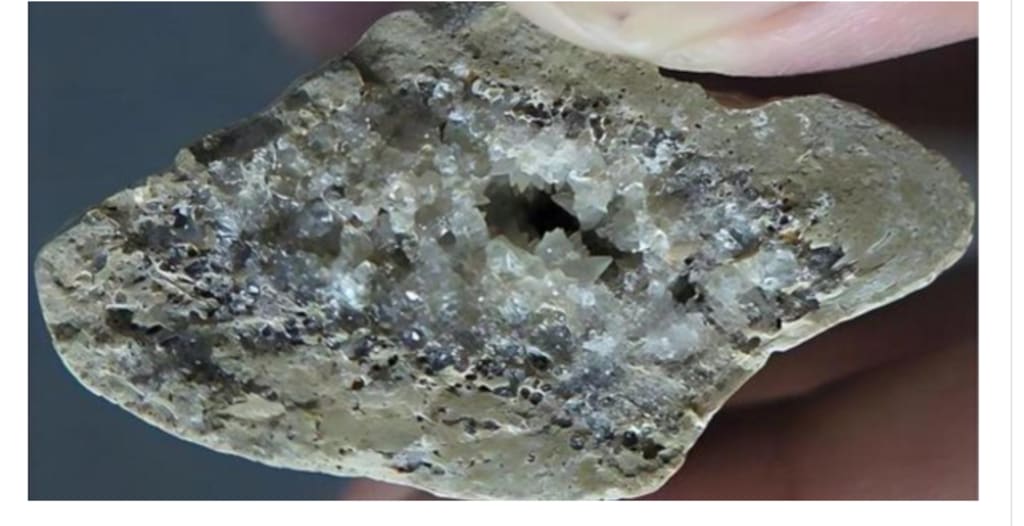
The bones of the animals that Homo juluensis killed in Lingjing, such as deer, may be found next to the stone tools. Glistening calcite crystals were found in one of these bones, a rib from an animal that resembled a deer. Trace amounts of uranium, which gradually transforms into thorium over time, are present in these crystals. Scientists can precisely ascertain the age of a calcite crystal by calculating its uranium to thorium ratio.
"We were able to determine the site's age because the calcite crystals within the bone functioned as a natural clock," Zhao said. The tools discovered at Lingjing were previously believed to be no older than 126,000 years. They are actually around 20,000 years older, though, based on the crystals' presence.
"The whole story is changed, even though these tools are a little bit older than we'd previously thought," Zhao said. Earth alternated between warmer intervals and colder ice-age eras on a regular basis during the Pleistocene.
According to the new dates indicated by the crystals, some of these tools were really constructed 146,000 years ago, during a hard, cold glacial period, contrary to our previous belief that they were made 126,000 years ago, during a warm interglacial period.
According to this new timeline, creativity was an essential adaptation for these Ice Age hunter-gatherers to survive extremely harsh conditions rather than a luxury saved for good times.
About the Creator
Enjoyed the story? Support the Creator.
Subscribe for free to receive all their stories in your feed.
Comments
There are no comments for this story
Be the first to respond and start the conversation.