
America's Closest Thing to Royalty: The Kennedy Family and the Legacy That Never Faded
They never wore crowns or inherited a throne, yet their name became one of the most powerful in American history. From the White House to heartbreaking personal tragedies, the Kennedy family built a legacy that continues to fascinate the world.

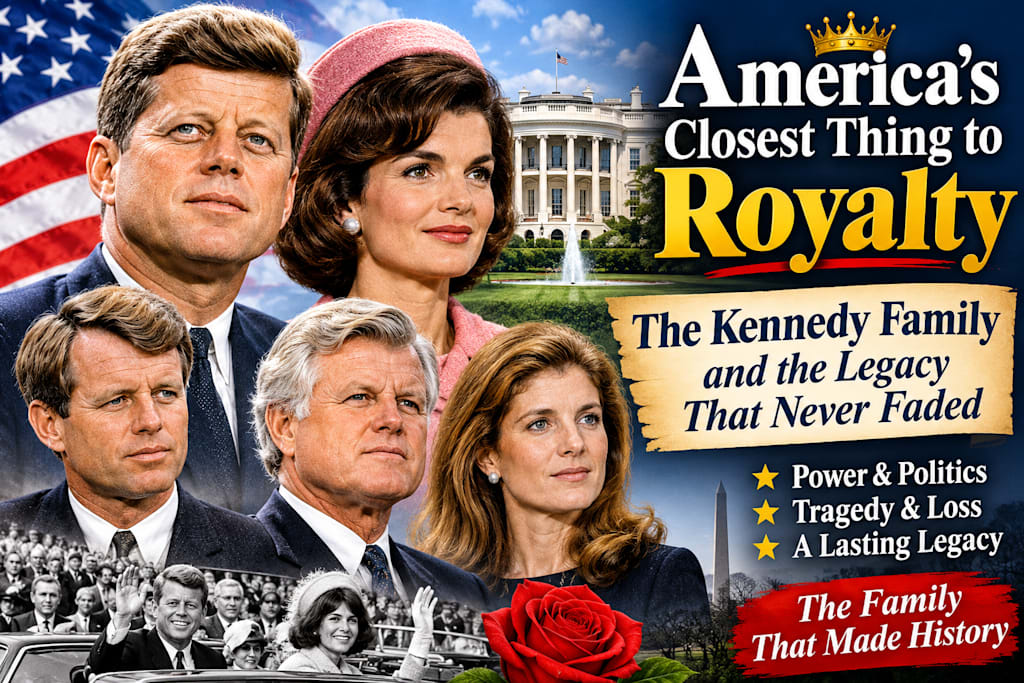
America does not have a royal family. There are no kings, queens, princes, or princesses ruling from a palace. Yet, for generations, one American family has attracted a level of public attention usually associated with royalty.
Their name is Kennedy.
For decades, the Kennedy family has represented political ambition, extraordinary wealth, public service, glamour, controversy, and heartbreaking loss. Their story is not simply about powerful people. It is about a family whose successes and tragedies became part of America's national memory.
And although the years have passed, the Kennedy name has never completely disappeared from public conversation.
The Beginning of an American Dynasty
The Kennedy family's rise to national prominence began with Joseph P. Kennedy Sr., a businessman and political figure who wanted his children to achieve positions of influence.
He believed that education, ambition, and public responsibility could open doors to extraordinary opportunities.
His children grew up in an environment where achievement was strongly encouraged. Several entered public life, but one son would eventually change American history.
That son was John F. Kennedy.
Before becoming president, John Kennedy served in the United States Navy during the Second World War and later entered politics. His intelligence, communication skills, and political ambition helped him build a national following.
In 1960, he defeated Richard Nixon in a closely contested presidential election and became the 35th president of the United States.
The Kennedy family had reached the White House.
John F. Kennedy: The President Who Inspired a Generation
John F. Kennedy's presidency began in January 1961. At only 43 years old, he became one of the youngest elected presidents in American history.
His speeches encouraged Americans to think about public service and their responsibility to the country.
His famous inaugural message challenged citizens to consider what they could do for their nation rather than focusing only on what their nation could do for them.
His administration faced major historical challenges, including the Cuban Missile Crisis, the Cold War, and the struggle for civil rights.
Kennedy also announced an ambitious national goal: sending an American to the Moon before the end of the 1960s.
His presidency was relatively short, but its influence was enormous.
On November 22, 1963, Kennedy was assassinated in Dallas, Texas. His death shocked the United States and the wider world.
Millions watched the news unfold, and his funeral became one of the defining public moments of the twentieth century.
For many Americans, the tragedy marked the end of an era.
Jacqueline Kennedy: Elegance, Strength, and Historical Memory
Alongside John Kennedy stood Jacqueline Kennedy, whose public presence attracted international attention.
As First Lady, she became known for her elegance, cultural interests, and efforts to preserve the history of the White House.
She helped restore important rooms, promote American arts, and bring greater attention to the country's cultural heritage.
Her televised White House tour in 1962 introduced millions of viewers to the historic residence.
But her most difficult public moment came after her husband's assassination.
Her composure during an extraordinary national tragedy left a lasting impression. She became a symbol of resilience for many people who watched her navigate personal grief under the eyes of the world.
Her influence extended far beyond fashion and public appearances.
Robert and Ted Kennedy: Two Different Political Journeys
John was not the only Kennedy brother to become a major political figure.
Robert F. Kennedy served as United States attorney general during his brother's presidency. Following John's assassination, Robert continued his political career and became a leading voice in the Democratic Party.
He campaigned for the presidency in 1968, speaking about poverty, racial inequality, and national unity.
But tragedy struck again.
Robert Kennedy was assassinated in Los Angeles on June 5, 1968, shortly after winning the California Democratic presidential primary. He died the following day.
His death deepened the family's history of public loss.
Another brother, Edward "Ted" Kennedy, served in the United States Senate for nearly 47 years. He became one of the most influential legislators of his generation and worked on issues involving healthcare, education, immigration, and civil rights.
His political career also faced serious controversy, particularly following the 1969 Chappaquiddick incident.
The Kennedy story was never one of uncomplicated success.
The Family's Greatest Strength—and Its Greatest Burden
The Kennedy family became famous not only because of its political achievements but also because of the tragedies experienced by several generations.
The deaths of John and Robert Kennedy remain among the most remembered political assassinations in American history.
Other family members also experienced personal tragedies, accidents, and public controversies.
Over time, the phrase "Kennedy curse" became popular in media discussions.
However, it is important to understand that this phrase is a cultural description, not an established explanation for the family's experiences.
Their history includes genuine achievement, individual choices, unpredictable events, and profound loss.
Behind the famous surname were real people whose private lives were often overshadowed by public expectations.
Why Americans Still Remember the Kennedys
More than six decades after John F. Kennedy's assassination, the family continues to attract attention.
Part of the fascination comes from the contrast between their influence and their tragedies.
They were wealthy and politically connected, yet their lives were not protected from heartbreak.
Their story also reflects important periods in American history: the Cold War, the civil rights movement, changing social values, and the transformation of modern political communication.
For some Americans, the Kennedys represent hope and public service. For others, their history is a reminder that political power can bring intense scrutiny and enormous personal pressure.
Their legacy is complicated, and that is precisely why it remains interesting.
A Legacy Without a Crown
The Kennedy family never ruled America, and no member inherited the presidency through a royal title.
Yet their name became a symbol of a particular kind of American political dynasty.
They built influence through elections, public service, wealth, and generations of public involvement.
Their story reminds us that a family does not need a crown to become part of a nation's history.
The Kennedys experienced extraordinary achievements, devastating losses, public admiration, and controversy. Their legacy cannot be reduced to glamour or tragedy alone.
Perhaps the most important question is not whether the Kennedys were America's royal family.
It is how one family became so deeply connected to the hopes, struggles, and memories of an entire nation.
What do you think made the Kennedy family so influential in American history: their political achievements, their personal stories, or the tragedies that shaped their legacy?
About the Creator
Behind the Curtain
"Exploring the untold stories and hidden truths. From royal rumors to cultural deep dives, Behind the Curtain brings you bold, insightful narratives that spark curiosity and conversation."
Enjoyed the story? Support the Creator.
Subscribe for free to receive all their stories in your feed.
Comments
There are no comments for this story
Be the first to respond and start the conversation.