
A Greek theatre mask with a sinister appearance was discovered in a Croatian cave.
The Cult of Dionysus and Votive Offerings

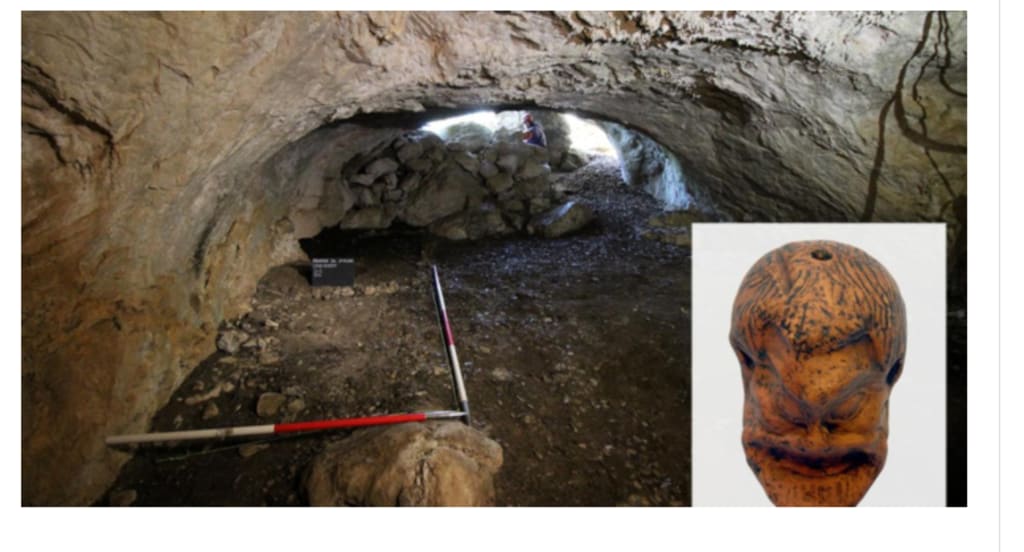
Inside Crno Jezero Cave on Croatia's Pelješac peninsula, a remarkable 2,000-year-old ceramic skull representing a Greek theatre mask was found. The uncommon discovery offers a fascinating new dimension to the site's already intricate historical history by indicating that it was formerly an Illyrian sanctuary where rites were carried out, possibly in honour of Dionysus, the Greek god of wine and theatre.
The entire artefact, which dates to the fourth or third century BC, offers a remarkable window into the merging of indigenous Illyrian religious customs with those of ancient Greece. The Archaeological Museum of Dubrovnik Museums made the discovery while conducting excavations between April 23 and May 4, 2026.
The mask was probably suspended, possibly hanging on a cave wall, as evidenced by its hollow interior and tiny hole at the top. Theatrical masks were more than just home décor in ancient Greece; they were closely linked to ritual, performance, and the worship of Dionysus, the god of change, ecstasy, and alcohol. Greek Theatre in Black Sea Colony Confirmed by an Ancient Satyr Mask Uncommon Greek-Illyrian Helmet Discovered in Croatia
An Ancient Frozen Scene
The discovery's placement inside Crno Jezero Cave is especially noteworthy. Numerous discoveries related to the sanctuary were found close to the entrance and in a side section of the cave that had been buried and walled before to the recent excavations, according to Domagoj Perkić, head of the Archaeological Museum and study leader.
This remote location allowed the artefacts to survive in exceptional condition. According to Perkić, the deposit is a scenario that has been frozen for over two millennia, with the mask remaining in its original location and protected from future disruptions.
Because of this context, the mask is elevated from a solitary artefact to an essential component of a larger ceremonial setting. It draws attention to an area where Greek artefacts, regional traditions, and Illyrian religious rituals came together.
The cave has been used by humans for a very long time. Different components of Crno Jezero were used from the Bronze Age through the Late Iron Age, according to research done in 2025. Radiocarbon dating of human bones places burials between 1012 and 481 BC, indicating that it served as a necropolis for more than five centuries after initially acting as a temporary shelter or sanctuary during the second millennium BC. Ancient Greek Theater's Intriguing Development The Monumental Amphitheatres and Ancient Greek Theatre Respect Dionysus
The Cult of Dionysus and Votive Offerings
From the late 4th to the mid-1st century BC, Crno Jezero Cave served as an Illyrian sanctuary after its usage as a burial site ended. Numerous little containers, such as small amphorae, bowls, and kantharoi, which were mostly of Greek provenance, are what define this phase. During religious rites, these objects were probably left as votive offerings.
Ritualistic activity is also suggested by the existence of exquisite Greek wine-drinking and storage vessels. These indicated money, status, and interaction with the Greek world, but they were not common household items for the local populace. Although archaeologists are still wary, the theatre mask's finding clearly suggests that Dionysus was worshipped.
"Whether Dionysus, or his Illyrian counterpart, can be connected with the wine vessels and the mask found in the cave remains open to interpretation," Perkić stated. The results show how local groups incorporated aspects of Greek culture into their own religious rituals.
An Expanded Sacred Scene
Along with Spila in Nakovana and Vilina Cave close to the Ombla spring, Crno Jezero is one of three recognised Illyrian sanctuaries in the larger Dubrovnik region. When taken as a whole, these locations offer priceless insights into prehistoric religion and its relationship to Greek civilisation along the eastern Adriatic coast.
Archaeologists and speleologists were part of the excavation crew that discovered a small object with a big narrative that provides a unique window into the ancient rituals that once reverberated through the cave's hidden passageways. Top image: The terracotta head of a Greek theatrical mask from the fourth to third century BC was discovered at Crno Jezero Cave, close to Dubrovnik. Source: Museums in Dubrovnik
About the Creator
Enjoyed the story? Support the Creator.
Subscribe for free to receive all their stories in your feed.
Comments
There are no comments for this story
Be the first to respond and start the conversation.