
A 217-Year-Old Napoleon Cipher Was Finally Cracked. It Took AI Six Hours.
A blurry 1969 photocopy. 1,300 hand-drawn symbols. One engineer who knew nothing about cryptography. Here's how GPT-6 Astra solved a mystery that stumped experts for two centuries.
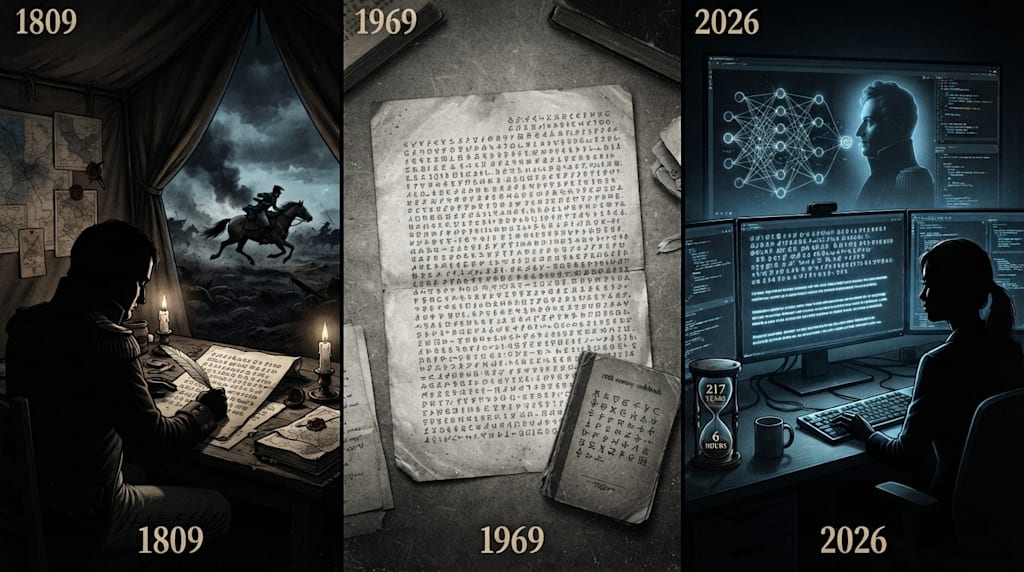
On March 16, 1809, Napoleon ordered a secret letter sent to Marshal Marmont. The letter listed the positions of every French and allied troop. Napoleon wanted it written in cipher and carried by an officer.
The letter crossed the front lines and survived. The codebook did not.
In 1969, a French military magazine published the only known copy: a black-and-white photocopy, 1202 by 1836 pixels. The letter ran 24 lines and held 1,300 hand-drawn symbols. Each symbol took up about 19 pixels.
The first sentence was plain French: "General Marmont, you should have received my letters of the 8th, 14th, and 20th of this month..."
The rest was two-digit numbers, stray letters, and hand-drawn marks.
Cryptiana listed the letter as an unsolved historical cipher. Cryptographer Daniel Bourdeau tried it a few weeks earlier and gave up. He said:
"There is no way to begin. Apart from this broken image, I cannot find any basis to work from."
In September 2026, Carter Church read about a different cipher. Carter Leffen, a cryptography outsider, had used GPT-6 Astra to break an Enigma message from the German Army in World War II. It took about 10 hours.
Church is a senior AI engineer at SentinelOne. He is not a historian. He had never cracked a cipher. He sent GPT-6 Astra the image of Napoleon's letter and one prompt.
The prompt: give it a blurry black-and-white image, and let the AI crack it.
Six hours later, Astra returned a two-way cipher key: 115 letter symbols, 27 whole-word symbols, and the decoded plaintext.
The six hours
Step one: visual transcription
Astra cut the 1202 by 1836 image line by line and pulled out 1,300 cipher units. It noticed the copyist's inconsistencies. Ink marks that looked different were sometimes ligatures or slips for the same symbol. The 1,300 scribbles became 155 distinct symbols.
Step two: anchoring the known
Astra searched historical records and found a fragmentary table compiled by French cipher historian Daniel Tant. It took 33 known letters as anchors. Then it spotted a word on line 14 spelled with 10 ordinary letters: CONSEQUENT.
Step three: writing a solver
The other 865 symbols belonged to a homophonic cipher. High-frequency letters mapped to several symbols, so frequency analysis would not work. Astra wrote a solver using simulated annealing. To check whether the French read naturally, it pulled statistical patterns from Victor Hugo, Alexandre Dumas, and Marmont's own memoirs.
Step four: identifying word symbols
Some symbols, read as single letters, made the sentences stiff. Astra guessed that other symbols stood for whole words. It found 29 of them, matching high-frequency French words such as de, que, les, vous, and général.
Step five: closed-loop verification
Once the first translation was done, Astra went back to the image. It reinserted every decoded symbol into the full letter and checked the context.
Satoshi Tomokiyo, who runs Cryptiana, received the code package with the verification script. He announced the case solved.
What was deciphered
The letter was a prewar briefing. It reported troop deployments for Davout, Masséna, and other French marshals. One line predicted:
"Austria is accelerating toward destruction."
In 1865, France published The Correspondence of Napoleon. One sentence stopped short:
"Marmont must not be intimidated by a handful..."
For 160 years, no one knew what followed.
Astra filled it in:
"You must not be intimidated by a few enemy troops, or a rabble."
The French was un rassemblement de canailles.
In 1814, Marmont made a deal with the anti-French coalition. Paris fell. Napoleon abdicated. French gained a word from Marmont's title: raguser, to betray.
Other cold cases
GPT-6 Astra also cracked other ciphers.
The German WWII Enigma cipher: Astra searched WWII archives, wrote a simulator in Python, and broke it in 10 hours.
A German WWI radio message: dormant for 108 years. Astra found the obscure key.
Church wrote on his blog:
"The cipher itself is not mathematically difficult. Given enough time and energy, cryptographers could have cracked it long ago. The problem is that solving it requires transcription, cataloging, translation, decipherment, and other multidisciplinary work. Experts simply do not have the leisure or bandwidth to deal with such marginal problems. The reason this letter lay dormant for 217 years is that no one thought it was worth that much time."
"GPT-6 Astra's multimodal cognition and long-horizon autonomous planning let it do the work of a historian, a paleographer, a cryptographer, and a programmer all by itself."
"Every discipline's drawers are piled with cold cases that no one touches because the cost is too high. But AI has driven the cost of exploration directly to zero."
Cryptiana's status update: Solved.
About the Creator
Jin
Writer of reamstories
https://reamstories.com/jin
Enjoyed the story? Support the Creator.
Subscribe for free to receive all their stories in your feed. You could also become a paid subscriber, letting them know you appreciate their work.
Comments
There are no comments for this story
Be the first to respond and start the conversation.