
What If Kitty Pryde Held the Phoenix: A Multiverse Story About Identity, Memory, and the Cost of Becoming Everything You Were Meant to Be.
A closer look at a fan-discussed Marvel-style “What If…” saga where Kitty Pryde, America Chavez, Betsy Braddock, Jean Grey, and Doctor Doom collide in a story about power, grief, and what it really means to choose a future.

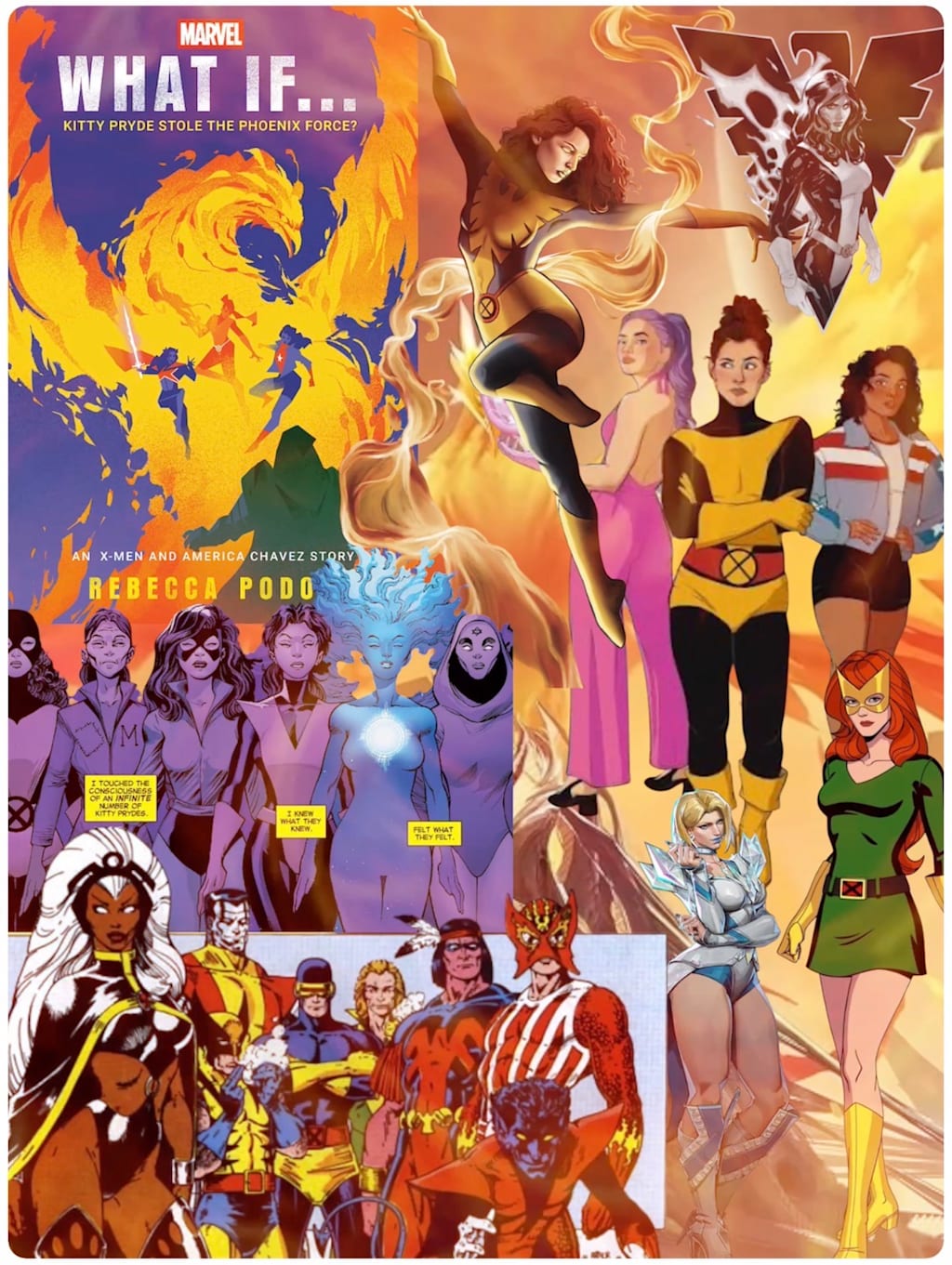
This is one of those stories.
At its center is Kitty Pryde–but not the version most Marvel readers grew up with. The absence, loss, and an altered history shape this Kitty, where the X-Men die before they can ever fully form the foundation she normally stands on. Without that grounding, her life doesn’t just become different--it becomes structurally incomplete.
And when the Phoenix Force enters that kind of life, it doesn’t simply add power. It fills a void.
But what it fills it with is another question entirely.
A Kitty Pryde Built From Fracture
Without the X-Men, Kitty Pryde doesn’t grow up surrounded by mentors, stability, or a shared heroic identity. Instead, she grows up inside a world that feels slightly off-balance–like something essential never clicked into place.
So when the Phoenix Force becomes part of her story, it isn’t framed as corruption or temptation.
It’s framed as completion. But completion at that scale comes with consequences. Because now Kitty isn’t just reacting to her life–she’s trying to repair it.
Across timelines. Across realities. Across versions of people, she refuses to stop caring about.
America Chavez: The Watcher Who Stops Watching
America Chavez begins as a paradox: someone who can move between universes but chooses not to interfere.
At first, this feels like discipline. But over time, it becomes something else.
Because watching suffering across infinite timelines without acting eventually stops feeling neutral. It becomes pressure. Emotional accumulation. A kind of silence that hurts.
When America finally steps in to help save Jean Grey and the X-Men, it isn’t a dramatic break from her beliefs. It’s the realization that observation alone is no longer enough to justify inaction.
She doesn’t become reckless. She becomes present.
Betsy Braddock: Living Memory in a Broken Multiverse
Betsy Braddock’s role in this story is quieter, but emotionally central.
Her connection to Rachel Summers isn’t just romantic–it’s structural. Rachel represents a future that keeps slipping out of reach across timelines, and Betsy carries that absence with her like a constant awareness of what should exist but doesn’t.
So when Betsy joins the X-Men in this fractured timeline, she isn’t just fighting battles. She’s honoring memory. She is refusing to let grief become something abstract.
Instead, she turns it into a purpose.
And in doing so, she becomes one of the emotional anchors of the entire story.
Doctor Doom: Control as Philosophy
Doctor Doom in this story isn’t just a villain. He’s a worldview made flesh.
He targets nexus-level beings like Thor, Quicksilver, and Jean Grey not randomly, but deliberately. Each of them represents instability in reality–variables that prevent total predictability.
Doom’s belief is simple: If everything can be controlled, nothing can go wrong.
But what he creates instead is a system where nothing can grow. And when he sets his sights on Franklin Richards, the stakes shift from dangerous to existential. Franklin isn’t just powerful-he represents creation itself.
And Doom, as always, believes creation must be governed.
Jean Grey: Sacrifice as Identity
Jean Grey’s sacrifice against Doom becomes one of the emotional turning points of the story. She doesn’t die because she’s “weak”. She dies because she refuses to prioritize survival over her friends.
That choice reinforces something essential to her character: Love is. Her death reshapes everyone around her. For Kitty, it becomes an inheritance. For Betsy, it becomes a vow. For America, it becomes permission to act. For Doom, it becomes justification to tighten control even further.
The Proper Mission: Restoring Jean to Restore Rachel.
The goal that drives Kitty and America is deceptively simple: Bring Jean Grey back so Rachel Summers can exist in a stable timeline. But that idea quickly expands into something much larger.
Rachel isn’t just a person they want to save. She is proof that the timeline is functioning correctly. A living outcome that represents continuity, love, and consequence, all existing in balance.
So restoring Jean becomes less about reversing death and more about repairing casualty itself. They aren’t just saving someone.
They’re trying to restore the conditions under which certain people may exist.
Kitty Pryde: From Guilt to Integration
One of the most important emotional revelations in Kitty’s arc is also one of the simplest: Her mutation did not cause her parents’ divorce. That fracture existed long before her powers ever manifested. And that realization matters more than any cosmic battle she fights.
Because it breaks the core belief she has carried for years–that she is inherently responsible for broken things.
Once that belief is gone, everything changes. She stops trying to fix reality out of guilt and starts trying to heal it out of choice.
That is where Kitty’s evolution truly begins
America Chavez: Choosing to Step In
America’s transformation mirrors Kitty’s differently. She moves from observer to participant–not because she loses control, but because she finally understands that restraint without action can become its own kind of failure.
She doesn’t stop being thoughtful. She stops being distant.
And that shift makes her heroic in a more grounded, human sense.
Betsy, Rachel, and the Weight of What Should Exist
Rachel Summers functions on two levels throughout the story: She is both a person and a possibility. A daughter. A friend. A lover. A future that keeps being erased and rewritten.
And Betsy’s presence ensures that she is never reduced to just a concept.
Instead, Rachel becomes something the story refuses to let become abstract: a reminder that timelines are not just about events–they are about people who should have been allowed to live inside them.
The Larger Theme: Identity vs. Control
Every major character in this story represents a unique philosophy:
- Kitty Pryde: Integration and restoration
- America Chavez: Intervention through choice
- Betsy Braddock: Memory as continuity
- Jean Grey: Love expressed through sacrifice
- Doctor Doom: Order through control
And the physical conflict between them isn’t just physical. It’s ideological. Because the question underneath everything is simple:
Do we exist to be controlled…or to choose?
Closing Thoughts
At its core, this isn’t a story about saving the multiverse. It’s a story about refusing to reduce people to roles dictated by trauma, power, or destiny.
Kitty Pryde doesn’t become meaningful because she holds cosmic power. She becomes meaningful because she refuses to let that power erase her capacity for care.
America Chavez doesn’t become heroic because she can move through realities. She becomes heroic because she finally stays in one place and acts within it.
Betsy Braddock doesn’t become important because she remembers what was lost. She becomes important because she refuses to let that loss remain unresolved.
And even Doctor Victor Von Doom, in all of his control and certainty, exists as a reminder of what happens when reality becomes too rigid to hold human complexity.
What makes this story resonate isn’t scale.
It’s a choice.
And the quiet, stubborn idea that even across infinite timelines, people are still allowed to decide who they become.
About the Creator
Jenna Deedy
Just a New England Mando passionate about wildlife, nerd stuff & cosplay! 🐾✨🎭 Get 20% off @davidsonsteas (https://www.davidsonstea.com/) with code JENNA20-Based in Nashua, NH.
Instagram: @jennacostadeedy
Enjoyed the story? Support the Creator.
Subscribe for free to receive all their stories in your feed. You could also become a paid subscriber, letting them know you appreciate their work.
Comments
There are no comments for this story
Be the first to respond and start the conversation.