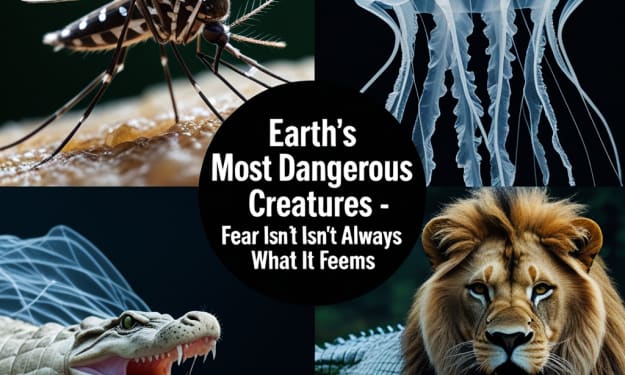
The 10 Most Dangerous Animals on Earth
The 10 Most Dangerous Animals on Earth
1. Mosquito (Anopheles spp.)
Annual Deaths: 725,000+
Length: 3-6 mm
Habitat: Tropical and subtropical regions worldwide
Alive or Extinct? Alive (thriving!)
Type of Danger: Disease vector (malaria, dengue, Zika, yellow fever)
Fatal Impact: Neurotoxic, systemic infections via parasites or viruses
Why It’s the World’s Deadliest Animal:
This tiny insect doesn’t kill with fangs or venom but with biological warfare. Mosquitoes are responsible for transmitting malaria, which kills over 600,000 people yearly, mostly children in sub-Saharan Africa. Add to that dengue, chikungunya, Zika, and yellow fever, and you've got an insect responsible for more deaths than all other animals combined.
Interesting Traits:
Only females bite — they need blood to nourish eggs.
Their antennae detect CO₂ from human breath, body heat, and even lactic acid in sweat.
Can lay hundreds of eggs in standing water.
Where It Strikes:
Africa, Southeast Asia, Central/South America
Anywhere with warm climates and stagnant water
Survival Tip:
Use repellents with DEET, wear long sleeves at dusk/dawn, and sleep under insecticide-treated nets.
2. Humans (Homo sapiens)
Annual Deaths: 475,000+ (homicides and war)
Height: Avg. 5.6–5.9 ft
Habitat: Global
Alive or Extinct? Alive (and dominating)
Type of Danger: Weapons, war, environmental destruction
Fatal Impact: Global-scale violence and ecosystem collapse
Dark Irony:
We are the only species on this list that kills deliberately and with malice. Human-on-human violence, systemic wars, terrorism, and homicides make us statistically one of the deadliest species on the planet.
Shocking Stats:
Over 100 million people died in the 20th century from war alone.
Humans are causing the 6th mass extinction, wiping out species 1,000x faster than natural rates.
How We Kill:
Guns, bombs, toxins
Deforestation, pollution, and climate change (killing indirectly)
Hard Truth:
We don’t just kill each other — we’re also driving entire ecosystems to collapse.
3. Box Jellyfish (Chironex fleckeri)
Annual Deaths: 100+ (likely underreported)
Length: Bell up to 30 cm wide; tentacles 3 meters
Habitat: Coastal waters of Australia, Philippines, and Thailand
Alive or Extinct? Alive
Type of Danger: Neurotoxic venom
Fatal Impact: Heart failure, respiratory paralysis, extreme pain
Why It’s a Nightmare:
The box jellyfish delivers one of the most painful stings in the natural world. Its nematocysts inject venom that attacks nerves, heart, and skin simultaneously. Death can occur in as little as two minutes.
Terrifying Traits:
Transparent and nearly invisible in water
Each tentacle has thousands of stinging cells
Can actively swim, unlike most jellyfish
Survival Tip:
Carry vinegar when swimming near reefs in Australia — it deactivates undischarged stingers. If stung, seek medical help immediately.
4. Saltwater Crocodile (Crocodylus porosus)
Annual Deaths: 1,000+
Length: 6–7 meters (20–23 ft)
Habitat: Estuaries, coastal rivers in Southeast Asia, Australia
Alive or Extinct? Alive
Type of Danger: Physical strength, stealth ambush
Fatal Impact: Crushed bones, drowning, massive trauma
The World’s Largest Reptile:
This prehistoric predator has a bite force of over 3,700 PSI—stronger than that of a T. rex. It can take down buffalo, sharks, and yes, humans.
Hunting Method:
Waits motionless for hours
Lunges in ambush
Performs a “death roll” to tear off flesh
Famous Incidents:
In 2021, a massive saltie killed a fisherman in the Philippines, dragging him into the water mid-cast. Authorities estimate the croc was over 18 feet long.