
Isis: Still a Goddess after All These Years
From Egyptian mythology to the Greco-Roman times, Isis’s influence has lasted for more than a millennia. And just when it seemed she’d vanish from history, she remerged on TV and in comic books.


To Live, Die and Live Again
Ancient Egyptian mythology can be best summed up as a life-and-death cycle. In many respects, the gods and goddesses were born, lived their lives, died and were reborn. And at the heart of it was a goddess, sometimes referred to as a queen, enchantress and a mother to gods.
Isis was no ordinary goddess. In the time she was worshipped, she became more popular than other deities of ancient Egyptian mythology that came before her. She was so popular that other cultures resurrected her and built temples that stretched from North Africa to Afghanistan in the east and England to the west.
Even to this day, Isis has become a member of not one but two comic book universes. In addition, she had her own Saturday morning TV show. So why all the love for Isis?
Some say it was her ability to raise the dead, others may state that she was the goddess for fertility and the creator of kings and queens. In truth, Isis represented the power of benevolence that has lasted over the years. Thus, she seemingly lives and lives again.
A New Goddess Gains Prominence
Isis embodies ancient mythology. Often, she is the first deity many lay persons will think of when being asked about these Egyptian gods. And why not? In her time she was considered one of the most important goddesses within mythology and was associated with giving life. In addition, she was a member of the ruling counsel of gods known as the Ennead in the ancient city of Heliopolis.
However, Isis was not one of the original deities. She was first mentioned in what was called the Pyramid Text, written down during the Fifth Dynasty of the Old Kingdom (approximately, 2465- 2323 BCE).
She came to represent the same things that Ancient Egyptians believed in her.
Written in hieroglyphics, the Pyramid Text is considered the oldest form of funerary text. As the name suggests, it was often included with the funeral rites of a pharaoh and contained spells, hymns and directions for transcending into the land of the dead. The Pyramid Text would later be translated and placed within a collection known as The Book of the Dead (or as we know it today as the Egyptian Book of the Dead).
The text was found on the wall within the pyramid resting place for the pharaoh, Unas. This alone is the one reason we know about funerary texts and the importance of Isis in the ritual.
Name Changes and Meaning
Interestingly Isis wasn’t always Isis. That name wouldn’t show up until the ancient Greeks adopted her as one of their gods. Instead, she was known by the names of Eset or Aset (which stood for throne). Isis is actually the Greek name, which has been her name ever since then.
The Greek origin of Isis is in the name. It is believed that Isis was a Greek mistranslation of the original name of the goddess. An “s” replaced the "t", forming the name that's commonly associated with her. It wasn't the only thing the Greco-Roman culture did for Isis; they incorporated her into their cult religions. She came to represent the same things that Ancient Egyptians believed in her.
Temples in her honor were built in Iraq, Greece and Rome. In fact, thanks to the Romans, her temples stretched beyond the Mediterranean and throughout parts of Europe that they conquered. This included one being in Roman-era London.
She was worshipped as a pagan goddess until her image and concept was suppressed and replaced by Christianity. Her worship as a goddess lasted until the 6th century A.D. The island of Philae in the Upper Nile held the last temple for her until it was disbanded and torn down by Byzantine Emperor Justinian.
Main Roles of Isis
Her roles were vast and often interwoven with the societies that celebrated her. They include:
Motherhood,
fertility,
simplicity,
children and
magic.
The ancient Egyptians worshiped her as an ideal mother and wife as well as for being the protector of slaves, sinners, artisans, and the downtrodden. It was also believed that she listened to the prayers of the wealthy, maidens, aristocrats, and rulers.
Devastated, yet determined, Isis gathered the body parts, wound them up (much like a mummy) and brought Osiris back to life.
She was, by far, the most venerated goddess of this society. She served the role of “alpha and omega”; she was the goddess upon whom all beginnings arose, and she was eventually the protector of the dead. This is a very powerful position for any deity to represent, for it was about the essence of life, itself.
Isis was also responsible for the rise of several important gods, including her son, Horus, and her brother/husband Osiris. Osiris was the God of the underworld. He was responsible for a peaceful afterlife. Horus, the falcon-headed deity, was Egypt’s most revered and oldest Gods. He was worshipped in most of the dynastic eras and into Greco-Roman culture as a cult figure.
The Primary Myth Surrounding Her
The story behind Isis is complex and its tale alters throughout the existence of ancient Egypt. The most common tale is that of her resurrecting her husband, Osiris. Osiris was murdered by Set, the god of the desert and chaos.
Set cut up Osiris’ body and sprinkled it throughout the land. Devastated, yet determined, Isis gathered the body parts, wound them up (much like a mummy) and brought Osiris back to life. In later periods in Ancient Egypt, mummification would become the ideal funeral rites for Pharaohs.
Also, a belief in this ancient land was that when the Nile River flooded its banks, Isis was mourning for her husband. Her tears overflowed into the Nile. When the water receded, leaving black fertile soil for crops, the ancient Egyptian saw this as a sign of Isis resurrecting her husband, as well as life. There's no doubt that farmers along this bank were pleased to have this “resurrection” take place every year.
Her Resurrection In Modern Times
Isis was resurrected for a short time. American TV – in particular, a Saturday morning TV show in the late 1970s – made Isis the alter ego of a female archeologist who fought crime and misdeeds in a show entitled The Secrets of Isis. In many respects, she was a superhero likened to Wonder Woman. The show lasted for one season.
Her television show was in association with Shazam! A DC superhero that was adopted for Saturday Morning TV on CBS. The show combined the two shows, calling it Shazam!/Isis Hour.
Despite the show’s demise, Isis popped up in other places. DC Comics turned her into a short-lived super heroine that was based on the TV show. Later, she had a recurring role in Marvel Comics.
Her Comic Book Career Gets Resurrected.
Surprisingly, Isis' existence in Marvel comics stretches back to the 40s. She first appeared in Captain America Comics #20 in 1942. Later, she returned to Marvel in Thor#239 in 1975 and would be part of the council/extraterrestrial race known as the Ennead.
Marvel essentially gave a similar backstory and powers as her mythical counterpart. In addition they gave her a physical appearance. According to a Marvel website she is described as being:
Height, 6 feet tall,
Brown eyes, and
Black hair.
Also, as part of the Ennead, her flesh and bones are “two and half times denser than human tissue, and can lift about 30 and 25 tons.” (Marvel, 2026). And, she is resistant to diseases, and stops aging upon reaching adulthood.
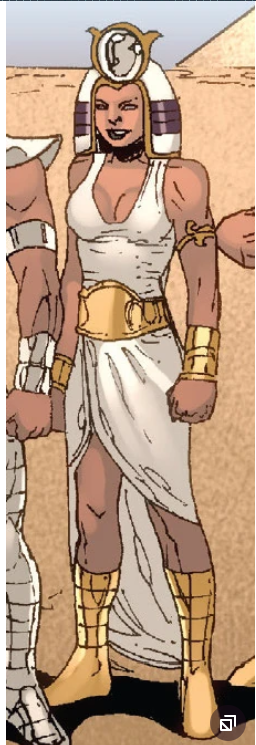
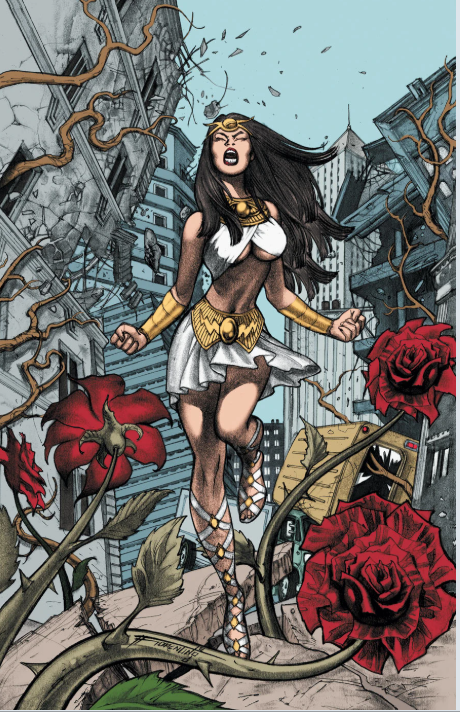
Interestingly, Isis is still part of the DC universe. Her comic debut was in Shazam!#25 in 1976 before being given her own publication. Later, she ended up in an DC inspired TV episode of Smallville and battled young Clark Kent. She also becomes a character from a dystopian future in episode 3 of Legends from Tomorrow.
In the comics, she’d have the alias of Adrianna Tomaz (which is the same as the 1976 TV show with a slight change: She is known as Adrianna Thomas) and would be married to the character Black Adam. She’d also appear in the cinematic version of Black Adam.
About the same time, she made her television return in the Marvel Cinematic Universe when she appeared as a council member of Egyptian gods in the show Moon Knight.
What’s In Store For the Future?
Isis, whether through Marvel or DC may continue; however, she may be part of several mediums as well. Aside from ending up on the silver screen or streaming, she has ended up as a video game character, too.
Isis was a goddess for Ancient Egypt, Greece and the Roman Empire. Her origin was purely Egyptian; however, her name and her influence spread throughout the Greco-Roman world. For this reason alone, Isis was so powerful that she influenced many cultures.
Work Cited
Fandom editors: "Isis (disambiguation)": DC Data Base Fandom/Wiki (retrieved 2026)
Britannica Editors: "Isis summary": Britannica.com (Retrieved 2026)
Rosie Lesso, MA: "Isis: Egyptian Goddess of Motherhood and Magic (7 Facts)": The Collector (Feb. 24, 2025)
Kellie Warren: "Book of the Dead: A Guidebook to the Afterlife": ARCE (American Research Center in Egypt) (Retrieved 2026)
Museum Editors: "Deities in Ancient Egypt - Isis": Rosicrusian Egyptian Museum (retrieved 2026)
Lindsey A. Mazurek: "Moving Gods: Isis’ Journey to Greece in the Roman Empire": Cambridge University Press (Feb. 23, 2023).
Staff writers: "Ancient Egyptian Gods and Goddess" : Discovering Egypt (Retrieved 2026).
Marc Richards: "The Secrets of Isis" : imbd.com (1975-1976).
Fandom Editors: "Isis (Earth-616)/Marvel Data Base": Fandom/wiki.com (retrieved 2026).
Marvel Website Editors: "Isis Powers, Enemies, History": Marvel.com (retrieved 2026)
About the Creator
Dean Traylor
* Masters in special education and degree in journalism.
*Seasoned writer for the last 30+ years (Newspapers, Magazines, Internet sites)
* Former writer at Hubpages, Helium, and Wikinut.
* Current: Medium (https://medium.com/@ds_traylor)
Enjoyed the story? Support the Creator.
Subscribe for free to receive all their stories in your feed.
Comments
There are no comments for this story
Be the first to respond and start the conversation.