
Atlantis: Reimagined: Why Kida Should Be the Hero of a Bronze Age Mediterranean Epic
A Myth Rebuilt From Archeology, Memory, and the Sea.

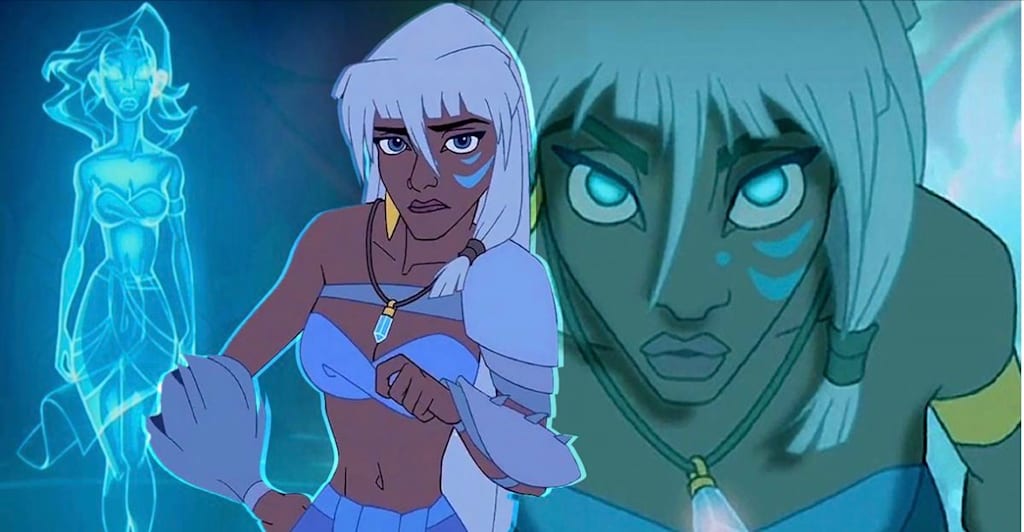
Disney’s Atlantis: The Lost Empire has always occupied a strange cultural space. Released in 2001, it was bold, visually distinctive, and unusually interested in archaeology and myth. Yet, it never achieved mainstream dominance like other Disney Renaissance-era films. Over time, however, it developed a strong cult following, precisely because it felt like something different: a science-fiction adventure disguised as mythic history. archeology
But if Disney were to ever return to Atlantis in live-action, there is an opportunity not merely to remake it, but to reimagine it.
Not as a lost city waiting to be discovered. But as a living civilization with its own memory, trauma, religion, ecology, and internal history. And at the center of that reimagining should be one decisive shift:
Princess Kida must become the true protagonist.
Kida as the True Narrative Center

In the original film, Kilo Thatch serves as the audience’s entry point into Atlantis. He is a linguist, the outsider, the interpreter of forgotten worlds. Through him, Atlantis is discovered.
Yet, the deeper emotional weight of the story has always belonged to elsewhere.
It belongs to Kida.
Kida is not merely a guide or supporting character. She is the inheritor of an entire civilization in decline. She is the daughter of a dying world, a culture struggling to remember itself, and a leader forced to confront the collapse of traditions that once sustained her people.
A reimagined adaptation would not simply adjust her role. It would restructure the narrative entirely around her perspective. The film would begin inside Atlantis, not outside it.
We would learn to understand Milo only after Atlantis has already been established as a complete, functioning society.
Greek Mythology and the Problem of Atlantis

The myth of Atlantis originates in the works of Plato, particularly Timaeus and Critias, where Atlantis is described as a powerful island civilization that eventually falls from grace and is destroyed by divine punishment.
The story is tied loosely to the figure of Poseidon, the Greek god of the sea, and to his mortal descendants. While interpretations vary, Atlantis has always existed in a liminal space between philosophy, myth, and allegory.
Importantly, Plato’s Atlantis is not merely a “lost city”. It is a moral narrative about hubris, balance, and decline.
In modern fantasy adaptations, however, Atlantis is often stripped of this philosophical weight and transformed into a pure adventure setting.
A Bronze Age Mediterranean reinterpretation would restore that depth.
Rather than being just a sunken kingdom, Atlantis becomes a mythic consequence of divine-human interaction- a civilization shaped by the gods, sustained by ritual, and destabilized when that balance is lost.
This is where Kida’s role becomes essential.
She is not just a princess. She is the living interface between myth and survival.
The Minoan World Beneath the Waves

One of the most interesting historical inspirations for Atlantis is the Bronze Age civilization of Crete, often referred to as Minoan.
Associated with sites such as the Palace of Knossos and the settlement of Akrotiri, the Minoans left behind frescoes depicting dolphins, bulls, marine life, and complex ritual scenes, suggesting a deeply symbolic relationship with the natural world.
Many scholars have speculated that catastrophic events such as the eruption of Thera may have contributed to later mythological memories of lost island civilisations.
A live-action Atlantis could draw heavily from this cultural and archaeological foundation.

Instead of presenting Atlantis as a futuristic underwater empire, it could be reimagined as a Bronze Age Aegean civilization that adapted to catastrophe rather than simply vanishing. Its architecture would reflect Minoan design principles: open courtyards, fresco-covered walls, fluid organic forms, and maritime symbolism embedded in every structure.
Its society would feel ancient, not alien.
Familiar, yet submerged in myth.
A Theocratic Civilization of Priesthood and Memory

In this reinterpretation, political power in Atlantis would not be purely monarchic. Instead, it would resemble a sacral system inspired by interpretations of Minoan religion.
Kida’s mother would not be a “queen” in the traditional sense. She would be a high priestess. Kida’s father would not be a “king”. He would be a high priest or guardian of ritual tradition. Their authority would not come from conquest or lineage alone, but from their role as interpreters of the divine system that sustains Atlantis.
At the center of this system would be the Mother Earth Goddess, a reinterpretation of the Minoan religious symbolism associated with fertility, nature, balance, and continuity.
The Crystal, central to Atlantis in the original film, would be reframed as a fragment of this divine creative force.
Not a machine.
Not technology.
But a residual artifact of creation itself.
A sacred anomaly that holds Atlantis together.
The Crystal as Divine Accident and Structural Fragility.

Rather than being engineered, the Crystal could be understood as an accidental byproduct of divine creation.
When the gods shaped Atlantis, whether through Poseidon or a broader pantheon, something was left behind. A fragment of raw divine energy embedded in the physical world. This fragment became the Crystal.
Over time, Atlantis built its entire civilization around it. This introduces a powerful narrative consequence: Atlantis was never designed to last forever. An unstable miracle sustained it. This reframes the civilization’s decline not as a simple catastrophe, but a structural inevitability.
And it makes Kida’s responsibility far more complex. She is not merely trying to save Atlantis. She is trying to understand whether Atlantis was ever meant to survive at all.
Animals, Ecology, and Sacred Balance

A reimagined Atlantis would also need to feel ecologically complete. Not just visually rich, but culturally integrated with its environment.
Dolphins, already present in Minoan frescoes, would serve as companions, messengers, and symbolic extensions of Atlantean identity. Bulls would present sacred strength and ritual continuity. Sea turtles, monk seals, octopi, sharks, and bluefin tuna would define the maritime world that sustains the civilization.
Wolves, lynxes, partridges, European rollers, foxes, Eurasian golden orioles, owls, hoopoes, bears, deer, herons, shovelers, marsh-harriers, antelope, and boar would all inhabit sacred wilderness zones, representing the untamed forces of nature.
Sheep, goats, cats, and dogs can help the Atlantean people support their daily lives through various domesticated breeds.
Lions and eagles would serve as symbols of divine guardianship and authority.
Even elephants and primates could appear as relics of ancient trade networks connecting Atlantis to a broader Mediterranean world.
These animals would not be decorative. They would form a symbolic ecosystem of meaning, where each species reflects a different dimension of Atlantean life: spiritual, political, ecological, or mythological.
Language as Archaeology

Language would also play a crucial role in grounding Atlantis in Bronze Age realism.
Rather than relying on a fully invented fantasy language, Atlantean speech could draw inspiration from Linear A, Mycenaean Greek, and reconstructed Bronze Age linguistic patterns. The result would be a language that feels ancient and partially unknowable—structured enough to be consistent, but incomplete enough to preserve the mystery.
In this system, Milo’s linguistic abilities remain important, but no longer dominant.
Kida understands the language not as an academic system, but as a lived inheritance. This creates a deeper narrative contrast between scholarship and cultural memory.
Greek Myth, Bronze Age Collapse, and Cultural Memory

Its cultures define the Bronze Age not only by its collapse.
The fall of interconnected civilizations during the Late Bronze Age remains one of history’s enduring mysteries. This collapse has often been absorbed into myth. Atlantis is one such myth.
A live-action reinterpretation could explicitly engage with this idea: Atlantis as a civilization shaped by catastrophe, remembered imperfectly through fragmented stories across generations.
In this sense, Atlantis is not an isolated fantasy kingdom. It is a cultural echo of real historic trauma.
A civilization suspended between memory and myth.
Modern Fantasy and the Politics of Lost Civilizations

Contemporary fantasy media has repeatedly reinterpreted lost civilizations through different cultural lenses.
Marvel’s Black Panther: Wakanda Forever reimagined Namor’s underwater kingdom as Talokan, drawing on pre-Columbian Mesoamerican civilizations and reframing Atlantis-like mythology through a lens of cultural specificity and historical trauma. Similarly, many modern fantasy worlds increasingly move away from generic “ancient advanced civilizations” toward more grounded, culturally specific reinterpretations.
A Bronze Age Mediterranean Atlantis would fit directly into this trend.
It would no longer be a vague utopia beneath the sea. It would be a culturally coherent civilization with identifiable archaeological inspiration, mythological structure, and ecological realism.
Why Kida Must Be the Hero

All these changes ultimately converge on a single narrative necessity.
If Atlantis is a living Bronze Age-inspired civilization. If it’s governed by the priesthood rather than a monarchy. If it’s sustained by a fragile divine artifact. If its culture is deeply ecological, mythological, and historically grounded. Then Kida cannot remain a secondary character.
She becomes the only possible center of the story.
Milo Thatch remains. But he is the bridge between worlds.
Kida is the world itself. Her relationships–with her parents, her friends, her culture, and her environment–become the emotional core of the film. And her ultimate decision is not simply whether Atlantis survives.
But what Atlantis means in the future.
Atlantis as Living Myth

A live-action Atlantis reimagined through a Bronze Age Mediterranean inspiration would not simply retell a cult classic.
It would reconstruct Atlantis as a mythic civilization rooted in archaeology, mythology, ecology, and cultural memory. It would transform the Crystal from a plot device into a divine artifact. It would transform Atlantis from a destination into a society. And it would transform Kida from a supporting princess into a fully realized mythic protagonist.
Not the woman waiting to be discovered.
But the heir to a world that refuses to disappear quietly into legend.
About the Creator
Jenna Deedy
Just a New England Mando passionate about wildlife, nerd stuff & cosplay! 🐾✨🎭 Get 20% off @davidsonsteas (https://www.davidsonstea.com/) with code JENNA20-Based in Nashua, NH.
Instagram: @jennacostadeedy
Enjoyed the story? Support the Creator.
Subscribe for free to receive all their stories in your feed. You could also become a paid subscriber, letting them know you appreciate their work.
Comments
There are no comments for this story
Be the first to respond and start the conversation.